MRI vs CT Scan Safety: Radiation, Risks, and What You Need to Know
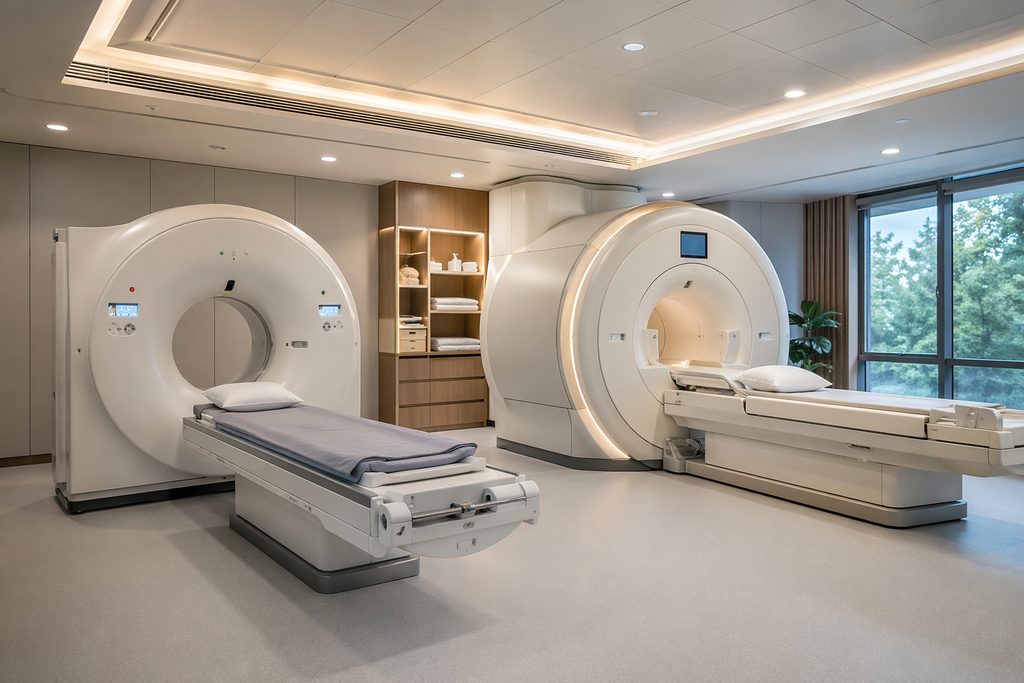
MRI vs CT Scan Safety: The Short Answer
Are you trying to figure out whether an MRI is safer than a CT scan? The short answer is yes, for most people. An MRI uses magnetic fields and radio waves to create images. No ionizing radiation is involved. A CT scan uses X-rays, which means radiation exposure. That exposure carries a small but real cancer risk that accumulates over a lifetime. So if your doctor says either test will give the information needed, the MRI generally carries less long-term biological risk.
But safety is not that simple. The right question is not “which machine is safer” but “which machine answers your clinical question with the least harm.” Sometimes a CT scan is the safer choice because it is faster. A patient who cannot lie still for 40 minutes, a trauma victim with internal bleeding, a person with certain metal implants — for them, an MRI might be impossible or dangerous. Safety depends on context.
Who Should Prefer an MRI — and Who Should Not
If you are comparing imaging options for a non-emergency condition, here is a practical breakdown.
An MRI is typically a better fit if you:
- Need repeated imaging over months or years for a chronic condition
- Are pregnant or might be pregnant and require non-urgent imaging
- Are a child or young adult with decades of cumulative radiation exposure ahead
- Have a known sensitivity to iodinated contrast dye used in many CT scans
- Need detailed soft-tissue views: brain, spinal cord, joints, ligaments, tumors
A CT scan may be the safer or only practical option if you:
- Have a pacemaker, cochlear implant, certain aneurysm clips, or metal fragments in your eye
- Cannot tolerate enclosed spaces (severe claustrophobia) and no open MRI is available
- Need imaging immediately after a stroke, head trauma, or suspected internal bleeding
- Have a condition that makes staying still for 30–60 minutes impossible
- Need to rule out certain lung or bone pathologies where CT has superior resolution
Notice something. The lists overlap with the question of necessity. If your doctor orders a CT for acute abdominal pain, refusing it because you read MRIs are safer could be the more dangerous choice. Delayed diagnosis of appendicitis or a bleed can kill. Radiation risk is statistical and long-term. Missed diagnosis is immediate.
The Options, Compared
| Factor | MRI | CT Scan |
|---|---|---|
| Radiation exposure | None | 2–10 mSv per scan (varies by body part) |
| Scan duration | 20–60 minutes | Under 5 minutes |
| Soft tissue detail | Excellent | Good, but inferior to MRI for brain, spinal cord, ligaments |
| Bone and lung detail | Limited | Excellent |
| Contrast agents | Gadolinium-based (small risk of NSF in kidney patients) | Iodine-based (risk of allergic reaction, kidney stress) |
| Comfort | Loud, enclosed, can trigger claustrophobia | Open, fast, minimal discomfort |
| Cost in China (self-pay, approximate) | $150–$500 per region | $80–$250 per region |
Which column fits you? If you need one-time imaging for an acute problem and have no contraindications, a CT scan is often the pragmatic choice. If you need serial imaging or have a soft-tissue question, an MRI usually wins. The cost difference matters too. We see many international patients surprised that an MRI in a top Chinese hospital costs less than a CT scan in a US emergency room.
MRI vs CT Scan Safety China: What International Patients Should Know
If you are traveling to China for medical imaging — or you live there as an expat — the safety question takes on a practical dimension. Hospital equipment varies. A top-tier hospital in Shanghai or Beijing will have 3.0 Tesla MRI machines that match anything in Europe or North America. A lower-tier facility in a smaller city may have older 1.5T units with longer scan times and lower image resolution. That does not make them unsafe. It makes them slower and sometimes less definitive.
What about radiation protocols? Chinese radiology departments in large public hospitals follow international dose-reduction guidelines. But enforcement is not uniform. A 2019 study published in the Chinese Journal of Radiology found that CT radiation doses in some Chinese hospitals exceeded diagnostic reference levels set in Europe. The variation between hospitals was significant. So the institution you choose matters as much as the machine type.
Also worth knowing: contrast agent safety. Gadolinium for MRI carries a small risk of nephrogenic systemic fibrosis in patients with severe kidney disease. Iodinated contrast for CT can trigger allergic reactions. Chinese hospitals typically require a kidney function test before contrast-enhanced scans. If you have a history of contrast reactions, tell the radiologist before your appointment. That is standard practice at top facilities like Shanghai’s leading academic hospitals.
MRI Scan Cost China: What You Will Actually Pay
Self-pay prices at Chinese public hospitals are transparent and surprisingly low by Western standards. An MRI of one body region — brain, lumbar spine, knee — typically costs between $150 and $500 at a top-tier public hospital. A CT scan runs $80 to $250 per region. At private international hospitals such as those listed on our private hospital directory, expect to pay 2 to 3 times those figures. Still far below US prices, where a brain MRI often bills at $1,500 to $3,000 before insurance.
What drives the variance? Hospital tier, machine strength (1.5T vs 3.0T), whether contrast is used, and whether you need a radiologist’s written report in English. Public hospitals usually provide reports in Chinese. If you need an English-language second opinion on your images, that is a separate service. We can coordinate that through our network of specialists.
One more cost factor: timing. A standard MRI appointment at a major public hospital in Beijing might have a wait of several days to two weeks. Same-day or next-day imaging often requires going through an international VIP department, which charges 1.5 to 2 times the standard rate. That is the trade-off: time versus money.
Best Hospital for MRI Shanghai: Where the Machines Are Strongest
If you are specifically looking for the best hospital for MRI Shanghai, the answer depends on what body part you need scanned. For neuroimaging, Huashan Hospital affiliated with Fudan University has one of the strongest neuroradiology departments in China. For cardiac MRI, Zhongshan Hospital is the reference center. For musculoskeletal imaging, Shanghai Sixth People’s Hospital is frequently cited by Chinese orthopedists. All three are in our database of 340+ top-ranked hospitals.
Machine availability is not the issue. Shanghai has dozens of 3.0T MRI units. The bottleneck is scheduling with a radiologist who specializes in your clinical question. A generic MRI report that says “nonspecific signal abnormality” is useless. A specialist radiologist who reads 500 knee MRIs a year will tell you whether that meniscal tear is surgical or not. That is the real value of choosing the right hospital.
Medical Imaging Packages China: Can You Book a Full-Body Scan?
Some international patients ask about medical imaging packages China — essentially, bundling an MRI, CT, ultrasound, and blood work into a single executive health screening. These exist. Most large Chinese hospitals offer “VIP health checkup” packages through their international departments. Prices range from $500 for basic packages to $3,000+ for comprehensive ones that include full-body MRI.
Should you do a full-body MRI “just to check”? The medical consensus in most countries is no. Full-body MRI in asymptomatic people finds incidental findings — harmless cysts, benign tumors, normal variants — that lead to anxiety, follow-up scans, and sometimes unnecessary biopsies. The American College of Radiology does not recommend whole-body MRI screening for people without symptoms or high genetic risk. If you want a health checkup in China, a targeted package based on your age, sex, and family history is smarter than a blanket scan.
Can I Get an MRI Instead of CT Abroad?
This question comes up constantly. A patient has a CT ordered in their home country. They read about radiation. They ask us: can I get an MRI instead when I travel to China? The honest answer is: maybe, but only if a doctor agrees it is medically equivalent for your specific question.
Here is the problem. CT and MRI are not interchangeable for every indication. A CT of the lungs shows pulmonary nodules with far greater sensitivity than MRI. A CT of the temporal bone shows fractures that MRI misses. If your doctor ordered a CT for a specific reason, swapping it for an MRI without clinical justification could miss the finding that matters. The right approach is to get a written second opinion on whether MRI would answer your clinical question. We can arrange that through our specialist network. Do not make the swap unilaterally.
That said, for many follow-up scans — brain tumor surveillance, liver lesion monitoring, multiple sclerosis progression — MRI is not just safer but superior. In those cases, traveling to China for imaging makes sense. You get a high-quality scan at a fraction of Western prices, and you can combine it with a specialist consultation.
Practical Considerations: Records, Visas, and Follow-Up
If you are coming to China for imaging, bring everything. Previous scans on CD or USB. Written reports. A referral letter from your doctor stating the clinical question. If your records are not in English or Chinese, get them translated. A radiologist reading your new MRI needs the old images for comparison. Without them, subtle changes get missed.
Visa category: for medical treatment or private medical affairs, the S2 visa is the applicable short-stay category. You will need supporting documents from the Chinese hospital — an appointment confirmation or invitation letter. Our team helps with that documentation. We cannot guarantee visa approval; that is the embassy’s decision. But complete paperwork makes refusal less likely.
Payment: public hospitals require prepayment. Bring a card that works in China or arrange payment through a trusted coordinator. Private international hospitals often accept direct insurance billing. Check before you book.
Follow-up: if the scan finds something, what then? If you are back home, you need a local doctor to act on the findings. If you are still in China, you can arrange a consultation with a specialist at the same hospital. We recommend planning for both scenarios before you travel.
Language: a radiologist in Shanghai may speak some English. The front desk staff probably will not. The technician positioning you in the MRI machine almost certainly will not. This is where a bilingual medical companion earns their fee. Not for the scan itself — for everything around it: registration, payment, finding the right floor, understanding the report, asking follow-up questions.
Frequently Asked Questions
For brain imaging, yes in most cases. MRI provides better soft-tissue contrast and involves no radiation. The exception is acute head trauma or suspected stroke, where CT is faster and detects bleeding immediately. For non-emergency brain imaging — headaches, seizures, tumor follow-up — MRI is the standard of care.
An MRI delivers zero ionizing radiation. A CT scan delivers between 2 and 10 millisieverts (mSv) depending on the body region. For context, a chest X-ray is about 0.1 mSv. A CT of the abdomen and pelvis is roughly 10 mSv, equivalent to about 3 years of natural background radiation. The lifetime cancer risk from a single CT is small — estimated at roughly 1 in 2,000 for a 10 mSv scan — but it is not zero.
It depends on the metal and where it is. Titanium implants, most dental fillings, and modern joint replacements are MRI-safe. Pacemakers, certain aneurysm clips, cochlear implants, and metal fragments in the eye may be contraindicated. You must disclose all implants before scheduling. Chinese hospitals will ask for documentation of the implant type. If you cannot provide it, they may refuse the scan for safety reasons.
The machine itself costs more to buy and maintain. A 3.0T MRI unit costs $1.5 to $3 million, and it requires liquid helium cooling and a shielded room. Scan times are longer, so fewer patients can be imaged per day. A CT scanner images a patient in minutes. That throughput difference drives the price gap.
Yes, and we recommend it. Having the scan and the expert read in the same visit avoids the gap between imaging and interpretation. You can schedule the MRI in the morning and see a specialist in the afternoon at many top hospitals. We coordinate the timing so you are not waiting weeks between steps.
Your Next Step
The core message is simple. An MRI avoids radiation, but safety means choosing the right test for your clinical question — not automatically demanding the radiation-free option. If you are considering imaging in China, we can help you select an appropriate hospital, coordinate appointments, and arrange a bilingual companion so you are not navigating a massive public hospital alone. We are not a hospital and we do not diagnose or interpret scans. We are the bridge between you and the right Chinese medical team. If you want to explore your options, request a free consultation through our patient services page. No pressure, no obligations — just a clear path forward.
For more medical information and treatment options in China, visit chinamedservices.com (China Medical Services).
