Hip Replacement in China: Anterior vs Posterior Approach Coordination
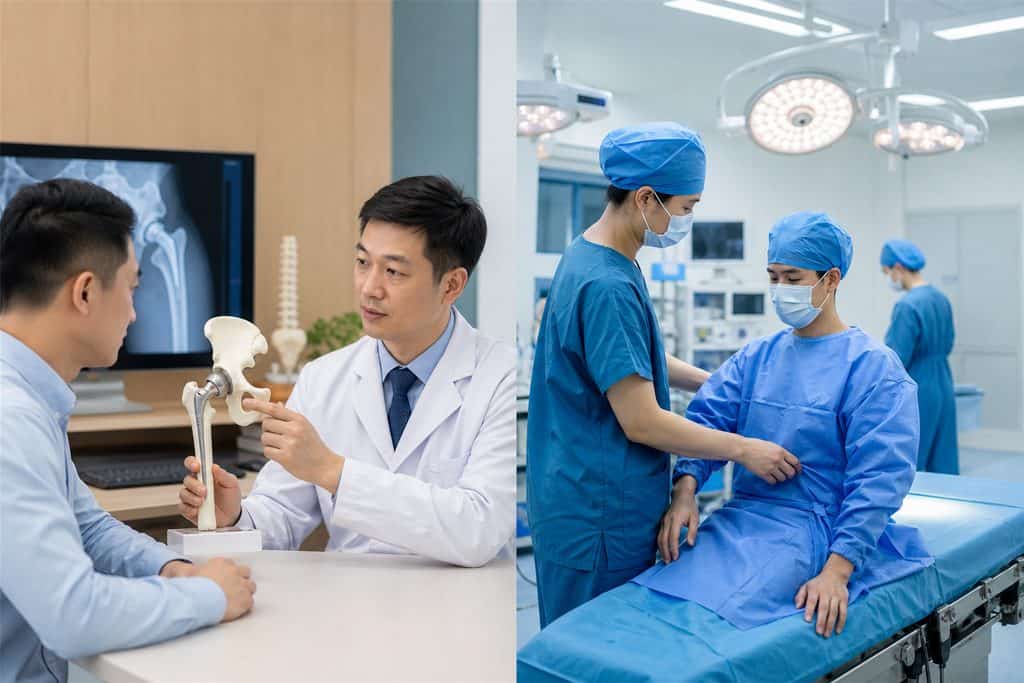
While patients in Canada wait a median 28.6 weeks for orthopedic surgery, surgeons at Beijing Jishuitan Hospital routinely perform over 300 joint replacements per month — with clinical outcomes that match or exceed Western benchmarks. The gap is not in surgical skill. It is in system capacity. If you have been told to wait a year for a hip that keeps you awake at night, that gap matters.
Key Takeaways
- Total hip replacement in China costs $8,000–$18,000 — roughly one-fifth to one-tenth of the US price — with no waiting list for international patients using the VIP channel.
- Anterior and posterior approaches are both available. The right choice depends on your anatomy, not on marketing claims that one is universally superior.
- Language barriers, visa requirements, and hospital registration systems make independent navigation extremely difficult — this is not a trip you can arrange with a few emails.
- Your surgical outcome depends far more on surgeon volume and hospital specialization than on which incision technique is used.
The Problem: A Waiting Game Your Joint Cannot Win
Hip osteoarthritis does not pause while you sit on a waiting list. Cartilage keeps thinning. Muscles keep weakening from disuse. Sleep keeps getting interrupted. A 2023 report from the Canadian Institute for Health Information found that only 66% of patients received hip replacement within the benchmark 26-week window. Some provinces averaged over 40 weeks. In the UK, the NHS waiting list for trauma and orthopedics surpassed 800,000 patients in mid-2024. The clinical term is “prolonged preoperative morbidity.” The human term is suffering that did not need to happen.
Cost is the other vise. In the United States, a total hip replacement without complications runs $39,000 to $45,000. With complications or a high-deductible plan, the patient’s out-of-pocket share can hit five figures. For uninsured patients, the number is simply impossible. So people wait. And while they wait, they lose mobility, independence, and — as multiple longitudinal studies have shown — cardiovascular fitness and mental health. The disease progresses. The surgery gets harder. The recovery takes longer.
China offers a structural way out. Not because Chinese surgeons are magicians. Because the system is built for volume, speed, and subspecialization at a scale that Western hospitals cannot match. The question is not whether the surgery can be done well there. It is whether you can access the right surgeon and the right approach for your specific hip.
Who We Are
We are not a hospital. We do not provide medical treatment, perform surgery, or offer clinical diagnoses. Our team at China Medical Services functions as your logistical architects — we bridge the gap between you and China’s top-tier orthopedic hospitals. We handle hospital matching, appointment coordination, bilingual medical companion services, visa guidance, and every practical detail from airport pickup to post-operative recovery support. We work with over 340 top-ranked hospitals across 37 cities. We do not sell surgery. We make it accessible, safe, and navigable for international patients who have run out of good options at home.
Why China’s Orthopedic System Delivers Results
Clinical Volume Drives Better Outcomes
There is a well-established relationship between surgeon volume and joint replacement outcomes. A 2019 study in The Journal of Arthroplasty found that surgeons performing more than 100 total hip replacements annually had significantly lower complication rates than low-volume peers. The average US orthopedic surgeon performs roughly 65 hip replacements per year. At a high-volume Chinese orthopedic center like Beijing Jishuitan Hospital or Shanghai Sixth People’s Hospital, a single surgeon may complete 200 to 500 annually. That is not a minor difference. It is a completely different learning curve.
This volume effect shows up in the data. Infection rates for primary hip replacement at top Chinese orthopedic hospitals run below 1%, consistent with international benchmarks. Dislocation rates, length of stay, and 90-day readmission rates are all comparable to major Western centers. The difference is that you can get on the schedule within weeks, not months or years.
Technology and Efficiency at Scale
Chinese hospitals do not operate like Western hospitals with a few high-tech suites for VIP patients. The scale changes everything. A single orthopedic department may run 8 to 12 operating rooms simultaneously, dedicated solely to joint replacement. Preoperative planning uses 3D CT reconstruction and templating software as standard. Many centers now offer robotic-assisted hip replacement using systems like Mako or domestic equivalents, though the evidence for robotic assistance over manual technique remains mixed — and we tell every patient that plainly.
The anterior approach, which spares muscle by going between the sartorius and tensor fasciae latae rather than cutting through the gluteus maximus and external rotators, is widely available. So is the posterior approach, which remains the most commonly performed technique globally and offers excellent visualization of the acetabulum. Chinese surgeons are trained in both. The question of which approach is appropriate for you is a clinical decision — not a marketing slogan.
Anterior vs Posterior Hip Replacement Cost China: The Real Numbers
Let us address the search query directly. When patients research anterior vs posterior hip replacement cost China, they often assume the anterior approach costs more because it is marketed as “minimally invasive” in the West. In China, the surgical approach does not significantly change the price. Both techniques fall within the same cost band. What drives cost variation is the hospital tier, the surgeon’s seniority, the implant brand (imported vs. domestic), and whether you use the standard public channel or the international VIP channel.
| Cost Component | Public Hospital Standard Channel | Public Hospital VIP/International Channel | Private International Hospital |
|---|---|---|---|
| Total Hip Replacement (all-inclusive) | $6,000 – $10,000 | $10,000 – $18,000 | $20,000 – $35,000 |
| Implant (imported prosthesis) | $2,500 – $5,000 | $3,000 – $6,000 | $5,000 – $8,000 |
| Hospital stay (3–7 days) | Included | Included | Included |
| Surgeon fee | $1,500 – $3,000 | $2,500 – $5,000 | $4,000 – $7,000 |
| Anesthesia and OR | $1,000 – $2,000 | $1,500 – $3,000 | $2,500 – $4,000 |
These numbers vary by hospital and case complexity. A revision hip replacement costs more. A patient with significant comorbidities costs more. But the range holds: you are looking at roughly one-fifth to one-third of the US price for comparable or higher surgical volume. The VIP channel premium buys you English-speaking coordination, a senior surgeon with confirmed availability, and a private room — not a better implant or a different operation.
Understanding the Two Approaches
How Long Does Anterior Hip Replacement Surgery Take in China?
Patients searching for how long does anterior hip replacement surgery take in China are usually trying to gauge complexity and risk. The answer: 60 to 90 minutes of surgical time for a routine primary case, which is consistent with global norms. The anterior approach sometimes takes slightly longer than posterior because the femur is harder to access and requires specialized traction tables or leg positioning. But we are talking about a 10–15 minute difference in experienced hands — clinically meaningless for the patient.
What matters more: anterior approach patients often mobilize faster in the first 48 hours. They may have less pain in the first week. They have fewer posterior hip precautions to follow because the posterior capsule and external rotators remain intact. But the anterior approach carries its own risks — lateral femoral cutaneous nerve injury causing thigh numbness, higher rates of intraoperative femur fracture in some studies, and a steeper learning curve for surgeons who were not trained on it during residency. No approach is categorically better. The best approach is the one your surgeon has done thousands of times.
Is Posterior Hip Replacement Safer Than Anterior Approach?
This question — is posterior hip replacement safer than anterior approach — reflects a real debate in the orthopedic literature. The short answer: neither is inherently safer. Both have complication rates in the 1–3% range for serious adverse events when performed by high-volume surgeons. The posterior approach has historically been associated with a higher dislocation rate, but modern soft-tissue repair techniques have closed that gap significantly. A 2020 meta-analysis in The Bone & Joint Journal found no statistically significant difference in dislocation rates between anterior and posterior approaches when a robust posterior capsular repair was performed.
The posterior approach gives the surgeon better visualization of the acetabulum, which matters for accurate cup positioning. It avoids the lateral femoral cutaneous nerve. It does not require a specialized traction table. For patients with obesity, significant deformity, or prior hip surgery, many surgeons prefer posterior because the exposure is more extensile and forgiving. These are clinical judgments made case by case. No registry data supports the claim that one approach is universally safer.
Best Hospital for Hip Replacement Shanghai and Beyond
When patients search for the best hospital for hip replacement Shanghai, they are often starting from zero — they know Shanghai has good hospitals, but not which ones specialize in joints. Here is what our team considers when matching a patient to a surgical center.
Shanghai Sixth People’s Hospital runs one of the highest-volume orthopedic departments in the world. Their joint replacement service performs thousands of hips annually. They were early adopters of the anterior approach in China and have published extensively on outcomes. For a patient specifically seeking anterior-superior hip replacement with a rapid recovery protocol, this is often our first recommendation in Shanghai.
Beijing Jishuitan Hospital is arguably China’s most famous orthopedic hospital. Their adult reconstruction division handles complex primary and revision cases referred from across the country. If your case involves significant deformity, post-traumatic arthritis, or a failed prior replacement, Jishuitan’s volume in complex revisions is hard to match anywhere. They offer both anterior and posterior approaches and will select based on your imaging, not your preference.
For patients considering medical tourism hip surgery package Beijing, several private international hospitals offer bundled packages that include surgery, private room, English-speaking nursing staff, and direct insurance billing. United Family Hospital in Beijing and Jiahui International Hospital in Shanghai both have orthopedic surgeons trained in Western fellowship programs who perform anterior and posterior hip replacements. The cost is higher — $25,000 to $35,000 — but the experience feels familiar to Western patients and the coordination burden is lighter.
Our department rankings page lists orthopedic surgery top-10 hospitals by city, drawn from the Fudan University hospital rankings. We use this as a starting point, then narrow further based on your specific case, preferred approach, implant preferences, and timeline.
What You Need to Know Before Going Alone
We have seen patients try to arrange this independently. Most give up. The barriers are structural, not trivial.
- Visa Requirements: Medical treatment in China requires an S2 visa with treatment documentation from the admitting hospital. You cannot apply without an invitation letter from a Chinese hospital. You cannot get that letter without a confirmed appointment. You cannot get that appointment without navigating a Chinese-language registration system. The circular dependency is real. M visas are for business — they are not valid for medical treatment. We handle the invitation letter and visa documentation as part of our coordination service.
- Hospital Registration Systems: Chinese public hospitals do not allow international patients to book surgery online. You must present in person for a consultation. The surgeon must examine you and review your imaging before agreeing to operate. There is no workaround for this — it is universal policy. What our team does is pre-arrange that consultation with the right surgeon, on a specific date, with a bilingual medical companion present, so you are not wandering through a 10,000-patient-per-day hospital alone.
- Payment and Insurance: Public hospitals require upfront payment, typically via Chinese bank transfer, WeChat Pay, or UnionPay card. Most international credit cards are not accepted. Most Western insurance plans require you to pay first and seek reimbursement later. Private international hospitals can do direct billing, but only with insurers they have agreements with. We help you understand the payment pathway before you commit to anything.
How We Help You Navigate This
These barriers exist for structural reasons. They are not designed to exclude foreign patients — the system was simply built for a domestic population. Our job is to bridge that gap.
Before you travel, we collect your medical records, imaging, and surgical history. We translate and format them for Chinese hospital standards. We present your case to one or more orthopedic departments and confirm which surgeon is appropriate and available. We arrange a video consultation if you want to speak with the surgeon before committing — our video consultation coordination service starts at $100–300 for a standard international department consult. Any consultation fee is credited in full toward on-the-ground coordination if you proceed with surgery within 90 days.
During your stay, a bilingual medical companion accompanies you to every appointment. They handle registration, queueing, payment, translation of clinical conversations, and the thousand small frictions that make a foreign hospital exhausting. This is not a translator on a phone app. It is a trained professional who knows the hospital layout, the workflow, and how to navigate the system efficiently. Our companion service starts from $200 per day.
After surgery, we coordinate your follow-up imaging, surgeon review, and discharge paperwork. We arrange a recovery hotel or serviced apartment near the hospital if needed. We make sure you have translated discharge instructions, a medication list in English, and a clear plan for your flight home — including DVT prophylaxis and mobility guidance for the journey.
If you are searching for a way to book hip replacement surgery abroad China fast track, understand that “fast track” in China means the VIP international channel — not skipping the consultation requirement, but compressing the timeline from first contact to surgery into 2–4 weeks instead of 2–4 months. That is what we facilitate. It is fast relative to waiting lists. It is not instant. Anyone promising otherwise is not being honest about how Chinese hospitals work.
Frequently Asked Questions
You can express a preference, and we will match you with a surgeon experienced in your preferred technique. But the final decision belongs to the surgeon, based on your anatomy, hip morphology, and medical history. A responsible surgeon will not perform an anterior approach on a patient with a femoral implant that blocks access, or a posterior approach on a patient with a high dislocation risk and poor soft tissue quality. The conversation should be collaborative. If a surgeon tells you one approach is always better, get a second opinion.
This is the hardest question, and we answer it directly. Your surgical team in China will provide post-operative imaging and a detailed operative note in English. Your local orthopedic surgeon can use these to manage any late complications — infection, dislocation, periprosthetic fracture. Chinese hospitals do not provide long-term follow-up for international patients, and your local surgeon is not obligated to manage another surgeon’s complication. We recommend establishing a relationship with a local orthopedic surgeon before you travel, so you have a safety net. Most will agree to see you for a consultation fee. Some will refuse. Know this before you go.
This concern is understandable given headlines about counterfeit goods from China. Orthopedic implants are a different category entirely. Top-tier Chinese hospitals use implants from the same multinational manufacturers used in the West — Zimmer Biomet, Stryker, DePuy Synthes, Smith & Nephew. These are imported, registered with China’s NMPA, and traceable by serial number. You can request the implant sticker and batch number for your records. If cost savings are achieved by using a domestic Chinese implant, the surgeon will disclose this and discuss the clinical evidence. Domestic implants from companies like Wego and AK Medical have published registry data showing outcomes comparable to imported prostheses. The choice is yours.
No. Most international patients stay 10–14 days after surgery. This covers the inpatient stay (typically 3–5 days), staple removal or wound check, a follow-up X-ray, and clearance to fly. You will be mobile on crutches by the time you leave. The full rehabilitation — gait training, strengthening, return to sport — happens at home over 3–6 months. We provide a rehabilitation protocol in English for your local physiotherapist to follow.
Your Next Step
Hip
For more medical information and treatment options in China, visit chinamedservices.com (China Medical Services).
