Egg Freezing Storage Limits: How Long Can Frozen Eggs Be Stored Safely?
When 34-year-old Elena from London started researching fertility preservation, she had one question that kept her up at night. Not about the injections. Not about the retrieval. She wanted to know: if I freeze my eggs now, how long do I actually have? The answer she found surprised her — and it shapes every decision she made after.
How Long Can Frozen Eggs Be Stored: The Short Answer
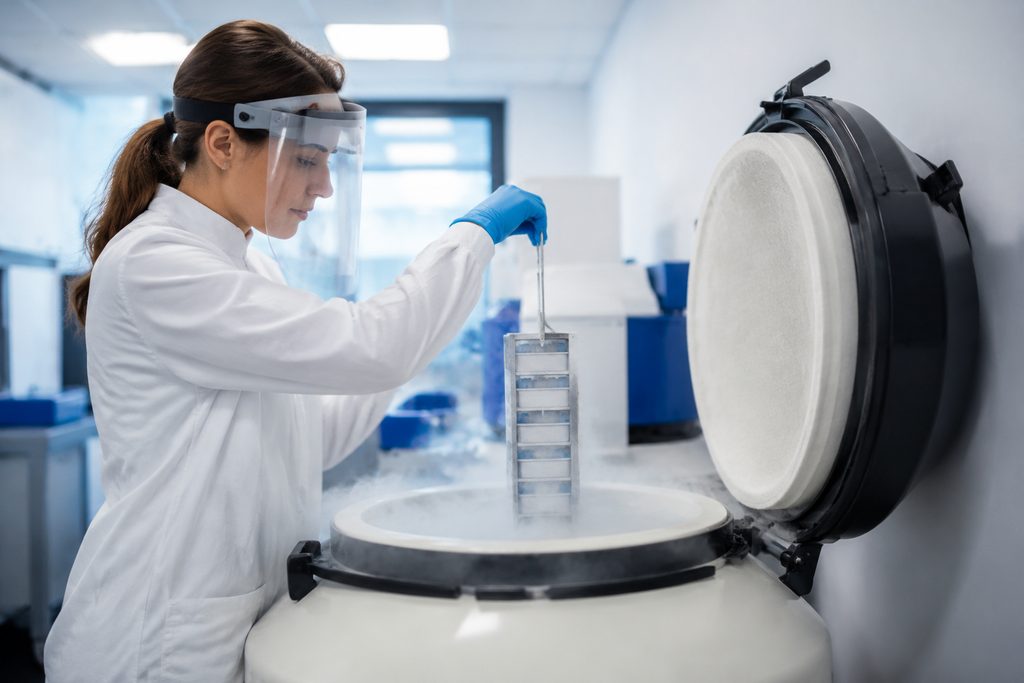
Frozen eggs can be stored indefinitely under proper cryogenic conditions. The biological clock stops at the moment of vitrification. Eggs held in liquid nitrogen at -196°C show no measurable deterioration after 10, 15, or even 20 years. The real limit isn’t scientific. It’s regulatory, financial, and personal.
Most countries set legal storage limits — typically 10 years, sometimes extendable. But the technology itself doesn’t degrade. A 2022 study in Reproductive BioMedicine Online found no significant difference in survival rates between eggs frozen for 3 months and eggs frozen for over a decade. So when patients ask how long can frozen eggs be stored IVF, the honest answer is: longer than most people will ever need.
That said, storage isn’t passive. It requires continuous liquid nitrogen monitoring, alarm systems, and facility redundancy. A power outage at the wrong moment can be catastrophic. This is where lab quality matters more than storage duration.
Who This Is Right For — and Who It Isn’t
Egg freezing works best when the decision is made early. But “early” means different things at different ages.
Typically good candidates:
- Women in their late 20s to mid-30s with no immediate pregnancy plans
- Patients facing chemotherapy or radiation that may damage ovarian reserve
- Those with a family history of early menopause
- Women undergoing IVF who produce more eggs than needed for a single cycle
Who should think twice:
- Women over 40 — egg quality declines sharply, and freezing may offer false reassurance
- Those with very low ovarian reserve (AMH below 0.5 ng/mL) — retrieval yields may not justify the cost
- Anyone expecting a guarantee — freezing improves odds, it doesn’t promise a baby
The math matters. A 2023 meta-analysis in Human Reproduction Update estimated that a woman freezing 15 eggs at age 35 has roughly a 70–80% chance of at least one live birth. At age 40, that drops below 40%. Age at freezing matters more than storage duration.
The Options, Compared
| Factor | China (Public Tier-3 IVF Center) | China (Private International Clinic) | US Average | UK Average |
|---|---|---|---|---|
| One cycle cost | $3,000–5,500 | $6,000–9,000 | $11,000–15,000 | £3,500–5,000 |
| Annual storage fee | $150–400 | $300–600 | $500–1,000 | £200–400 |
| Legal storage limit | No fixed statutory cap; contract-based | No fixed statutory cap; contract-based | Typically 10 years, extendable | 10 years standard, extendable to 55 |
| English-speaking staff | Limited | Standard | Standard | Standard |
| Wait time to start cycle | 2–6 weeks | 1–3 weeks | 2–8 weeks | 4–12 weeks (NHS) or 1–3 weeks (private) |
Which column fits which reader? If budget is the primary constraint and you’re comfortable navigating a Chinese-language environment with a bilingual companion, public tier-3 centers offer the best egg freezing cost China has available. If you want Western-style communication and direct insurance billing, a private international clinic in Shanghai or Beijing is the better match. US and UK options remain viable for those who prefer staying closer to home — but expect to pay two to three times more for the same laboratory technology.
What Determines Egg Viability After Thawing
Storage duration matters less than three other variables. First: the vitrification protocol. Modern flash-freezing prevents ice crystal formation far better than the slow-freezing methods used before 2010. A 2021 review in Fertility and Sterility reported post-thaw survival rates of 85–95% with vitrification, compared to 60–70% with older slow-freeze techniques.
Second: the embryology lab. The skill of the embryologist who handles your eggs — from stripping cumulus cells to loading the cryodevice — directly affects survival. This is where top-tier Chinese IVF centers have a real edge. Facilities like the reproductive medicine departments at Peking University Third Hospital and Shanghai Ninth People’s Hospital process thousands of cycles annually. Volume builds competence.
Third: the storage facility itself. Continuous temperature monitoring, backup nitrogen supply, and 24/7 alarm systems are non-negotiable. When evaluating any clinic — in China or elsewhere — ask about their tank monitoring protocols. A reputable lab will answer without hesitation.
What Egg Freezing Cost China Actually Includes
The headline price for a cycle rarely covers everything. Here’s what patients typically pay for:
Usually included in the cycle fee:
- Initial consultation and baseline ultrasound
- Ovarian stimulation medications (sometimes billed separately)
- Monitoring appointments during stimulation
- Egg retrieval procedure
- Anesthesia for retrieval
- First 6–12 months of storage
Often billed separately:
- Pre-cycle bloodwork (AMH, FSH, infectious disease panel)
- Annual storage renewal after the first year
- Thawing and fertilization when you eventually use the eggs
- Embryo culture and transfer
- Medication for a future frozen embryo transfer cycle
In Shanghai, expect a complete cycle at a private clinic to run $7,000–10,000 all-in. At a public hospital, $4,000–6,500 is realistic. Annual storage adds $150–600 depending on the facility. These figures vary by hospital and case complexity, but they’re consistently a fraction of Western prices.
Ask for a written itemized quote before committing. Reputable clinics provide one without hesitation. If a clinic won’t break down the costs, that’s a signal to look elsewhere.
Practical Considerations: Records, Visas, and Language
If you’re considering fertility preservation packages abroad, China has a specific set of logistical realities worth understanding before you book.
Medical records. Bring recent AMH, FSH, estradiol, and antral follicle count results. If they’re older than 3 months, expect to repeat them in China. Clinics will also require infectious disease screening (HIV, hepatitis B and C, syphilis) before any procedure.
Visa category. Medical treatment in China falls under the S2 visa, not the M visa. The S2 is issued for short-term private affairs, including medical treatment, and requires supporting documentation from the hospital. Your accompanying partner or family member also applies for an S2. Processing typically takes 1–2 weeks at your local Chinese embassy or consulate.
Payment. Chinese public hospitals generally require upfront payment. International credit cards are accepted at private clinics, but public facilities often require local payment methods or cash deposits. Insurance rarely covers elective egg freezing abroad, so budget for out-of-pocket payment.
Language. Public hospital staff rarely speak conversational English. A bilingual medical companion — typically from $300 per day — handles registration, queue management, payment, and translation. Private international clinics like United Family or Jiahui have English-speaking staff as standard.
Follow-up. Egg freezing requires no long-term in-country follow-up. You fly home after retrieval, and the eggs remain in storage. Annual storage fees can usually be paid by international bank transfer. If you later want to use the eggs, you’ll return for thawing, fertilization, and transfer.
Frequently Asked Questions
At top-tier centers, yes. China’s leading reproductive medicine departments use the same vitrification technology as Western clinics, and their embryologists handle case volumes that most Western labs never see. The key is choosing a facility with verifiable credentials — look for centers ranked among China’s top 10 for reproductive medicine and those with international accreditation. Avoid small, unaccredited clinics offering unusually low prices.
In Shanghai, private international clinics typically charge $6,000–9,000 per cycle, while public tier-3 hospitals charge $3,000–5,500. The best egg freezing clinic Shanghai price depends on whether you need English-language service. If you do, the premium at a private clinic is usually worth it. If you’re comfortable with a translator, public centers offer excellent technology at lower cost. Reputable options include the reproductive medicine center at Shanghai Ninth People’s Hospital and the international division of Renji Hospital.
This is the hard question most people avoid. Clinics typically send multiple reminders before any action. If fees remain unpaid for an extended period — usually 1–2 years — the eggs may be discarded or, in some jurisdictions, donated to research. Read the storage contract carefully before signing. Some clinics offer prepaid long-term storage at a discount, which eliminates this risk entirely.
Yes, but it’s complicated. International egg transport requires specialized cryoshipping services, import permits from the destination country, and coordination between both clinics. Costs typically run $2,000–5,000. Not all countries accept eggs from all facilities. If you think you might want to use the eggs in a different country, verify the destination country’s import rules before freezing, not after.
The number depends on your age. At 30–34, freezing 10–15 mature eggs gives a reasonable chance of one live birth. At 35–37, aim for 15–20. At 38–40, you may need 25–30 or more — which often requires multiple cycles. Some women produce enough eggs in one cycle; others need two or three. A fertility specialist can estimate your expected yield based on AMH and antral follicle count before you commit.
Your Next Step
The storage limit on frozen eggs is not the constraint most people think it is. The real variables are the quality of the lab, your age at freezing, and the number of mature eggs retrieved. Get those three things right, and your frozen eggs will be waiting whenever you’re ready.
Our team at China Medical Services helps international patients evaluate fertility clinics across China’s 340+ top-ranked hospitals and private international facilities. We are not a hospital and we do not provide medical advice or diagnoses. What we do is handle the practical side: verifying clinic credentials, coordinating appointments, arranging bilingual companions, and clarifying costs before you travel. If you want to understand your options for reproductive medicine in China or explore fertility centers in Shanghai, start with a conversation. No commitment, just clarity.
For more medical information and treatment options in China, visit chinamedservices.com (China Medical Services).
