Robotic Prostate Surgery Results: Is Robotic Prostatectomy Better Than Traditional?
Is Robotic Prostate Surgery Better? Comparing Outcomes, Recovery, and Robotic Prostatectomy Cost China
Have you been diagnosed with prostate cancer and now face a decision that feels impossible to make alone? The question “is robotic prostate surgery better than traditional” open surgery is one we hear from patients every week. The answer matters because it shapes your continence, your sexual function, and your long-term cancer control. It also shapes your budget. A robotic prostatectomy cost China runs between $18,000 and $32,000 at leading hospitals, compared to $40,000 to $70,000 in the United States for the same da Vinci platform. That gap is real. But cost means nothing without clinical evidence. Let us walk through what the data actually shows.
Key Takeaways
- Robotic prostatectomy using the da Vinci system reduces average blood loss to under 200 mL, compared to 600–1,000 mL in open surgery, according to meta-analyses published in European Urology.
- High-volume Chinese urology centers now perform 400–800 robotic prostatectomies annually, a case volume that independently predicts better continence and potency outcomes.
- Robotic surgery is not automatically “better” for every patient — men with very high-risk or locally advanced disease may need a wider open dissection that robotics can complicate.
- Recovery time after robotic prostate removal averages 2–4 weeks for desk work versus 6–8 weeks after open surgery, but catheter duration and continence recovery still vary widely by surgeon experience.
The Problem: Prostate Cancer Treatment Forces Men Into High-Stakes Tradeoffs
Prostate cancer affects approximately 1 in 8 men during their lifetime. In the United States alone, the American Cancer Society projected 299,010 new cases in 2024. For men with localized disease, the decision between active surveillance, radiation, and surgery is already difficult. But once surgery is chosen, a second decision appears: open radical prostatectomy or robotic-assisted radical prostatectomy. That choice determines whether you wake up with a 20-centimeter abdominal incision or six small port sites. It also determines whether you go home in two days or five. And whether you regain urinary control in three months or twelve.
Many men assume newer technology automatically means better outcomes. That assumption is understandable but incomplete. The real question is not whether the robot is “better” in a laboratory. It is whether the robot in the hands of a specific surgeon at a specific hospital produces better results for your specific cancer grade and stage. The data is nuanced. And the financial stakes are enormous. In countries like Canada, the United Kingdom, and Australia, public system wait times for robotic prostatectomy can stretch from 3 to 9 months depending on the province or trust. In the United States, even insured patients face out-of-pocket costs that routinely exceed $10,000 after deductibles and coinsurance. That reality pushes many men to look abroad — and to ask hard questions about the robotic prostatectomy cost China offers versus other destinations.
Why Robotic Prostatectomy Delivers Measurable Advantages in High-Volume Centers
The single strongest predictor of continence and potency after prostatectomy is not the machine. It is the surgeon’s annual case volume. Studies published in The Journal of Urology and BJU International consistently show that surgeons performing more than 100–150 radical prostatectomies per year achieve significantly better functional outcomes than low-volume surgeons. A top Chinese urology department at a hospital like Fudan University Shanghai Cancer Center or Peking University First Hospital completes 400–800 robotic prostatectomies annually. That volume allows the surgical team to refine nerve-sparing technique, reduce positive margin rates, and manage intraoperative complications with confidence. For comparison, the average urologist in the United States performs fewer than 20 radical prostatectomies per year. Many perform fewer than 10. The difference in reps is staggering.
Volume also matters for the operating room staff. Robotic prostatectomy requires a coordinated team: console surgeon, bedside assistant, scrub nurse, and anesthesia team familiar with steep Trendelenburg positioning and pneumoperitoneum. When that team works together daily, operative time drops, blood loss decreases, and conversion to open surgery becomes rare. At leading Chinese centers, conversion rates are consistently below 1%. That is not marketing language. It is what happens when a team does the same complex operation multiple times every single week.
Technology and Efficiency at Scale
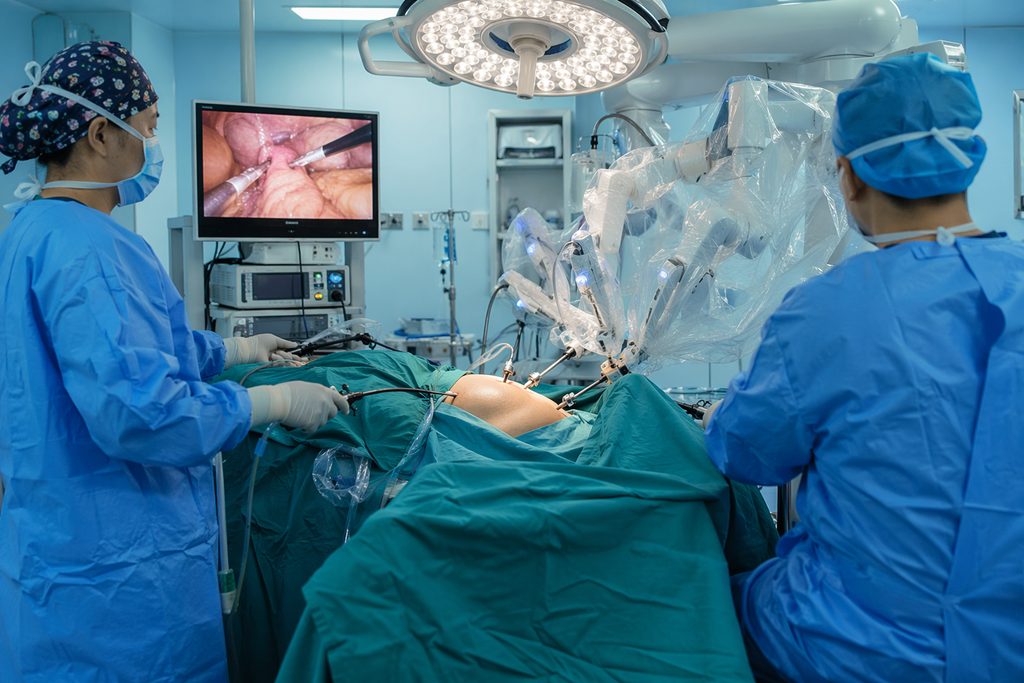
The da Vinci surgical system provides 10x magnified 3D visualization and wristed instrumentation with seven degrees of freedom. That technology translates into concrete intraoperative advantages. The surgeon sees the neurovascular bundles — the delicate nerves responsible for erections — with far greater clarity than in open surgery. The precision of the instruments allows for tighter dissection around the urethral sphincter, which directly affects how quickly you regain urinary control. Intraoperative blood loss averages under 200 mL in robotic series, compared to 600–1,000 mL in open radical prostatectomy. Lower blood loss means fewer transfusions, less hemodynamic stress, and faster postoperative recovery.
But the technology alone does not guarantee results. A da Vinci robot in a low-volume hospital is still a low-volume experience. What makes the Chinese model structurally different is concentration. The Chinese hospital system funnels complex cancer cases to a relatively small number of top-tier centers. Fudan University Shanghai Cancer Center, for example, operates one of the largest robotic urology programs in Asia. Patients from across the country travel there specifically for prostate cancer surgery. That concentration creates a feedback loop: high volume leads to better outcomes, which attracts more patients, which further increases volume. The same dynamic exists at Memorial Sloan Kettering in New York or Martini-Klinik in Hamburg. The difference is that Chinese centers offer this volume at a fraction of the Western price.
Cost Advantage Without Quality Compromise
Let us address the obvious objection directly. Lower cost does not mean lower quality. The structural reasons for the price difference are straightforward. Chinese hospital systems operate with lower labor costs for nurses, technicians, and support staff. Hospital construction and equipment procurement benefit from domestic manufacturing scale. The da Vinci robot itself is the same machine used in American and European operating rooms — manufactured by Intuitive Surgical in California. The disposables and instruments are the same. The difference is what the hospital charges for the operating room time, the surgical team, and the inpatient stay.
A robotic prostatectomy cost China typically ranges from $18,000 to $32,000 at a top public hospital’s international department. That price usually includes the surgeon fee, anesthesia, operating room, robotic instrument costs, and a 5–7 day inpatient stay. In the United States, the same procedure carries a list price of $40,000 to $70,000 before insurance negotiation. In the United Kingdom, private hospitals charge £18,000 to £28,000. In Australia, private robotic prostatectomy runs AUD $25,000 to $40,000. The Chinese price is not suspiciously cheap. It reflects a different cost structure, not a different standard of care. The hospitals performing these operations are the same ones ranked among China’s top 10 for urology in the Fudan Hospital Rankings — the most respected hospital ranking system in the country.
What Recovery Actually Looks Like After Robotic Prostate Removal
Recovery time after robotic prostate removal follows a fairly predictable arc, though individual variation is real. Most men spend one to two nights in the hospital. The urinary catheter stays in place for 5 to 10 days, depending on the surgeon’s protocol and whether a cystogram confirms the anastomosis is watertight. Once the catheter comes out, the real work begins. Urinary control returns gradually. Some men are dry within weeks. Others need 3 to 6 months of pelvic floor exercises and patience. The majority of men achieve social continence — meaning no pads or one security pad per day — within 3 to 6 months after robotic surgery at high-volume centers.
Erectile function is slower and more variable. If the surgeon performed bilateral nerve-sparing, and if you had good baseline erectile function before surgery, the odds of recovering erections sufficient for intercourse within 12 to 24 months are roughly 50–70% at experienced centers. Without nerve-sparing — which is necessary when the cancer sits close to the neurovascular bundles — the odds drop sharply. This is why choosing a surgeon who performs nerve-sparing robotic prostatectomy regularly matters so much. It is also why the question “is robotic prostate surgery better than traditional” cannot be answered with a simple yes. The robot enables better nerve-sparing in skilled hands. It does not guarantee it.
Return to work depends on your job. Desk work: 2 to 4 weeks. Physical labor: 6 to 8 weeks. Driving: once the catheter is out and you are off narcotic pain medication, typically 10 to 14 days after surgery. Heavy lifting — anything over 10 kilograms — should wait 6 weeks to protect the anastomosis and the port-site hernias. These timelines assume no complications. A postoperative ileus, a urinary tract infection, or a lymphocele can extend recovery by days or weeks. These complications occur in 5–10% of cases even at excellent centers. Anyone who tells you robotic prostatectomy is risk-free is not being honest with you.
Is Robotic Prostate Surgery Better Than Traditional? What the Head-to-Head Data Shows
The most rigorous comparison comes from randomized controlled trials. The landmark study is the LAP-01 trial from Germany, published in European Urology in 2021. It randomized men with localized prostate cancer to either robotic-assisted radical prostatectomy or open radical prostatectomy. At 3 months, the robotic group reported significantly better urinary continence and erectile function scores. At 12 months, the differences narrowed but remained in favor of robotics for continence. Cancer control — measured by positive surgical margin rates and biochemical recurrence — was equivalent between the two approaches. That last point matters. The robot did not compromise cancer outcomes. It improved recovery without sacrificing oncologic safety.
A 2020 Cochrane systematic review reached similar conclusions. Robotic prostatectomy was associated with shorter hospital stay, lower blood transfusion rates, and better early functional outcomes compared to open surgery. Long-term oncologic outcomes were comparable. The review also noted that the quality of evidence was moderate, not high — because surgical trials are notoriously difficult to blind. You cannot hide the incision from a patient. But the direction of the evidence is consistent across dozens of studies. For most men with localized prostate cancer, robotic surgery offers a faster, less bloody recovery with at least equivalent cancer control.
| Outcome Measure | Robotic Prostatectomy | Open Prostatectomy |
|---|---|---|
| Average blood loss | 150–250 mL | 600–1,000 mL |
| Hospital stay | 1–3 days | 4–7 days |
| Catheter duration | 5–10 days | 10–14 days |
| Return to desk work | 2–4 weeks | 6–8 weeks |
| 12-month continence (high-volume center) | 85–95% | 80–90% |
| Positive margin rate (pT2 disease) | 10–15% | 12–18% |
| Cost in China (international dept.) | $18,000–$32,000 | $12,000–$20,000 |
| Cost in the United States | $40,000–$70,000 | $30,000–$50,000 |
The table shows something important. Open surgery in China is cheaper than robotic surgery in China. So why choose the robot? Because the functional recovery advantages — faster continence, earlier return to normal activity, less blood loss — are worth the incremental cost for most men. The robot is not always necessary. A healthy 50-year-old with low-risk disease and excellent baseline function who wants the best possible shot at preserving erectile function should strongly consider robotics. A 75-year-old with significant comorbidities and low-risk disease might do just as well with open surgery or even radiation. The right choice depends on your priorities, your anatomy, and your surgeon’s honest assessment of what they can achieve with each approach.
How to Book Robotic Prostate Surgery in China: The Practical Path
If you are considering traveling to China for robotic prostatectomy, the process is more structured than most Western patients expect. Here is what actually happens. First, you submit your existing medical records: PSA history, biopsy pathology report, MRI images and reports, and any prior treatment notes. The urology department reviews these remotely. A written second opinion from a top Chinese urology specialist costs $300–$500 and gives you a clear assessment of whether robotics is appropriate for your case and what nerve-sparing approach is feasible. A video consultation with the specialist costs $500–$800 and allows you to ask direct questions about continence expectations, potency odds, and surgical plan. If the remote evaluation confirms you are a candidate, the hospital’s international department can coordinate a surgical date. You cannot book surgery without first completing this remote evaluation. That is not our policy — it is the hospital’s rule, and it protects you from traveling thousands of miles only to learn you are not a surgical candidate.
Visa logistics matter. For medical treatment in China, the correct visa category is S2, which covers short-term private affairs including medical treatment. Your accompanying family member also applies for an S2 visa. The hospital’s international department will provide an official invitation letter and treatment confirmation document to support your application. Processing times vary by embassy and country, but you should allow 4 to 8 weeks from document submission to visa approval. Do not book flights until the visa is in your passport. And do not assume the M visa — the commercial and trade visa — has anything to do with medical travel. It does not. Using the wrong visa category can result in denial of entry.
Practical tip: Bring a complete digital and physical copy of your medical records. Chinese hospitals will want the original pathology slides or blocks for their own pathologist to review before surgery. Arrange for your home hospital to release these directly to the Chinese hospital’s pathology department. This step alone can take 2–4 weeks, so start early.
Payment is another practical consideration. Chinese public hospitals require prepayment before admission. The international department will provide a cost estimate, and you will deposit funds upfront. Major credit cards are accepted at international departments, but wire transfer is often smoother for large amounts. Private international hospitals in China — such as United Family Healthcare or Jiahui Health — offer direct insurance billing and English-speaking staff throughout, but their robotic prostatectomy prices run higher, typically $35,000 to $50,000. If your insurance covers treatment abroad, check whether the hospital is in your insurer’s network. Many international insurers have direct billing arrangements with Chinese private hospitals but not with public hospital international departments. You may need to pay upfront and seek reimbursement. Confirm this before you commit.
Language is the final barrier. Public hospital international departments have some English-speaking staff, but the nursing floor, the radiology department, and the billing office often do not. You will need someone who speaks Mandarin and understands how Chinese hospitals work. That person handles registration, queues for imaging, translates during ward rounds, and clarifies medication instructions. A bilingual medical companion in China costs from $300 per day. It is not a luxury. It is the difference between a smooth hospital stay and a stressful one.
Frequently Asked Questions
Is robotic prostate surgery better than traditional open surgery for cancer control?
The best available evidence says cancer control is equivalent. Randomized trials and large observational studies show no significant difference in positive surgical margin rates or long-term biochemical recurrence between robotic and open prostatectomy when performed by experienced surgeons. The robot’s advantages are in recovery, not in curing cancer more effectively.
How much does robotic prostatectomy cost in China compared to the US?
A robotic prostatectomy cost China at a top public hospital’s international department typically runs $18,000 to $32,000. The same procedure in the United States costs $40,000 to $70,000 before insurance. In the UK, private hospitals charge £18,000 to £28,000. The Chinese price reflects lower labor and facility costs, not lower clinical standards. Final pricing always varies by hospital and case complexity.
What is the recovery time after robotic prostate removal?
Most men stay in hospital for 1 to 3 days and have a urinary catheter for 5 to 10 days. Return to desk work takes 2 to 4 weeks. Full physical activity resumes at 6 to 8 weeks. Urinary continence improves steadily over 3 to 6 months. Erectile function recovery takes 12 to 24 months and depends heavily on whether nerve-sparing was performed and your baseline function.
Can I book robotic prostate surgery in China without traveling there first?
You cannot book surgery directly. The hospital requires a remote evaluation first: you submit your records, the urology team reviews them, and you complete a written second opinion or video consultation. Only after the hospital confirms you are a surgical candidate can a surgical date be coordinated. This protects you from traveling internationally for a surgery that may not be appropriate for your case.
What if something goes
For more medical information and treatment options in China, visit chinamedservices.com (China Medical Services).
