Dental Bridge vs Implant: Cost, Recovery, and China Options
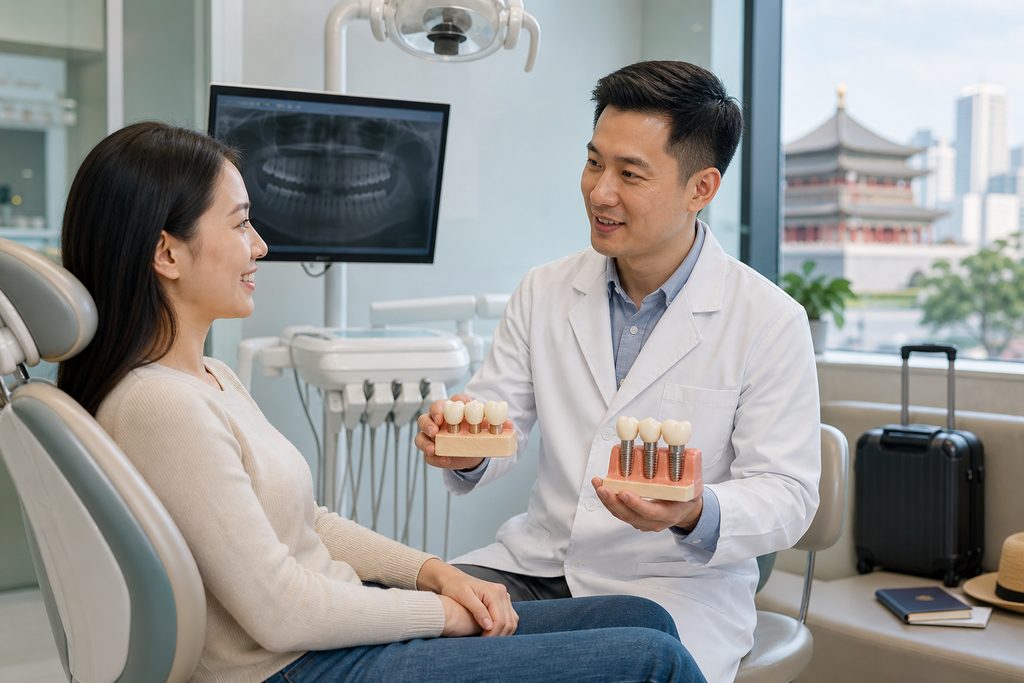
Dental Bridge vs Implant Cost China: Which Restoration Makes Sense for You
While a single dental implant in the United States routinely runs $3,000 to $6,000 per tooth, the same procedure at a top-tier Chinese dental hospital often costs between $800 and $1,800. That gap explains why thousands of international patients now weigh the dental bridge vs implant cost China question before booking a flight. The decision involves more than money, though. Bone density, adjacent tooth health, recovery tolerance, and long-term maintenance all matter.
We work with patients every week who arrive in Shanghai or Beijing unsure which restoration path to choose. Some need a single molar replaced. Others face a three-unit gap after years of extractions. The right answer depends on clinical factors a dentist must evaluate — but understanding the real differences in cost, procedure, recovery, and durability helps you ask better questions before you commit.
Key Takeaways
- A dental implant in China costs $800–$1,800 per tooth at public hospitals, versus $3,000–$6,000 in the US — a 60–70% savings.
- Bridges cost less upfront ($400–$900 per unit in China) but typically need replacement every 10–15 years, while implants can last 25+ years.
- Implants require adequate jawbone density and a 3–6 month healing window; bridges need healthy adjacent teeth to serve as anchors.
- Chinese dental hospitals in Shanghai and Beijing offer same-week consultations, but complex implant cases still require two trips or an extended stay.
The Problem: Replacing One Tooth Costs More Than a Month’s Rent
Top Chinese dental hospitals now use CBCT-guided implant planning as standard, not as an upsell. The workflow: cone-beam scan on day one, 3D surgical guide fabrication overnight, implant placement on day two, and temporary crown within 72 hours in select cases. Digital impressions replace messy trays. Same-day crown milling is available at private international clinics like Jiahui and United Family. This is not experimental technology — it is the default at hospitals that treat thousands of dental tourists annually.
Chinese dental implant costs are lower for the same reason cardiac surgery costs less: labor economics and hospital efficiency. A Chinese prosthodontist’s salary is a fraction of a US dentist’s, but training standards at top hospitals — many affiliated with Fudan University or Peking University — are internationally benchmarked. Implant brands are identical: Straumann, Nobel Biocare, Osstem, and Dentium dominate the Chinese market. The titanium is the same. The difference is overhead, not materials or expertise.
Dental Bridge vs Implant: The Real Clinical Tradeoffs
This is the section most patients skip to after checking prices. Understand the mechanics before deciding.
How a Bridge Actually Works
A traditional three-unit bridge replaces one missing tooth by crowning the two adjacent teeth and suspending a false tooth between them. Those adjacent teeth must be healthy enough to survive being filed down — typically removing 1–2mm of enamel from each. That is irreversible. If either anchor tooth later fails, the entire bridge fails. Bridges do not stop bone loss in the gap because nothing stimulates the jawbone beneath the pontic.
How an Implant Actually Works
An implant is a titanium screw surgically placed into the jawbone, topped with an abutment and crown after osseointegration — the process where bone fuses to the implant surface. This takes 3–6 months in the lower jaw and 4–7 months in the upper jaw. The implant stimulates bone like a natural tooth root, preventing resorption. It requires no alteration of adjacent teeth. It is cleaned like a natural tooth.
Is a Dental Bridge Better Than an Implant for Back Teeth?
For molars, the answer leans toward implants — but with caveats. Molars absorb the highest bite forces: up to 200 pounds of pressure during chewing. A bridge supported by premolars can fail under repeated heavy loading, especially in patients with bruxism. An implant placed in a molar position handles force naturally. But molar implants require sufficient bone height above the inferior alveolar nerve in the lower jaw or below the sinus floor in the upper jaw. When bone is inadequate and grafting is declined, a bridge becomes the practical choice. So the question is not which is universally better — it is which fits your anatomy, budget, and timeline.
| Factor | Dental Bridge (3-unit, China) | Single Implant + Crown (China) |
|---|---|---|
| Upfront cost | $1,200–$2,700 total ($400–$900 per unit) | $800–$1,800 total |
| Procedure time | 2–3 visits over 1–2 weeks | 2 visits over 3–6 months (or same-day protocol in select cases) |
| Adjacent tooth impact | Filed down permanently | None |
| Bone preservation | No — bone loss continues under pontic | Yes — implant stimulates bone |
| Typical lifespan | 10–15 years | 25+ years with proper care |
| Failure mode | Decay or fracture of anchor teeth | Peri-implantitis (rare, manageable) |
Costs vary by hospital tier and case complexity. Public hospitals like Shanghai Ninth People’s Hospital and Peking University School of Stomatology sit at the lower end. Private international clinics with English-speaking staff run higher.
Dental Bridge vs Implant Recovery Time China: What to Expect
Recovery is where the two paths diverge sharply. A bridge involves no surgery — just tooth preparation and impressions. Mild sensitivity for a few days is normal. Most patients eat soft foods for a week and resume normal chewing within two weeks. The bridge is cemented at the final visit, typically 7–14 days after the first appointment.
An implant is a surgical procedure. The placement itself takes 30–60 minutes under local anesthesia. Expect swelling and mild discomfort for 3–5 days. Sutures dissolve or are removed at day 7–10. But the implant is not ready for a permanent crown until osseointegration completes — a minimum of 3 months, often 4–6. During that period, you wear a temporary restoration or go without a tooth in the gap. For international patients, this means either two trips to China (placement trip, then restoration trip 3–6 months later) or an extended stay if your schedule allows.
Practical tip: Some Chinese clinics offer same-day “immediate load” protocols where a temporary crown is placed on the implant at surgery. This works only in cases with excellent primary stability and is not suitable for all patients. Ask your dentist whether you qualify before committing to a single-trip plan.
Dental Bridge Price Shanghai and Beijing: Real Numbers
Shanghai and Beijing dominate dental tourism in China, and their pricing reflects hospital tier more than geography. The dental bridge price Shanghai patients typically encounter breaks down as follows:
- Public hospital prosthodontics department (e.g., Shanghai Ninth People’s Hospital): $400–$700 per unit for porcelain-fused-to-metal bridges; $600–$900 per unit for zirconia bridges.
- Private international clinics (e.g., Jiahui, United Family): $800–$1,200 per unit for zirconia, with English-speaking staff and direct insurance billing.
- Beijing public hospitals (e.g., Peking University School of Stomatology): $350–$650 per unit for PFM; $550–$850 for zirconia.
For a three-unit bridge replacing one missing tooth, budget $1,200–$2,700 in Shanghai at a public hospital, or $2,400–$3,600 at a private international clinic. A single implant with crown runs $800–$1,800 at public hospitals and $1,500–$2,500 at private clinics. These are out-of-pocket prices for international patients. Insurance reimbursement depends on your home policy — most US dental insurers offer limited or no coverage for overseas treatment, though some PPO plans allow out-of-network claims.
Can I Get a Dental Bridge Instead of Implant Abroad? Yes — With These Conditions
The short answer: yes, you can get a dental bridge instead of an implant abroad, and many patients do. The longer answer involves candidacy. A bridge is appropriate when adjacent teeth already have large fillings or crowns and would benefit from full coverage anyway. It is also the fallback when bone grafting is declined or medically inadvisable. But if your adjacent teeth are pristine, filing them down to support a bridge is a tradeoff many dentists — in China or elsewhere — would hesitate to recommend.
Chinese dentists are generally conservative about this. At top teaching hospitals, the standard of care mirrors Western prosthodontic guidelines: preserve healthy tooth structure whenever possible. You may hear a recommendation for an implant even when a bridge is cheaper, because the long-term cost of replacing a failed bridge — and the damage to anchor teeth — often exceeds the implant’s upfront premium.
How to Book Dental Implant or Bridge Treatment in Beijing
If you decide to book dental implant or bridge Beijing treatment, the process differs from what you might expect at home. Chinese public hospitals do not allow overseas patients to pre-book general outpatient appointments online. You register on-site, often the same day, and wait in queue. At high-demand departments like prosthodontics at Peking University School of Stomatology, morning registration can fill by 8:30 AM.
The practical alternative is the hospital’s international medical department or VIP clinic. These channels allow advance booking, provide English interpretation, and shorten wait times — at roughly 1.5–2 times the standard outpatient price. A consultation that costs $30 at the general counter might run $60–$90 through the international department. For most international patients, the premium is worth it: you avoid language barriers, navigation confusion, and multi-hour queues.
Private international clinics like United Family Beijing and Raffles Medical offer online booking, English-speaking dentists, and direct insurance billing. Prices run 30–50% higher than public hospitals but remain far below US private rates.
Practical Considerations: Documentation, Visas, and Follow-Up
For dental treatment in China, you need less paperwork than for major surgery — but do not arrive empty-handed. Bring recent panoramic X-rays or CBCT scans if you have them. If you are considering an implant, a current panoramic image helps the dentist assess bone height before you travel. Without it, expect to pay $30–$80 for imaging on-site.
Visa requirements are straightforward. For medical treatment, apply for an S2 visa with a supporting letter from the treating hospital or clinic. The S2 covers short stays for private affairs including medical treatment. For treatment requiring multiple visits over more than 180 days, an S1 visa applies. Your accompanying family members also apply for S2 visas. Approval is not guaranteed and depends on the latest consulate requirements, so submit the hospital’s invitation letter and your treatment plan with the application.
Payment at Chinese public hospitals is upfront — cash, WeChat Pay, Alipay, or international credit cards at larger facilities. Private international clinics accept major credit cards and often bill insurers directly. If you plan to claim reimbursement from a home insurer, request itemized receipts and a treatment summary in English before leaving.
Follow-up after returning home is simpler for bridges than implants. A well-made bridge needs only routine hygiene and occasional adjustment. An implant requires a check at 6 months and annually thereafter — any competent dentist in your home country can perform these. Just request your Chinese dentist’s surgical notes and implant brand information (the manufacturer and model are etched on the implant packaging) so your home dentist knows what system you have.
Frequently Asked Questions
How much cheaper is a dental implant in China really?
A single implant with crown costs $800–$1,800 at top Chinese public hospitals, compared to $3,000–$6,000 in the United States. Even after adding flights and accommodation, most patients save 50% or more on a single implant. The savings multiply for multiple implants or full-arch restorations.
Is it safe to get dental work done in China?
At top-tier teaching hospitals and JCI-accredited private clinics, yes. Chinese prosthodontists at institutions like Shanghai Ninth People’s Hospital and Peking University School of Stomatology train to international standards and use the same implant brands as Western dentists. The key is choosing a reputable facility — not a budget clinic with no international track record.
What if my implant fails or the bridge breaks after I return home?
Implant failure rates are low — around 2–5% over 10 years — and most failures occur within the first year. If an implant fails after you return home, a local dentist can remove it and discuss replacement options. Bridges can chip or debond over time; repairs are routine for any prosthodontist. Request complete records from your Chinese provider so your home dentist can continue care without guesswork.
Do I need two trips to China for an implant?
In most cases, yes — one trip for implant placement and a second trip 3–6 months later for the permanent crown. Some clinics offer immediate-load protocols where a temporary crown is placed at surgery, but this is case-dependent. If two trips are impractical, a bridge may be the better logistical fit since it completes in 1–2 weeks.
Will my dental insurance cover treatment in China?
Most US dental insurers do not cover overseas treatment, though some PPO plans allow out-of-network claims with itemized receipts. Contact your insurer before booking. If coverage is denied, the out-of-pocket cost in China is often lower than your US copay plus deductible anyway.
Your Next Step
The dental bridge vs implant decision comes down to your bone health, adjacent teeth condition, budget, and tolerance for a longer timeline. Both options are performed to high standards at top Chinese dental hospitals at a fraction of Western prices. We help international patients identify appropriate hospitals in Shanghai, Beijing, and other cities, coordinate appointments through international departments, and arrange bilingual support. We are not a dental practice and do not provide diagnoses — but we can help you navigate the system so you arrive prepared and informed. If you are weighing a bridge against an implant and want clarity on costs and logistics in China, request a free consultation and our team will help you map the options.
For more medical information and treatment options in China, visit chinamedservices.com (China Medical Services).
