Yangtze River Delta Hospital Access: How One Escort Covers Shanghai and Jiangsu
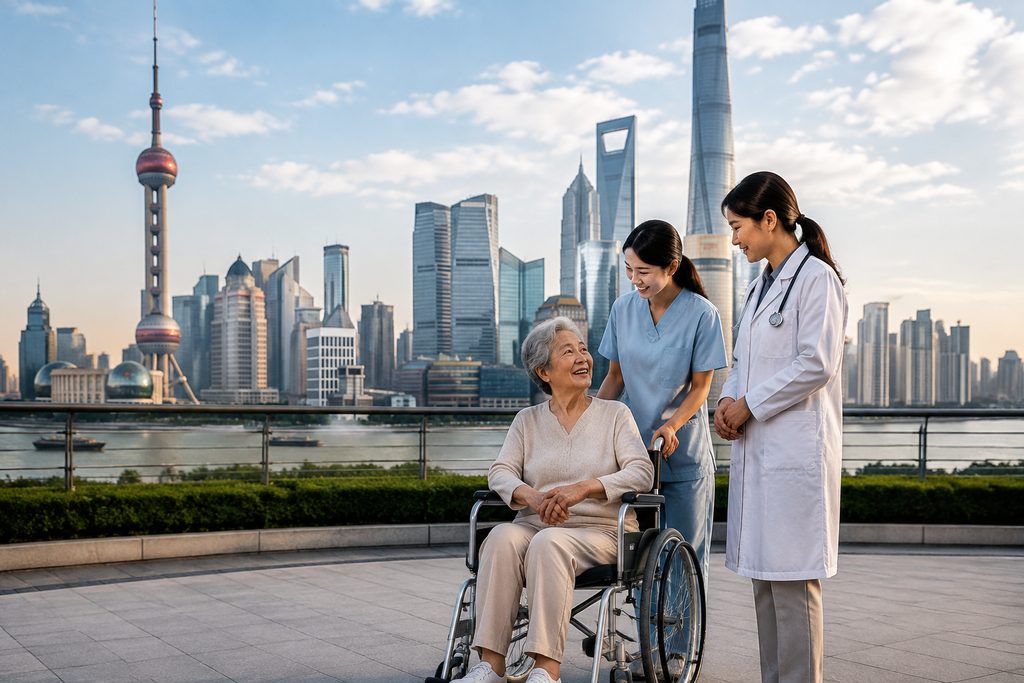
While a patient in the UK waits an average of 15 weeks for a cardiology appointment, a specialist at Zhongshan Hospital in Shanghai sees 80–100 patients in a single morning session. The capacity exists. The clinical outcomes are published and strong. The bottleneck for an international patient is not the medicine. It is geography, language, and knowing which door to walk through. Our escort service solves this by covering not just one city, but the entire Yangtze River Delta — Shanghai and Jiangsu province — as a single, continuous coverage zone.
That means you are not locked into one hospital in one postcode. You get a bilingual coordinator who can move with you from a consultation at Ruijin Hospital in downtown Shanghai on Tuesday to a procedure at a top-ranked Jiangsu facility on Thursday. The region contains 18 of China’s Fudan-ranked top 100 hospitals, spread across multiple cities. One escort. Full access. No gaps.
Full Yangtze River Delta Hospital Access: The Short Answer
Yes, a single escort team can navigate hospitals in both Shanghai and Jiangsu for you. Our coordinators are based in the region and travel with you. The distance between Shanghai and Suzhou is 30 minutes by high-speed train. Nanjing is 60 minutes. The real question is not whether the escort can cover the geography — it is whether your case benefits from accessing multiple hospitals across two provinces. For many complex cases, the answer is yes.
The caveat: not every patient needs multi-city access. If your case is straightforward and a single specialist at one Shanghai hospital can handle it end-to-end, you may not need the Jiangsu leg. But if you are comparing treatment plans, seeking a specific subspecialty, or want a second opinion from a different hospital system before committing to surgery, the cross-province model saves weeks of back-and-forth.
Who This Is Right For — and Who It Isn’t
This service is built for a specific type of medical traveler. Here is who typically benefits most.
Good candidates:
- Patients with complex or rare conditions who need opinions from multiple subspecialty teams before deciding on a treatment path.
- Families comparing surgical approaches — for example, robotic-assisted surgery at one hospital versus traditional open surgery at another.
- Patients who have already received a diagnosis abroad but want to evaluate treatment options at both public and private hospitals across the region.
- Those traveling with family members who need coordinated logistics across multiple appointments in different cities.
Who should reconsider:
- Patients with a single, well-defined condition that one specialist can clearly address — you may not need the multi-city component.
- Anyone medically unstable for travel. A long day moving between cities, even with support, is physically demanding.
- Patients whose home physician has advised against any delay in treatment. Getting multiple opinions takes days, not hours.
Being honest about who should not do this is what makes the service credible. We turn away cases that do not fit.
The Options, Compared
International patients accessing Yangtze River Delta hospitals typically choose between three approaches. Each has trade-offs in cost, coverage, and coordination burden.
| Approach | Geographic Coverage | Cost (USD) | Coordination Burden | Best For |
|---|---|---|---|---|
| Self-navigation with ad-hoc translators | One city, one hospital | $50–150/day (translator only) | High — you manage registration, appointments, travel, and medical records | Budget-conscious patients with simple cases and high tolerance for logistics |
| Single-city hospital international center | One hospital campus | Included in international department fees (consultation $100–300) | Low at that hospital; zero outside it | Patients certain they only need one hospital |
| Regional escort with multi-city access | Shanghai + Jiangsu (all Fudan-ranked hospitals in the corridor) | From $300/day (bilingual escort); coordination fee from $300 | Low — escort handles registration, translation, travel between cities, and record transfer | Patients comparing multiple hospitals, seeking second opinions, or needing subspecialty access across provinces |
The regional escort model costs more per day than a standalone translator. But it eliminates the hidden cost of delays. A patient who spends three extra weeks in China because they cannot coordinate appointments across hospitals burns far more in accommodation and lost time than the escort fee. For anyone visiting more than one hospital, the math usually favors the coordinated approach.
How to Access All Hospitals in Yangtze River Delta as International Patient
The Yangtze River Delta medical corridor runs from Shanghai westward through Suzhou, Wuxi, Changzhou, and into Nanjing. High-speed rail connects every major city on this line. A patient can have an 8 a.m. consultation in Shanghai, take the 11:30 train to Suzhou, and be in a specialist’s office by 1:30 p.m. Our escorts do this route weekly.
The hospitals worth accessing span two categories. In Shanghai, the Fudan-ranked top-tier public hospitals dominate: Zhongshan Hospital for cardiology and liver surgery, Ruijin Hospital for endocrinology and hematology, Huashan Hospital for neurosurgery and dermatology, and Fuwai Hospital’s Shanghai branch for cardiac surgery. In Jiangsu, Jiangsu Province Hospital in Nanjing ranks among China’s top 20 for multiple specialties, and Suzhou’s First Affiliated Hospital of Soochow University carries strong reputations in oncology and orthopedics.
Accessing these hospitals as a foreigner without an escort means navigating each hospital’s separate registration system. Chinese public hospitals do not share patient records across provinces. You register fresh at each one. You bring your own translated medical history. You queue for a registration number at 6 a.m. if you want a same-day slot. An escort eliminates this fragmentation. We carry your translated records. We pre-register where the hospital system allows it. We know which departments accept walk-in foreign patients and which require advance coordination through the international medical center.
This is not theoretical. A patient from Dubai with a complex spinal condition recently used our cross-province access to consult orthopedic surgeons at three hospitals in four days: Changzheng Hospital in Shanghai, the Affiliated Hospital of Nantong University in Jiangsu, and back to Shanghai for a final MDT review. The alternative would have been three separate trips to China. The escort made it one continuous journey.
Escort Service Covering Shanghai and Jiangsu Hospitals Cost
The daily bilingual escort fee starts at $300 for an 8-hour day. That covers one coordinator who handles registration, queueing, payment, translation during consultations, and navigation between facilities. If your itinerary spans multiple days across Shanghai and Jiangsu, the daily rate applies to each day of active hospital visits. Travel days with no medical appointments are not charged at the full escort rate.
What drives the total cost up or down: the number of hospitals you visit, the distance between them, and whether any require VIP international department coordination (which carries its own hospital-side fees, typically 1.5–2× the standard consultation price). A two-day itinerary visiting one Shanghai hospital and one Nanjing hospital might run $600 in escort fees plus intercity train tickets. A five-day multi-hospital evaluation across four cities could reach $1,500–$2,000 in escort coordination.
Hospital consultation fees are separate and paid directly to the hospital. Expect $30–$80 for a standard specialist consultation at a public hospital, or $100–$300 at an international medical center. These are the hospital’s own charges. We do not mark them up.
And here is the key financial detail: any remote consultation fee you pay — a written second opinion at $300–500 or a video consultation at $100–300 — is credited in full toward on-the-ground coordination if you decide to come to China within 90 days. That means you can start with a remote evaluation, confirm that the multi-city approach makes sense, and then apply that investment directly to your escort coordination. No sunk cost.
Practical Considerations: Records, Visas, and What Happens After You Leave
Multi-city hospital access demands organized medical records. Bring everything translated into English or Chinese. Bring imaging on a CD or USB, not just printed reports. Chinese specialists want to see the raw DICOM files for CT and MRI scans, not just the radiologist’s summary. If you arrive with only a one-page report, expect to repeat the imaging — which is fast and affordable in China, but avoidable if you prepare properly.
Visa category matters. Foreign nationals coming to China for medical treatment apply for an S2 visa, with the purpose noted as medical treatment. Your accompanying family members also apply for S2 visas. The hospital providing your primary consultation can issue an invitation letter that supports the visa application. We guide you through which documents each hospital requires to issue that letter. The S2 visa typically allows a stay of up to 180 days, which covers even extended multi-hospital evaluation timelines.
Payment at Chinese public hospitals is predominantly upfront. You pay the consultation fee, the imaging fee, and the procedure deposit before services are rendered. International credit cards are accepted at international medical centers but rarely at standard public hospital counters. Bring a UnionPay card, use Alipay linked to an international card, or carry sufficient cash. Your escort handles the payment logistics at each counter so you are not standing at a cashier window trying to explain which department you are paying for.
After you return home, continuity of care depends on how well your Chinese medical records are translated and formatted for your home physician. We provide a translated discharge summary and key imaging reports. But your home doctor will need to interpret these within their own system. We recommend scheduling a follow-up video consultation with your Chinese specialist 4–6 weeks after returning home to review recovery progress or next-step decisions. The video consultation fee applies, but it keeps the care continuum intact.
Frequently Asked Questions
Yes. The escort travels with you. The high-speed rail network connects Shanghai to Suzhou in 30 minutes, Wuxi in 45 minutes, and Nanjing in 60 minutes. Our coordinators are based in the region and know the registration systems, department locations, and international patient protocols at the major hospitals in both provinces. You are not hiring a Shanghai escort who occasionally visits Jiangsu. You are hiring a regional team that works this corridor daily.
There is no single package price because each patient’s itinerary differs. A basic two-day, two-city coordination starts around $600 in escort fees plus hospital charges. A comprehensive one-week multi-hospital evaluation across Shanghai and Jiangsu typically runs $1,500–$2,500 in coordination fees, depending on the number of hospitals and travel complexity. Hospital fees are separate and paid directly. We provide a detailed cost breakdown after reviewing your medical records and proposed hospital list — always before you commit to anything.
This happens more often than you might think. A patient arrives expecting surgery at Hospital A, the specialist recommends a different approach, and suddenly you want a second opinion at Hospital B before proceeding. With a regional escort, this pivot is a same-day or next-day adjustment. We call Hospital B’s international center, check specialist availability, and re-route. Without an escort, you are alone in a foreign city trying to register at a new hospital from scratch. The flexibility is the point of the multi-city model.
Even with escort coordination fees included, the total cost of a multi-hospital evaluation in China runs well below comparable medical tourism destinations. A cardiac surgery workup across two hospitals in Shanghai and Nanjing, including escort fees, consultations, imaging, and 10 days of accommodation, might total $3,000–$5,000. A similar multi-hospital evaluation in Singapore or South Korea would run $8,000–$15,000 before treatment even begins. The treatment itself — if you proceed — costs a fraction of Western prices. The escort fee is a small line item in a much larger savings equation.
Your Next Step
Accessing top-ranked hospitals across Shanghai and Jiangsu does not require multiple trips, multiple coordinators, or months of planning. It requires one experienced team that knows the region’s hospitals, speaks the language, and can move with you from one facility to the next without losing continuity. That is what we do.
We are not a hospital. We do not diagnose or treat. We are the coordination layer between you and China’s top-tier medical institutions — handling hospital matching, appointment scheduling, bilingual escorting, and the logistics that turn a fragmented system into a smooth patient journey. If you are considering treatment in China and want to understand whether multi-city access makes sense for your case, start with a free consultation. Tell us your diagnosis, your goals, and the hospitals you are considering. We will tell you honestly whether the cross-province approach adds value — and what it would cost.
For more medical information and treatment options in China, visit chinamedservices.com (China Medical Services).
