How Painful Is a Dental Implant? Real Recovery Data and China Costs
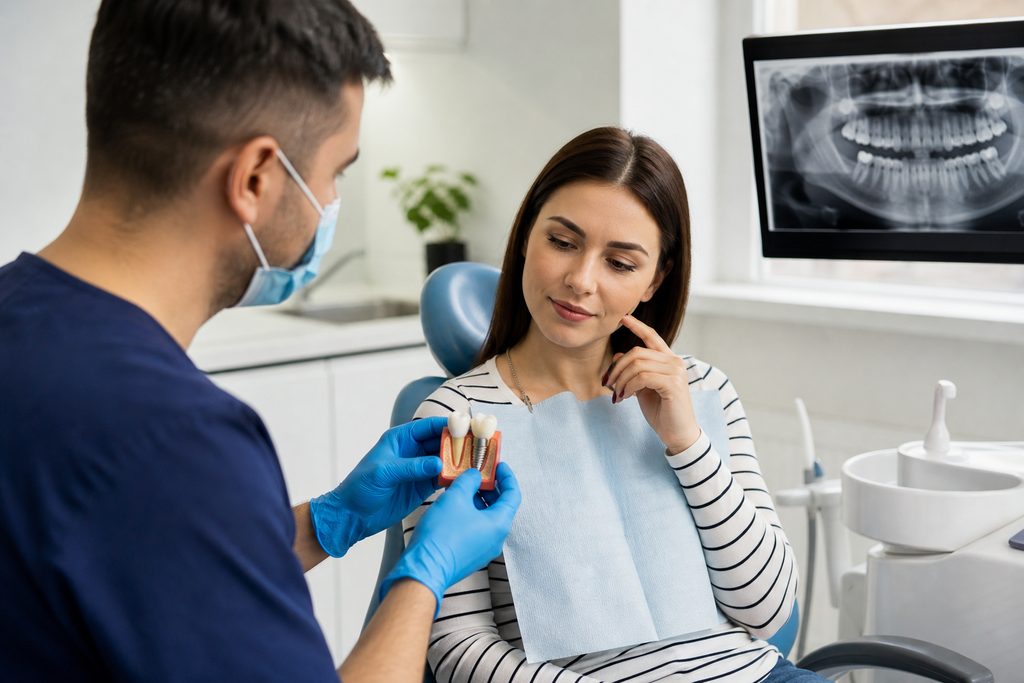
Dental Implant Pain: The Short Answer
Most patients rate the actual dental implant pain level China clinics report as 3 to 4 out of 10 during the procedure itself. That is less than a tooth extraction. The implant placement involves drilling into bone, but the bone itself has very few pain receptors. What you feel is pressure and vibration. The real discomfort arrives six to twelve hours later, once the local anesthetic wears off. That post-operative soreness typically peaks at 24 to 48 hours and fades substantially within three to five days.
But here is the caveat nobody mentions in the brochure. The pain experience splits into two distinct phases. The surgical phase is genuinely mild for most people. The recovery phase depends almost entirely on whether you needed a bone graft, how many implants were placed, and whether your surgeon used a flapless technique. A single anterior implant with no graft? You might take ibuprofen for one day and forget it happened. A full-arch restoration with sinus lift and bilateral grafts? Expect a solid week of genuine discomfort, swelling, and soft-food restrictions.
Your pain threshold matters less than the surgical plan.
Who This Is Right For — and Who It Isn’t
A dental implant replaces a missing tooth root with a titanium post, then crowns it with a ceramic tooth. The procedure works brilliantly for most adults with good bone density. But it is not universal.
Good candidates typically include:
- Adults with one or more missing teeth and fully developed jawbones
- People with healthy gums and no active periodontal disease
- Non-smokers or those willing to quit for at least eight weeks around surgery
- Patients with controlled diabetes (HbA1c below 7%)
- Anyone willing to commit to a three-to-six-month healing window before the final crown
You should probably not pursue implants if any of these apply:
- Uncontrolled diabetes or autoimmune conditions that impair bone healing
- Active chemotherapy or radiation to the jaw within the past 12 months
- Severe bruxism (teeth grinding) that has not been addressed with a night guard
- Insufficient bone volume and an unwillingness to undergo grafting
- Pregnancy — elective surgery should wait until after delivery
Being honest about who should not do this is what keeps the success rate high. Implant survival at ten years is approximately 95% in healthy non-smokers. In heavy smokers with poor oral hygiene, that number drops below 80%. The surgery is not the hard part. The discipline afterward is.
The Options, Compared
If you are missing a tooth, you have three real choices. Each has a different pain profile, cost structure, and longevity. Here is how they stack up.
| Option | Procedure Pain (1-10) | Recovery Time | Typical Cost (China) | Lifespan |
|---|---|---|---|---|
| Single Dental Implant | 3-4 | 3-7 days soreness | $800-2,500 | 20+ years with care |
| Dental Bridge | 2-3 | 2-4 days | $400-1,200 | 10-15 years |
| Partial Denture | 1-2 | 1-2 weeks adjustment | $200-800 | 5-8 years |
| Full-Arch Implants (All-on-4) | 5-7 | 1-2 weeks | $8,000-20,000 | 20+ years |
The bridge seems cheaper and less painful up front. But it requires shaving down the two adjacent healthy teeth, and when it fails — and it will, eventually — you lose three teeth instead of one. The denture is painless to place but never stops being a foreign object in your mouth. Patients who choose dentures often report chronic gum soreness that never fully resolves.
The single implant has the highest short-term surgical discomfort but the best long-term outcome. You are trading one week of mild pain for two decades of not thinking about the gap.
How Painful Is a Dental Implant Procedure Without Sedation?
This is the question that keeps people up at night before surgery. The answer is reassuring for most. Local anesthesia alone is sufficient for single-tooth implants in roughly 85% of cases. You stay awake. You hear the drill. You feel pressure and vibration but no sharp pain. The entire placement for one implant takes 30 to 60 minutes.
But “no sharp pain” is not the same as “no sensation.” Patients consistently describe the sound and vibration as the most unpleasant part. The bone drill produces a low-frequency hum that travels through your skull. Some people find it deeply unsettling. If you are one of them, ask about oral sedation or nitrous oxide. These add $100 to $300 to the cost and are widely available at international dental clinics in Shanghai and Beijing.
Full-arch cases are different. Placing four to six implants per arch takes two to three hours. Most surgeons recommend IV sedation for this. You are not unconscious like general anesthesia, but you will remember very little. The dental implant recovery pain duration for full-arch cases also runs longer — typically seven to fourteen days of noticeable soreness and swelling.
So the honest answer: for a single implant, local anesthesia is fine for most people. For multiple implants or severe dental anxiety, sedation transforms the experience from tolerable to genuinely comfortable.
What Dental Implant Treatment Actually Costs in Shanghai
Dental implant cost Shanghai varies dramatically by implant brand, clinic tier, and whether you need bone grafting. Here are the real numbers.
A single implant using a Korean brand (Osstem, Dentium) at a mid-tier private clinic in Shanghai runs $800 to $1,200. The same tooth using a Swiss brand (Straumann) or Swedish brand (Nobel Biocare) at an international hospital dental department costs $1,500 to $2,500. That price typically includes the implant fixture, abutment, and crown. It does not include the initial consultation, CBCT scan ($50-150), or any necessary extractions.
Bone grafting adds $300 to $800 per site. A sinus lift for upper molar implants adds $800 to $1,500. If you need both, your single implant just doubled in cost.
Dental implant packages China price structures often bundle these elements. A typical package at a private dental chain includes consultation, CBCT, implant placement, abutment, and a zirconia crown for a fixed price. Packages range from $1,200 for Korean systems to $3,000 for premium Swiss systems. Ask what is excluded. Sedation, grafting, and temporary crowns are the usual omissions.
Compared to the United States, where a single implant averages $3,000 to $6,000, the savings are substantial. Even at Shanghai’s premium international clinics, you pay roughly half the US price for the same implant brand.
Practical Considerations: Records, Visas, and Follow-Up
If you are traveling to China for dental implants, the logistics are straightforward but not trivial. You need a panoramic X-ray or CBCT scan taken within the past six months. Most clinics will accept these by email for a preliminary assessment. A written treatment plan and cost estimate usually follows within three to five days.
For the visa, you need an S2 visa for short-term medical treatment or private affairs. Bring your clinic’s invitation letter, treatment plan, and proof of funds to the Chinese embassy or consulate in your home country. Processing typically takes four to seven business days. Your accompanying family member applies for the same S2 category.
Payment at Chinese private dental clinics is upfront. Most accept international credit cards, bank transfers, or cash. Public hospital dental departments often require prepayment at a cashier window and do not accept foreign cards. International clinics like United Family or Jiahui accept direct insurance billing from major international insurers. If you have dental insurance with out-of-network benefits, save every receipt and submit for reimbursement after returning home.
Language is the biggest practical barrier at public hospitals. Registration, payment, and imaging departments rarely have English-speaking staff. A bilingual medical companion, available from $300 per day through China Medical Services, handles registration, payment, and translation so you are not navigating a 10,000-patient-per-day hospital alone.
Follow-up after returning home matters. Most implant systems require a healing check at two weeks, then again at three months before the final crown. If you cannot return to China, coordinate with a local dentist who is willing to complete the restoration phase. Get your Chinese surgeon’s detailed surgical notes and implant brand specifications before you leave. This is not optional — your home dentist needs to know the exact implant system to order compatible components.
Frequently Asked Questions
Most patients rate single-implant placement at 3 to 4 out of 10 with local anesthesia only. You feel pressure and vibration, not sharp pain. The drilling sound bothers people more than the physical sensation. If you are anxious, oral sedation or nitrous oxide adds $100 to $300 and makes the experience far more comfortable.
Peak soreness hits 24 to 48 hours after surgery. For a single implant without grafting, most people stop taking pain medication by day three. Mild tenderness when chewing may linger for one to two weeks. Full-arch cases with bone grafts can produce meaningful discomfort for seven to fourteen days. Ice packs for the first 48 hours help more than medication.
Korean implant systems at mid-tier private clinics in Shanghai or Guangzhou start around $800 per tooth. These are not inferior products — Osstem and Dentium have decades of clinical data and are used widely across Asia. The lower price reflects lower brand licensing fees, not lower surgical quality. Ask about the surgeon’s case volume regardless of the implant brand.
Early implant failure occurs in roughly 2 to 5 percent of cases, usually within the first three months. Signs include persistent pain beyond two weeks, mobility of the implant, or pus at the gum line. If this happens, the implant is removed, the site is allowed to heal for three to six months, and a new implant can usually be placed. Most Chinese clinics offer a warranty period of one to five years on the implant fixture. Get the warranty terms in writing before surgery.
Yes, for single implants. The cabin pressure change does not affect the implant site. But schedule at least 48 hours after surgery before flying to manage any bleeding or swelling in a controlled environment. For full-arch cases with grafting, wait five to seven days. Your surgeon should clear you for travel before you book the return flight.
Your Next Step
The pain question has a clear answer: dental implants are far less painful than most people fear, with a 3 to 4 out of 10 surgical experience and a three-to-five-day recovery for single teeth. The bigger decisions are about implant brand, bone grafting needs, and where to have the work done. China offers the same premium implant systems used in the US and Europe at roughly half the price, with internationally accredited dental departments in Shanghai, Beijing, and Guangzhou.
We are China Medical Services, a coordination team that connects international patients with top-tier Chinese hospitals and clinics. We are not a hospital and we do not provide medical diagnoses. What we do is handle the logistics — clinic matching, appointment coordination, bilingual accompaniment, and visa guidance — so you can focus on your treatment. If you want to explore dental implant options in China, request a free consultation through our patient coordination service. We will review your case, recommend appropriate clinics, and give you honest cost estimates before you commit to anything.
One week of mild soreness. Twenty years of not thinking about the gap. That is the real trade-off.
For more medical information and treatment options in China, visit chinamedservices.com (China Medical Services).
