Weight Loss Surgery and Gallstones: China’s Cost-Effective Care Path
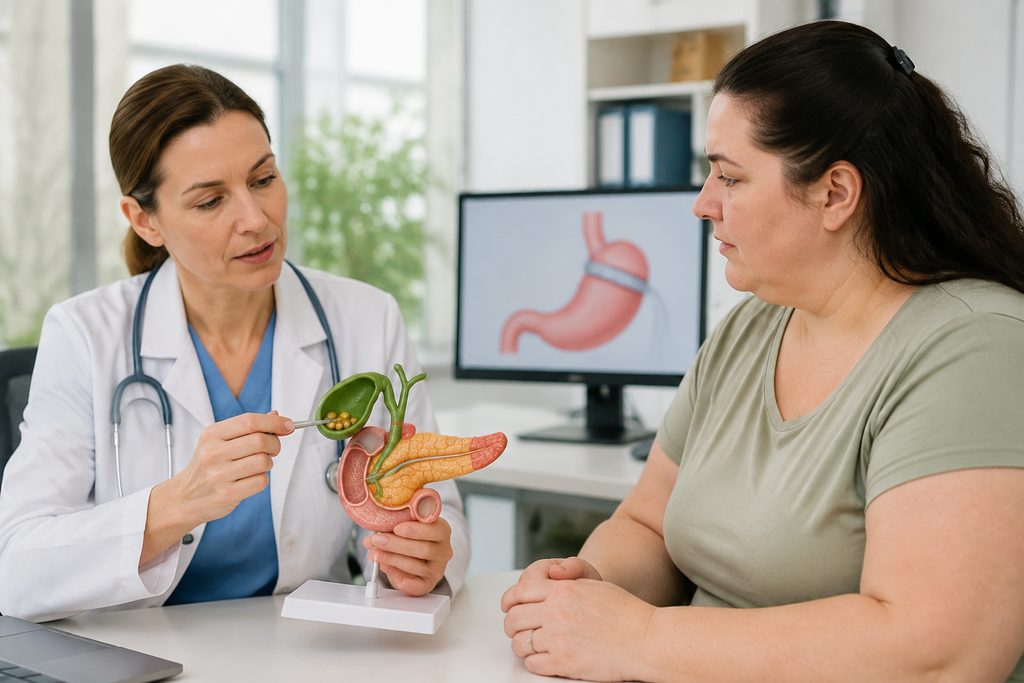
Can Weight Loss Surgery Cause Gallstones? The Short Answer
Yes. Between 30% and 50% of patients develop gallstones within 6 to 18 months after bariatric surgery. Rapid weight loss makes the liver secrete extra cholesterol into bile while the gallbladder empties less efficiently. The result is sludge, then stones. Most people never feel a thing. A minority end up needing surgery.
Here’s the part most articles skip: the risk isn’t random. It tracks with how fast you lose weight and which procedure you had. Gastric bypass carries a higher stone risk than sleeve gastrectomy. And if you already had silent stones before surgery, the odds climb further.
Who This Is Right For — and Who It Isn’t
Knowing your actual risk level changes what you should do next. Some people should treat gallstones as a near-certainty and plan accordingly. Others can reasonably watch and wait.
Higher-risk profiles — where proactive monitoring makes sense:
- You lost more than 25% of body weight in under six months
- You had Roux-en-Y gastric bypass rather than sleeve gastrectomy
- An ultrasound before surgery showed sludge or tiny stones
- You’re female, over 40, or have a family history of gallbladder disease
- You feel intermittent right-upper-quadrant pain after fatty meals
Who should not rush into gallbladder removal:
- You have no symptoms. Prophylactic removal isn’t standard practice after bariatric surgery, even with stones present
- Your stones were found incidentally and you’re within 3 months of your weight loss surgery — your body is still adapting
- You have a bleeding disorder or severe adhesions from prior abdominal operations that make another surgery genuinely dangerous
- You’re still losing weight rapidly and can tolerate a watch-and-wait approach under ultrasound surveillance
The distinction matters because removing a gallbladder that isn’t causing trouble exposes you to surgical risk with no clear benefit. But ignoring recurring biliary colic can lead to pancreatitis or cholangitis — both far more serious than a routine cholecystectomy.
The Options, Compared
If you need your gallbladder out after bariatric surgery, you have three realistic paths. They differ in cost, wait time, and what happens if anatomy from your prior operation complicates the procedure.
| Path | Typical Cost (USD) | Wait Time | Key Trade-off |
|---|---|---|---|
| US hospital (self-pay or high-deductible) | $18,000–35,000 | 2–8 weeks | Highest cost; familiar system; insurance may cover partially |
| Private international hospital in China | $8,000–15,000 | 1–2 weeks | English-speaking staff; insurance direct billing; Western-style coordination |
| Top-tier Chinese public hospital (international/VIP department) | $4,000–8,000 | 3–10 days after consultation | Lowest cost; excellent surgical volume; language barrier without a companion |
The public hospital route works best for patients comfortable with a bilingual medical companion handling registration, translation, and discharge paperwork. The private international option suits those who want JCI-accredited facilities and direct insurance settlement. Both beat US pricing by 60–80% for the same laparoscopic procedure.
Gallbladder Removal After Weight Loss Surgery Cost China: What the Price Actually Includes
The headline number for gallbladder removal after weight loss surgery cost China — that $4,000–8,000 range — covers the surgeon’s fee, operating room time, standard laparoscopic equipment, anesthesia, a 2–3 night hospital stay, and basic postoperative medications. It does not include your flight, visa fees, hotel for family members, or the bilingual companion service if you use one.
What drives the variance? Three things. First, hospital tier: a Fudan-ranked top-100 public hospital in Shanghai or Beijing charges more than a strong provincial hospital. Second, anatomy: if your prior gastric bypass left dense adhesions, the surgeon may need longer operative time or advanced energy devices. Third, whether you need an intraoperative cholangiogram to rule out common bile duct stones — that adds $300–600.
Some hospitals now offer a combined package when you book gallstone surgery with a bariatric review. You get a preoperative ultrasound, liver function panel, surgical consultation, and the cholecystectomy under one coordinated plan. This matters because your weight-loss history changes the surgical approach. The port placement differs. The anesthesia risk profile differs. A surgeon who regularly operates on post-bariatric patients handles these adjustments without hesitation.
Weight Loss Surgery and Gallbladder Problems: What to Expect Month by Month
The timeline after bariatric surgery follows a predictable pattern. Knowing it helps you distinguish normal adaptation from a brewing problem.
Months 1–3: The fastest weight loss window. Bile cholesterol saturation peaks. Most patients feel nothing. Some report bloating or mild nausea after meals — often dismissed as part of adjusting to a tiny stomach.
Months 4–9: This is when symptomatic stones typically declare themselves. Episodes of sharp right-upper-quadrant pain lasting 30 minutes to several hours. Often misread as reflux or ulcer pain. An ultrasound settles it in ten minutes.
Months 10–18: Risk starts tapering as weight loss slows. But stones that formed earlier don’t dissolve on their own. If you’ve had two or more biliary colic episodes, surgery is usually recommended regardless of where you are in this window.
One complication specific to post-bariatric patients: common bile duct stones. They’re more frequent after gastric bypass because of altered biliary dynamics. If your pain comes with jaundice, dark urine, or fever, that’s an emergency — not a scheduling question.
Best Hospital for Gallstone Treatment After Bariatric Surgery China: What to Look For
Not every hospital that performs cholecystectomies handles post-bariatric patients well. The difference shows up in three places: preoperative imaging protocols, intraoperative decision-making, and postoperative dietary guidance that accounts for your altered anatomy.
What separates a genuinely strong program:
- Bariatric surgery volume above 200 cases per year — surgeons who see post-bypass anatomy regularly don’t get surprised by adhesions or altered landmarks
- Routine use of laparoscopic ultrasound or cholangiography during gallbladder removal to catch common duct stones in one operation
- An integrated hepatobiliary and bariatric team — not a general surgeon who occasionally does gallbladders
- Clear protocol for patients with prior Roux-en-Y — including ERCP access plans if a duct stone is found, since standard ERCP is anatomically impossible after gastric bypass
Several public hospitals in Shanghai, Beijing, and Guangzhou meet these criteria. Their bariatric surgery departments rank among China’s top 10 for the specialty, and their hepatobiliary units handle thousands of cholecystectomies annually. You can review specialty rankings on our department comparison pages to see which institutions lead in both areas.
One honest caveat: the best clinical programs are not always the easiest to navigate as a foreign patient. Registration systems operate in Chinese. Queues form early. That’s where a local coordinator changes the experience from exhausting to manageable.
Can Gastric Bypass Cause Gallstones? The Mechanism Explained
Gastric bypass raises gallstone risk more than any other weight loss procedure. The numbers: roughly 40–50% of bypass patients develop stones, versus 30–35% after sleeve gastrectomy. Why the gap?
Bypass reroutes the upper digestive tract. Food skips the duodenum, which normally triggers cholecystokinin release — the hormone that tells your gallbladder to squeeze. Less stimulation means stagnant bile. Stagnant bile concentrates. Concentrated bile precipitates cholesterol crystals. Crystals become stones.
Add rapid weight loss on top, which independently increases biliary cholesterol secretion, and you have two compounding mechanisms. That’s why some bariatric programs prescribe ursodeoxycholic acid (UDCA) for the first six months after bypass. It reduces stone formation by about 50% in clinical trials. Not all surgeons offer it. Worth asking about.
Bariatric Surgery Gallstone Risk Management Shanghai: A Practical Protocol
Shanghai’s major bariatric centers have converged on a risk-management approach that international patients can adopt regardless of where they had their original surgery. The protocol has four steps.
First, a baseline ultrasound before or immediately after bariatric surgery. This establishes whether stones or sludge already exist. Second, UDCA prophylaxis for high-risk patients — typically 500–600 mg daily for six months, though your prescribing doctor decides based on your specific history. Third, scheduled ultrasound at 6 and 12 months post-surgery, even without symptoms. Fourth, early surgical referral if stones appear with any symptom, since waiting rarely improves outcomes in the post-bariatric population.
Several Shanghai hospitals now bundle this monitoring into their bariatric follow-up programs. If you’re traveling to China for treatment or already live in the region, this integrated approach avoids the fragmented care that happens when your bariatric surgeon and your gallbladder surgeon never communicate.
What It Costs: A Realistic Breakdown
Let’s put concrete numbers on the table. These are ranges, not quotes — final pricing depends on your specific anatomy, hospital choice, and whether complications arise.
Diagnostic phase: Ultrasound $30–80 in a Chinese public hospital. Liver function panel $20–50. Surgical consultation $50–150 through an international department. Total: under $300 to know exactly what you’re dealing with.
Surgical phase: Laparoscopic cholecystectomy at a top-tier public hospital international department: $4,000–8,000. At a private international hospital like United Family or Jiahui: $8,000–15,000. Add $300–600 if intraoperative cholangiography is needed. Add $1,000–2,500 if a common bile duct stone requires an additional procedure.
Coordination phase: A bilingual medical companion runs from $300 per day. Most gallbladder patients need 2–3 days of support: consultation day, surgery day, and discharge day. Airport transfer is $200 round-trip. Hospital appointment coordination starts at $300.
All-in, a self-pay patient flying to Shanghai for gallbladder surgery after bariatric surgery typically spends $6,000–12,000 including travel and coordination. The same procedure in the US averages $25,000–30,000 for uninsured patients. The gap widens if your insurance has a high deductible.
Practical Considerations: Records, Visa, and Follow-Up
The logistics are manageable if you prepare the right documents before you travel.
Medical records you’ll need: your original bariatric operative report (critical — the surgeon needs to know exactly what was done), recent ultrasound or CT images, liver function and pancreatic enzyme results from the last 60 days, and a list of current medications. If your records aren’t in English or Chinese, professional translation helps. Our team handles this as part of coordination.
Visa: Medical treatment in China falls under the S2 visa category, with a note indicating your treatment purpose. You’ll need an invitation letter or treatment confirmation from the hospital, plus standard passport and application materials. Processing typically takes 1–2 weeks. Family members accompanying you apply for the same S2 category. Requirements shift occasionally, so check with the nearest Chinese embassy or consulate before booking flights.
Payment: Public hospital international departments require prepayment — usually a deposit covering the estimated surgical cost, settled at discharge. Private international hospitals often accept major international insurance with direct billing. Bring a credit card with a high enough limit or arrange a wire transfer in advance.
Follow-up after returning home: Your Chinese surgeon will provide a discharge summary in English, including operative findings and any pathology results. Most patients need one follow-up at 2–4 weeks, which can happen remotely via video consultation if no complications arise. Your local primary care physician can handle routine wound checks.
Frequently Asked Questions
Most surgeons prefer waiting at least 3–6 months after bariatric surgery before performing a cholecystectomy. Your body needs time to stabilize after the first operation. But if you develop acute cholecystitis, pancreatitis, or obstructive jaundice, the gallbladder comes out on an emergency basis regardless of timing. The risk of operating too early is mainly technical — inflammation and altered anatomy make the surgery harder, not impossible.
No. Gallbladder removal doesn’t change your stomach size, your malabsorption profile, or your metabolic rate. Some patients report looser stools for a few weeks after surgery, which resolves as the digestive system adapts to continuous bile flow. Your weight loss trajectory after bariatric surgery continues unaffected.
Several hospitals offer combined coordination: a bariatric review plus gallbladder surgery under one admission. This works well if you’re traveling internationally and want to address both issues in a single trip. The bariatric surgeon reviews your weight loss progress and adjusts your nutrition plan while the hepatobiliary surgeon handles the gallbladder. You save on travel costs and get two specialist opinions for the price of one trip. The coordination fee for this combined approach typically runs higher than a single-procedure booking, but the total remains far below Western prices.
This is the scenario that worries post-bypass patients most. Standard ERCP can’t reach the bile duct through the rerouted anatomy. Specialized centers use one of two approaches: balloon-assisted ERCP through the bypass limb, or laparoscopic common bile duct exploration done at the same time as gallbladder removal. Both require genuine expertise. When evaluating hospitals, ask directly how many post-bypass patients with duct stones they’ve treated in the past year. A good answer includes specific numbers. A vague answer is a red flag.
It depends entirely on your policy. Some international insurers have direct billing arrangements with private hospitals in China. Others reimburse after the fact, which means you pay upfront and file a claim. Public hospital international departments generally require prepayment and provide itemized receipts for reimbursement. Check your policy’s out-of-network coverage and whether medical travel is explicitly included or excluded. Our team can provide the documentation your insurer needs, but we cannot guarantee coverage.
Your Next Step
Gallstones after weight loss surgery are common, treatable, and — with the right planning — manageable without derailing your health or your finances. The key is knowing your actual risk, monitoring appropriately, and acting early if symptoms appear.
China Medical Services helps international patients navigate Chinese hospitals for gallbladder surgery and related care. We are not a hospital and we don’t diagnose conditions. What we do is coordinate: records translation, hospital matching, appointment scheduling, bilingual companionship, and discharge support. If you’re weighing your options, start with a conversation about your specific situation at our patient services page. No pressure, no obligation — just clarity on what’s possible.
The gallstones didn’t choose you. But you get to choose where and how they’re handled.
For more medical information and treatment options in China, visit chinamedservices.com (China Medical Services).
