Ablation vs Medication for AFib: The Evidence, Real Costs, and Why Patients Look Abroad
Key Takeaways
- Catheter ablation outperforms antiarrhythmic drugs for maintaining normal rhythm, with the CABANA trial showing 51% of ablation patients free from AFib recurrence at 5 years versus 41% on medication alone.
- In China, catheter ablation for atrial fibrillation typically costs $15,000–$25,000 at top-tier public hospitals, roughly one-fifth to one-quarter of the $80,000–$120,000 billed in the United States.
- Chinese cardiac centers perform ablation volumes unmatched in the West — Fuwai Hospital alone completes over 14,000 cardiac surgeries annually, with dedicated electrophysiology teams handling thousands of AFib ablations per year.
- You cannot simply email a Chinese public hospital and book a procedure. The system requires in-person evaluation first, which is why most international patients use a structured coordination pathway.
The Problem: Living on Medication That Stops Working
Atrial fibrillation affects approximately 33 million people globally, and for many, the first-line answer is a daily pill. Antiarrhythmic drugs like amiodarone, flecainide, or propafenone can help, but the long-term picture is sobering. The AFFIRM trial, published in the New England Journal of Medicine, found that rhythm-control medication strategies did not reduce mortality compared to simple rate control — partly because the drugs themselves carry risks. Amiodarone, still widely prescribed, can cause thyroid dysfunction, pulmonary fibrosis, and liver damage with prolonged use.
Then there is the effectiveness gap. Studies consistently show that only 40–50% of patients remain in normal sinus rhythm after one year on antiarrhythmic medication. For a 58-year-old with paroxysmal AFib, that means a coin flip on whether the palpitations, fatigue, and stroke anxiety return. Medication also requires indefinite adherence, regular blood monitoring, and dose adjustments that many patients find exhausting.
The financial cost adds up too. In the US, a year of newer anticoagulants like apixaban or rivaroxaban runs $5,000–$7,000 out of pocket for uninsured or high-deductible patients, before adding antiarrhythmic drugs and cardiology visits. Over a decade, medication management can easily exceed the one-time cost of a definitive procedure.
Why Ablation Is Gaining Ground — and Where the Evidence Points
The core question — is ablation better than medication for AFib? — has been studied in multiple randomized trials. The answer is nuanced but increasingly clear for certain patient groups.
CABANA and EARLY-AF: What the Trials Actually Show
The CABANA trial, published in JAMA in 2019, randomized 2,204 patients with symptomatic AFib to either catheter ablation or drug therapy. The headline result: ablation reduced the composite of death, disabling stroke, serious bleeding, or cardiac arrest by 17% compared to medication, though the difference did not reach statistical significance in the intention-to-treat analysis. However, the per-protocol analysis — looking at patients who actually received their assigned treatment — showed a significant 33% reduction in the primary endpoint. Recurrence of atrial arrhythmia was also markedly lower: 51% of ablation patients remained AFib-free at 5 years versus 41% in the medication arm.
The EARLY-AF trial, published in the New England Journal of Medicine in 2021, was even more striking. Among 303 patients with untreated paroxysmal AFib, cryoballoon ablation as first-line therapy resulted in 57% freedom from atrial tachyarrhythmia at one year, compared to 32% for antiarrhythmic drugs. That is nearly double the success rate for patients who had never tried medication before.
Cardiac Ablation vs Medication for AFib Success Rate: What Patients Should Expect
When patients search for cardiac ablation vs medication for afib success rate, they want a number. Here it is, honestly. For paroxysmal AFib, a single catheter ablation achieves freedom from AFib in 60–70% of patients at one year, and 50–60% at five years. For persistent AFib, single-procedure success drops to 50–60% at one year. A second ablation raises long-term success to 70–80% for paroxysmal cases. Medication, by comparison, keeps 40–50% of patients in rhythm at one year, with adherence and side effects eroding that further over time.
That means ablation is not a guaranteed cure. But for many patients — especially younger ones, those with paroxysmal AFib, and those who have failed one antiarrhythmic drug — the evidence strongly favors trying ablation earlier rather than later.
Safety Profile: Catheter Ablation in Experienced Hands
The most serious complications from AFib ablation — cardiac perforation, stroke, atrioesophageal fistula — occur in well under 1% of procedures at high-volume centers. The 2017 expert consensus statement from HRS/EHRA/ECAS cites major complication rates of 2–3% overall, with mortality below 0.1%. But volume matters enormously. Centers performing more than 100 ablations annually have significantly lower complication rates than low-volume centers. This is where the Chinese hospital system has a structural advantage.
Why China Has Become a Serious Option for AFib Ablation
Volume Drives Proficiency
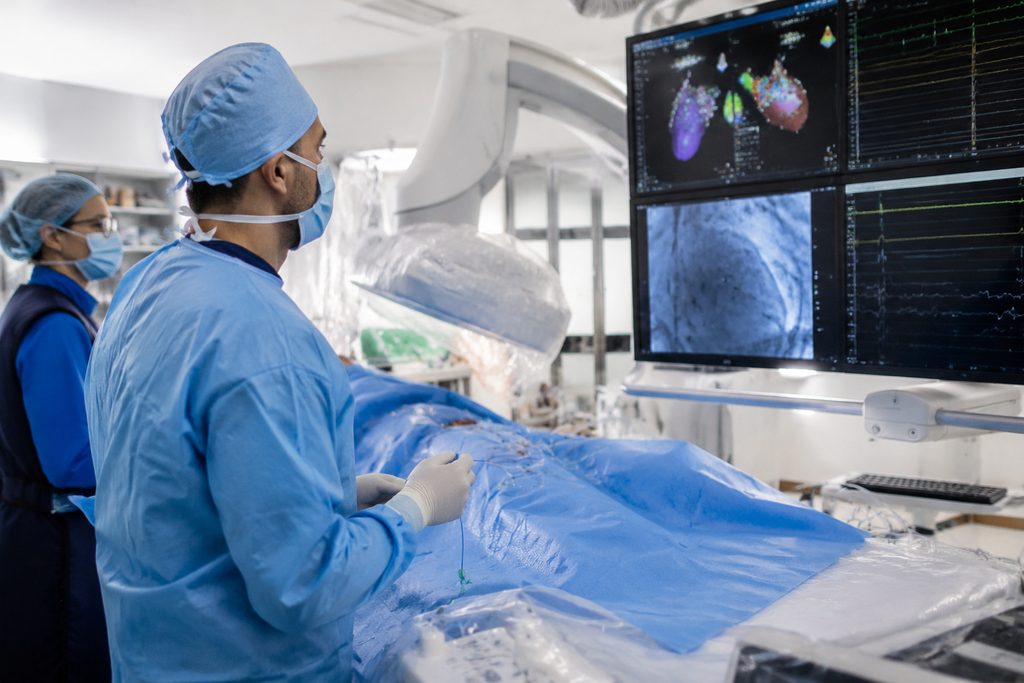
Chinese electrophysiology labs operate at a scale that is difficult to comprehend from a Western perspective. Fuwai Hospital in Beijing, the national cardiovascular center, performs over 14,000 cardiac surgeries annually and its arrhythmia center handles thousands of catheter ablations each year. Zhongshan Hospital in Shanghai, affiliated with Fudan University, runs one of the largest electrophysiology programs in Asia. When a single center performs more AFib ablations in a month than many Western hospitals do in a year, the procedural teams develop a rhythm — literally and figuratively — that translates into efficiency and safety.
This matters because AFib ablation is a technical skill. Pulmonary vein isolation requires precise catheter manipulation, real-time electroanatomic mapping, and rapid recognition of complications. The operator who has done 2,000 cases has seen anatomical variants and complications that a 200-case operator has only read about.
Technology Without the Wait
Top Chinese cardiac centers use the same equipment found in leading US and European hospitals: CARTO and EnSite 3D mapping systems, cryoballoon and radiofrequency catheters, intracardiac echocardiography. The difference is access. In Canada and the UK, patients wait 6–18 months for elective AFib ablation under public systems. In China’s top-tier public hospitals, once a patient completes the required in-person evaluation, scheduling typically happens within 2–4 weeks. For a patient whose AFib episodes are worsening, that wait time reduction has real clinical value.
Afib Ablation Cost China: The Structural Reason Prices Are Lower
The afib ablation cost China patients pay is lower not because the care is inferior, but because the cost structure is fundamentally different. Chinese public hospitals operate on high volume and thin margins. Physician salaries are a fraction of US equivalents. Hospital administrators are not negotiating with American insurance networks. The result: a catheter ablation that bills at $80,000–$120,000 in the US costs $15,000–$25,000 at a top Chinese public hospital. Even at the international VIP departments of Fuwai or Zhongshan, where English-speaking coordination is included, the total typically stays under $30,000.
| Procedure | United States (cash price) | United Kingdom (private) | China (top-tier public) |
|---|---|---|---|
| Catheter ablation for AFib | $80,000–$120,000 | $25,000–$40,000 | $15,000–$25,000 |
| Cryoballoon ablation | $70,000–$100,000 | $22,000–$35,000 | $14,000–$22,000 |
| Pre-procedure cardiac MRI + CT | $3,000–$5,000 | $1,500–$2,500 | $800–$1,500 |
| 3-day hospital stay (private room) | $8,000–$15,000 | $4,000–$7,000 | $1,500–$3,000 |
Prices vary by hospital and case complexity. These are reference ranges, not quotes.
Is Catheter Ablation Safe in China? What International Patients Should Verify
The honest answer to is catheter ablation safe in China is: yes, at the right centers, with the right preparation. The key is hospital selection. China has over 35,000 hospitals, but only a small fraction — roughly the top 5% — meet international standards for complex cardiac procedures. The Fudan University hospital rankings, published annually, identify the top 100 comprehensive hospitals and top 10 in each specialty. For cardiac arrhythmia work, patients should look at hospitals ranked among the top 10 for cardiology or cardiac surgery.
Safety also depends on communication. Chinese public hospitals serve enormous volumes — a single outpatient department may see 10,000 patients daily. Without Chinese language ability, navigating registration, payment, pre-procedure testing, and post-operative instructions is genuinely difficult. This is not a reason to avoid China; it is a reason to plan properly. International patients who use a structured pathway with bilingual coordination report far smoother experiences than those who attempt to self-navigate.
One more safety consideration: hospital infection control. Chinese top-tier hospitals have invested heavily in this area since 2020. Fuwai and Zhongshan both maintain rigorous protocols for cardiac catheterization labs, including dedicated teams for device reprocessing and antibiotic stewardship. Ask any hospital you consider about their catheterization lab infection rates and their major complication rate for AFib ablation. A reputable center will share these numbers.
Where to Go: Evaluating Hospitals for AFib Ablation in China
When patients search for the best hospital for atrial fibrillation ablation Shanghai, they are usually comparing a handful of institutions. Here is what actually differentiates them.
Shanghai has two standout options. Zhongshan Hospital, affiliated with Fudan University, is consistently ranked among China’s top 5 for cardiology and cardiac surgery. Its arrhythmia center performs several thousand ablations annually and has pioneered techniques for persistent AFib. Ruijin Hospital, affiliated with Shanghai Jiao Tong University, is another top-tier choice with a strong electrophysiology program and a well-established international patient department.
In Beijing, Fuwai Hospital is the reference center for cardiovascular medicine in China. Its annual cardiac surgery volume exceeds any other hospital globally. The arrhythmia team includes some of the most experienced operators in the world, and the hospital’s international department handles foreign patients routinely.
For patients who prefer a Western-style environment, private international hospitals like United Family Healthcare and Jiahui International Hospital in Shanghai offer English-speaking staff, JCI accreditation, and direct insurance billing. However, their AFib ablation volumes are lower than the major public centers, and prices run higher — typically $30,000–$45,000. The trade-off is comfort and language convenience versus raw procedural volume.
Our guide to China’s top-ranked hospitals breaks down the Fudan rankings by city and specialty, which is a useful starting point for shortlisting.
How International Patients Actually Book AFib Treatment in China
Here is the reality that surprises many Western patients: you cannot simply book a catheter ablation in China from abroad. Public hospitals require an in-person outpatient evaluation before scheduling any procedure. The doctor must see you, review your records, and confirm the diagnosis before the hospital will place you on the surgical schedule.
This is not a bureaucratic obstacle — it is a clinical safeguard. But it does mean the process for international patients is staged.
The typical pathway looks like this. First, you send your existing medical records — ECG, Holter monitor results, echocardiogram, any prior ablation reports, current medication list. A Chinese electrophysiologist reviews these and provides a written assessment: whether you are a candidate for ablation, what approach they would recommend, and what additional testing you would need.
Second, you travel to China for the in-person consultation. This is where the S2 visa applies — the short-stay visa used for medical treatment and private affairs. Your accompanying family member applies for the same S2 category. The hospital issues a medical invitation letter that supports the visa application. Processing typically takes 1–3 weeks depending on your home country’s Chinese embassy or consulate.
Third, if the in-person evaluation confirms the plan, the hospital schedules the ablation. At this point, most patients stay in China for 7–10 days: 1–2 days for pre-procedure testing, 1 day for the procedure, 2–3 days of inpatient monitoring, and 1–2 days for post-operative review before flying home.
Some patients ask about book afib treatment package China options. Packages do exist at private international hospitals, which bundle consultation, procedure, hospital stay, and sometimes accommodation. At public hospitals, the model is different — you pay for each component separately, and a coordination service can help manage the logistics without inflating the medical fees.
For a deeper look at the process, our patient coordination overview explains how international patients navigate the stages from remote evaluation to discharge.
Medication Alternatives Abroad: What Else Should You Consider?
Not every patient with AFib needs ablation. When searching afib medication alternatives abroad, patients are often asking a broader question: what are my options beyond the drugs I have already tried?
The honest answer includes several pathways. First, newer antiarrhythmic drugs — dronedarone, for example, has a better safety profile than amiodarone for some patients. Second, hybrid approaches: some centers offer a combination of surgical ablation (mini-maze) and catheter ablation for persistent AFib, which can improve success rates. Third, lifestyle interventions — weight loss, sleep apnea treatment, and alcohol reduction — have been shown in randomized trials to reduce AFib burden significantly. The LEGACY study found that sustained weight loss of 10% or more was associated with a six-fold greater likelihood of arrhythmia-free survival.
China offers access to all of these. The country’s TCM hospitals also provide adjunctive therapies — acupuncture for symptom management, herbal formulations for sleep and stress — that some patients find helpful alongside conventional treatment. Our guide to traditional Chinese medicine hospitals explains what is evidence-based and what is not.
But for patients with symptomatic paroxysmal AFib who have failed one antiarrhythmic drug, the evidence increasingly points to ablation as the next step rather than trying a second or third medication. The EARLY-AF trial’s first-line ablation results are shifting guidelines in this direction.
Practical Considerations: What You Need Before Traveling to China for Ablation
If you are seriously considering catheter ablation in China, prepare these items before you go. First, your medical records. You need a complete set: 12-lead ECG, 24–48 hour Holter monitor report, echocardiogram, any cardiac CT or MRI, prior ablation procedure notes if applicable, and a current medication list with dosages. Have these translated into Chinese if possible — a medical translation service or your coordination team can handle this.
Second, your visa. The S2 visa is the correct category for short-stay medical treatment in China. You will need a medical invitation letter from the hospital you plan to visit, plus your passport, application form, and proof of funds. Processing times vary by embassy; allow at least 2–4 weeks. Do not book flights until the visa is approved.
Third, payment. Chinese public hospitals require prepayment for procedures. Major credit cards are accepted at international departments, but wire transfer is often more reliable for large amounts. Private international hospitals may bill your insurance directly if you have a policy with a global network. Public hospitals generally do not do direct billing — you pay, then claim reimbursement from your insurer. Verify your policy’s coverage for overseas treatment before committing.
Fourth, language. Top-tier public hospitals have international departments with English-speaking staff, but the moment you step outside that department — into radiology, the pharmacy, or the billing office — Chinese becomes essential. A bilingual medical companion who handles registration, queue management, fee payment, and interpretation is not a luxury; it is the difference between a smooth experience and a frustrating one.
Fifth, follow-up. After you return home, you will need to send follow-up ECGs and Holter results back to the Chinese team at 3, 6, and 12 months. Most top centers offer remote follow-up via their international departments. Confirm this arrangement before you leave.
Frequently Asked Questions
Is ablation actually better than medication for AFib?
For many patients, yes. The CABANA and EARLY-AF trials show ablation achieves higher rates of freedom from AFib than antiarrhythmic drugs, especially for paroxysmal AFib.
For more medical information and treatment options in China, visit chinamedservices.com (China Medical Services).
