Is There Treatment for Spinal Cord Injury? China’s Advanced Options
Is There Treatment for Spinal Cord Injury? The Short Answer
Yes. Treatment exists, and it spans three connected phases: acute surgical stabilization, intensive neurorehabilitation, and emerging biological therapies. The spinal cord injury treatment cost China runs roughly $25,000 to $65,000 for surgery plus a 4-6 week inpatient rehab program. That compares to $180,000 to $450,000 for equivalent care in the United States.
But here is the caveat no honest provider will skip: spinal cord injury is not a single disease with a single fix. A complete ASIA-A injury at T4 responds very differently than an incomplete C5 injury. The right question is not “is there treatment” but “what treatment, at what stage, with what realistic goal.”
Who This Is Right For — and Who It Isn’t
China’s top rehabilitation hospitals and neurosurgery centers handle a high volume of spinal cord injuries. That volume matters. A surgeon who sees 400 traumatic SCI cases a year develops pattern recognition that no textbook can teach. But volume is not a magic wand.
Good candidates for traveling to China for SCI care typically fit this profile:
- Medically stable — at least 2-4 weeks post-injury, off ventilator unless the injury is high cervical and ventilation is permanent
- Past the acute inflammatory phase — the spinal cord swelling has peaked and begun to subside
- Have complete medical records including MRI, CT, and ASIA impairment scale scoring
- Realistic about goals — improved function, bladder control, trunk stability, or reduced spasticity, not necessarily walking
- Have a family member or companion who can travel with them
Who should not make this trip?
- Anyone with an active systemic infection, unhealed surgical wounds, or uncontrolled blood pressure
- Patients in the first 72 hours after injury — the acute window belongs at a local trauma center
- Anyone expecting a guaranteed cure. No center on earth offers that
- Patients with severe cognitive impairment from a concurrent traumatic brain injury
- Those whose insurance explicitly excludes overseas treatment and who cannot self-pay
Being honest about who should stay home is what makes the rest of this article worth reading.
The Options, Compared
Treatment for spinal cord injury splits into established care and investigational care. Established care includes decompression surgery, spinal fusion, and structured rehabilitation. Investigational care includes cell-based therapies, epidural stimulation, and brain-computer interface training. China has active programs in both categories.
| Option | Typical Cost in China | Typical Cost in USA | Who It Suits |
|---|---|---|---|
| Decompression & fusion surgery | $18,000 – $35,000 | $90,000 – $180,000 | Acute or subacute instability, cord compression |
| Inpatient rehab (4-6 weeks) | $8,000 – $20,000 | $60,000 – $150,000 | All patients post-stabilization |
| Stem cell or cell therapy (investigational) | $15,000 – $40,000 per course | $25,000 – $80,000 (clinical trial or offshore) | Chronic incomplete injuries, 6+ months post-injury |
| Epidural stimulation implant | $35,000 – $60,000 | $100,000 – $250,000 | Selected chronic complete injuries |
| Comprehensive package (surgery + rehab + follow-up) | $40,000 – $65,000 | $200,000 – $450,000 | International patients seeking bundled care |
Which column suits which reader? If you are within 6 weeks of injury and have cord compression, the surgical column applies. If you are 6 months post-injury with a stable plateau, the cell therapy and epidural stimulation columns become relevant. The package column suits someone who wants one coordinator handling surgery, rehab, and discharge planning.
What Actually Happens in a Chinese SCI Rehabilitation Program
This is the section that answers the unspoken question behind the search: what would my days actually look like?
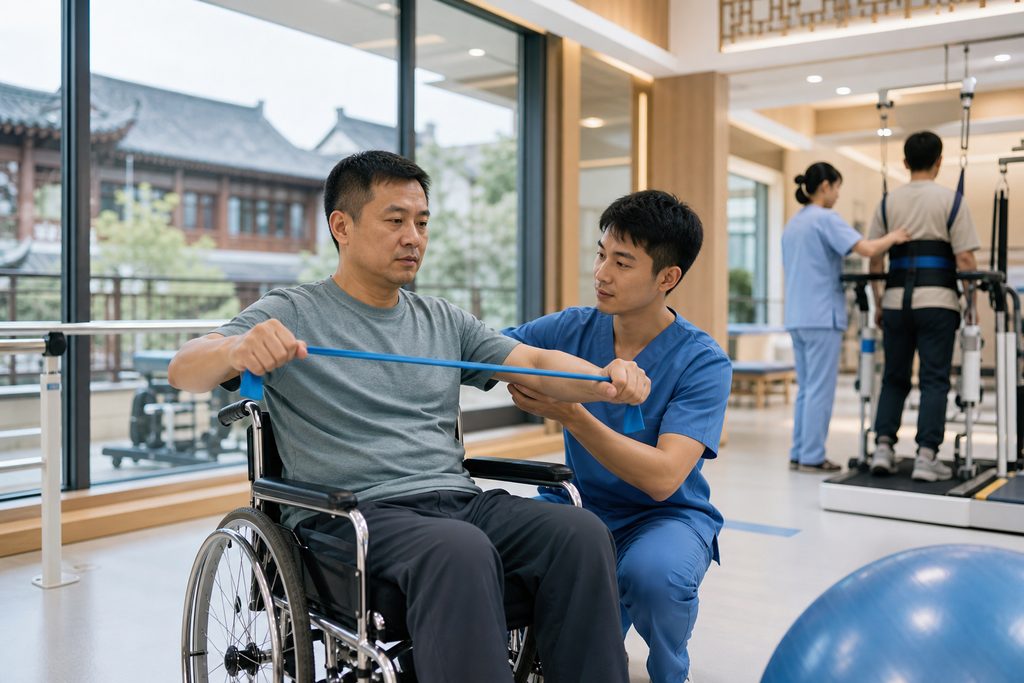
A typical inpatient program at a top rehabilitation center in Shanghai or Beijing runs 5-6 days per week, 4-6 hours of therapy daily. Mornings usually start with physical therapy — weight-bearing on a tilt table if trunk control is poor, transfer training, gait training with a robotic exoskeleton if there is any lower limb activation. Afternoons rotate through occupational therapy, functional electrical stimulation, and hydrotherapy where available. Traditional Chinese Medicine is often integrated — acupuncture for pain and spasticity, sometimes tuina massage for muscle tone management.
What surprises most international patients is the intensity. Chinese rehab culture pushes volume. Sessions are longer and more frequent than typical Western outpatient rehab. That intensity is part of why patients travel. But it is also exhausting. A good program builds in rest, and a good coordinator tells you that before you arrive.
The outcome data matters here. For incomplete injuries, structured intensive rehab in China reports functional improvement rates — measured as at least one ASIA grade improvement — in roughly 40-60% of patients depending on injury level and time since injury. Those numbers come from published cohort studies at major centers. They are real. They are also not guarantees.
How Much Does Spinal Cord Injury Surgery Cost Abroad — the Real Numbers
Let’s put hard figures on the table. The question “how much does spinal cord injury surgery cost abroad” has a wide answer, because “abroad” spans Mexico, Turkey, Germany, Thailand, and China. Here is what our team sees in current practice.
In China, a posterior spinal fusion for a thoracic burst fracture with cord compression runs $18,000 to $28,000 at a top public hospital’s international department. A more complex cervical corpectomy with anterior-posterior fixation runs $28,000 to $40,000. These prices include surgeon fees, anesthesia, implants, and a standard 7-10 day hospital stay. They do not include international airfare, visa fees, or a companion’s lodging.
Germany and Switzerland deliver excellent SCI surgery, but prices start around $70,000 for a straightforward fusion and climb quickly. Turkey sits between China and Europe — typically $30,000 to $50,000 for comparable surgery. Mexico is cheaper for some procedures but has fewer centers with high-volume SCI specialization and limited integrated rehab.
What drives the variance in China specifically? Hospital tier, implant brand (domestic versus imported titanium systems), surgeon seniority, and whether you go through the standard international department or a VIP green channel. The green channel adds 50-100% to the base price but buys faster scheduling and more direct access to senior specialists.
Stem Cell Therapy for Spinal Cord Injury Price China — Separating Evidence from Marketing
No topic in SCI care attracts more hope and more hype than stem cell therapy. The stem cell therapy for spinal cord injury price China typically ranges from $15,000 to $40,000 per course, depending on cell type, delivery method, and the institution’s regulatory status.
What is actually being offered? At legitimate academic centers, you will find three main approaches. Umbilical cord mesenchymal stem cells delivered intrathecally — that is, into the spinal fluid. Autologous bone marrow mononuclear cells, harvested from the patient’s own hip and injected into the injury site or spinal fluid. And, less commonly, neural progenitor cells under formal clinical trial protocols.
The evidence base is mixed. Some published Chinese trials report modest improvements in ASIA motor scores, bladder function, and spasticity — often in the range of 5-15 point motor score gains in incomplete injuries. Other studies show no statistically significant benefit over intensive rehab alone. What is clear: cell therapy works best in incomplete injuries treated 6-24 months post-injury. Complete injuries treated years later show the least response.
If a clinic promises walking after one injection, walk away. If a clinic publishes its protocols, requires a full pre-treatment assessment, and sets modest expectations, that is a different conversation.
Best Hospital for Spinal Cord Injury Shanghai — and Beyond
Shanghai hosts several of China’s strongest SCI programs. The question “best hospital for spinal cord injury Shanghai” deserves a nuanced answer, because “best” depends on your injury type and stage.
For acute surgical management, Shanghai Changzheng Hospital and Huashan Hospital are frequently cited by local physicians and appear on Fudan’s specialty reputation rankings for neurosurgery and orthopedics. Changzheng has a long-standing spinal surgery tradition with high annual case volumes. Huashan brings strength in peripheral nerve and spinal cord microsurgery. For rehabilitation, Shanghai Sunshine Rehabilitation Center and the rehab departments of Ruijin Hospital run structured SCI programs with integrated TCM.
Outside Shanghai, Beijing’s China Rehabilitation Research Center (CRRC) is arguably the country’s highest-volume SCI rehabilitation facility, with dedicated SCI wards and decades of outcome data. West China Hospital in Chengdu handles massive trauma volumes given Sichuan’s mountainous terrain. Our specialty hospital rankings break down neurosurgery and orthopedics programs by city, and our Shanghai city guide covers logistics for international patients.
One honest note: the “best” hospital for one patient may be a poor fit for another. A C5 incomplete injury needing aggressive upper limb retraining belongs at a rehab-heavy center. An L1 burst fracture needing a complex anterior reconstruction belongs at a surgical powerhouse. Matching the center to the injury, not the other way around, is the whole task.
Practical Considerations: Records, Visa, Payment, and Follow-Up
International SCI care has logistics that can sink the whole plan if ignored. Here are the ones that actually matter.
Medical records. Chinese specialists will not accept a one-page discharge summary. You need the full packet: hospital admission notes, operative reports, all MRI and CT images on CD or DICOM link, ASIA scale scoring, and current medication list. Have everything translated into English and, ideally, Mandarin. Our team handles document translation and formatting as part of case management.
Visa. For medical treatment in China, the applicable short-stay category is the S2 visa, annotated for medical purposes. Your companion applies for the same S2 category. The hospital’s international department issues an invitation letter and treatment confirmation that supports the application. Processing time varies by consulate — plan for 3-6 weeks. S1 applies for stays exceeding 180 days. There is no “medical visa” as such, and the M visa is for commercial trade, not treatment.
Payment. Chinese public hospitals require prepayment for scheduled surgery. International departments typically quote a package price and require a deposit before admission — often 50-80% of the estimated total. Credit cards are accepted at international departments but may carry surcharges. Wire transfer is standard for larger amounts. Private international hospitals like United Family or Jiahui offer direct insurance billing if your policy covers overseas care; public hospital international departments usually expect self-pay with reimbursement from your insurer afterward.
Language. Top-tier public hospitals have English-speaking staff in their international departments, but the moment you leave that bubble — radiology, pharmacy, the rehab gym — Mandarin dominates. A bilingual medical companion changes the daily experience from stressful to manageable. We provide this service, but we also tell patients plainly: without either strong Mandarin or a companion, a public hospital is hard.
Follow-up after returning home. Your Chinese team will give you a discharge summary, imaging, and a rehab protocol. The challenge is continuity. Your home physician may be unfamiliar with the specific surgical technique or cell therapy protocol used. We recommend scheduling a video consultation with your Chinese team 4-6 weeks after returning home, and again at 3 months. Written second opinions from the treating team run $300-500; video consultations $100-300 for standard international department follow-ups.
Frequently Asked Questions
Yes, for certain patients. A written second opinion based on your existing records costs $300-500 and takes 7-14 days. A video consultation with a specialist runs $100-300. These remote options answer the “what would China actually offer me” question before you commit to travel. For surgery and intensive rehab, however, expect at least 3-6 weeks in China — there is no shortcut around that.
Partially. You cannot book a specific surgeon’s operating slot from overseas through the standard public hospital system — that requires an in-person outpatient visit first. What you can arrange in advance is the international department pathway: records review, tentative treatment plan, admission scheduling, and a bundled quote. Our coordination service handles this pre-arrival work. If we cannot secure the appointment we promise, the coordination fee is refunded in full.
This is the question everyone should ask and few do. The honest answer: no SCI treatment guarantees improvement. The fallback is that intensive rehab itself builds function regardless of whether a surgical or cell therapy intervention adds to it. That is why we advise patients to frame the trip as “intensive rehabilitation plus surgical or biological intervention” rather than betting everything on one procedure. The rehab component has value even if the experimental component underperforms.
Some international policies do, most do not. Policies with worldwide coverage excluding the US sometimes cover approved Chinese hospitals, especially JCI-accredited private institutions. Public hospital international departments rarely have direct billing arrangements with foreign insurers. You pay upfront and claim reimbursement. Check your policy’s fine print on “experimental treatments” — many exclude stem cell therapy entirely. Get pre-authorization in writing before booking anything.
Your Next Step
The core message is simple: treatment for spinal cord injury exists, China offers it at a fraction of Western prices with high clinical volumes, and the right question is not “is there treatment” but “which specific treatment, at which center, for my specific injury.”
We are China Medical Services — a coordination team, not a hospital. We do not diagnose, we do not treat, and we never promise outcomes. What we do is handle the part that exhausts patients: records translation, hospital matching, appointment coordination, visa guidance, and bilingual companionship on the ground. If you want to understand whether a Chinese SCI program makes sense for your situation, start with a free consultation. Tell us your injury level, your current function, and your goals. We will tell you honestly whether this path is worth pursuing — and if it is not, we will say so plainly.
For more medical information and treatment options in China, visit chinamedservices.com (China Medical Services).
