ACL Recovery: A Realistic Timeline to Sports and Return to Play
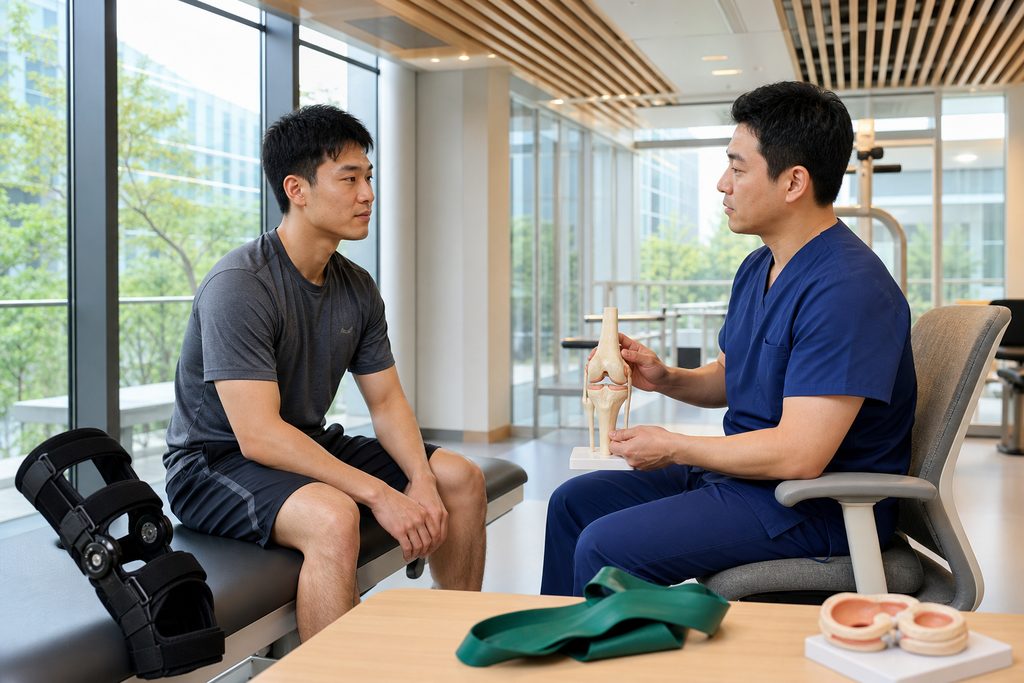
An anterior cruciate ligament tear is one of the most disruptive injuries an athlete can face. In plain terms, the ACL is a thick band of tissue running diagonally through the middle of your knee. It keeps your shinbone from sliding too far forward under your thighbone and provides rotational stability. When it snaps — usually from a sudden stop, pivot, or awkward landing — the knee can feel unstable, as if it might buckle. Surgery is not always mandatory. But for anyone who wants to return to cutting sports like soccer, basketball, or skiing, an ACL reconstruction is often the only realistic path back.
What does ACL reconstruction cost China actually look like for an international patient? The honest answer: significantly less than in the United States or Western Europe, but the price depends on graft choice, hospital tier, and whether you use a standard public pathway or an international VIP channel. At top-tier Chinese orthopedic centers, the procedure typically ranges from $6,000 to $15,000 for the hospital and surgeon component. That compares with $25,000 to $50,000 or more in the U.S. before insurance adjustments. The savings are real. But the bigger question most patients should ask is not about the bill — it is about the timeline. A well-executed reconstruction is only the first chapter of a nine-to-twelve-month story.
How This Actually Works, Step by Step
You have an MRI confirming a complete ACL tear. Maybe you tore it two weeks ago, maybe six months ago. The sequence from that moment to a return to sport follows a predictable arc, whether you have surgery in Chicago, London, or Shanghai.
First, you need a period of prehabilitation. The knee should be calm — minimal swelling, near-full extension, and a quadriceps that can fire properly. Most surgeons want you to spend two to six weeks on prehab before they will operate. Operating on a stiff, swollen knee leads to a harder recovery and a higher risk of arthrofibrosis, a condition where scar tissue locks the joint.
Second, you send your records for review. That means your MRI images, the radiology report, your surgical history, and ideally a short note from your current physiotherapist about your range of motion and strength. A written second opinion from a top Chinese orthopedic department runs $300 to $500. A video consultation with a specialist runs $500 to $800. You do not need to fly to China to find out whether surgery is indicated or what graft the surgeon would recommend.
Third, if you decide to proceed, the hospital confirms a surgical date. This is where China differs from many Western systems. In most Chinese public hospitals, you cannot book a surgery slot from overseas through the standard registration desk. You would need to appear in person for an outpatient visit first. For international patients, the practical route is the hospital’s international department or a coordinated VIP channel, which allows the surgical team to review your file and schedule a date before you travel. That coordination service typically costs from $300, and it is the difference between arriving with a plan and arriving with a hope.
Fourth, you fly. You will need an S2 visa, which is the short-stay category used for private affairs including medical treatment. Your hospital provides an invitation letter and treatment confirmation. Processing time varies by embassy, but plan for two to four weeks. Your companion or family member applies for the same S2 category.
Fifth, surgery happens. You stay in the hospital for two to five days. Then the long part begins.
ACL Recovery: A Realistic Timeline to Sports
No honest surgeon will promise you a return to full competition in under nine months. The biology of graft healing does not care how motivated you are. Whether the surgeon uses a hamstring autograft, a patellar tendon autograft, or an allograft, the new tissue goes through a phase called ligamentization — a process where the graft actually weakens before it strengthens. That weak phase peaks around months three to five. It is exactly the period when many athletes feel good enough to test the knee. And it is exactly when re-tears happen.
| Stage | Timeframe | What Actually Happens |
|---|---|---|
| Prehab | 2–6 weeks before surgery | Swelling control, full extension, quad activation. Surgery is booked only after the knee is calm. |
| Surgery and hospital stay | Day 0–5 | ACL reconstruction, usually arthroscopic. Discharge with crutches and a brace protocol. |
| Early protection | Weeks 1–4 | Weight-bearing as tolerated, passive range of motion, quad sets. No open-chain knee extension. |
| Gait normalization | Weeks 4–8 | Wean off crutches. Stationary bike. Straight-line walking with a normal pattern. |
| Strength phase | Months 2–4 | Closed-chain strengthening. Squats, leg press, single-leg work. Graft is at its weakest — no pivoting. |
| Running progression | Months 4–6 | Only after passing strength symmetry tests. Straight-line jogging, then tempo runs. |
| Agility and plyometrics | Months 6–8 | Cutting drills, lateral work, jump landing mechanics. Sport-specific movement patterns. |
| Return-to-sport testing | Months 9–12 | Isokinetic testing, hop tests, psychological readiness. Clearance only if limb symmetry is ≥90%. |
That table is the honest version. Any clinic that tells you a six-month return to competitive pivoting sports is either working with an elite athlete under daily supervision or selling you something. For the rest of us, nine to twelve months is the realistic window. Some patients need fourteen. The knee does not care about your tournament schedule.
What Can Go Wrong — and What Happens Then
The failure modes for ACL recovery are well documented. The most common is not a surgical error. It is a rehab error.
Re-tear of the graft or the opposite knee. Studies consistently report that young athletes returning to pivoting sports have a re-injury rate of 15 to 25 percent, with the contralateral ACL at nearly equal risk. The cause is almost always returning too early or skipping the final strength and biomechanics phase. If this happens, the path is a revision reconstruction — a more complex surgery with a longer recovery and a slightly lower success rate.
Arthrofibrosis. Scar tissue forms inside the joint, limiting extension. You lose the ability to fully straighten the leg. This is often preventable with early range-of-motion work. If it develops, treatment ranges from aggressive physiotherapy to a manipulation under anesthesia or arthroscopic scar tissue removal.
Infection. Rare — under 1 percent in most large series — but serious. It requires washout surgery and intravenous antibiotics. Top Chinese orthopedic departments publish infection rates in line with international benchmarks, but no hospital on earth can promise zero.
Persistent quadriceps weakness. Some patients never fully restore quad strength symmetry. That leads to altered landing mechanics and chronic knee pain. The fix is months of targeted loading, not more surgery.
How to Evaluate a Hospital for Best ACL Surgery Hospitals Shanghai
Shanghai is home to several of China’s strongest orthopedic departments. When international patients ask about the best ACL surgery hospitals Shanghai has to offer, the answer depends on what they mean by “best.”
Some patients want the highest surgical volume and the most experienced sports medicine teams. Those are typically the large public teaching hospitals with dedicated sports medicine divisions. They perform hundreds of ACL reconstructions annually. Their surgeons see the full spectrum — from teenage footballers to middle-aged skiers. The trade-off is that these hospitals run on high patient volume. The standard outpatient experience can be overwhelming without Chinese language skills. That is where a bilingual medical companion becomes essential, not optional.
Other patients want a Western-style experience with English-speaking staff and direct insurance billing. For them, Shanghai’s private international hospitals — such as Jiahui or United Family — offer ACL reconstruction with imported implants and a more familiar care model. The cost runs higher, sometimes two to three times the public hospital price, but still below typical U.S. rates.
The right question is not “which hospital is number one.” It is “which hospital’s surgical volume and aftercare model fits my situation.” A surgeon who does 300 ACLs a year but provides minimal post-operative guidance is a worse choice than one who does 150 with a structured return-to-sport program. Ask about the rehabilitation pathway, not just the operation.
Practical Considerations: Records, Visa, Payment, and Follow-Up
Before you book anything, gather your records. You will need the original MRI, ideally in DICOM format, not just printed films. You will need the radiology report. You will need a summary of any prior knee surgeries, your current range of motion, and your activity goals. Sending incomplete records to a hospital in China means delays and repeated emails. Our team handles this translation and organization as part of the coordination service.
Visa timing is the step people forget. The S2 visa process requires an invitation letter from the hospital, which you can only get after a physician has reviewed your file and agreed to take your case. That review takes time. Then the embassy takes more time. If you want surgery in month three, start the record review in month one.
Payment works differently than in many Western systems. Chinese public hospitals generally require pre-payment for the estimated surgical cost before admission. International insurance is often reimbursed after the fact, not billed directly. Private international hospitals in China are more likely to offer direct billing with major insurers. Confirm this before you commit.
Language is the friction point most patients underestimate. A top Shanghai orthopedic hospital may see 10,000 outpatient visits per day across all departments. The registration desk, the imaging center, the pharmacy — none of these run in English by default. A bilingual companion who knows the hospital’s physical layout and administrative flow can save you hours of standing in the wrong queue. The service costs from $300 per day, and for most international patients it is the single highest-value line item in the entire trip.
Follow-up at home is non-negotiable. The surgeon in China will give you a detailed rehab protocol. Your local physiotherapist needs to follow it. If there is a conflict between what the surgeon says and what your local physio wants to do, the surgeon’s protocol wins — at least for the first six months. Video follow-up with the Chinese team is available, and most will review your progress at months three, six, and nine.
Frequently Asked Questions
For a return to pivoting sports — soccer, basketball, tennis, skiing — the realistic window is nine to twelve months after surgery. Some patients are cleared at eight months if they pass every strength and biomechanics test. Many are not cleared until twelve or fourteen. Returning before nine months carries a measurably higher re-tear risk.
Yes, but the surgery location is less important than the rehab location. The graft heals the same way whether it was placed in Shanghai or Seattle. What matters is whether you have access to a physiotherapist who follows a structured, criteria-based protocol for at least nine months. If you travel for surgery, have a rehab plan at home before you leave.
The surgical fee is one line item. You will also pay for pre-operative imaging, anesthesia, hospital bed days, the graft fixation implants, post-operative medications, and possibly a brace. Then there are the non-medical costs: flights, visa fees, accommodation, and a bilingual companion if you use one. A full package, including coordination and a two-week stay, typically falls between $10,000 and $20,000 depending on hospital tier.
The surgery itself, at a top-ranked Chinese orthopedic center, is performed to international standards. Chinese sports medicine surgeons operate at high volume and use the same arthroscopic techniques and implants as their Western counterparts. The risk is not the surgery. The risk is poor planning — arriving without proper records, choosing a hospital that cannot communicate with you, or leaving without a rehab plan. A well-structured package handles those risks. A cheap package ignores them.
Modern protocols are criteria-based, not time-based. You advance to the next phase only when you pass objective tests: full knee extension, no effusion, quad strength symmetry of at least 80 percent for running and 90 percent for sport clearance, and passing scores on hop tests. Time is a minimum threshold, not a trigger. A patient at month ten who fails the strength test is not cleared, no matter what the calendar says.
Your Next Step
ACL reconstruction is a well-understood operation with a predictable recovery arc. The operation takes an hour. The return to sport takes a year. If you are considering surgery in China, the value is not just the lower cost — it is access to high-volume sports medicine surgeons and a coordinated pathway that removes the administrative chaos. Our team at China Medical Services handles record translation, hospital matching, visa guidance, and on-the-ground bilingual support. We do not perform surgery, and we do not promise outcomes. What we do is make sure you arrive prepared, understand every step, and leave with a rehab plan you can actually follow. If you want to explore whether a top Chinese orthopedic department is the right fit for your knee, start with a free consultation. We will review your situation and tell you honestly whether this path makes sense.
The knee will heal on its own schedule. Your job is to plan around that schedule, not fight it.
For more medical information and treatment options in China, visit chinamedservices.com (China Medical Services).
