Foot Surgery Recovery: A Day-by-Day Guide to Walking Again
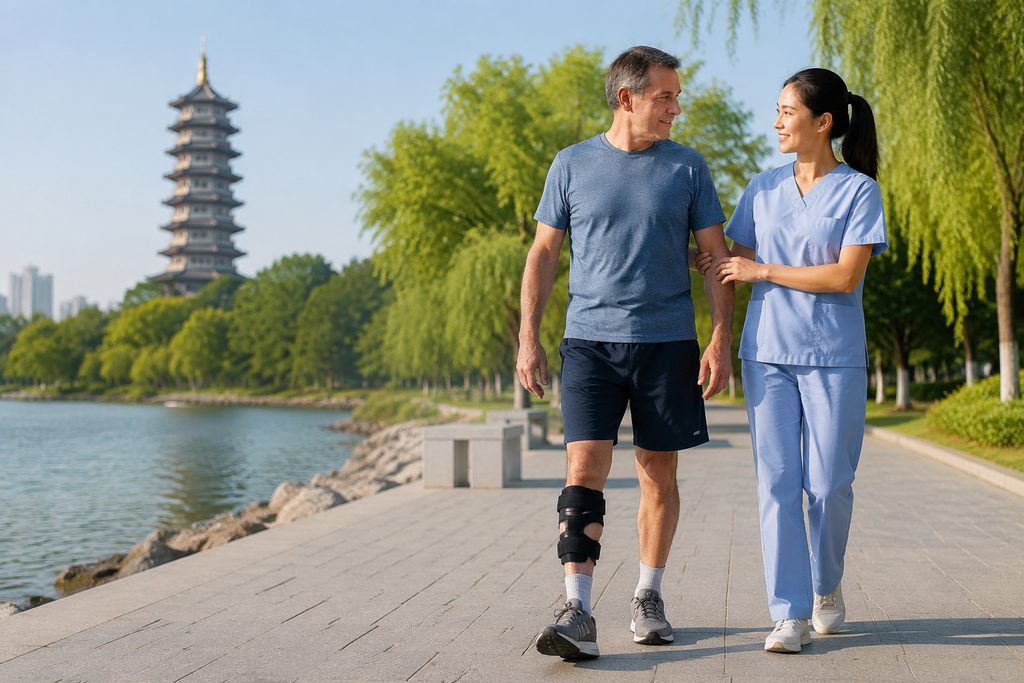
While patients in Canada wait a median 28.6 weeks for orthopedic surgery, surgeons at Beijing Jishuitan Hospital routinely perform over 300 joint replacements per month — with clinical outcomes that match or exceed Western benchmarks. That contrast matters when you are lying in bed staring at a swollen foot, wondering if you made the right call. Recovery is not a single event. It is a sequence of small, measurable wins.
So let us answer the question you actually typed. Foot surgery recovery time by day varies by procedure, but for a typical bunionectomy or metatarsal osteotomy, you are looking at roughly 6 weeks to walk in a normal shoe, 3 months to resume most activities, and up to 12 months for full soft-tissue remodeling. A simple hammertoe correction heals faster. A triple arthrodesis takes far longer. The day-by-day breakdown below assumes a moderate outpatient procedure — not a complex reconstruction.
Foot Surgery Recovery Time by Day: The Short Answer
Here is the honest version: the first 72 hours hurt more than most surgeons admit. You will be non-weight-bearing or heel-weight-bearing. Swelling peaks around day 3. By day 14, sutures typically come out. By week 6, bone healing is usually sufficient for a stiff-soled shoe. That timeline holds for most forefoot procedures. Rearfoot and ankle work doubles it.
The complication is that “healed” and “functional” are different things. Bone may unite at 6 weeks, but the surrounding tendons, ligaments, and nerves take months to adapt. You will feel twinges, numbness, and stiffness long after the X-ray looks clean. That is normal. It is also why so many patients underestimate the recovery before surgery and overestimate their progress during it.
Who This Is Right For — and Who It Isn’t
Foot surgery is not a lifestyle choice. It is a mechanical repair. The right candidate has exhausted conservative options and still cannot walk without significant pain.
Typically a good candidate:
- Has a structural deformity confirmed by weight-bearing X-ray — hallux valgus, rigid hammertoe, accessory navicular, etc.
- Has failed 6+ months of orthotics, physical therapy, and activity modification
- Is non-smoker or willing to quit 6 weeks before and after surgery (smoking doubles nonunion risk)
- Has realistic expectations about downtime and rehabilitation
- Has adequate circulatory health — no untreated peripheral artery disease
Who should not rush into this:
- Patients with active infection, poorly controlled diabetes (HbA1c above 8%), or severe neuropathy
- Those who cannot comply with non-weight-bearing restrictions for 2–6 weeks
- Anyone seeking cosmetic foot reshaping without functional pain — the risk-benefit math does not work
- Patients with unrealistic hopes of returning to high-impact sport within 2 months
The Options, Compared
Not every foot problem needs an operation. And not every operation needs to happen in your home country. Here is the landscape, laid out plainly.
| Option | Typical Recovery to Walking | Cost Range (USD) | Best For |
|---|---|---|---|
| Conservative care (orthotics, PT) | No downtime | $200–$1,500/year | Mild-to-moderate deformity, first-line treatment |
| Minimally invasive bunionectomy (MIS) | 2–4 weeks in surgical shoe | $8,000–$18,000 (US); $3,000–$6,000 (China) | Mild-to-moderate hallux valgus, active patients |
| Open osteotomy with fixation | 6–8 weeks protected weight-bearing | $12,000–$25,000 (US); $4,000–$8,000 (China) | Moderate-to-severe deformity, revision cases |
| Joint fusion (arthrodesis) | 10–12 weeks non-weight-bearing | $15,000–$30,000 (US); $5,000–$10,000 (China) | End-stage arthritis, failed previous surgery |
MIS techniques sound appealing — smaller scars, faster early recovery. But they are not right for every deformity. Severe bunions with significant rotational components often need open surgery for adequate correction. The right column depends on your X-ray, not your preference.
And the cost column deserves attention. Foot surgery cost China runs roughly one-third to one-half of US private-pay rates, even at top-tier public hospitals with international departments. That includes surgeon fees, hospital stay, and basic rehabilitation. It does not include flights or lodging. For patients facing high deductibles or no insurance, that math changes the conversation.
Day-by-Day Recovery: What Actually Happens
Here is the granular timeline you came for. This assumes a moderate forefoot procedure — bunionectomy, hammertoe correction, or neuroma excision. Rearfoot and ankle surgeries shift everything by 2–4 weeks.
Day 0–1: The First 24 Hours
Nerve block from surgery wears off around hour 12–18. Take your first pain medication before that happens — do not wait for the pain to arrive. Elevation above heart level is non-negotiable: 23 hours a day for the first 3 days. Ice behind the knee, not directly on the cast or bandage. Expect numbness, tingling, and a foot that feels like it belongs to someone else.
Day 2–3: Peak Swelling
This is the hardest stretch. Swelling peaks. Pain peaks. Sleep is fragmented. You will question why you did this. That is a normal emotional response to surgery, not a sign something went wrong. Keep the foot elevated. Wiggle your toes if the dressing allows. Do ankle pumps with the non-operated leg to prevent blood clots.
Patients often ask, can I walk after bunion surgery day 3? The blunt answer: no, not in any meaningful sense. You may be allowed to hobble to the bathroom with crutches or a knee scooter, heel-touching only. Walking normally on day 3 is not a goal — it is a risk. Putting weight on an unstable osteotomy before bone healing starts can shift the fixation and ruin the correction.
Day 4–7: The Turning Point
Swelling starts to subside. Pain becomes more of a dull ache than a sharp throb. You will sleep better. If you had a drain, it comes out around day 2–3. Your surgeon may allow you to shower with a waterproof cover. This is when patients start feeling human again — and when they most often overdo it. Resist the urge to test the foot.
Week 2: Sutures Out
Most surgeons remove sutures between day 10 and 14. The incision should be dry and closed. You may transition from a bulky surgical dressing to a lighter bandage or compression sock. Swelling is still present, especially at the end of the day. Continue elevation whenever sitting.
Week 3–4: Protected Weight-Bearing
Depending on your procedure and surgeon’s protocol, you may begin partial weight-bearing in a stiff-soled surgical shoe or walking boot. Physical therapy often starts now — gentle range-of-motion exercises, scar massage, and gait training. The foot will look thinner but still swollen. Bruising may persist for weeks.
Week 6: The Bone Check
Follow-up X-rays assess bone healing. If the osteotomy site shows adequate callus formation, you can usually transition to a supportive athletic shoe. Walking is still slow and deliberate. Swelling after activity is normal and may continue for 3–6 months. This is the milestone most patients mark as “recovered,” but it is really just the beginning of functional recovery.
Week 12: Most Activities Resume
You can walk moderate distances, drive (if it was your left foot and you have adequate reaction time), and return to low-impact exercise like swimming or cycling. High-impact activity — running, jumping, court sports — typically waits until month 4–6. Stiffness in the morning is common. It fades as the foot warms up.
Month 6–12: The Long Tail
Full soft-tissue remodeling takes a year. Nerves regenerate at roughly 1mm per day, so numbness along the incision can linger for months. Some patients report intermittent swelling for up to a year, especially after long days on their feet. This is not failure. It is biology.
How Long Does Foot Surgery Take to Heal: The Variables
So how long does foot surgery take to heal? The honest answer is 6 weeks for bone, 3 months for function, 12 months for full adaptation. But those numbers shift based on several factors you partially control.
Age matters, but less than you think. A 65-year-old non-smoker heals faster than a 45-year-old smoker. Nutrition matters — protein intake of 1.2–1.5g per kg of body weight supports bone and soft-tissue repair. Vitamin D deficiency delays bone healing measurably. And compliance with weight-bearing restrictions is the single biggest predictor of uncomplicated recovery. Patients who walk too early have higher rates of nonunion, hardware failure, and revision surgery.
The procedure itself is the other wildcard. A simple neuroma excision may have you walking in a surgical shoe within days. A Lapidus fusion — where the first metatarsal is fused to the medial cuneiform — requires 6–8 weeks of strict non-weight-bearing. Your surgeon’s protocol matters too. Some use early weight-bearing protocols with rigid fixation; others are conservative. Ask before surgery, not after.
Practical Considerations: Planning for Foot Surgery in China
If you are weighing treatment at a top-ranked Chinese hospital, a few logistics deserve attention before you book a flight.
First, documentation. Bring weight-bearing X-rays, any MRI or CT, and a summary of prior conservative treatments. Chinese orthopedic surgeons will want to see the full picture before recommending surgery. Written second opinions from a top foot and ankle department cost $300–500 and can clarify whether surgery is even indicated before you travel.
Second, visa. Foreign patients coming to China for medical treatment apply for an S2 visa, which covers short-term private affairs including medical care. Your hospital’s international department can provide the invitation letter and supporting documents. We help coordinate this — the process is straightforward but requires hospital paperwork that cannot be improvised.
Third, payment. Public hospitals in China require prepayment or staged deposits. International departments at hospitals like Huashan Hospital or Shanghai Sixth People’s Hospital accept foreign payment methods but generally do not direct-bill Western insurers. You pay, then claim reimbursement. Private international hospitals like United Family or Jiahui often bill insurers directly, but their surgical fees run higher — closer to Western private rates.
Fourth, language. Top-tier public hospitals see thousands of patients daily. The surgical team may speak some English, but the registration desk, pharmacy, and imaging departments likely will not. A bilingual medical companion — from $300 per day — handles queueing, payment, translation, and navigation. It is not a luxury; it is the difference between a smooth process and a stressful one.
Finally, follow-up. Most foot surgeries require X-ray checks at 2 weeks, 6 weeks, and 12 weeks. If you return home before the 12-week mark, your local orthopedic surgeon can handle follow-up imaging. But the operating surgeon should see the 6-week films at minimum. Video consultation for follow-up is an option — $100–300 for a standard international department consult.
Frequently Asked Questions
No. At day 3, you are non-weight-bearing or heel-touch weight-bearing only. Walking normally this early risks shifting the osteotomy and compromising the correction. Most patients use crutches or a knee scooter for the first 2 weeks, then transition to a surgical shoe with partial weight-bearing around week 3–4.
Bone healing is typically adequate by 6 weeks, but “complete” healing — including soft-tissue adaptation, nerve regeneration, and resolution of intermittent swelling — takes 6 to 12 months. You will feel mostly normal by month 3, but residual stiffness and occasional swelling can persist for a year.
Foot surgery cost China at a top-tier public hospital’s international department typically runs $3,000–$8,000 for a bunionectomy or hammertoe correction, compared to $12,000–$25,000 for a comparable US procedure. Complex reconstructions or fusions range $5,000–$10,000 in China. These figures vary by hospital, surgeon seniority, and case complexity — and exclude travel and lodging.
Wait at least 7–10 days after surgery before flying, and longer if you had significant bone work. The risk of deep vein thrombosis is elevated after lower-extremity surgery, and cabin pressure changes can worsen swelling. Your surgeon should clear you for flight. Compression stockings, aisle seats, and frequent ankle pumps reduce risk.
Revision rates for foot surgery vary by procedure but run roughly 5–15% for bunionectomies. Failure modes include nonunion, malunion, hardware irritation, and nerve entrapment. If you have persistent pain beyond 6 months or new mechanical symptoms, get a second opinion — ideally from a surgeon who did not perform the original operation. Revision surgery is more complex and carries higher risk than primary surgery.
Your Next Step
Recovery from foot surgery is predictable but demanding. The first 72 hours are hard. The first 6 weeks require discipline. The first year requires patience. None of it is mysterious — but all of it is easier when you know what is coming and have the right support around you.
We are China Medical Services, and we help international patients navigate treatment at top-ranked Chinese hospitals. We are not a hospital and we do not provide medical advice. What we do is handle the logistics — hospital matching, appointment coordination, bilingual companions, visa guidance — so you can focus on healing. If you are considering foot surgery and want to understand your options in China, start with a free consultation. No pressure. Just a conversation about whether this path makes sense for you.
For more medical information and treatment options in China, visit chinamedservices.com (China Medical Services).
