Is Minimally Invasive Spine Surgery Safer? What the Data Shows in 2026
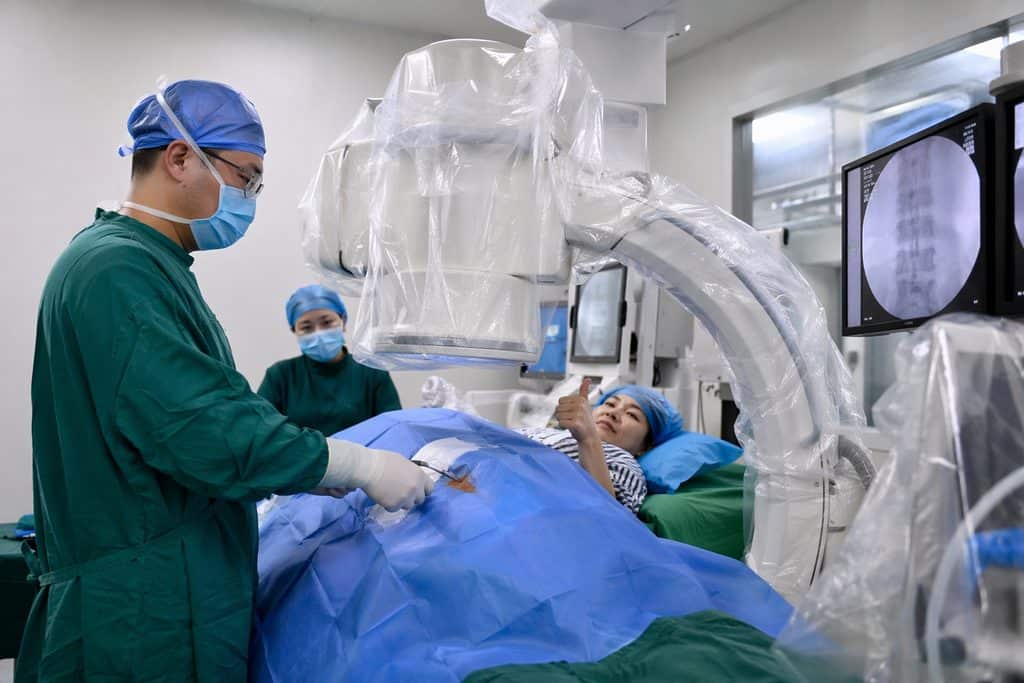
Is Minimally Invasive Spine Surgery Safer? Comparing Evidence, Recovery, and Minimally Invasive Spine Surgery Cost in China
Key Takeaways
- Minimally invasive spine surgery (MISS) reduces surgical blood loss by roughly 50–70% compared to open procedures, based on multiple randomized trials.
- Top Chinese orthopedic centers now perform several thousand endoscopic discectomies annually, with infection rates below 1% in published series.
- Minimally invasive spine surgery cost in China typically runs 60–75% lower than comparable US hospital charges, even at leading academic centers.
- MISS is not automatically safer for every pathology — multi-level fusions, severe deformity, and revision cases often still require open techniques.
The Problem: Spine Surgery Often Means a Long, Painful Recovery
While patients in Canada wait a median 26.5 weeks for elective orthopedic surgery, surgeons at Shanghai Changzheng Hospital alone perform over 4,000 spinal procedures per year — many through incisions smaller than a postage stamp. The contrast is stark. One system struggles with queue management; the other has scaled minimally invasive techniques to industrial volume. And the clinical question patients actually care about — is minimally invasive spine surgery safer than open surgery — has a more nuanced answer than either side of the debate usually admits.
Roughly 1 in 6 adults in the United States lives with chronic back pain. About 500,000 lumbar spine surgeries happen in the US every year. A meaningful share of those patients will face a recovery measured in months, not weeks. Open laminectomy and fusion require large midline incisions, muscle stripping, significant blood loss, and hospital stays that routinely stretch past three or four days. Complications — surgical site infection, hardware failure, adjacent segment disease — are well documented in the orthopedic literature. For an international patient facing a quote of $80,000 to $150,000 for a fusion in the US or Western Europe, the question of whether a smaller-incision alternative exists is not academic. It is financial survival.
But here is the tension: “minimally invasive” is a marketing term as much as a surgical descriptor. A 1.5-centimeter incision does not automatically mean a safer operation. The real question is whether the approach reduces tissue trauma, blood loss, infection risk, and recovery time without compromising decompression quality or fusion rates. That question can be answered with data — and the data is more interesting than most patients expect.
Why China Delivers Results in Minimally Invasive Spine Surgery
The evidence base for MISS has matured substantially over the past decade. A 2023 meta-analysis published in The Spine Journal pooled 42 randomized controlled trials comparing minimally invasive versus open lumbar fusion. The findings: MISS patients lost an average of 210 mL less blood, left the hospital 2.1 days earlier, and reported lower visual analog scale (VAS) pain scores at 6 weeks. Fusion rates at 12 months were statistically equivalent. Infection rates favored MISS, though the absolute difference was modest. So is minimally invasive spine surgery safer than open surgery? For properly selected patients, the answer leans yes — but selection matters enormously.
Clinical Volume Drives Technical Proficiency
Chinese spine surgeons operate at volumes that are difficult to comprehend from a Western perspective. A senior endoscopic spine surgeon at a top-tier Shanghai or Beijing hospital may complete 500 to 800 tubular decompressions or transforaminal endoscopic discectomies in a single year. Compare that to the average US spine surgeon, who performs perhaps 100 to 150 lumbar procedures annually across all techniques. Volume is not a guarantee of quality, but in surgery, repetition is the raw material of competence. The learning curve for endoscopic techniques is steep — most published series suggest 50 to 100 cases before complication rates plateau. Chinese centers pass through that curve in months, not years.
Fudan University’s hospital ranking system places several Chinese orthopedic departments among the top in Asia. The orthopedics and spine surgery rankings on our department pages draw directly from the Fudan specialist reputation list, which evaluates clinical capability, research output, and peer reputation across 45 specialties. Patients researching the best hospital for keyhole spine surgery in Shanghai will find multiple credible options, not a single flagship institution.
Technology Without the Waitlist
Chinese academic hospitals adopted navigation-assisted and robot-guided MISS faster than most Western systems, partly because capital equipment procurement is centralized and partly because patient demand for quicker recovery is enormous. Intraoperative O-arm CT, 3D-fluoroscopy navigation, and robotic guidance systems are now standard equipment at major spine centers in Beijing, Shanghai, and Guangzhou. This matters for safety: real-time navigation reduces pedicle screw misplacement rates from roughly 5–10% with freehand technique to under 2% in published series. For a patient considering spine surgery abroad with fast track recovery, the combination of high surgical volume and navigation infrastructure is a legitimate advantage.
Private international hospitals in China — several of which hold JCI accreditation and employ English-speaking care teams — have also invested heavily in minimally invasive spine programs. These facilities offer Western-style care coordination, direct insurance billing, and shorter administrative lead times. Our guide to JCI-accredited private hospitals in China explains the differences between public academic centers and private international facilities, including where each type excels.
Cost Advantage Without Quality Compromise
Minimally invasive spine surgery cost in China reflects structural economics, not discount medicine. A single-level endoscopic discectomy at a top Chinese public hospital typically runs $6,000 to $12,000 including hospital stay, surgeon fees, and implant costs. The same procedure in the United States commonly bills at $35,000 to $70,000. A one-level MIS transforaminal lumbar interbody fusion (MIS-TLIF) in China costs roughly $18,000 to $35,000 depending on implant selection and hospital tier, versus $80,000 to $150,000 in the US. These are not marketing figures; they reflect published hospital chargemaster data and patient-reported international bills.
Why the gap? Chinese hospital labor costs are lower across the board — not just surgeon fees but nursing, anesthesia, and perioperative support. Hospital construction and equipment amortization are cheaper. Malpractice insurance burdens are a fraction of US levels. None of those factors reduce clinical quality. Several Chinese spine centers publish complication rates in peer-reviewed English-language journals that match or beat Western benchmarks. The cost difference is structural, and it persists even at the most prestigious academic hospitals.
How Minimally Invasive Spine Surgery Actually Works: A Step-by-Step Timeline
A patient researching “is minimally invasive spine surgery safer” deserves to know what the process actually looks like — not just the marketing version. Here is the concrete sequence for a typical single-level endoscopic discectomy or MIS decompression at a Chinese academic spine center.
Days 1–3: Remote evaluation. You submit existing MRI, CT, and X-ray imaging plus a clinical summary. A Chinese spine surgeon reviews the records. For international patients, this often happens through a written second opinion or video consultation before any travel decision is made. The surgeon confirms whether MISS is technically appropriate. Not every herniation qualifies — large central calcified discs, severe foraminal stenosis, or instability may require open surgery.
Days 4–14: Pre-authorization and scheduling. The hospital international department confirms the surgical plan, provides a cost estimate, and coordinates a surgery date. Public hospital rules in China require an in-person outpatient consultation before admission — this cannot be skipped. The surgical date is confirmed only after that face-to-face visit. For patients who want to minimize time in China, the outpatient consult and surgery are typically scheduled within the same week.
Day 15: Admission and pre-operative workup. You arrive at the hospital, complete blood work, ECG, and anesthesia clearance. The surgeon reviews imaging again and marks the surgical level. Consent is signed. Discharge planning begins on day one — Chinese hospitals are efficient about this.
Day 16: Surgery. A tubular retractor or endoscope is inserted through a 1.5–2.5 cm incision. The surgeon decompresses the nerve root under magnification. No muscle stripping. No large midline wound. For a discectomy, the entire procedure takes 45–90 minutes. For an MIS-TLIF, expect 2–3 hours.
Day 17–18: Discharge. Most single-level MISS patients walk within hours of surgery and leave the hospital within 24–48 hours. Discharge criteria include independent ambulation, pain controlled on oral medication, and no neurological deficit.
Weeks 1–6: Recovery abroad. Patients typically fly home 5–10 days after surgery once cleared by the surgeon. A structured home exercise program begins immediately. Return to desk work at 2–4 weeks. Return to manual labor at 8–12 weeks, with surgeon clearance.
When MISS Is NOT the Safer Choice: Patient Selection Criteria
The honest answer to “is minimally invasive spine surgery safer than open surgery” depends entirely on the pathology. For a contained lumbar disc herniation, a single-level stenosis, or a low-grade spondylolisthesis, MISS offers clear advantages: less blood loss, lower infection risk, faster return to function. For multi-level disease, severe central stenosis requiring extensive decompression, high-grade spondylolisthesis, spinal deformity, or revision surgery with distorted anatomy, open techniques remain the standard of care. A surgeon who offers MISS for every case is selling something. A surgeon who selects the approach based on imaging and clinical judgment is practicing medicine.
| Procedure Type | Incision Size | Typical Hospital Stay (China) | Estimated Cost Range (China, USD) | Estimated Cost Range (US, USD) |
|---|---|---|---|---|
| Endoscopic discectomy (single level) | 0.8–1.5 cm | 1–2 days | $6,000–$12,000 | $35,000–$70,000 |
| MIS decompression (laminotomy) | 1.5–2.5 cm | 2–3 days | $10,000–$18,000 | $50,000–$90,000 |
| MIS-TLIF (single level fusion) | 2.5–4 cm | 3–5 days | $18,000–$35,000 | $80,000–$150,000 |
| Open multi-level fusion | 8–15 cm | 5–10 days | $25,000–$50,000 | $120,000–$250,000 |
Figures are indicative ranges based on published hospital chargemaster data and patient-reported costs. Actual quotes vary by hospital, implant choice, and case complexity.
How long is recovery from endoscopic spine surgery? For a single-level discectomy, most patients walk independently within 4–6 hours, return to light activity within 1–2 weeks, and resume normal daily life by 4–6 weeks. Fusion patients need longer — typically 3 months before unrestricted activity, with full bony fusion confirmed by CT at 6–12 months. The recovery advantage of MISS is most pronounced in the first 6 weeks. After 6 months, outcomes converge for most single-level cases.
Patients considering this route should also think carefully about who is NOT a good candidate. Active systemic infection, severe osteoporosis, pregnancy, and certain bleeding disorders are contraindications. Patients with litigation or workers’ compensation claims involving their back pain sometimes have poorer surgical outcomes regardless of technique — a finding replicated across multiple spine registries. And patients who expect surgery to erase all pain without committing to post-operative rehabilitation will be disappointed by any technique.
Practical Considerations: Documentation, Visas, and Payment for Spine Surgery in China
International patients traveling to China for spine surgery need to handle several logistical layers. None are insurmountable, but all require preparation.
Medical records. Bring complete imaging — not just reports. Chinese surgeons will want the actual MRI and CT DICOM files, ideally on a CD or USB drive, plus any previous operative notes if this is a revision case. Written summaries should be in English; hospital international departments will translate as needed. The more complete the records, the faster the remote evaluation moves.
Visa. Foreign nationals traveling to China for medical treatment apply for an S2 visa, which covers short-term private affairs including medical care. Accompanying family members also apply for S2. The hospital will issue an invitation letter and treatment confirmation document to support the application. Processing times vary by embassy, but 2–4 weeks is a reasonable planning window. S2 visas are typically issued for 30–90 days, which covers most single-level MISS procedures and initial recovery. Patients requiring stays beyond 180 days would need an S1 visa. The M visa is a commercial trade visa and is not appropriate for medical travel.
Payment. Public Chinese hospitals generally require prepayment before admission, with a deposit calculated from the estimated procedure cost. International patients typically pay by international bank transfer, major credit card, or cash. Private international hospitals in China more commonly offer direct insurance billing — if you have international health insurance, check whether the facility has a direct settlement agreement before you commit. Reimbursement from US or European insurers after the fact is possible but requires itemized invoices and translated medical records, which hospital international departments provide routinely.
Language. Top public academic hospitals have international departments with English-speaking coordinators, but the ward nursing staff and junior doctors may speak limited English. A bilingual medical companion — someone who handles registration, payment queues, imaging appointments, and real-time translation during ward rounds — removes a significant source of stress. Whether you arrange this independently or through a coordination service is a personal choice, but do not assume fluent English throughout the hospital.
Follow-up after returning home. Chinese spine surgeons typically schedule a video follow-up at 2 weeks and 3 months post-op. You will need local imaging (X-ray or CT) sent back for review. For fusion patients, a 6-month and 12-month CT is standard to confirm bony union. Your home spine surgeon or physiatrist can manage the rehabilitation phase — Chinese surgeons are generally comfortable with shared follow-up care, provided communication channels stay open.
Frequently Asked Questions
For a contained, single-level lumbar disc herniation, endoscopic or tubular discectomy carries lower blood loss, lower infection risk, and faster recovery than open discectomy, with equivalent neurological outcomes at 12 months. For large central herniations, calcified discs, or cases with significant instability, open surgery may be the safer choice. The surgeon’s selection criteria matter more than the technique label.
A single-level endoscopic discectomy in China typically costs $6,000 to $12,000 all-in, compared to $35,000 to $70,000 in the United States. A single-level MIS fusion runs $18,000 to $35,000 in China versus $80,000 to $150,000 in the US. These are hospital charges only; add $3,000 to $8,000 for international travel, accommodation, and coordination support depending on length of stay and service level.
Serious complications — nerve injury, infection, hardware failure — are rare but real, in any country. Top Chinese academic hospitals have complication rates published in peer-reviewed journals that match Western benchmarks. If a complication occurs, the treating hospital is responsible for managing it. International patients should carry medical travel insurance that covers complication management and emergency evacuation. A written second opinion before committing to surgery reduces — but does not eliminate — the risk of poor patient selection.
You can initiate the process remotely — submit imaging, complete a video consultation, and receive a provisional surgical plan and cost estimate. But Chinese public hospital rules require an in-person outpatient consultation before admission. The surgery date is confirmed only after that face-to-face visit. Packages that promise a confirmed surgery date before you arrive are not following standard public hospital protocol. Private international hospitals have more flexibility but still require an in-person assessment for any elective spine procedure.
For a single-level endoscopic discectomy: walk within hours, light activities at 1–2 weeks, desk work at 2–4 weeks, full normal activity at 6–8 weeks. For an MIS-TLIF fusion: walk within 24 hours, desk work at 3–4 weeks, unrestricted activity at 12 weeks, full bony fusion confirmed at 6–12 months. Recovery is not instant, and the first 2 weeks after any spine surgery are uncomfortable. But the trajectory is significantly shorter than open surgery for comparable pathology.
Your Next Step
The decision to have spine surgery — in China or anywhere else — should rest on imaging, clinical judgment, and honest patient selection
For more medical information and treatment options in China, visit chinamedservices.com (China Medical Services).
