Video Interpretation: Remote Help for Navigating Chinese Hospitals
Key Takeaways
- Remote video interpretation connects you to live medical translators during hospital visits in China, typically costing $100–300 per session through hospital international departments or private services.
- China’s top hospitals handle patient volumes that dwarf Western facilities — Fuwai Hospital alone performs over 14,000 cardiac surgeries annually — which makes navigating them without language support genuinely difficult.
- Public hospital outpatient clinics in China generally cannot be pre-booked from overseas, and same-day registration requires in-person queueing — a reality that surprises many first-time international patients.
- Video interpretation works best as one layer of support; for complex visits, in-person bilingual companions remain the more reliable option because they also handle registration, payment, and wayfinding.
The Problem: Language Barriers Turn Routine Hospital Visits Into Ordeals
Walking into a Chinese public hospital without Mandarin is disorienting in ways that are hard to overstate. Fuwai Hospital in Beijing sees over 14,000 cardiac surgeries and hundreds of thousands of outpatient visits every year. The hallways are packed. Signage is predominantly in Chinese. Registration kiosks, payment counters, pharmacy queues, and lab collection windows operate on a system that assumes you can read, speak, and follow rapid-fire instructions in the local language.
For a foreign patient, even a simple follow-up appointment can spiral into hours of confusion. You need to find the right building, the right floor, the right department. You need to pay a deposit before seeing a doctor. You need to understand when and where to collect results. None of this is impossible — millions of patients navigate it daily — but without language support, the cognitive load is enormous.
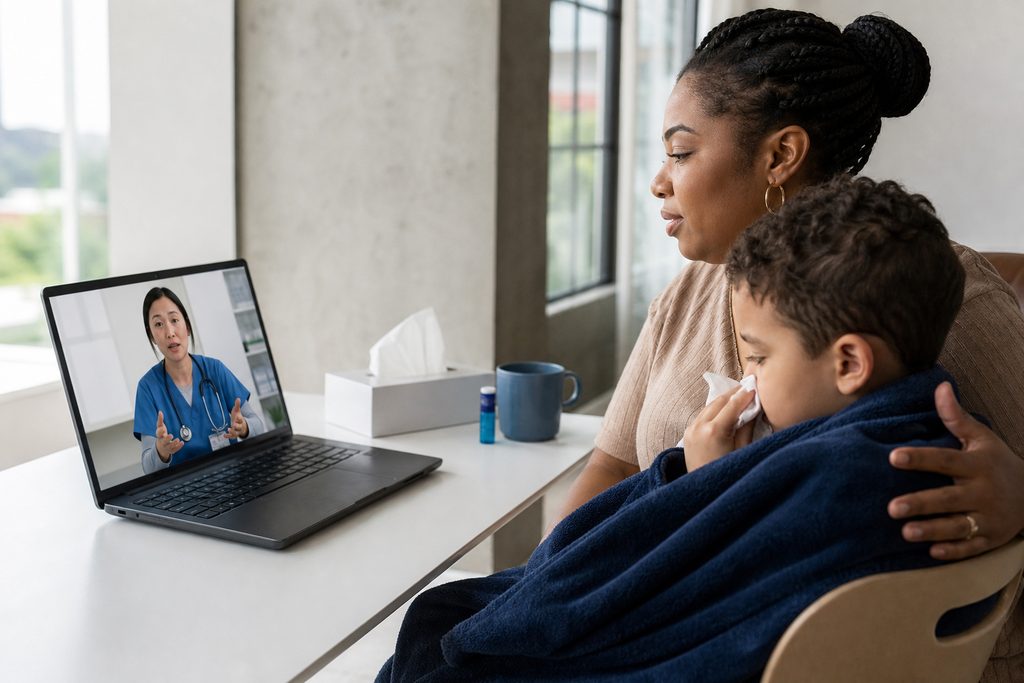
That is where a video interpreter for hospital China visits enters the picture. The idea is simple: you connect with a professional medical interpreter through your phone or a hospital-provided screen, and they translate conversations between you and the medical staff in real time. It sounds like an elegant fix for a hard problem. And in some situations, it genuinely is.
But remote interpretation has real limits. A video interpreter can translate what a doctor says. They cannot physically guide you from the registration desk on the first floor to the ultrasound department in Building 3. They cannot hold your place in a queue. They cannot help you fill out a paper form that requires a Chinese-character signature.
So the honest answer is this: video interpretation is a useful tool, sometimes the only tool available — and it is not a complete substitute for on-the-ground help.
How Video Interpretation Actually Works in Chinese Hospitals
The mechanics vary depending on which hospital you visit and which service you use. Understanding how does video interpretation work in Chinese hospitals requires separating the different models.
Hospital-Provided Interpretation Through International Departments
Many of China’s top-tier public hospitals operate dedicated international medical departments — often called “VIP clinics” or “international outpatient centers.” These departments serve foreign patients and typically employ bilingual or multilingual staff. When a patient needs language support beyond the staff’s capabilities, the hospital may arrange a video call with a contracted interpretation agency.
This model has real advantages. The interpreter is usually familiar with medical terminology. The connection is initiated by hospital staff, which reduces technical friction. And the cost is sometimes bundled into the international department’s consultation fee, which typically runs higher than standard outpatient fees.
But there is a catch. International departments in major public hospitals generally require advance booking, and the consultation fees are roughly 1.5 to 2 times standard outpatient rates. That premium buys you shorter queues, English-speaking staff, and a calmer environment. It does not guarantee that every interaction — at the pharmacy, the lab, the imaging center — will have interpretation support.
Third-Party Video Interpretation Services
A growing number of companies offer standalone remote medical interpretation for patients in China. You book a session, connect through a mobile app or web platform, and a professional interpreter joins your hospital visit remotely. Some services operate 24/7, which matters if you are in a different time zone or need help during an emergency room visit at 2 a.m.
Pricing for remote medical interpreter cost Shanghai and Beijing varies. Hospital international departments may charge $100–300 per video consultation session. Independent platforms sometimes offer lower rates, but quality and medical specialization vary widely. The key distinction: a general interpreter who speaks Mandarin and English is not the same as a trained medical interpreter who understands oncology terminology, can explain a surgical consent form, and knows how to phrase questions about drug allergies.
Video Interpretation vs. In-Person Bilingual Companions
Here is where the practical reality bites. Can I use video translation at Beijing hospital visits? Yes, in many cases. Will it solve every problem? No.
In-person bilingual medical companions — the service model this site’s partner network offers — handle the physical logistics that video interpreters cannot. They queue at registration windows. They pay deposits. They read signage. They walk you from the cardiology department to the lab. They translate conversations face-to-face, which is faster and more natural than passing a phone back and forth.
Video interpretation is better than nothing. It is significantly better than relying on translation apps, which frequently mangle medical terminology. But for a first-time visit to a large Chinese public hospital, in-person support removes a layer of stress that remote help simply cannot reach.
What Video Interpretation Costs — and What You Are Actually Paying For
Hospital-arranged video interpretation during international department consultations typically costs $100–300 per session. Independent platforms charge $30–80 per hour, though medical specialization may not be guaranteed. Top-specialist video consultations at major hospitals run $500–800. Prices vary by hospital and case complexity.
For a simple, scheduled consultation at a hospital international department, video interpretation can be sufficient. For anything more complex — multiple departments, lab tests, pharmacy pickup, or surgical consent — in-person bilingual support is strongly recommended. Video interpreters cannot help with physical navigation, queueing, or paperwork.
Some independent platforms offer 24/7 access, which can be useful for time zone differences or emergency situations. Hospital-arranged interpretation is generally limited to business hours. If you need round-the-clock availability, confirm the service’s hours and test the platform before you arrive in China.
What is the difference between a video interpreter and a bilingual medical companion?
A video interpreter translates conversations remotely. A bilingual medical companion is physically present with you at the hospital, handling registration, queueing, payment, wayfinding, and face-to-face translation. Companions typically cost from $300 per day. For first-time visits to
Frequently Asked Questions
Yes. The hospitals used for international patients are JCI-accredited and follow the same international safety standards as top hospitals in the US and Europe. Surgical teams perform high volumes of procedures — often more than their Western counterparts — which studies show leads to better outcomes.
Costs vary by procedure and hospital, but international patients typically save 40-80% compared to US prices — even when factoring in travel and accommodation. A consultation with our team will give you an exact, all-inclusive quote with no hidden fees.
Send us your existing medical reports to get started. We handle everything from hospital selection and appointment scheduling to visa assistance and post-operative recovery planning. Your medical records are reviewed by the specialist before you even book a flight.
For more medical information and treatment options in China, visit chinamedservices.com (China Medical Services).
