Airport Drop-Off After Surgery in China: Getting You Home Safely
While patients in Canada wait a median 28.6 weeks for orthopedic surgery, surgeons at Beijing Jishuitan Hospital routinely perform over 300 joint replacements per month — with clinical outcomes that match or exceed Western benchmarks. That contrast drives thousands of international patients to China each year. But a successful operation is only half the journey. The other half is getting home.
If you are searching for the best hospital for medical tourism in China, you are likely already thinking about the full arc of care — arrival, treatment, recovery, and departure. This article focuses on the final leg: airport drop-off after discharge. How it works, what it costs, when you can safely fly, and what happens if something goes wrong.
We coordinate this process regularly for patients treated at top-tier institutions like Fuwai Hospital, Peking Union Medical College Hospital, and the international departments of Shanghai’s major centers. The logistics are more predictable than most people expect. But they are not automatic. And they require planning that starts well before your surgery date.
How This Actually Works, Step by Step
You do not simply walk out of a Chinese hospital and hail a taxi to the airport. Not after a hip replacement. Not after cardiac surgery. The process has discrete stages, and each one involves someone making a decision.
First, your surgical team clears you for discharge. That clearance includes a written summary of your procedure, medication list, wound care instructions, and any restrictions on movement or sitting duration. You will need this document at the airport if you require wheelchair assistance or priority boarding.
Second, your discharge date gets confirmed. Chinese public hospitals often discharge patients earlier than Western hospitals — sometimes day 3 or 4 after a joint replacement. That is not a sign of poor care. It reflects a different model: hospital beds are for acute stabilization, and rehabilitation happens elsewhere. But it means your airport transfer needs to be arranged quickly once the date is set.
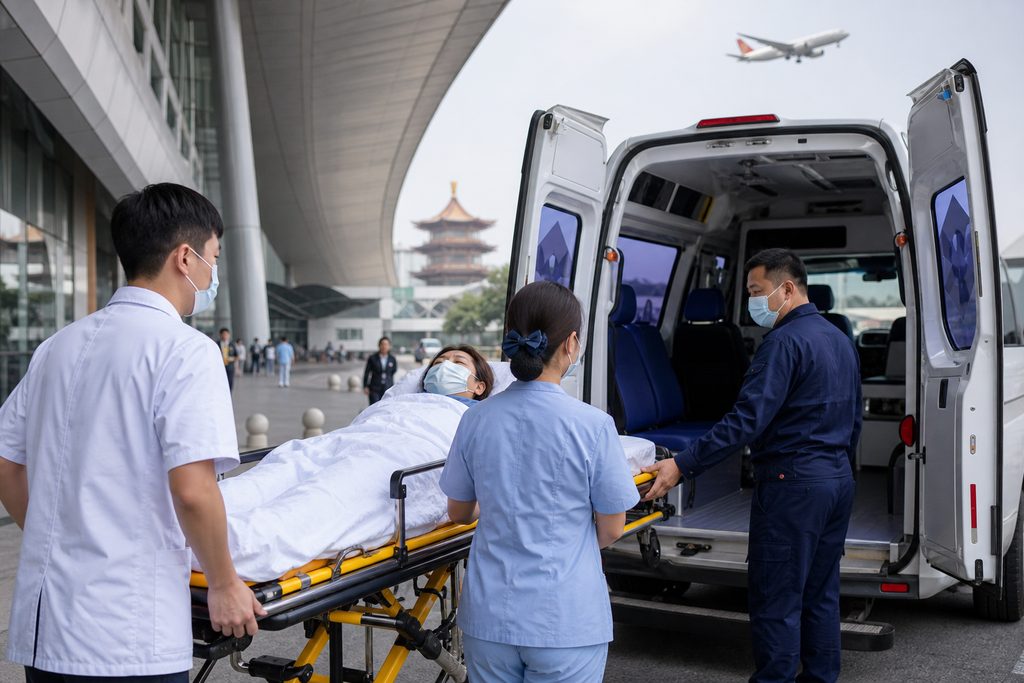
Third, a medical companion or coordinator arranges the vehicle. For most patients, a standard van or SUV with a driver is sufficient. For patients with mobility restrictions, a vehicle with a higher seat position and space for crutches or a walker is better. For patients who cannot sit upright for long, a reclining seat or even a medical transport vehicle with a stretcher may be necessary.
Fourth, the companion handles the airport itself. Chinese airports are large, busy, and mostly Chinese-language. Your companion navigates check-in, baggage, security, and boarding. They communicate with airline staff about your medical needs. They stay with you until you pass through security and reach your gate.
Finally, you board. The airline may require a medical clearance form — called a MEDIF form — if you are flying within a certain window after surgery. More on that below.
Airport Drop-Off After Surgery: Timing, Safety, and Logistics
The question most patients ask is simple: is it safe to fly after surgery in China? The answer depends on the procedure. It is not a single rule.
For minor procedures — cataract surgery, diagnostic laparoscopy, small dermatologic excisions — flying is generally acceptable 24 to 48 hours after discharge, provided there are no complications. For major orthopedic surgery like hip or knee replacement, most surgeons recommend waiting 7 to 14 days before a long-haul flight. The primary risk is deep vein thrombosis, or DVT. Immobility plus cabin pressure changes increase clot risk. Your surgeon will likely prescribe compression stockings and possibly a short course of anticoagulant medication.
For cardiac surgery, the window is longer. Fuwai Hospital, which performs over 14,000 cardiac surgeries annually, typically advises international patients to remain in Beijing for 10 to 21 days after discharge before flying. This allows time for sternal stability, medication adjustment, and a follow-up echocardiogram. Flying too early after open-heart surgery is genuinely dangerous. Cabin pressure affects cardiac output. Turbulence stresses the sternum.
For neurosurgery or procedures involving the brain or spine, the airline may require a medical escort. Some airlines refuse to board passengers within 10 days of cranial surgery. You need to check with the specific carrier before booking your return ticket.
So the honest answer: yes, it is safe — if you respect the timeline your surgeon gives you. The danger comes when patients try to compress the recovery window to save money on hotel nights. That is a false economy. A pulmonary embolism at 35,000 feet is not something any savings justify.
A Realistic Timeline
Here is what the departure phase actually looks like for a typical international patient who had major surgery in China. This assumes you are already in the country and recovering.
| Stage | Timeframe | What Happens |
|---|---|---|
| Discharge clearance | Day of discharge, morning | Surgeon signs off. Discharge summary prepared in Chinese and English. |
| Medication and instructions | Same day | Pharmacy fills prescriptions. Companion translates dosing schedule and wound care steps. |
| Transfer to hotel or recovery apartment | Same day, afternoon | Vehicle arranged. Patient rests near the hospital for the required observation period. |
| Post-discharge observation | 3 to 21 days, depending on procedure | Follow-up appointment at the hospital. Suture removal if needed. Imaging if required. |
| Fit-to-fly clearance | 1 to 3 days before departure | Surgeon or treating physician completes the airline’s MEDIF form. This is mandatory for many carriers. |
| Airport drop-off | Departure day | Companion arrives at hotel 3 hours before flight. Vehicle takes patient to airport. Companion assists through check-in, security, and boarding. |
Notice the waiting steps people forget. The fit-to-fly clearance is not instant. Chinese hospital administrative offices have working hours. If your surgeon is in surgery all day, the form might not be signed until evening. Plan for that. Also, the MEDIF form must be submitted to the airline at least 48 to 72 hours before departure for most carriers. If you wait until the day before, the airline may refuse boarding.
Document translation is another quiet delay. Your discharge summary, medication list, and imaging reports need to be translated into English for your home physician. That takes one to two days if done properly. Our team handles this as part of discharge coordination, but if you are arranging things independently, factor in the time.
What Can Go Wrong — and What Happens Then
Let us be direct about the failure modes. They are real, and they happen.
Post-operative complication before departure. A wound infection. A fever. Unexpected pain. If this happens during your observation window, you return to the hospital. This is why staying near the treating hospital matters. A patient who flies home immediately after discharge and develops a complication mid-flight has no recourse. A patient who stays in a nearby hotel for a week has direct access to the surgical team that operated on them.
Airline refuses boarding. This happens more often than people think. The gate agent sees a passenger in a wheelchair with recent surgical scars and asks for documentation. If the MEDIF form is missing or incomplete, the airline can deny boarding. The recourse is to reschedule the flight and complete the paperwork. That costs money and time. It is entirely avoidable with proper coordination.
Pain during the flight. Long-haul flights are uncomfortable for healthy people. After surgery, they can be genuinely difficult. The cabin pressure changes. The seats are narrow. The air is dry. Your companion can arrange for an aisle seat, extra legroom, and a wheelchair escort through the airport. But the flight itself is still the flight. Bring your pain medication in your carry-on, not checked luggage. Keep a copy of your prescription with you.
Lost medical documents. You arrive home and realize your discharge summary is in a bag that did not make the connection. Or you left it at the hotel. This is why we create digital copies of everything before departure. Cloud storage. Email. A USB drive. Redundancy is not paranoia — it is standard practice for cross-border medical travel.
Language barrier at the airport. Chinese airport staff may not speak English. Security personnel almost certainly do not. If you cannot communicate your needs — wheelchair, priority boarding, medical equipment — you may end up standing in a long queue in pain. A bilingual companion eliminates this specific failure mode entirely.
Choosing the Right Hospital Matters for Your Departure, Too
Here is a connection most patients miss: the hospital you choose affects how smoothly your airport drop-off goes. Not because of the hospital’s location, though that matters. Because of the quality of its discharge process.
Top-tier Chinese hospitals with established international departments understand what foreign patients need. They produce bilingual discharge documents as a matter of routine. Their nursing staff knows how to explain wound care to a patient who does not speak Chinese. Their administrative offices are familiar with airline MEDIF forms and fit-to-fly certificates.
Smaller hospitals may not have this infrastructure. The surgery might be fine. The discharge process might be chaotic. You could end up with a handwritten Chinese discharge note that no one at the airport or at home can read.
This is why patients searching for the best hospital for medical tourism in China should look beyond surgical reputation. The Fudan rankings matter. JCI accreditation matters. But so does the hospital’s experience with international patients. A hospital that treats 500 foreign patients a year has systems in place. A hospital that treats 5 does not.
The top-ranked hospitals in China are concentrated in Beijing, Shanghai, and Guangzhou. These cities also have the most developed international patient infrastructure. That is not a coincidence. It is a feedback loop. Hospitals that serve international patients well attract more of them, which funds better services, which attracts more patients.
If you are considering treatment in Shanghai, for example, the international departments at Zhongshan Hospital and Ruijin Hospital are accustomed to coordinating airport transfers for post-surgical patients. They have preferred vendors. They know which airlines are cooperative with medical passengers and which are difficult. That institutional knowledge is worth something.
Practical Considerations: Records, Visas, Payment, and Follow-Up
Before you book your return flight, get these pieces in order.
Medical records. You need a complete set in English: discharge summary, operative report, pathology report if applicable, medication list with generic drug names, imaging CDs or digital files, and a fit-to-fly certificate. Request these before discharge, not after. Once you leave the hospital, getting documents reissued from abroad is slow and frustrating.
Visa timing. You came to China on an S2 visa for medical treatment. Your departure date must fall within the visa validity period. If complications extended your stay, you need to apply for an extension at the local exit-entry administration bureau before your visa expires. Overstaying is not a minor issue. It carries fines, detention, and potential bans on future entry. Your coordinator should track this.
Payment. Chinese public hospitals require prepayment for services. Your final bill is settled before discharge. International departments often accept major credit cards and bank transfers. Private international hospitals like United Family and Jiahui offer direct insurance billing. The private international hospitals in China are generally the easiest option for patients with comprehensive insurance, but they are more expensive than public hospital international departments.
Insurance. If your home insurer is reimbursing your treatment costs, you need itemized receipts and translated documentation. Some insurers require pre-authorization for the return flight if you are flying with medical restrictions. Check your policy before departure.
Follow-up at home. Your surgeon in China will give you a follow-up schedule — usually a video consultation at 2 weeks, 6 weeks, and 3 months. Confirm that the hospital supports remote follow-up before you leave. Most top-tier international departments do. Get the contact details of the specific coordinator or nurse who will handle your case after you return home.
Frequently Asked Questions
Generally yes, but not immediately. Most orthopedic surgeons at top Chinese hospitals recommend waiting 7 to 14 days after a hip replacement before a long-haul flight. The primary concern is deep vein thrombosis. Your surgeon will likely prescribe compression stockings and possibly anticoagulants. You will also need a fit-to-fly certificate from the treating physician. Airlines may refuse boarding without it.
You have three options. One: ask the hospital’s international department if they provide transfer services — many do, at an additional cost. Two: book a private medical transport company, which is appropriate for patients who need a stretcher or medical escort. Three: use a coordination service like ours, which arranges a suitable vehicle and a bilingual companion to handle the airport process from hotel to gate. For most post-surgical patients, a standard van with a companion is sufficient.
Airport transfer itself typically costs around $200 round-trip. A bilingual medical companion for departure day starts from $300. Full coordination packages — including hospital matching, appointment scheduling, translation, and departure logistics — range from $3,000 to $8,000 depending on complexity. The treatment itself is separate. For context, the cost of medical treatment in Shanghai for foreigners at a top public hospital international department is typically one-fifth to one-tenth of the equivalent procedure in the United States. A cardiac bypass that costs $120,000 in the US might cost $12,000 to $20,000 in Shanghai. But prices vary by hospital and case complexity.
This usually happens because the MEDIF form is missing, incomplete, or submitted too late. Airlines require medical clearance for passengers flying within a certain window after major surgery — typically 7 to 21 days depending on the procedure and carrier. If you are denied boarding, the recourse is to reschedule and complete the paperwork. This is why we submit the MEDIF form 72 hours before departure and carry physical copies to the airport. Prevention is the only reliable strategy.
It depends on the surgery and your mobility. After minor procedures, flying alone is usually fine. After major orthopedic, cardiac, or neurosurgery, a companion is strongly recommended — if not a medical professional, then at least a bilingual coordinator who can navigate the airport and advocate for you. Some airlines require a medical escort for passengers with significant mobility restrictions. Check with your carrier before booking.
Your Next Step
Getting home safely after surgery in China is a process, not an afterthought. It starts with choosing a hospital that understands international patients and ends with a coordinated departure that accounts for documentation, timing, and airline requirements. The gap between those two points is where complications happen — and where good coordination prevents them.
We are China Medical Services. Our team connects international patients with top-tier Chinese hospitals and handles the logistics that make treatment abroad feasible: hospital matching, appointment coordination, bilingual companionship, visa guidance, and departure support. We do not provide medical advice, and we do not promise outcomes. We handle the practical layer so your medical team can focus on the medicine.
If you are planning surgery in China — or already recovering and thinking about the flight home — a conversation costs nothing. Tell us where you are in the process, and we will tell you what the path forward looks like.
Plan the departure before you book the arrival. That is the difference between a stressful journey and a smooth one.
For more medical information and treatment options in China, visit chinamedservices.com (China Medical Services).
