Medical Translation: From Your Records to Real-Time Help in China
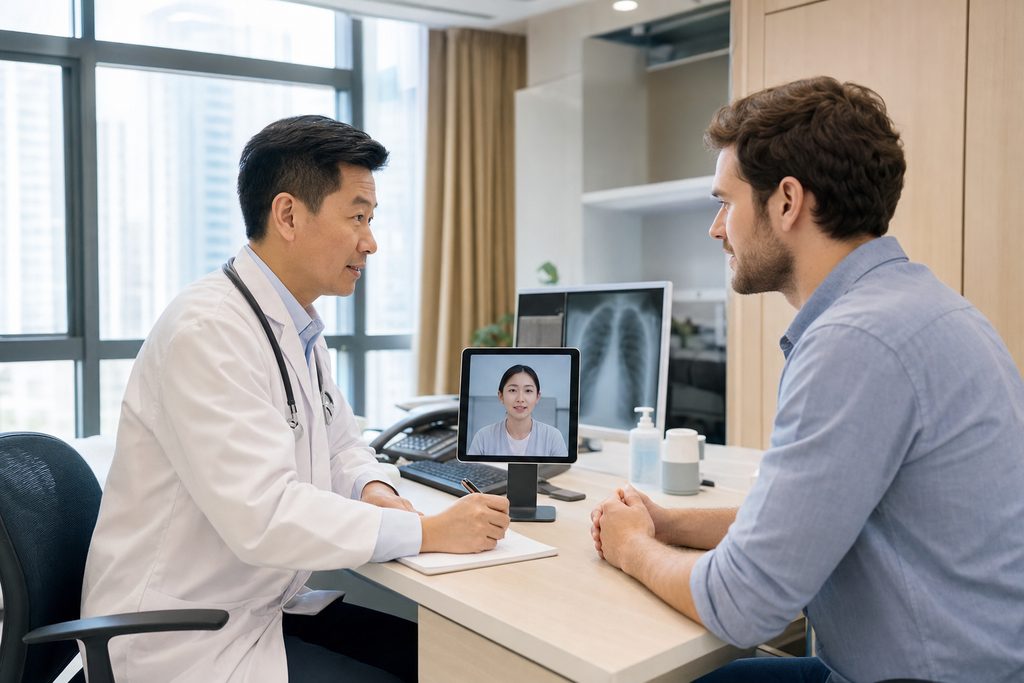
Medical translation is not just swapping words. It means taking your medical history — MRI reports, blood panels, pathology slides, discharge summaries — and turning them into a format Chinese specialists can act on. Then it extends into the hospital itself, where a bilingual coordinator interprets during consultations, clarifies dosage instructions, and makes sure the doctor’s spoken advice matches your written plan. For international patients, this two-stage process often determines whether a trip to China for treatment succeeds or stalls. Many people researching cancer treatment cost in China discover early that the real bottleneck is not the price. It is the paperwork, and then the language barrier on the ground.
Our team has coordinated cases across 37 cities and 340+ top-ranked hospitals. We have seen the same pattern repeat: patients arrive with incomplete records, get frustrated at registration desks, and leave without a clear treatment plan. Translation, done properly, prevents that. This article explains how the process works, what it costs, what goes wrong, and how to prepare.
How This Actually Works, Step by Step
You start by sending us whatever medical documents you have. PDFs from your oncologist, DICOM files from a radiology center, handwritten notes from a surgeon — all of it. Our team sorts the material, identifies what is missing, and has it translated into Simplified Chinese by medical translators familiar with oncology, cardiology, orthopedics, and other specialties. We do not use general translators. A phrase like “lymphovascular invasion present” must be rendered precisely, or a Chinese pathologist may misinterpret the staging.
Once the translated file is ready, we submit it to the appropriate department at your target hospital. If you have a specific hospital in mind — say, a cardiac center in Shanghai — we route it there. If you are unsure, we match your condition against our hospital database and recommend options. The hospital reviews the records and either accepts the case for a video consultation or requests additional imaging. That review typically takes 3 to 10 business days, depending on the department’s caseload.
The next stage is the real-time help. If you decide to travel, a bilingual medical companion meets you at the hospital. This person handles registration, queues, payment windows, and in-room interpretation. They are not doctors, but they understand how Chinese hospitals operate — which window opens first, how to read a queue ticket, what to say when a receptionist asks for a specific form. This is the part that cannot be done remotely.
Why Written Translation Alone Is Not Enough
Translated records get you through the door. They do not get you through the day. Chinese public hospitals are enormous. A single outpatient building can see 10,000 patients daily. Signage is often bilingual in international departments, but the actual workflow — lab slips, pharmacy queues, CT scheduling — runs on Chinese-language systems and fast-spoken Mandarin. Even patients who speak conversational Chinese struggle with medical terminology, dialect variation, and the speed of hospital staff.
Real-time help fills that gap. A companion does not just translate words. They translate the system. They know that a “fast track” queue at a Shanghai hospital requires a specific stamp, that certain imaging centers require cash deposits before scanning, and that a doctor’s verbal instruction to “come back in two weeks” may not match the written follow-up slip. These are small things that compound into missed appointments and wasted days.
For patients weighing is it safe to have surgery in China, the safety question often comes down to communication. Medical errors happen everywhere. The risk rises when patients cannot confirm their own medication allergies, surgical history, or current prescriptions with the surgical team. A companion reduces that specific risk.
A Realistic Timeline
Here is what the process looks like from first contact to hospital admission, with realistic ranges. This assumes you already have a diagnosis and are considering treatment in China.
| Stage | What Happens | Duration |
|---|---|---|
| Day 1–3 | You send medical records; we review for completeness and identify gaps | 1–3 days |
| Day 4–10 | Medical translation into Simplified Chinese; back-translation check for accuracy | 5–7 days |
| Day 11–20 | Hospital department review; request for additional imaging or tests if needed | 3–10 days |
| Day 21–35 | Video consultation scheduled with specialist; written summary provided after | 1–2 weeks lead time |
| Week 6–8 | S2 visa application with hospital invitation letter; consulate processing | 1–3 weeks, varies by country |
| Week 8–10 | Travel to China; in-person consultation; additional tests ordered | 3–5 days in country |
| Week 10–14 | Surgery or treatment scheduled, subject to hospital admission rules | 1–4 weeks, varies by department |
The forgotten step is document translation. Patients assume their English records will be accepted. Some international departments do accept English. Most do not. Even when they do, the reviewing physician may not read English fluently enough to catch nuances in a pathology report. Translation adds a week, but skipping it can add a month of back-and-forth.
What Can Go Wrong — and What Happens Then
Records arrive incomplete. This is the most common failure. A patient sends a CT report but not the actual DICOM files. The hospital cannot evaluate tumor margins from a written summary alone. We catch this during the initial review and request the missing files before submission. If the hospital rejects the case, we ask for the specific reason and either supplement the file or route it to a different department with different requirements.
Translation errors happen. Medical translation is hard. A term like “negative for malignancy” must not become “malignancy present” through careless phrasing. We use back-translation — a second translator converts the Chinese back into English, and we compare the two versions. Discrepancies trigger a re-translation. This costs more but prevents catastrophic misunderstandings.
The hospital changes its mind. A department that accepted your case for video consultation may decline to schedule surgery until you appear in person. This is standard practice at Chinese public hospitals. No remote consultation guarantees admission. Our role is to coordinate the in-person visit and advocate for your case, but the final decision rests with the hospital. If a specific hospital declines, we present alternatives from the 340+ hospitals in our network.
You arrive and the doctor is unavailable. Specialists at top Chinese hospitals are extremely busy. A scheduled appointment can shift by hours or days. A companion helps here — they can rebook, wait in the queue, and call you when the doctor is actually ready. Without that support, you sit in a crowded waiting room with no idea what is happening.
What Good Translation Actually Costs
Translation pricing varies by document volume and complexity. A basic set of records — blood work, one imaging report, a discharge summary — typically costs $150 to $400 to translate professionally. Complex oncology cases with multiple pathology reports, genetic testing, and prior treatment histories run $400 to $800. These are separate from consultation fees.
For context, a written second opinion from a top Chinese specialist costs $300 to $500. A video consultation with a senior specialist runs $500 to $800. A multidisciplinary team review costs $1,500 to $2,000. These fees are credited in full toward on-the-ground coordination if you proceed to treatment in China within 90 days. The translation fee itself is not credited — it is a standalone service.
Patients researching how much does IVF cost in China or spine surgery price Beijing often overlook these ancillary costs. A $12,000 cardiac bypass at a top Chinese hospital sounds attractive compared to $120,000 in the US. But add $500 for translation, $800 for a specialist video consult, $300 per day for a companion, and $200 for airport transfer, and the total is still a fraction of Western prices. The key is knowing the full picture before you commit.
Practical Considerations: Records, Visas, and Follow-Up
Bring everything. Every scan, every lab result, every prescription, every surgical note. Even documents you think are irrelevant — a chest X-ray from five years ago, an old allergy test — can inform a Chinese specialist’s assessment. Digital files are fine, but bring printed copies too. Some hospital departments require physical documents for their archives.
Visa category matters. For medical treatment in China, the correct visa is S2, annotated for medical purposes. Accompanying family members also apply for S2. The M visa is for commercial and trade activities and is not appropriate for medical travel. Processing times vary by consulate, so start early. You will need a hospital invitation letter, which we can help obtain after your case is accepted for consultation.
Payment at Chinese public hospitals is generally prepaid. You deposit funds at admission, and the hospital deducts as services are provided. International insurance is usually reimbursement-based — you pay upfront and claim later. Private international hospitals like United Family or Jiahui often bill insurers directly, but their prices run higher. For patients asking best hospital for heart surgery Shanghai, the answer depends on whether you prioritize cost, insurance compatibility, or specific surgeon expertise. Zhongshan Hospital Fudan University performs among the highest volumes of cardiac surgery in China, but its public wards operate on a prepaid model. Its international department offers more English support at roughly 1.5 to 2 times the standard pricing.
Follow-up at home is the overlooked stage. Chinese surgeons will give you a discharge summary in Chinese. Your home physician needs it in English. We can translate that document before you leave, so you arrive home with a usable record. Without that, you may face delays in post-operative care, prescription refills, or physical therapy referrals.
Frequently Asked Questions
No. The hospital needs written Chinese records to open your file, schedule consultations, and obtain departmental approvals. An interpreter helps with spoken communication but cannot substitute for translated documents. Both are necessary. The written translation comes first; the real-time interpreter comes when you arrive.
Ask for back-translation. A second translator renders the Chinese version back into English, and you compare it to your original. Any meaningful discrepancy indicates an error. Our team uses this method for all oncology, cardiology, and surgical records. For routine lab values, the risk is lower, but for staging and pathology, accuracy is non-negotiable.
Hospitals reject records for specific reasons: missing imaging files, unclear prior treatment history, or a condition outside the department’s scope. We request the reason in writing and address it. That may mean obtaining DICOM files from your original imaging center, adding a translated summary from your treating physician, or routing your case to a different department. Rejection is not final. It is a request for more information.
Safety depends on hospital selection, communication quality, and your own medical fitness. Top-ranked Chinese hospitals perform high volumes of complex procedures — Fuwai Hospital alone performs over 14,000 cardiac surgeries annually. But volume does not eliminate risk. The main risk factor for foreign patients is communication failure. A bilingual companion mitigates that. Choose a hospital with an established international department, confirm your surgical team’s experience with your specific procedure, and do not skip the in-person consultation before surgery.
For many solid tumor surgeries, Chinese public hospital pricing runs one-fifth to one-tenth of US list prices. A lung resection that bills $80,000 in the US may cost $12,000 to $20,000 at a top Chinese hospital. Chemotherapy and immunotherapy drug costs vary widely depending on whether the drug is domestically manufactured or imported. Always request a written cost estimate from the hospital’s international department before committing. Prices vary by hospital and case complexity.
If you are comparing hospitals or trying to understand where your condition fits, our top-ranked hospital database organizes China’s best institutions by city and specialty. For oncology specifically, the specialty rankings show which hospitals lead in cancer care, cardiac surgery, orthopedics, and reproductive medicine.
Your Next Step
The translation stage is where most international patients lose time or make costly mistakes. Getting it right from the start — complete records, professional medical translation, and a clear plan for on-the-ground support — changes the entire experience. We coordinate that process across 340+ top-ranked hospitals in 37 Chinese cities. We do not practice medicine, and we do not promise outcomes. We handle the logistics, the language, and the hospital navigation so you can focus on the medical decisions.
If you are considering treatment in China, start with a conversation. Tell us your diagnosis, what records you have, and what you are trying to accomplish. We will tell you honestly whether China makes sense for your case, and what the next 90 days would look like. Visit our patient services page to begin. No commitment, no pressure — just a clear picture of what is possible.
For more medical information and treatment options in China, visit chinamedservices.com (China Medical Services).
