Health Checkup: Eye Screening Add-On Costs and Best Clinics in China
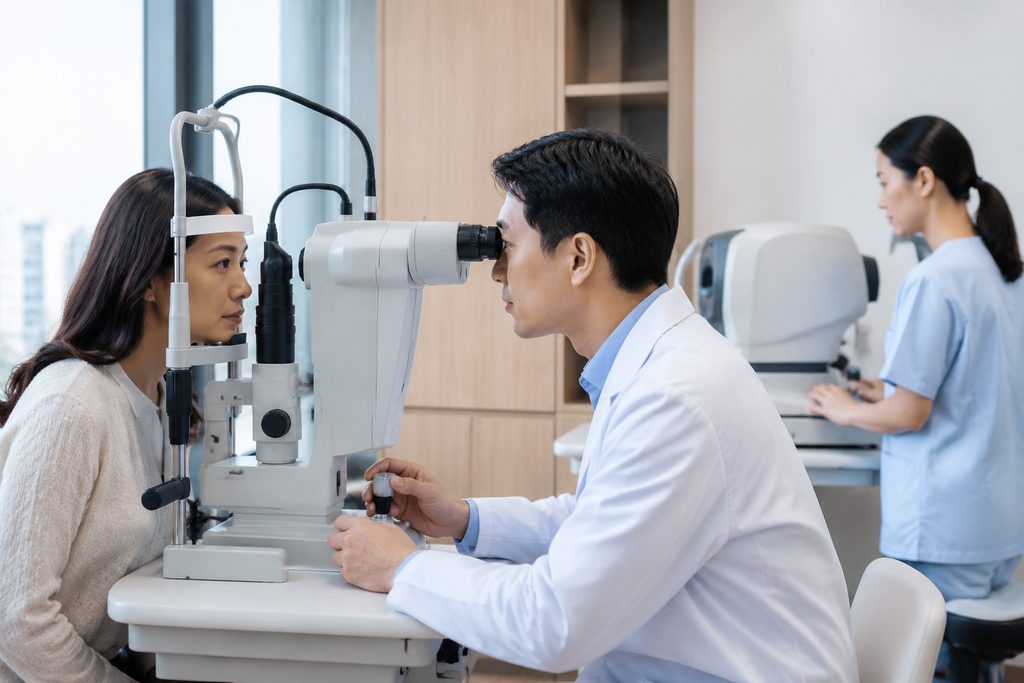
You have probably heard that adding an eye screening to a general health checkup in China is either suspiciously cheap or needlessly complicated. The reality sits somewhere else entirely. A comprehensive dilated eye exam at a top-tier Chinese hospital typically runs between $40 and $150 as an add-on to an executive physical. The same service in the United States averages $200 to $400 without insurance. That gap exists because China’s high-volume hospital system spreads equipment costs across thousands of patients daily. But cost alone is not the reason to book it. The reason is access to diagnostic equipment that many Western clinics reserve for specialist referrals.
Our team at China Medical Services coordinates these add-ons for international patients every week. We have watched people fly into Shanghai for a corporate physical, add a retinal scan on a Tuesday, and leave Thursday with OCT images their home optometrist never offered. This article explains what the add-on actually covers, what it costs, where to get it, and what can go wrong.
How This Actually Works, Step by Step
You do not need to be in China to start. The sequence looks like this.
First, you send us your existing eye history if you have one: prescription, past retinal photos, any glaucoma or diabetes notes. Our team translates those records into Chinese and forwards them to the ophthalmology department at your preferred hospital. That step takes two to three business days.
Second, the hospital’s international patient office reviews your file and confirms which add-on package fits. A basic screening includes visual acuity, intraocular pressure, slit-lamp exam, and fundus photography. A deeper add-on adds optical coherence tomography (OCT) and visual field testing. The hospital quotes a price range based on that package. You approve it before anything is scheduled.
Third, we lock your appointment date. Public hospital outpatient clinics in China cannot be pre-booked from overseas through normal channels. But the international medical department or VIP clinic can reserve a slot. That is the channel we use. Lead time is usually five to ten days, sometimes shorter in Beijing or Shanghai.
Fourth, you arrive. A bilingual companion meets you at the hospital entrance, handles registration, walks you to the ophthalmology floor, and translates every instruction. The eye screening itself takes 30 to 60 minutes depending on whether you add OCT. Dilation adds another 20 minutes of waiting for drops to work.
Fifth, an ophthalmologist reviews your images with you. You leave with a written report in English and a CD or USB containing the raw imaging files. You can take those to your home doctor.
Eye Screening Cost China: What the Add-On Actually Includes
The phrase “eye screening cost China” covers a wide range. A bare-bones vision check at a local optical shop might cost $5. That is not what we arrange. The add-on we coordinate attaches to a full executive health checkup at a hospital’s international medical center or VIP clinic.
Here is a realistic price breakdown based on current quotes from public tertiary hospitals in Beijing, Shanghai, and Guangzhou. Prices vary by hospital and case complexity.
| Screening Component | Typical Add-On Cost in China (USD) | Typical US Price (USD, uninsured) |
|---|---|---|
| Visual acuity + refraction | $15–$30 | $60–$120 |
| Intraocular pressure (tonometry) | $10–$20 | $40–$80 |
| Slit-lamp examination | $15–$35 | $70–$150 |
| Fundus photography (retinal imaging) | $25–$60 | $100–$250 |
| Optical coherence tomography (OCT) | $40–$90 | $150–$350 |
| Visual field test | $30–$70 | $120–$300 |
| Full add-on package (all above) | $120–$305 | $540–$1,250 |
These numbers are not marketing. They reflect what our patients actually pay at the hospital cashier. The spread exists because a top-tier eye center like the one at Fudan University’s Eye and ENT Hospital in Shanghai charges more than a strong general hospital ophthalmology department in Chengdu. Both are excellent. Both are far below Western rates.
What does a comprehensive eye exam price abroad tell you? Very little about quality. It tells you about labor costs and insurance overhead. China’s advantage is volume. A single ophthalmologist at a major Chinese hospital may examine 80 to 120 patients per day. That repetition builds diagnostic speed that Western clinics cannot match. It also means you need to know exactly what you are buying.
Best Eye Clinic Shanghai for Foreigners: Where to Book the Add-On
If you search for the best eye clinic Shanghai for foreigners, you will find three tiers. Each serves a different need.
The first tier is the public specialist hospital. The Eye and ENT Hospital of Fudan University is the reference point. Its ophthalmology department consistently ranks among China’s top three in the Fudan specialty reputation rankings. The hospital handles complex retinal disease, glaucoma, and pediatric eye conditions at enormous scale. The international department offers English-speaking coordination. Expect efficient but busy clinics. You will not get a leisurely consultation. You will get world-class imaging and a senior ophthalmologist’s read.
The second tier is the international medical center inside a large general hospital. Huashan Hospital’s international clinic, Ruijin Hospital’s VIP wing, and Shanghai United Family Hospital all offer eye screening as part of broader health checkup packages. These are calmer, with more English support and direct insurance billing at the private facilities. Prices run 1.5 to 2 times the public specialist hospital.
The third tier is the private international hospital. Jiahui Health and Shanghai United Family operate JCI-accredited facilities with Western-style appointment flow. You can book an eye screening package online, pay by credit card, and receive a report formatted for your home physician. The trade-off is cost: expect $250 to $500 for a full add-on package. Still cheaper than many US out-of-pocket rates.
For most international patients adding eye screening to a general checkup, the public specialist hospital international department offers the best balance of expertise and price. We can help you compare options across Shanghai’s top hospitals.
A Realistic Timeline
People underestimate how long the surrounding logistics take. The eye exam itself is quick. Everything around it is not.
| Stage | What Happens | Realistic Duration |
|---|---|---|
| Day 1–3 | You send eye records; we translate and forward to hospital | 2–3 business days |
| Day 4–7 | Hospital reviews records, confirms package and price | 3–5 business days |
| Day 8–14 | Appointment locked; S2 visa application if not already in China | 5–10 business days for appointment; visa 4–10 business days after submission |
| Day 15–20 | Travel to China, airport pickup, hotel check-in | 1–2 days |
| Day 21 | Eye screening add-on performed; results reviewed same day | 2–3 hours on site |
| Day 22+ | Optional follow-up video consultation with same ophthalmologist | Within 7 days of request |
The step people forget is document translation. If your previous retinal scans or glaucoma notes are in English, most Chinese hospitals still want a Chinese summary attached. That adds two days. If you have no prior records, the process shortens. You simply book the screening and go.
Visa timing matters too. Medical travel to China uses the S2 visa category, not the M visa. The M visa is for commercial and trade activities. For a short medical trip, S2 is the correct short-stay category, issued for private affairs including medical treatment, with exact requirements confirmed by your local Chinese embassy or consulate. Approval typically takes one to two weeks but can stretch longer during peak seasons.
What Can Go Wrong — and What Happens Then
Several things can go sideways. We would rather you know before you fly.
The most common issue is dilation. If you add a dilated fundus exam, your pupils stay wide for four to six hours. You cannot drive, read comfortably, or stare at screens. Some patients schedule the eye add-on for the morning and then try to attend business meetings in the afternoon. That is a mistake. Book the eye screening as the final item of your health checkup day.
Another failure mode: you bring an old prescription but no retinal history, and the ophthalmologist finds something unexpected. A suspicious optic nerve. A retinal tear. In that case, the hospital will recommend additional imaging or a same-day glaucoma specialist consult. That costs extra, usually $50 to $150. It is not a scam. It is standard clinical escalation. You can decline, but you will leave with an incomplete picture.
Language failure is real. Even in international departments, the front-desk staff may switch to Chinese under pressure. A bilingual companion solves this. Without one, you may stand in the wrong queue for 40 minutes. That is the single most common complaint we hear from patients who tried to navigate alone.
And then there is the report. Some hospitals issue imaging reports in Chinese only unless you specifically request English. We request English at booking. If the report still arrives in Chinese, we arrange translation within 48 hours. You should not accept a Chinese-only report if you plan to share it with your home ophthalmologist.
Is Eye Screening in China Safe? Equipment, Standards, and What the Numbers Mean
The question “is eye screening in China safe” deserves a straight answer. Yes, with qualifications.
The equipment at top-tier Chinese eye centers is current. OCT machines from Zeiss, Heidelberg, and Topcon are standard. Fundus cameras are digital and high-resolution. The same devices you would find at a major US academic center. Infection control in international departments follows JCI-style protocols, with single-use tonometer tips and disposable chin-rest paper.
The qualification is about where you go. A random optical shop in a shopping mall is not a hospital. It may use older equipment and skip dilation. It may push you to buy glasses. That is not what we arrange. We only coordinate with ophthalmology departments at hospitals ranked in the Fudan specialty reputation list or JCI-accredited private facilities. You can browse our top-ranked hospital database to see which institutions qualify.
How long does an eye checkup take in China? The screening itself runs 30 to 60 minutes. With dilation, add 20 minutes of waiting. With OCT and visual field testing, add another 30 minutes. Total on-site time is usually two to three hours. That is comparable to a US comprehensive exam, but the Chinese visit tends to move faster because technicians handle imaging while the ophthalmologist focuses on interpretation.
The numbers on your report matter more than the speed. Intraocular pressure above 21 mmHg warrants glaucoma evaluation. A cup-to-disc ratio above 0.5 on fundus photography suggests the same. OCT retinal nerve fiber layer thickness below normal for your age needs follow-up. If any of these appear, the ophthalmologist will tell you. If they appear and no one mentions them, ask.
Practical Considerations: Records, Visa, Payment, and Follow-Up
Bring every eye record you have. Old prescriptions help establish refractive stability. Past retinal photos give the ophthalmologist a baseline. If you have diabetes, hypertension, or a family history of glaucoma, say so at booking. Those conditions change which add-on components matter.
Visa category is S2 for short medical stays, as covered earlier. Do not apply for an M visa. The embassy will ask for an invitation letter from the hospital or a medical coordination service. We provide the supporting documentation after your appointment is confirmed. Approval is never guaranteed, but a confirmed hospital appointment strengthens the application.
Payment is straightforward. Public hospital international departments accept cash, UnionPay, and major credit cards. Some accept international wire transfers for larger packages. Private international hospitals accept Visa and Mastercard directly and often bill your insurer. Public hospitals require upfront payment; you then claim reimbursement from your insurer at home. Keep every receipt.
Follow-up at home is the step people skip. Take your CD or USB of raw images to your local ophthalmologist. A good home doctor will want to compare the OCT against future scans. If the Chinese ophthalmologist recommends a repeat visual field test in six months, schedule it. Do not let the report sit in a drawer.
Frequently Asked Questions
You cannot book a public hospital outpatient slot directly from overseas. The international medical department or VIP clinic can reserve a slot, and that is the channel we use. Send your records, approve the package and price, and we lock the appointment. Lead time is usually five to ten days.
Usually yes. When added to a general health checkup, the eye screening shares registration and facility fees, which lowers the marginal cost. A standalone comprehensive eye exam at the same hospital often costs $80 to $200. The add-on route typically saves 20 to 40 percent.
It depends on your plan. Many international insurers reimburse preventive screening at accredited facilities, but you must submit the itemized receipt and English report. Some insurers require pre-authorization. Check before you book. We can provide the documentation your insurer requests.
The ophthalmologist will explain the finding and recommend next steps. If you need treatment, we can coordinate a follow-up with the same department or a specialist referral. You are never obligated to proceed with treatment in China. You can take the images and report home and decide there.
Most international medical centers allow it. Some budget packages exclude specialist add-ons, so confirm at booking. The hospitals we work with in Beijing, Shanghai, and Guangzhou all offer ophthalmology add-ons to their executive physical packages.
Your Next Step
Adding eye screening to a Chinese health checkup is one of the highest-value moves an international patient can make. The imaging is current, the ophthalmologists are experienced, and the cost is a fraction of Western rates. What it requires is coordination: the right hospital, the right channel, and someone on the ground who speaks the language.
We are China Medical Services. We match international patients with top-tier Chinese hospitals and handle the logistics — appointment booking, document translation, bilingual companionship, and visa documentation. We do not provide medical advice or guarantee clinical outcomes. If you want to explore adding an eye screening to your next China health checkup, tell us your situation and we will map the options.
Your vision is worth a second look. Now you know how to get one in China without the guesswork.
For more medical information and treatment options in China, visit chinamedservices.com (China Medical Services).
