Middle East Patients: Care After China, Continuity Without Gaps
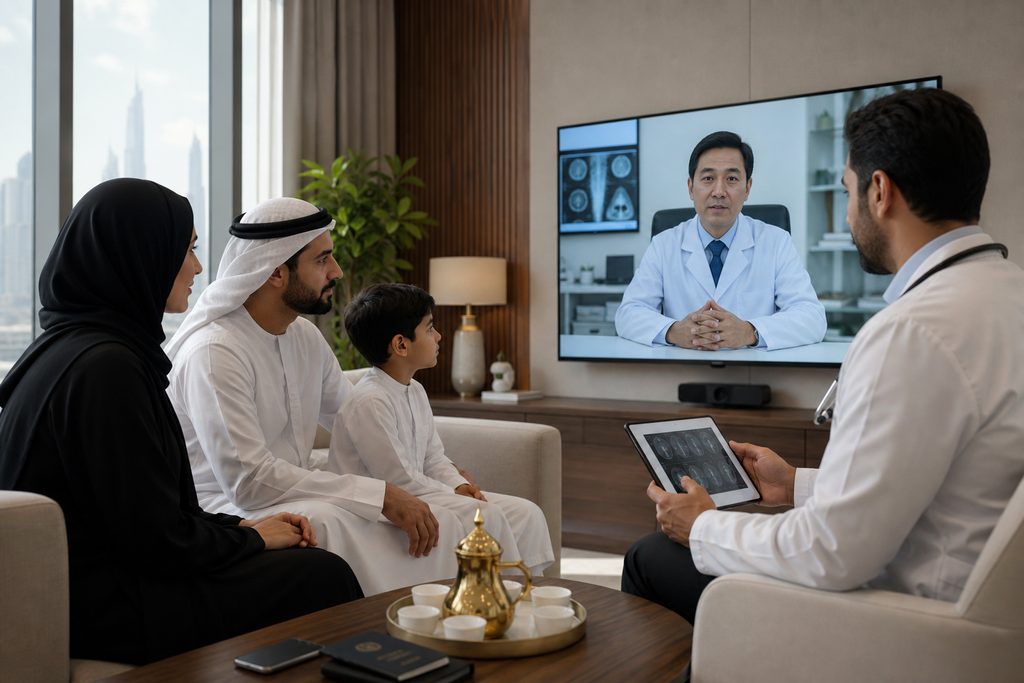
Have you ever wondered what happens after the plane lands back in Riyadh, Dubai, or Doha? You completed treatment in Shanghai or Beijing. The surgery went well. But now you’re home, and the follow-up MRI is scheduled, the medication list is long, and your local oncologist has questions about what the Chinese team actually did. That gap between hospital discharge in China and continued care in the Middle East is where outcomes quietly improve or quietly erode.
We see this every week. A patient from Abu Dhabi finishes a complex cardiac procedure at Fuwai Hospital, then returns home with a discharge summary that his local cardiologist finds difficult to interpret. A family from Jeddah completes a cancer treatment protocol in Shanghai, and the follow-up imaging schedule needs coordination across two health systems. The question is not whether care in China was excellent. The question is whether the continuity of that care survives the flight home.
This article addresses exactly that. We will walk through how post-China care coordination actually works, what realistic timelines look like, what can go wrong, and how to build a bridge between your Chinese medical team and your doctors back home. The cancer treatment cost China for Middle East patients is often 50-70% lower than equivalent care in the Gulf or the United States, but the real value depends on what happens in the months after discharge.
How This Actually Works, Step by Step
Let’s trace a real sequence. A patient from Kuwait has just finished a course of treatment at a top oncology department in Shanghai. Before flying home, several things need to happen in the right order.
First, the Chinese medical team prepares a comprehensive discharge package. This includes the complete medical record, imaging files on CD or secure cloud link, pathology reports, medication regimen, and a written follow-up plan. At China Medical Services, we review this package with the patient before departure. We check that every document is in English or has a certified translation. We confirm the medication names match international generic names, not just Chinese brand names.
Second, we schedule the first follow-up video consultation. Most top Chinese hospitals now offer this through their international departments. The patient goes home, recovers, and at the 4-week or 8-week mark, sits down with their local doctor and connects to the Chinese specialist on the same screen. This is not a luxury. It prevents the most common failure: the local doctor changing the protocol because they cannot reach the original team.
Third, we arrange for ongoing monitoring. Blood tests, imaging, and cardiac markers can often be done locally in the Gulf, with results uploaded to a shared platform that the Chinese team reviews. If something looks off, the Chinese specialist requests a video call or, in rare cases, recommends a return visit.
The sequence is not complicated. But it requires someone to own the handoff. That is the role we play.
What “Care After China” Actually Means for Middle East Patients
Care after China is not a single event. It is a 12-month arc with three distinct phases: immediate recovery at home, structured follow-up with both teams, and long-term monitoring that slowly shifts to the local provider. Each phase has different failure points.
In the immediate phase, the main risks are medication errors and unrecognized complications. A patient from Oman who had a liver procedure in Guangzhou might develop a low-grade fever two weeks after returning home. Is it normal post-operative inflammation or an infection? The local emergency department has no context. Without a direct line to the Chinese surgical team, the patient gets broad-spectrum antibiotics and a stressful night in the ER that might have been avoided with one video call.
In the structured follow-up phase, the risk is protocol drift. A patient from Qatar who had cardiac surgery in Beijing returns home with a specific anticoagulation regimen. The local cardiologist, unfamiliar with the exact valve type used, adjusts the dose based on local norms. That adjustment might be fine. Or it might increase stroke risk. The only way to know is to have the Chinese team review the change.
In the long-term phase, the risk is simple neglect. The patient feels fine. Follow-up appointments get postponed. The 12-month scan becomes an 18-month scan. For cancer patients, this is where recurrence gets missed. A structured post-China care plan prevents this drift.
A Realistic Timeline
Here is what a typical post-treatment coordination timeline looks like for a Middle East patient returning from care in China. This assumes an uncomplicated recovery and a patient who follows the plan.
| Timeframe | What Happens | Who Is Involved | Realistic Duration |
|---|---|---|---|
| Week 1 (before departure) | Discharge package preparation, document translation, medication review | Chinese medical team, care coordinator | 2-3 days |
| Week 2-3 (at home) | Initial recovery, first local check-up, baseline labs | Patient, local GP or specialist | 1-2 weeks |
| Week 4-6 | First joint video consultation with Chinese team and local doctor | Patient, local doctor, Chinese specialist | 45-60 minutes |
| Month 2-3 | Follow-up imaging or labs as per protocol, results uploaded for Chinese review | Patient, local imaging center, Chinese team | 1-2 weeks for review |
| Month 6 | Mid-point assessment, medication adjustment if needed | Chinese specialist via video | 30-45 minutes |
| Month 12 | Final structured review, transition to local long-term monitoring | Both teams | 1-2 weeks |
Notice what this timeline includes that most patients forget: document translation takes days, not hours. Video consultations need to be scheduled around time zone differences between the Gulf and China, which is only 4-5 hours but still requires planning. And the local doctor needs time to review the Chinese records before the joint call. None of this happens automatically.
What Can Go Wrong — and What Happens Then
Let’s be blunt about the failure modes. We have seen all of them.
The first is lost or incomplete records. A patient leaves the hospital with a paper discharge summary in Chinese and a CD of imaging that their local hospital cannot open. This happens more often than you would think. The fix is straightforward: before departure, we verify every document, convert imaging to standard DICOM format, and provide certified English translations. If the patient is already home and discovers missing records, we contact the hospital’s international department and request re-issuance. This takes 1-2 weeks.
The second is the local doctor who refuses to engage. Some Gulf-based physicians are skeptical of Chinese medical records. They may dismiss the treatment plan or refuse to participate in a joint video consultation. This is frustrating but not insurmountable. We provide the local doctor with the Chinese specialist’s credentials, publication list, and hospital profile. Most doctors respond to peer-level evidence. If they still refuse, we help the patient find a local physician who is willing to collaborate.
The third is a complication that requires re-evaluation in China. This is rare but real. A patient develops a post-operative issue that the local team cannot resolve. The Chinese specialist reviews the imaging remotely and determines whether the patient needs to return. If so, we coordinate the return visit, including visa renewal if needed and hospital re-admission.
The fourth is medication mismatch. Chinese hospitals often prescribe medications that are not available under the same name in the Gulf. A pharmacist in Dubai might substitute a different formulation, which changes the absorption profile. We address this by providing the international generic name for every medication, along with the specific formulation details, before the patient leaves China.
Is Chemotherapy Safe in China? What Middle East Patients Should Verify
This question comes up constantly. A family from Riyadh is considering whether their mother should receive chemotherapy in Shanghai or stay in Saudi Arabia. They ask: is chemotherapy safe in China? The honest answer is yes, at top-tier hospitals, with qualifications.
China’s top oncology departments, including those ranked among China’s top 10 for oncology, follow international protocols. They use the same chemotherapy agents, the same dosing guidelines, and the same safety monitoring as major cancer centers in the United States and Europe. The difference is cost and volume. Chinese oncologists at large centers treat far more patients per week than their Gulf counterparts, which translates to deep clinical experience with rare side effects and complex cases.
But safety depends on where you go. A top-ranked oncology department at a Fudan-ranked hospital in Shanghai is not the same as a small private clinic in a second-tier city. We only work with hospitals in the top 5% of China’s 35,000+ hospitals, ranked by Fudan and JCI. That filter matters.
For Middle East patients specifically, the practical concerns are language, nursing standards, and infection control. Top international departments in Shanghai and Beijing have English-speaking staff and Western-style nursing ratios. Private international hospitals like United Family or Jiahui offer JCI-accredited care with direct insurance billing. The safety question is not about the chemotherapy itself. It is about the environment in which it is delivered.
How to Book an Oncology Package at a Shanghai Hospital
Patients often search for how to book oncology package Shanghai hospital services. The reality is more nuanced than a simple online booking. Public hospitals in China do not allow overseas patients to pre-book treatment packages through a website. You cannot click “purchase chemotherapy package” and show up.
What actually happens is a staged process. First, the patient sends existing medical records — pathology reports, imaging, prior treatment history — for review by the oncology department. This is a written second opinion, typically costing $300-500 for a top specialist review. If the Chinese team confirms they can treat the patient, the next step is a video consultation, which costs $500-800 for a top specialist.
Only after the remote evaluation does the hospital issue a formal treatment plan and cost estimate. At that point, we coordinate the S2 visa application for medical treatment, the hospital admission, and the on-the-ground logistics. The “package” is not a product you buy online. It is a coordinated sequence of evaluations, approvals, and scheduling.
Best Hospital for Heart Surgery in Beijing: Price and Reality Check
Middle East patients with cardiac conditions frequently ask about the best hospital for heart surgery in Beijing price. The answer is Fuwai Hospital, without serious competition. Fuwai performs over 14,000 cardiac surgeries annually, the highest volume of any heart center in the world. For coronary artery bypass grafting, the cost at Fuwai’s international department typically ranges from $12,000 to $20,000, depending on case complexity. The equivalent procedure in the United States costs $120,000 or more.
But the price tag is not the whole story. Fuwai is a public hospital with enormous patient volume. The international department provides English-speaking coordinators, priority scheduling, and private rooms, at roughly 1.5 to 2 times the cost of the standard public channel. That premium is worth it for a patient who does not speak Chinese and needs efficient navigation.
After surgery, the post-discharge follow-up is critical. Fuwai’s international department offers structured follow-up video consultations. We coordinate these with the patient’s local cardiologist in the Gulf, ensuring that anticoagulation management and echocardiogram reviews happen on schedule.
Recovery After Liver Transplant in China: What the Timeline Looks Like
Patients searching for how long is recovery after liver transplant in China are usually planning logistics. They need to know how long to stay in China after surgery and when they can fly home.
The honest answer: plan for 4 to 8 weeks in China after a liver transplant. The first 2 to 3 weeks are in-hospital recovery, with close monitoring of graft function, immunosuppression levels, and surgical healing. The next 2 to 5 weeks are outpatient monitoring near the hospital. The transplant team needs to see the patient regularly during this period to adjust immunosuppressant dosing and catch early rejection.
Flying home too early is dangerous. A long-haul flight from Shanghai to Dubai or Riyadh within the first month post-transplant increases the risk of deep vein thrombosis and pulmonary embolism. Most transplant centers require a minimum of 4 weeks on the ground before clearing a patient for a long flight, and many prefer 6 to 8 weeks for higher-risk patients.
After returning home, the patient needs lifelong immunosuppression monitoring. The Chinese transplant team can review local lab results remotely and adjust dosing via video consultation. This ongoing relationship is not optional; it is standard post-transplant care.
Medical Visa for Chinese Hospital Treatment from UAE: The Correct Category
One of the most common questions from UAE-based patients is about the medical visa for Chinese hospital treatment from UAE. The correct category is the S2 visa, which covers short-term private affairs including medical treatment. For stays exceeding 180 days, the S1 visa applies.
The M visa is for commercial and trade activities. It is not a medical visa. Using an M visa for medical treatment can create problems at the border and with hospital registration. We always advise patients to apply for the correct category from the start.
The S2 visa application requires supporting documents from the Chinese hospital: an official invitation letter, a treatment plan, and proof of hospital registration. The processing time varies by Chinese embassy or consulate in the Gulf, but typically ranges from 4 to 10 business days. We assist with document preparation and submission guidance, but we never guarantee approval. Visa decisions rest entirely with the Chinese embassy.
For family members accompanying the patient, each person applies for their own S2 visa. Children and spouses are typically approved without difficulty when the patient’s documents are in order.
Practical Considerations: Records, Visas, Payment, and Follow-Up
Yes, and this is standard practice for our patients. We schedule joint video consultations where your local physician and the Chinese specialist review your case together. Most Gulf-based doctors are willing to participate when they receive the Chinese specialist’s credentials and a clear summary of the treatment plan.
If a post-treatment issue cannot be resolved locally, the Chinese team reviews your imaging and labs remotely first. If they determine you need to return, we coordinate the visa, hospital re-admission, and on-the-ground logistics. Budget for this possibility before your initial trip.
Is it safe to fly home shortly after surgery in China
Frequently Asked Questions
Is it safe to have surgery in China?
Yes. The hospitals used for international patients are JCI-accredited and follow the same international safety standards as top hospitals in the US and Europe. Surgical teams perform high volumes of procedures — often more than their Western counterparts — which studies show leads to better outcomes.
How much does medical treatment cost in China?
Costs vary by procedure and hospital, but international patients typically save 40-80% compared to US prices — even when factoring in travel and accommodation. A consultation with our team will give you an exact, all-inclusive quote with no hidden fees.
How do I start the process?
Send us your existing medical reports to get started. We handle everything from hospital selection and appointment scheduling to visa assistance and post-operative recovery planning. Your medical records are reviewed by the specialist before you even book a flight.
Frequently Asked Questions
Yes. The hospitals used for international patients are JCI-accredited and follow the same international safety standards as top hospitals in the US and Europe. Surgical teams perform high volumes of procedures — often more than their Western counterparts — which studies show leads to better outcomes.
Costs vary by procedure and hospital, but international patients typically save 40-80% compared to US prices — even when factoring in travel and accommodation. A consultation with our team will give you an exact, all-inclusive quote with no hidden fees.
Send us your existing medical reports to get started. We handle everything from hospital selection and appointment scheduling to visa assistance and post-operative recovery planning. Your medical records are reviewed by the specialist before you even book a flight.
For more medical information and treatment options in China, visit chinamedservices.com (China Medical Services).
