A Health Checkup: How Long It Takes and What to Expect in China
A Health Checkup: How Long It Takes — The Short Answer
A health checkup in China typically takes between 3 and 6 hours for a standard package. That’s the on-site time. For an executive screening with advanced imaging, expect a full day. Some comprehensive programs split testing across two mornings. But here’s what most people get wrong: the actual scanning and blood draws are fast. The waiting between stations is what eats the clock. And the full body checkup cost China varies enormously depending on which tier of hospital you choose.
If you’re coming from abroad, the timeline extends. Plan for at least 2 to 3 days in-country: one day for the checkup itself, one day for a follow-up consultation to review results, and buffer time for scheduling. Shanghai and Beijing international departments can often compress this into 48 hours. Smaller cities may need more flexibility.
Who This Is Right For — and Who It Isn’t
Executive health screenings in China attract a specific profile. You’re a good candidate if you want a dense battery of tests without months of referrals back home. You’re also a fit if you’re already traveling to China for business or family reasons and want to use the trip efficiently.
Typically good candidates:
- Adults 35–65 with no acute symptoms but who want baseline cardiac, metabolic, and cancer-marker data
- People with a family history of specific conditions who want targeted imaging (low-dose CT, ultrasound, endoscopy)
- Travelers who prefer paying out-of-pocket for speed rather than navigating insurance gatekeeping
- Patients who already have abnormal findings from their home country and want a second-look workup
Who should not pursue this:
- Anyone with active, unstable symptoms — chest pain, unexplained weight loss, severe pain. That’s not a checkup; that’s an urgent medical evaluation.
- People who need a single specific test. A standalone MRI or colonoscopy is cheaper and faster booked directly.
- Those who cannot tolerate a full day of fasting, blood draws, and walking between departments.
- Patients whose home physicians require specific lab methodologies or certifications that Chinese labs may not match.
Being honest about who shouldn’t do this matters. A checkup is not a diagnosis. It’s a snapshot.
The Options, Compared
Chinese hospitals don’t offer one uniform “checkup.” The tier of hospital — public Grade III-A, international private, or VIP international department — changes the price, the pace, and the language support. Here’s how the main options stack up for a foreign patient considering a comprehensive medical checkup abroad duration and cost.
| Option | Typical Duration On-Site | Price Range (USD) | Language Support | Best For |
|---|---|---|---|---|
| Public Grade III-A standard package | 4–6 hours, often split across 2 days | $150–$500 | Limited; bring a companion | Budget-focused, healthy adults |
| Public hospital international department | 3–5 hours, results in 24–48h | $600–$1,500 | English-speaking coordinators | Foreigners wanting credible public-hospital expertise |
| Private international hospital (JCI) | 3–4 hours, results same or next day | $800–$2,500 | Full English, Western-style reporting | Those who want comfort and direct insurance billing |
| Executive VIP package (top-tier hospital) | Full day, sometimes 2 mornings | $1,500–$3,000+ | Dedicated coordinator, private lounge | Senior executives, high-net-worth individuals |
The public standard package is the cheapest full body checkup cost China offers, but the experience is functional, not comfortable. The international departments of major public hospitals — like those in Beijing and Shanghai — give you the clinical credibility of a top Chinese institution with English coordination. Private international hospitals trade some of that academic prestige for a smoother, more familiar experience. If you’re asking how long does a health checkup take in Shanghai specifically, the answer depends heavily on which column you pick.
What Actually Happens During the Day
Most people picture a checkup as one room, one doctor, one conversation. In China, it’s a production line. You move from station to station. Understanding that flow before you arrive removes most of the anxiety.
A typical morning starts at 7:30 or 8:00 AM. You check in, receive a badge or wristband, and change into a provided gown. Fasting blood work comes first — usually 6 to 10 vials covering complete blood count, lipids, glucose, liver and kidney function, thyroid panel, and tumor markers like CEA, AFP, CA19-9, and PSA for men. Then you move to anthropometrics: height, weight, blood pressure, body composition analysis.
Imaging follows. A chest X-ray or low-dose CT. An abdominal ultrasound. For women, breast ultrasound or mammography. For men over 50, a prostate ultrasound. Some packages include a carotid artery ultrasound or a coronary artery calcium score. The machines are modern. The pace is brisk.
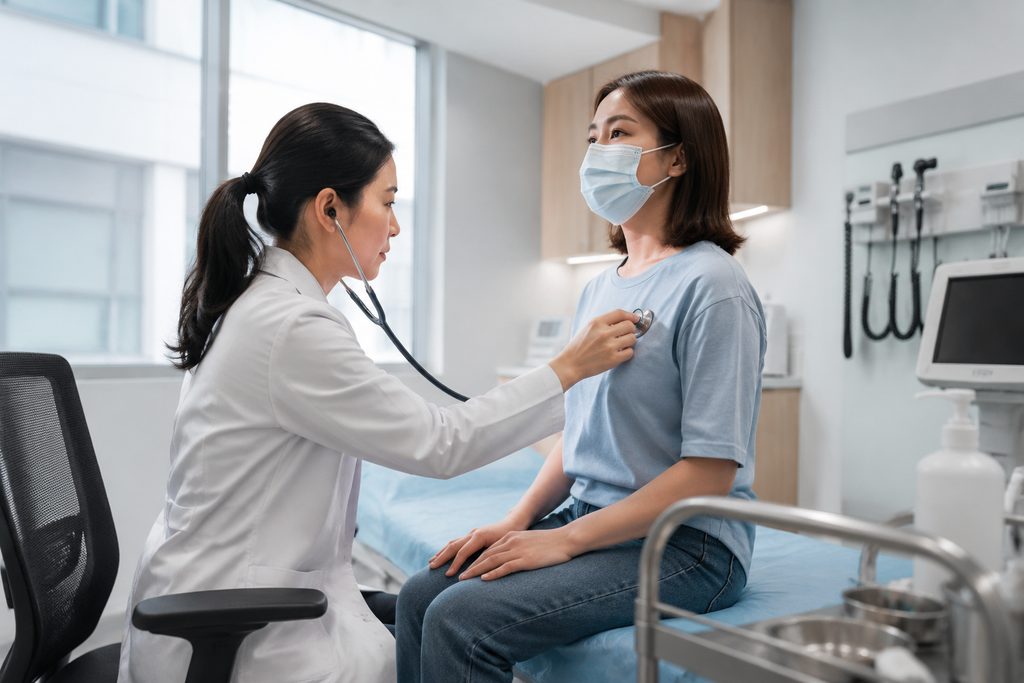
Then the physician consultation. A doctor reviews your questionnaire, listens to your heart and lungs, and asks about family history. In public departments this may take 5 minutes. In VIP international departments, 20 to 30 minutes. That difference is real and it’s one of the reasons the executive health screening package Beijing price runs higher than a standard public option.
If your package includes an endoscopy — gastroscopy or colonoscopy — that adds 2 to 3 hours including sedation and recovery. Some hospitals schedule endoscopy on a separate day to keep the main checkup under 5 hours.
How Long Does a Health Checkup Take in Shanghai: Day-by-Day
Shanghai is the most common entry point for international patients. The city’s top hospitals — Zhongshan, Ruijin, Huashan — all operate dedicated health management centers. So a realistic timeline for someone flying in looks like this:
Day 0: Arrive in Shanghai. Check into hotel near the hospital. No alcohol after 8 PM. Fast from 10 PM.
Day 1: Checkup from 7:30 AM to approximately 12:30 PM. If endoscopy is included, you’re done by 3 PM. Eat, rest, hydrate. Some results — blood work, urinalysis — are ready the same afternoon.
Day 2: Return for imaging review and physician consultation. The doctor walks through every finding, flags abnormalities, and recommends follow-up. You receive a printed report and, increasingly, a digital copy. Fly out that evening or the next morning.
That’s the compressed version. It works if you book through an international department or a private hospital. Walk into a public registration desk without Chinese language support and the same process can stretch to 4 or 5 days.
What It Costs
The full body checkup cost China ranges from roughly $150 to $3,000+. The spread is wide because the package contents vary dramatically. A $200 public hospital package covers basic labs, chest X-ray, abdominal ultrasound, and a brief physician review. A $2,500 executive package at a top-tier international department adds low-dose CT, cardiac ultrasound, carotid ultrasound, tumor markers, thyroid function, bone density, and a 30-minute consultation with a senior physician.
What drives the price:
- Imaging modality — ultrasound is cheap; CT and MRI are not; PET-CT is the most expensive at $800–$1,200 per scan
- Endoscopy — adding gastroscopy and colonoscopy typically adds $300–$700 including sedation
- Hospital tier — the same test costs 2 to 3 times more in a VIP international department than in a public standard clinic
- Gender and age — women’s packages with mammography and gynecological exams run 20–30% higher; packages for over-50s add more cardiovascular and cancer screening
None of these prices include travel, accommodation, or translation services. And none of them are a quote. They vary by hospital and case complexity. But they give you a realistic band to plan around. For context, a comparable executive screening in the United States or Singapore typically runs $3,000 to $8,000, and you’ll wait weeks for an appointment. In China, you can often book full health checkup China fast — sometimes within 48 hours of inquiry, especially through international departments.
Practical Considerations: Records, Visa, Payment, and Follow-Up
You’ll need your passport, any prior imaging or lab reports from your home physician, and a list of current medications. Bring those in English. The hospital will translate what’s necessary. If you have specific concerns — a family history of colon cancer, a breast lump, recurring headaches — write them down and hand that list to the coordinating nurse at check-in.
Visa matters. For a medical checkup, the applicable short-stay category is the S2 visa, issued for private affairs including medical treatment. You’ll need supporting documents from the hospital — an appointment confirmation or invitation letter from the health management center. Requirements shift by embassy and season, so check with the Chinese consulate in your country before booking flights. The S2 is not a guarantee of entry; it’s an application. Start the process at least 3 to 4 weeks before your intended travel date.
Payment is straightforward. Public hospitals require prepayment — cash, UnionPay, or major credit cards. Private international hospitals often accept direct insurance billing if you carry a policy with a global network. Even then, expect to pay a deposit at registration. Keep every receipt. Your home insurer may reimburse you after the fact, but Chinese public hospitals will not bill them directly.
Language is the friction point most foreigners underestimate. A public hospital health management center may process 1,000 patients a day. Signage is in Chinese. Staff may not speak English. A bilingual companion — someone who knows which window to visit, which form to fill, which elevator to take — turns a 6-hour ordeal into a 3-hour morning. That’s what our team does. We don’t diagnose anything and we’re not a hospital. We handle the logistics so you can focus on the results.
After you return home, the work isn’t finished. You’ll have a report, possibly 8 to 12 pages, with values and reference ranges. Some findings will be flagged. Not every flagged item is clinically significant — reference ranges vary by lab and population. The responsible next step is to share the full report with your primary care physician at home. They know your history. They can decide what needs follow-up and what doesn’t.
Frequently Asked Questions
Yes, often more so. Chinese health checkup packages bundle tests that Western systems typically gate behind symptoms or specialist referrals — things like abdominal ultrasound, tumor markers, and carotid artery imaging. The trade-off is interpretation. A flagged tumor marker doesn’t mean cancer; it means more testing. A good physician consultation at the end of your checkup is essential to separate signal from noise.
You can complete a standard package without endoscopy in about 4 hours if you book through an international department or private hospital and arrive at opening time. Results review may happen the same afternoon or the next morning. If your flight leaves that evening, ask the hospital to email the full report. Most international departments will do this.
Executive packages at Beijing’s top hospitals — places like Peking Union Medical College Hospital‘s international department — typically add cardiac ultrasound, carotid artery ultrasound, low-dose chest CT instead of X-ray, a wider tumor marker panel, thyroid function, and a longer consultation with a senior physician. You also get a private waiting area and a dedicated coordinator. That’s why the price runs $1,500 to $3,000 instead of $300 to $600.
Yes. Chinese health management centers don’t require a physician referral the way some Western systems do. You contact the hospital or a coordinator, choose a package, and schedule a date. International departments can often confirm within 48 to 72 hours. The limiting factor is usually your visa timeline, not the hospital’s availability.
This is the question everyone thinks and few ask. If a finding is urgent — a suspicious mass, a critical lab value — the hospital will tell you immediately and recommend follow-up imaging or a specialist consultation. You are not obligated to pursue treatment in China. You can take the report home and act there. But if you want to move forward in China, the same hospital can usually arrange a specialist appointment within days, not months. That’s one of the quiet advantages of doing the checkup where the treatment would happen.
Your Next Step
A health checkup in China is fast, dense, and affordable by Western standards. The trade-offs are language, navigation, and the need to interpret results carefully. If you know what you’re walking into, it’s a rational use of a trip you may already be planning.
Our team at China Medical Services helps international patients arrange checkups at Fudan-ranked public hospitals and JCI-accredited private international hospitals across 37 cities. We coordinate appointments, provide bilingual companions, and make sure your report gets into the right hands. We don’t diagnose, and we don’t treat. We handle the logistics. If you’re considering a checkup in China and want a clear picture of what it would look like for your specific situation, start with a conversation. Request a free consultation, and we’ll help you think it through.
That’s the core of it: know what you’re buying, understand the timeline, and plan for the follow-up. The checkup itself is the easy part.
For more medical information and treatment options in China, visit chinamedservices.com (China Medical Services).
