Stroke Rehab in China: Costs, Timelines, and Top Hospitals for Recovery
Stroke Rehab: The Short Answer
You’ve probably heard that recovering from a stroke means accepting a slow, uncertain decline. The reality is different — structured rehabilitation in China delivers measurable functional gains, often at a fraction of Western prices. The stroke rehab cost China patients typically pay runs $8,000 to $25,000 per month for comprehensive inpatient programs at top-tier facilities, compared with $30,000 to $60,000 monthly in the United States. That figure covers physician oversight, daily physical and occupational therapy, speech-language pathology, nursing care, and facility fees.
But numbers alone don’t tell the whole story. What you actually pay depends on stroke severity, hospital tier, length of stay, and whether you choose a public hospital’s international wing or a private rehabilitation center. And cost is only one factor. The quality of therapy, the intensity of daily sessions, and the continuity of care after discharge matter just as much as the price tag.
Who This Is Right For — and Who It Isn’t
Stroke rehabilitation in China works best for a specific profile of patient. Knowing whether you fit that profile matters more than any hospital ranking.
Typically good candidates:
- Patients 2–12 weeks post-stroke who are medically stable but have clear functional deficits — mobility, speech, swallowing, or fine motor control
- People who can tolerate 3–5 hours of active therapy per day
- Patients with adequate cardiopulmonary reserve; rehab is physically demanding
- Families who can commit to a minimum 4–6 week stay for meaningful gains
- Those whose insurance or personal funds allow for out-of-pocket payment upfront
Who should not pursue this:
- Patients in the acute phase (first 7–10 days) who still require intensive neurocritical care
- Those with unstable blood pressure, uncontrolled seizures, or active infections
- People with severe cognitive impairment who cannot participate in goal-directed therapy
- Patients whose primary need is long-term custodial care rather than active rehabilitation
- Anyone medically unfit for air travel — a decision only the treating neurologist can make
Being honest about who should not travel is what makes the rest of this guidance trustworthy. Stroke rehab is not a spa retreat. It is hard work, and the patients who improve most are those who arrive ready to work.
The Options, Compared
When international patients evaluate stroke rehabilitation, three genuine alternatives exist: staying in their home country, traveling to China, or choosing another medical-travel destination such as Thailand or Germany. Each has real trade-offs.
| Factor | United States | China (Top-Tier) | Thailand |
|---|---|---|---|
| Monthly inpatient rehab cost | $30,000–$60,000 | $8,000–$25,000 | $12,000–$20,000 |
| Therapy hours per day | 2–3 | 3–5 | 2–4 |
| Typical program length | 3–4 weeks | 4–8 weeks | 3–6 weeks |
| English-speaking staff | Standard | International wings: yes; general wards: limited | Common in private hospitals |
| Technology (robotics, VR) | Widely available | Available at top centers | Moderate |
| Insurance direct billing | Yes | Rare in public; some private | Common in private |
Which column fits you? If insurance covers your care at home and language is a barrier, staying put may be right. If you are paying out of pocket and want maximum therapy intensity per dollar, China’s top rehabilitation hospitals become very compelling. Thailand offers a middle ground with strong private-sector English support but less depth in neurological rehabilitation volume than China’s busiest centers.
What Actually Happens in a Chinese Stroke Rehab Program
This is the section most articles skip. Here is what a typical day looks like at a top rehabilitation department in China — say, at a major teaching hospital in Beijing or Shanghai.
Morning rounds start around 8:00 AM. A rehabilitation physician, a physical therapist, an occupational therapist, and often a speech-language pathologist review your progress from the previous day. They adjust goals. Not vague goals — specific ones like “increase passive shoulder flexion from 90 to 120 degrees” or “produce 10 intelligible two-word phrases during breakfast.”
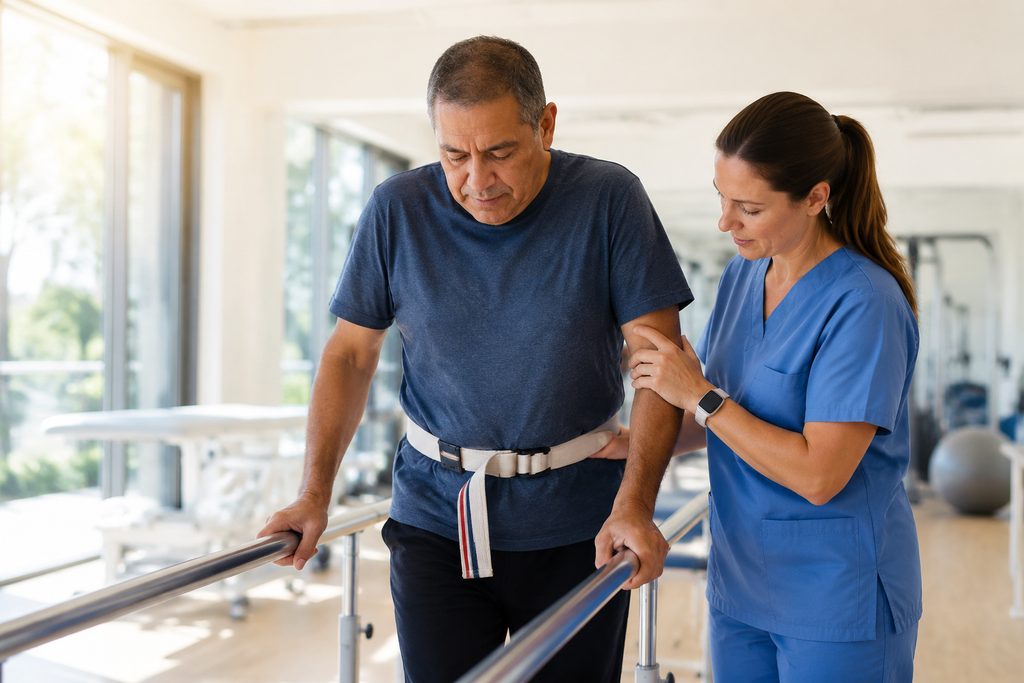
Then therapy begins. Physical therapy focuses on gait, balance, transfers, and strength. Occupational therapy works on dressing, eating, toileting, and fine motor tasks. Speech therapy addresses aphasia, dysarthria, and swallowing. In China, patients at top centers often receive acupuncture as an adjunct — not as a replacement for conventional therapy, but alongside it. The evidence for acupuncture in stroke motor recovery is mixed but suggestive for spasticity reduction and pain management. Many international patients find it a useful complement they could not easily access at home.
Afternoon sessions often include robotic-assisted gait training, mirror therapy for upper limb function, or transcranial magnetic stimulation in research-active centers. The intensity is the differentiator. More therapy hours per day, sustained over four to eight weeks, correlates with better functional outcomes — and that is where the value proposition lies.
How Long Does Stroke Recovery Take in China
The honest answer: meaningful recovery takes months, not weeks. But the trajectory matters more than the total duration.
For a typical ischemic stroke survivor with moderate hemiparesis, the first 4 weeks of intensive inpatient rehab in China often produce the most visible changes — improved walking distance, better arm function, clearer speech. Weeks 5 through 8 consolidate those gains and build endurance. Beyond 12 weeks, progress slows but continues, especially for language and complex motor tasks. Most international patients plan a 4–8 week initial stay, then return home with a structured home exercise program and remote follow-up consultations.
What drives the variance? Age, stroke location, baseline fitness, depression, and family support. A 58-year-old with a small subcortical infarct and no prior disability may regain independent walking in 3 weeks. An 82-year-old with a large middle cerebral artery stroke and atrial fibrillation may need 6 months to achieve modified independence. No honest provider can promise a specific timeline.
Stroke Rehab Cost China: What the Numbers Include
Let’s break down what you actually pay for. The stroke rehab cost China hospitals quote typically bundles these components:
- Bed and nursing care: $150–$400 per day depending on room class and hospital tier
- Physician oversight: $100–$250 per day for rehabilitation specialist rounds
- Physical therapy: $60–$120 per session (1 hour); most patients receive 2–3 sessions daily
- Occupational therapy: $50–$100 per session
- Speech-language pathology: $50–$90 per session
- Acupuncture: $30–$60 per session when included
- Diagnostics and imaging: $500–$2,000 total for baseline MRI/CT and lab work
What is usually not included: international airfare, visa fees, airport transfers, a bilingual companion, meals for family members, and any post-discharge telemedicine follow-up. Budget an additional $3,000–$6,000 for these logistics on a typical 6-week stay.
Is Stroke Rehab in China Effective? What the Evidence Says
Effectiveness is the question every family asks first. The answer is yes — with conditions.
China’s top rehabilitation departments handle enormous patient volumes. A single major rehabilitation center in Beijing may treat over 2,000 stroke inpatients annually. That volume translates into clinical experience that smaller centers cannot match. The best stroke rehabilitation hospital in China — often cited as China Rehabilitation Research Center in Beijing or the rehabilitation departments at Huashan Hospital and West China Hospital — consistently rank among the country’s top programs in the Fudan specialty reputation list for rehabilitation medicine.
But effectiveness depends on three things: arriving at the right time, receiving adequate therapy intensity, and having a discharge plan you can actually follow at home. A brilliant 4-week program followed by 6 months of inactivity produces poor long-term outcomes. The patients who do best combine an intensive inpatient stay in China with a structured home program and periodic remote check-ins.
What about the evidence for specific interventions? Constraint-induced movement therapy, task-specific training, and high-intensity gait training all have strong support in the rehabilitation literature. Chinese centers increasingly incorporate these evidence-based approaches alongside traditional modalities. The key is finding a program that emphasizes active, repetitive, task-oriented practice rather than passive modalities alone.
Practical Considerations: Records, Visa, Payment, and Follow-Up
Traveling to China for stroke rehabilitation requires preparation. Here is what actually matters.
Medical records: You need a complete discharge summary from the treating hospital, all imaging on CD or via secure link (CT, MRI, MRA), current medication list, and any speech or swallow evaluation reports. Have these translated into English — most hospitals already provide English summaries for international patients. A written second opinion before travel costs $300–$500 and can confirm whether a Chinese rehabilitation team believes you are a suitable candidate.
Visa: Medical treatment in China falls under the S2 visa category, with S1 for stays exceeding 180 days. Family members accompanying you also apply for S2. You will need an invitation letter from the receiving hospital and documentation of the treatment plan. Processing typically takes 1–3 weeks. No visa category guarantees approval, and requirements shift — check with the nearest Chinese embassy or consulate before booking flights.
Payment: Public hospitals in China require prepayment. Most international patients wire funds or pay by credit card at admission, then draw down the deposit as services are rendered. Insurance reimbursement is retrospective — you pay first, then claim. Private international hospitals may offer direct billing with certain insurers, but confirm this in writing before committing.
Language: General wards in public hospitals operate in Mandarin. International wings provide English-speaking coordinators, but day-to-day interactions with therapists may still require translation. A bilingual medical companion costs from $300 per day and handles registration, scheduling, interpretation, and navigation — practical support that becomes essential when you are also managing a family member’s recovery.
Follow-up after returning home: Before discharge, request a detailed home exercise program in English, a medication reconciliation, and a plan for remote video consultations. Many Chinese rehabilitation teams offer 30–60 minute follow-up video calls at $100–$300 per session. That continuity is often the difference between maintaining gains and losing them.
Frequently Asked Questions
A comprehensive 6-week inpatient program at a top-tier Chinese hospital typically costs $12,000–$30,000 total, excluding travel and visa expenses. Shorter 4-week stays run $8,000–$20,000. The range reflects hospital tier, room class, therapy intensity, and whether you choose a public international wing or a private facility. Always request an itemized quote before committing.
Several institutions stand out. China Rehabilitation Research Center in Beijing is dedicated exclusively to rehabilitation and ranks among the top programs nationally. The rehabilitation departments at Huashan Hospital in Shanghai and West China Hospital in Chengdu also carry strong reputations. For English-speaking coordination and Western-style amenities, international wings at these public hospitals or JCI-accredited private facilities like those listed on our private hospital directory are worth comparing.
You cannot book a general public ward bed remotely — public hospitals require in-person registration and physician evaluation first. What you can do is arrange a remote video consultation ($100–$300) with the rehabilitation team, submit your records for a written second opinion ($300–$500), and then coordinate admission through the hospital’s international department. This staged approach lets the Chinese team confirm suitability before you spend money on flights. Admission itself remains subject to hospital rules and bed availability.
Top rehabilitation hospitals are attached to full-service general hospitals with emergency departments, neurology, and neurosurgery on site. If a patient deteriorates — new stroke symptoms, seizure, infection — they are transferred to acute care within the same institution. This is a real advantage of choosing a rehabilitation program inside a major teaching hospital rather than a standalone rehab facility. Still, medical complications can extend your stay and increase costs beyond the initial quote.
Most international insurance plans require pre-authorization and reimburse after the fact. Chinese public hospitals do not bill insurers directly — you pay upfront, then submit claims. Some private international hospitals in China offer direct billing with select insurers, which simplifies cash flow but often comes with higher base prices. Check with your insurer about out-of-network rehabilitation coverage before making any deposits.
Your Next Step
Stroke recovery is a long road, and choosing where to spend the most intensive months of that journey is a decision no family should make alone. We help international patients evaluate whether Chinese rehabilitation programs fit their medical needs and budget — by reviewing records, arranging remote consultations with top rehabilitation teams, and coordinating the logistics if you decide to travel.
We are not a hospital, and we do not provide medical advice or diagnoses. What we do is connect you with the right specialists and handle the practical barriers that make cross-border care intimidating. If you are weighing stroke rehab options and want an honest assessment of whether China makes sense for your situation, request a free consultation with our team. No pressure, no obligation — just clear answers to help you decide.
For more medical information and treatment options in China, visit chinamedservices.com (China Medical Services).
