Your Rehabilitation Journey: Navigating Post-Surgery Recovery in China’s Top Hospitals
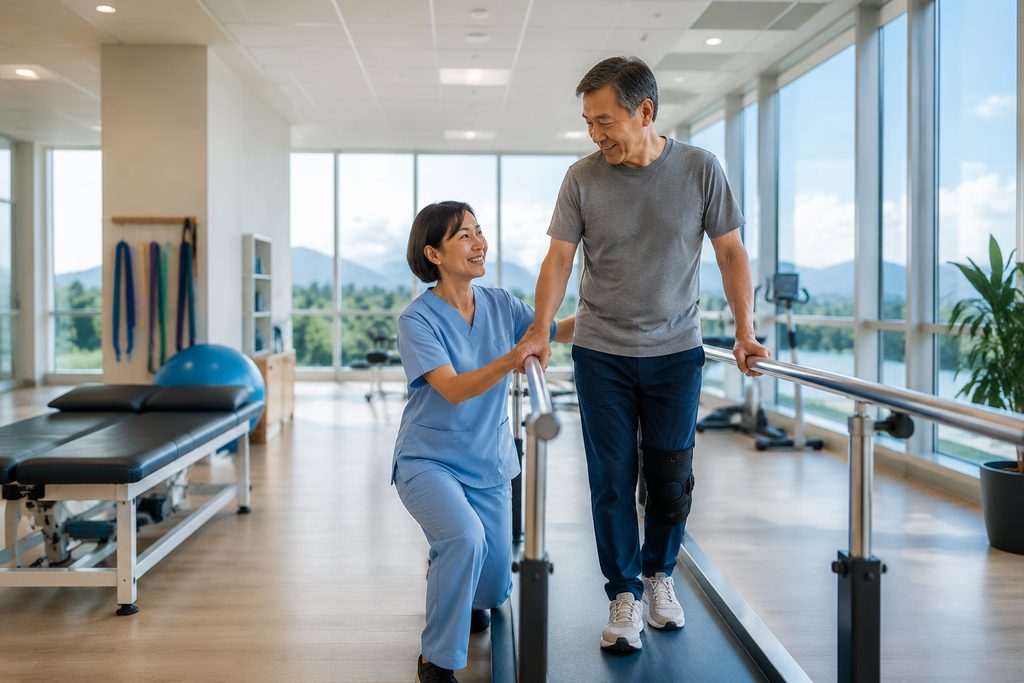
While patients in Canada wait a median 26.5 weeks between specialist referral and orthopedic surgery, surgeons at Beijing Jishuitan Hospital perform over 300 joint replacements monthly. That contrast reshapes how you think about your rehabilitation journey.
The gap between needing surgery and actually recovering from it has become the defining problem in Western healthcare. You get the procedure. Then you are discharged. Then what?
For thousands of international patients each year, the answer increasingly involves China. Not because it is exotic. Because it is fast, structured, and dramatically less expensive.
Key Takeaways
- Orthopedic rehab cost China typically runs 60-75% below equivalent US programs, with inpatient rehabilitation averaging $150-350 per day versus $1,500-2,500 in America.
- China’s top rehabilitation hospitals integrate TCM modalities like acupuncture and tuina massage alongside conventional physiotherapy, a combination rarely available in Western settings.
- Language and coordination barriers are real. Without bilingual support, navigating admission, therapy schedules, and discharge planning in a Chinese hospital is extremely difficult.
- Your medical records, imaging, and surgical notes must be translated and reviewed before any rehab program can be properly designed. This step cannot be skipped.
The Problem: Rehabilitation Is Where Recovery Actually Happens — And Where Systems Fail
Approximately 310 million surgeries are performed worldwide each year, according to the Lancet Commission on Global Surgery. For a large share of those patients, the operation itself is only the midpoint. The months that follow determine whether the procedure delivers lasting benefit or becomes another statistic in the growing literature on failed recovery.
In the United States, the average inpatient rehabilitation stay after joint replacement costs between $1,500 and $2,500 per day. A typical 14-day stay lands between $21,000 and $35,000. In the United Kingdom, NHS waiting lists for community rehabilitation services stretched to over 320,000 people in 2024. In Canada, patients routinely wait 4 to 6 months for publicly funded outpatient physiotherapy after hospital discharge.
So the surgery happens. Then the system stalls.
That stall is not just inconvenient. It is clinically harmful. Studies in the Journal of Bone and Joint Surgery show that delayed or inadequate rehabilitation after total knee arthroplasty correlates with reduced range of motion, higher rates of arthrofibrosis, and worse long-term functional outcomes. Scar tissue forms. Muscles atrophy. The window for optimal recovery narrows.
For patients paying out of pocket, the math becomes brutal. You pay $30,000 for the surgery. Then another $25,000 for rehab. Then insurance caps kick in. Then you are on your own.
Why China’s Rehabilitation Infrastructure Delivers Results
China has built rehabilitation capacity at a scale and speed that most Western systems cannot match. The country now operates over 340 top-ranked hospitals across 37 cities, many with dedicated rehabilitation departments that handle thousands of post-surgical cases annually.
Clinical Volume Creates Pattern Recognition
A rehabilitation physician at a major Chinese orthopedic center may oversee 50 to 80 post-operative patients per day. That is not an assembly line. It is pattern recognition at scale. When you have seen 10,000 knee replacement recoveries, you know exactly when a patient’s swelling is normal and when it signals early infection. Chinese rehab teams have seen it all — because they see it every single day.
Fuwai Hospital in Beijing performs over 14,000 cardiac surgeries annually, making it the highest-volume heart center in the world. Its cardiac rehabilitation program Shanghai counterpart at Zhongshan Hospital manages thousands of post-CABG and post-valve patients each year. That volume translates into protocols that are refined, tested, and adjusted continuously.
Integrated TCM Modalities Add a Layer Western Rehab Lacks
Chinese rehabilitation departments routinely combine conventional physiotherapy with acupuncture, tuina (medical massage), and herbal medicine. This is not alternative medicine bolted on as an afterthought. It is integrated into the daily therapy schedule. A typical post-knee-replacement day at a Chinese rehab hospital might include 45 minutes of physiotherapy, 30 minutes of acupuncture for pain and swelling, and 20 minutes of tuina to improve circulation and mobility.
Clinical evidence supports this combination. A 2023 meta-analysis in the Journal of Orthopaedic Surgery and Research found that acupuncture as an adjunct to standard rehabilitation after total knee arthroplasty significantly reduced pain scores at 2 and 4 weeks post-surgery compared to rehabilitation alone. For patients wary of opioid dependence, this matters enormously.
Cost Structure: Why Orthopedic Rehab Cost China Is a Fraction of Western Rates
Let’s address the obvious question. Why is orthopedic rehab cost China so much lower? Is something being cut?
The answer is structural. Chinese hospital labor costs are lower because the cost of living for medical staff is lower. Hospital construction costs are lower. Administrative overhead is leaner. None of that affects the quality of the physiotherapy itself. The exercises, the manual therapy, the gait training — these are the same evidence-based practices used globally.
| Rehabilitation Service | China (USD) | United States (USD) | United Kingdom (USD, private) |
|---|---|---|---|
| Inpatient rehab, per day | $150–350 | $1,500–2,500 | $900–1,400 |
| Outpatient physiotherapy, per session | $30–80 | $100–250 | $70–120 |
| Full 14-day post-joint-replacement rehab package | $2,100–4,900 | $21,000–35,000 | $12,600–19,600 |
| Cardiac rehab program (8-week outpatient) | $800–2,500 | $3,000–8,000 | $2,500–5,000 |
| Stroke rehab (30-day inpatient) | $4,500–10,500 | $45,000–75,000 | $27,000–42,000 |
These figures vary by hospital tier and case complexity. A top-tier public hospital’s international department will charge more than a standard ward. A private international hospital like United Family or Jiahui will charge more still — but even their rates typically undercut Western private rehab by 40-50%.
Your Rehabilitation Journey: Week-by-Week Timeline After Major Orthopedic Surgery
Every patient’s timeline differs. But for a typical total knee or hip replacement, here is what a structured Chinese rehab program actually looks like.
Week 1 — Inpatient, acute phase. You remain in the surgical hospital. Physiotherapists begin passive range-of-motion exercises within 24 hours of surgery. Goal: achieve 90 degrees of knee flexion before discharge. Pain management combines standard analgesics with acupuncture if you consent.
Week 2 — Transfer to rehabilitation unit. Most Chinese hospitals move post-surgical patients to a dedicated rehab floor or partner facility. Daily schedule: 2 hours of physiotherapy split into morning and afternoon sessions. Gait training with parallel bars. Swelling management with compression and elevation.
Weeks 3-4 — Intensive outpatient or continued inpatient. If you stay inpatient, expect 3-4 hours of therapy daily. If outpatient, plan for daily sessions. This is when scar tissue management and full weight-bearing progression happen.
Weeks 5-8 — Functional restoration. Stair training, balance work, and return-to-activity preparation. By week 8, most patients walk independently without assistive devices.
How long is stroke rehab in Beijing? The timeline stretches considerably. A typical ischemic stroke patient spends 4 to 6 weeks in inpatient rehabilitation, with the first 2 weeks focused on basic mobility and dysphagia management, and subsequent weeks on fine motor skills, speech therapy, and activities of daily living. Some patients extend to 12 weeks depending on deficit severity.
Choosing the Right Facility: What Actually Matters When Comparing Options
Not every rehabilitation hospital in China is equal. Some are world-class. Others are not. Here is how to evaluate your options honestly.
First, check whether the facility is ranked in the Fudan University hospital rankings — the most authoritative hospital evaluation system in China. The top-ranked hospitals list includes only the top 5% of China’s 35,000+ hospitals. If a rehab facility is not on this list, ask why.
Second, look at the rehabilitation department’s specific reputation. The Fudan rankings include 45 specialty lists. For post-orthopedic-surgery rehab, you want a hospital ranked among China’s top 10 for orthopedics or rehabilitation medicine. Our department rankings break this down by specialty.
Third, verify English-speaking staff availability. In a standard Chinese public hospital ward, English is rare. In international departments and private hospitals, it is standard. Is post-surgery rehab in China safe for a foreigner who speaks no Mandarin? The medical care is safe. The logistics are the problem — and that is where bilingual support becomes essential.
Fourth, consider the city. Beijing and Shanghai have the highest concentration of top-ranked rehab facilities. But Guangzhou, Chengdu, and Hangzhou also host excellent programs at lower cost. The Beijing hospital network offers the most options, while Shanghai’s international hospital ecosystem provides the smoothest English-language experience.
A hard truth: You cannot simply email a Chinese public hospital and book a rehab bed. Standard outpatient registration requires in-person queueing. Surgery and inpatient admission require an in-person consultation first. For international patients, the practical path is through a hospital’s international department or a coordination service that handles registration, translation, and scheduling on your behalf.
Practical Considerations: Documents, Visas, and Payment for Your Rehab Stay
Planning a rehabilitation stay in China requires more paperwork than a typical medical tourism trip. Here is what you actually need.
Medical records. Bring everything: surgical notes, discharge summaries, imaging (MRI, CT, X-ray — both digital files and printed films), pathology reports if relevant, and a list of current medications. All documents should ideally be translated to Chinese before arrival. Most hospital international departments can arrange translation, but having it done in advance speeds up admission.
Visa. For medical treatment and rehabilitation in China, the applicable short-stay category is the S2 visa, annotated for medical treatment purposes. Stays beyond 180 days require an S1 visa. Accompanying family members also apply for S2. Requirements vary by embassy, and you will need supporting documents from the receiving hospital — typically an invitation letter or treatment confirmation. No visa category guarantees approval; each application is assessed individually.
Payment. Chinese public hospitals require prepayment. Expect to deposit a lump sum at admission, then top up as treatment progresses. International departments and private hospitals may accept international credit cards; standard public wards often do not. Most international patients pay out of pocket and seek reimbursement from their home insurer afterward. Private international hospitals like those listed on our international hospital page frequently offer direct insurance billing.
Language. Even in international departments, not every nurse or therapist speaks fluent English. A bilingual companion who can translate during therapy sessions, clarify medication instructions, and handle administrative tasks dramatically reduces friction. This is not a luxury. For many patients, it is the difference between a smooth recovery and a stressful ordeal.
Frequently Asked Questions
Yes — at top-ranked hospitals. The best Chinese rehabilitation departments follow international clinical protocols and maintain accreditation standards comparable to Western institutions. The risk is not in the medical care; it is in navigating a system where you do not speak the language and do not know which facilities are genuinely top-tier. Choose a Fudan-ranked hospital and you are getting care at a level that matches or exceeds most Western rehab centers.
For a 4-week inpatient orthopedic rehab program, budget $4,200 to $14,000 for medical costs, depending on hospital tier. Add $1,500 to $3,000 for accommodation if you choose outpatient rehab. Flights, visa fees, and daily living expenses are additional. The total typically lands at 50-70% less than an equivalent US program, even after travel costs.
Complications like infection, deep vein thrombosis, or poor progress do occur — in every country. Chinese top-tier hospitals are equipped to manage these. What matters is having a clear escalation path: your rehab physician should have direct access to the surgical team that performed your original operation, whether that surgery happened in China or abroad. Ask about this before you commit to any program. If the rehab facility cannot articulate how it handles complications, keep looking.
You cannot book a bed directly with a public hospital from overseas. What you can do is arrange a remote consultation — sending your surgical records and imaging for review by a Chinese rehabilitation specialist. Based on that review, the hospital can confirm whether you are a suitable candidate and provide a treatment plan and cost estimate. This is the standard first step for international patients. It also protects you from traveling to China only to discover the program cannot meet your needs.
Your Next Step
Your rehabilitation journey does not have to stall after surgery. China’s top hospitals offer structured, high-volume, cost-effective rehab programs that rival anything available in the West — at a fraction of the price. The challenge is not the quality of care. It is the coordination.
We help international patients navigate that process: hospital selection based on your specific surgery, remote consultation with Chinese rehabilitation specialists, document translation, visa guidance, and bilingual on-the-ground support. We are not a hospital and we do not provide medical advice or diagnoses. We are the bridge between you and China’s medical expertise.
If you are weighing your options, start with a conversation. Explore our patient coordination services and see whether a structured rehab program in China makes sense for your recovery.
Recovery is not a passive process. It is a decision. Make it with full information.
For more medical information and treatment options in China, visit chinamedservices.com (China Medical Services).
