Long Hospital Stays: A Companion for the Stay in China
Key Takeaways
- A bilingual medical companion in China costs from $300 per day, covering translation, navigation, and coordination across a hospital system where 340+ top-ranked hospitals serve over 35,000 total institutions.
- Family members can stay with patients in most Chinese public hospital wards, but private rooms with sleeping space for a relative are limited and often require booking through an international or VIP department.
- The biggest barrier for foreign patients is not medical quality — it is operational friction: registration queues, payment counters, pharmacy pickup, and specialist referrals all run in Mandarin.
- Before committing to any extended stay, confirm the hospital’s visitor policy, the ward type, and whether the companion service covers the specific hospital you have chosen.
The Problem: A Hospital Stay Abroad Is Not Just About Medicine
A long term hospital stay companion China is not a luxury. It is often the difference between a coordinated recovery and a disorienting, costly mess. The numbers put this in perspective. A single day in a US hospital costs anywhere from $2,800 to over $5,000 depending on the state and acuity level, according to Kaiser Family Foundation data. For a two-week stay, that is $40,000 to $70,000 before a single procedure. Patients facing extended treatment — oncology cycles, complex orthopedic revisions, cardiac rehabilitation — routinely burn through savings in weeks, not months.
Now add the language barrier. China’s top public hospitals see 10,000+ outpatient visits per day at major centers. Registration machines, lab result printers, pharmacy windows, and ward nursing stations operate almost entirely in Mandarin. Without someone who reads the signs, knows which floor handles what, and can advocate with nurses and billing staff, a patient can lose hours daily just navigating logistics. That lost time compounds over a long stay.
Why a Companion Changes the Equation for a Long Term Hospital Stay Companion China
The evidence for companion support during hospitalization is not anecdotal. A 2018 systematic review in the Journal of Patient Experience found that patients with consistent caregiver presence reported lower anxiety, better pain management, and fewer communication errors with clinical staff. In a foreign hospital system, the companion’s role expands dramatically: they become the patient’s operational memory, language bridge, and cultural interpreter.
Clinical Volume Means Nothing Without Navigation
Fuwai Hospital in Beijing performs over 14,000 cardiac surgeries annually — the highest volume in the world. Zhongshan Hospital in Shanghai handles complex liver and cardiac cases at a scale unmatched in Europe. But volume does not help a patient who cannot find the right building. A companion who knows the hospital layout, the check-in sequence, and the timing of ward rounds saves hours. That is not a soft benefit. It is operational efficiency that directly affects how quickly tests get ordered and results get reviewed.
Cost Structure Rewards Longer Stays
A cardiac bypass in a top Chinese public hospital runs $12,000 to $20,000. In the US, the same procedure exceeds $120,000. That gap widens for extended stays. A private international hospital in Shanghai with JCI accreditation and English-speaking staff might charge $800 to $1,500 per night for a private room. A public hospital VIP ward runs about 1.5 to 2 times the standard rate — often $150 to $400 per night. Add a companion at $300 per day, and a three-week stay still lands far below Western costs.
Private Hospital Long Stay Package Shanghai Cost: What the Numbers Show
When patients ask about a private hospital long stay package Shanghai cost, they are usually comparing two models. Private international hospitals — United Family, Jiahui, Parkway, Raffles — offer bundled packages for extended oncology, rehabilitation, and post-surgical care. These packages typically include the room, nursing, meals, and basic consumables. Prices range from $1,200 to $3,000 per night depending on the hospital and ward class. A two-week package lands between $16,800 and $42,000. That is significant. But it includes English-speaking staff, direct insurance billing, and Western-style amenities. For patients with international insurance, the out-of-pocket portion can be minimal.
| Stay Component | Public Hospital Standard Ward | Public Hospital VIP/International Ward | Private International Hospital |
|---|---|---|---|
| Room cost per night | $40–$120 | $150–$400 | $800–$3,000 |
| Bilingual companion (per day) | $300 | $300 | Often included or $200–$300 |
| English-speaking staff | Rare | Common | Standard |
| Family overnight stay | Limited, fold-out bed | Usually allowed, sofa bed | Usually allowed, proper bed |
| Direct insurance billing | No — prepay, then claim | Sometimes | Yes |
Can Family Stay with Patient in Chinese Hospital? Ward Rules Explained
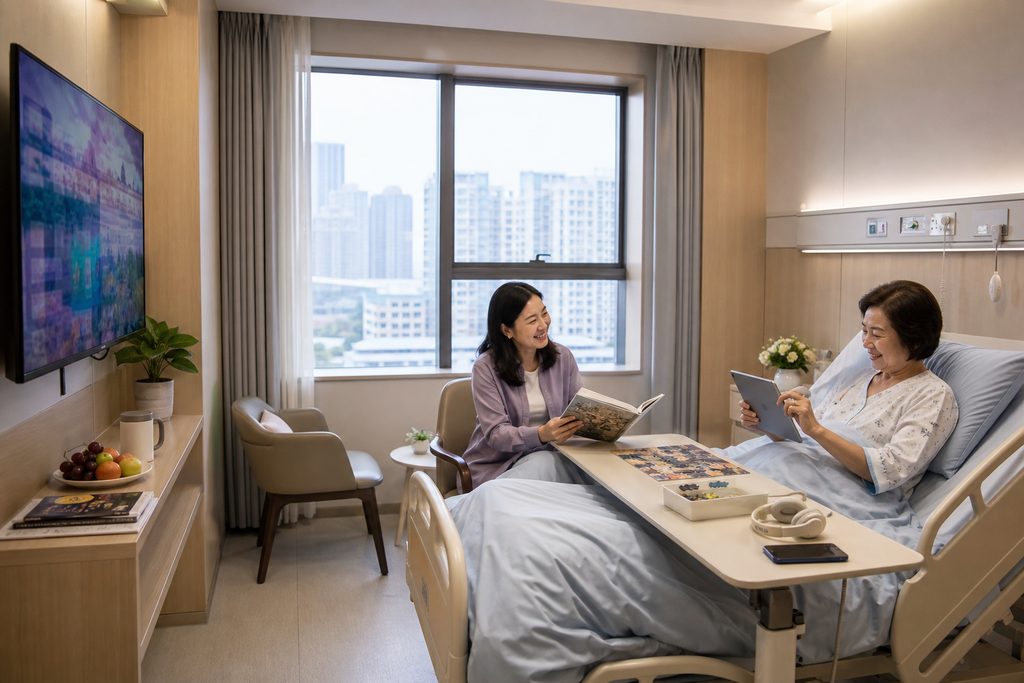
The short answer is yes, in most cases. But the conditions vary sharply by hospital tier and ward type. Standard public hospital wards in China are typically shared rooms with 3 to 6 beds. A family member can stay, but often only on a fold-out chair or narrow cot. Space is tight. Privacy is minimal. For a long stay, this wears on both patient and caregiver.
VIP and international wards are different. These units — often on dedicated floors — offer single or double rooms with a sofa bed, private bathroom, and sometimes a small refrigerator. Family presence is expected and accommodated. The trade-off is cost: 1.5 to 2 times the standard rate. For a three-week stay, that could mean an extra $1,000 to $4,000. Many families decide the space and privacy are worth it, especially when a companion is also present during the day.
Some hospitals enforce quiet hours and limit overnight visitors to one person. Others require a hospital-issued caregiver pass. Confirm the specific policy before booking flights. Our team checks this for every patient because it is exactly the kind of detail that causes friction on arrival.
How to Arrange Companion for Hospital Stay Abroad: A Step-by-Step View
Arranging support for an extended stay in China is not a single phone call. It is a sequence of decisions. Here is how the process works in practice.
First, choose the hospital. For complex cardiac cases, Fuwai Hospital in Beijing or Zhongshan Hospital in Shanghai are the obvious references. For oncology, the Fudan University Cancer Hospital and Peking Union Medical College Hospital carry strong reputations. The top-ranked hospitals database organizes these by city and specialty, which saves hours of scattered research.
Second, secure the ward type. Standard public wards cannot be booked in advance from overseas. You need the hospital’s international or VIP channel. That is where a coordination service becomes practical. We contact the international department, submit translated records, and confirm bed availability. Without this step, a patient arrives and queues like everyone else — which for a long stay is a poor start.
Third, arrange the companion. A bilingual medical companion handles registration, payment queues, pharmacy pickup, test scheduling, and interpretation during ward rounds. The companion does not replace a nurse or doctor. They remove the operational burden so the patient and family can focus on treatment decisions.
Book Extended Hospital Stay with Caregiver Beijing: What to Confirm Before You Commit
Beijing has 21 of China’s Fudan-ranked top 100 hospitals — the highest concentration of any city. That density creates options, but also confusion. When patients ask us to help book extended hospital stay with caregiver Beijing, we walk through a checklist first.
Confirm the hospital accepts foreign patients through its international department. Not all do. Some top public hospitals have no dedicated international channel and will not coordinate overseas bookings. In those cases, a private international hospital in Beijing — United Family, Raffles, or Jiahui — may be the better fit, especially for longer stays where language support matters daily.
Check the caregiver policy. Does the hospital allow a hired companion on the ward during treatment hours? Most do, but some ICU and isolation units restrict access. A companion who cannot enter the ward loses half their value. We verify this before any commitment.
Understand payment. Public hospitals require prepayment — a deposit is loaded onto the patient’s hospital card, and charges are deducted daily. If the balance runs low, treatment pauses until it is topped up. A companion monitors this balance and handles top-ups so the family does not get surprised at 9 p.m. on a Sunday.
Practical tip: Bring a power bank, a multi-plug adapter, and a translation app loaded with offline Mandarin. Hospital Wi-Fi in China can be unreliable, and outlets near hospital beds are often in awkward positions.
What to Bring for Long Hospital Stay Overseas: A Realistic Packing List
Packing for a hospital stay abroad is different from packing for travel. The patient is not sightseeing. They are living in a clinical environment for weeks. What to bring for long hospital stay overseas breaks into four categories.
Documents first. Passport, visa, medical records, imaging discs, medication list with generic names, insurance policy documents, and a notarized translation of any advance directive. Keep physical copies and digital scans. Chinese hospital registration desks want to see originals, not phone screens.
Comfort items. Hospital gowns are standard in China, but patients often prefer their own loose clothing for non-procedure days. Bring slip-on shoes, a warm layer — hospital air conditioning runs cold — and a neck pillow. Earplugs and an eye mask matter more than most people expect. Shared wards are not quiet at 6 a.m.
Communication tools. A smartphone with a China-compatible SIM or roaming plan. A tablet loaded with movies and books. A pocket translator for moments when the companion is not present. And a notebook for writing down questions for the next ward round.
Daily logistics. A refillable water bottle — boiled water is available on most wards. Snacks that travel well, though hospital cafeterias and nearby shops cover most needs. Cash in RMB for small purchases, though mobile payment via Alipay or WeChat is now nearly universal.
Practical Considerations: Visas, Payment, and Follow-Up for a Long Term Hospital Stay Companion China
Bilingual medical companion services start at $300 per day for a full 8-hour day. For a three-week stay, that is $6,300. Some providers offer reduced rates for extended bookings. VIP coordination packages range from $5,000 to $8,000 for end-to-end support. Final pricing varies by hospital and case complexity.
Complications are handled by the medical team, not the companion. But the companion’s role in a crisis is real: they ensure the family understands what is happening, they escalate concerns to the international department, and they document everything. A billing dispute is easier to resolve when someone can read the itemized statement and speak with the cashier in Mandarin. We do not promise perfect outcomes. We do promise that nothing gets lost in translation.
Yes, and that is often the smarter sequence. The companion service can help evaluate hospital options based on your diagnosis, budget, and ward preferences. But the final hospital choice should come from medical considerations, not logistics. We help with both, and the companion service page explains how the consultation works.
Your Next Step
A long hospital stay in China is manageable with the right preparation and the right person on the ground. The medical quality is there. The cost advantage is real. The operational friction is the only thing standing between you and a smooth stay. China Medical Services helps international patients arrange bilingual companions, hospital coordination, and the practical logistics of extended treatment in China. We are not a hospital and we do not provide medical advice. Start with a free consultation — tell us your diagnosis, your preferred city, and your timeline, and we will map out what is feasible.
Frequently Asked Questions
Yes. The hospitals used for international patients are JCI-accredited and follow the same international safety standards as top hospitals in the US and Europe. Surgical teams perform high volumes of procedures — often more than their Western counterparts — which studies show leads to better outcomes.
Costs vary by procedure and hospital, but international patients typically save 40-80% compared to US prices — even when factoring in travel and accommodation. A consultation with our team will give you an exact, all-inclusive quote with no hidden fees.
Send us your existing medical reports to get started. We handle everything from hospital selection and appointment scheduling to visa assistance and post-operative recovery planning. Your medical records are reviewed by the specialist before you even book a flight.
For more medical information and treatment options in China, visit chinamedservices.com (China Medical Services).
