Inpatient Companion: Video Calls With Family in Chinese Hospitals
Key Takeaways
- Most Chinese public hospital wards do not provide bedside Wi-Fi reliable enough for video calls; international departments and private hospitals are the realistic exceptions.
- Staying connected with family during an inpatient stay usually requires a combination of a local SIM card, a VPN configured before arrival, and a bilingual companion who can negotiate nursing-station logistics.
- Private international hospitals in Shanghai and Beijing often include family video call facilitation as a standard service, while public hospital international wards typically accommodate it upon request.
- Expect to budget $300–800 per day for a private room with dependable connectivity, depending on the hospital tier and city.
The Problem: Isolation During a Hospital Stay Abroad
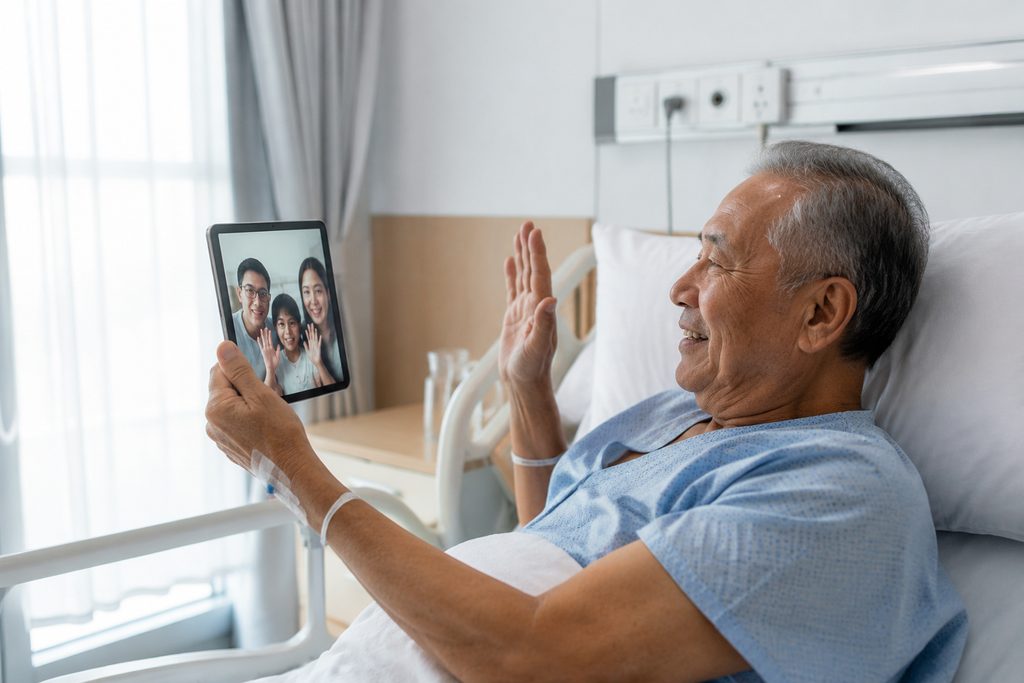
An inpatient video call family China hospital arrangement sounds straightforward until you are lying in a ward bed at 2 a.m., staring at a buffering screen, while your spouse in London or your daughter in Toronto waits for a connection that will not hold. The anxiety of being hospitalized in a foreign country compounds quickly when you cannot reliably reach the people who anchor you.
A 2023 survey by the Joint Commission International found that communication barriers and isolation rank among the top three stressors reported by international patients, alongside pain management and financial uncertainty. The study noted that patients who maintained regular video contact with family showed measurably lower cortisol levels during recovery. That is not sentimental fluff. That is physiology.
China’s public hospital system presents a specific challenge here. The sheer scale of these institutions — some single-day outpatient volumes exceed 10,000 visits — means that infrastructure priorities focus on clinical throughput, not guest connectivity. Public Wi-Fi in wards is often restricted, throttled, or blocked entirely for foreign applications. WeChat works. FaceTime often does not. WhatsApp sometimes will not even open without a VPN.
So the question is not whether video calls with family during a hospital stay in China are possible. They are. The question is what infrastructure, preparation, and hospital choice make them dependable.
Why Hospital Choice Determines Your Video Call Experience
The single biggest variable is not your phone. It is where you are admitted. China’s hospital landscape splits into three tiers for international patients, and each handles family communication differently.
Public Hospital Standard Wards: Assume Nothing Works
Standard wards at top-ranked public hospitals — the kind listed in the Fudan rankings across 340+ hospitals in 37 cities — are built for volume. Beds are often arranged three to six per room. Curtains separate patients, not walls. A shared nursing station handles dozens of beds per shift.
Wi-Fi in these wards, where it exists, is typically a captive portal requiring a Chinese phone number for SMS verification. Even after connecting, international video calling apps face inconsistent connectivity. Some hospitals block VPN traffic at the network level. Others simply do not have enough bandwidth for stable video during peak evening hours when every patient and visitor is online.
But here is the operational reality that matters more: nurses on standard wards are not equipped to facilitate family video calls. They are managing medication schedules, wound care, and physician rounds. Asking a nurse to hold a phone so your family can see you is not a service they can reliably provide. A bilingual medical companion fills that gap — positioning the device, managing the connection, translating when a doctor walks in mid-call.
International Departments: The Middle Path
Most major public hospitals operate an international department or VIP wing. These units charge roughly 1.5 to 2 times standard rates and offer private or semi-private rooms, English-speaking coordination staff, and — critically for this topic — more flexible connectivity policies.
In international departments, staff are accustomed to foreign patients. Requests like “can I video call family during hospital stay China” are routine, not exceptional. Nursing stations in these units will often help schedule a call around treatment times. Some provide in-room Wi-Fi with fewer restrictions, though a VPN remains advisable for consistent access to Western platforms.
The trade-off is cost and availability. International department beds are limited. Booking one requires coordination through the hospital’s international office, which is where a service like our patient coordination team becomes useful — not to sell you access, but to navigate the paperwork and timing so you do not arrive in Beijing only to find the international ward full.
Private International Hospitals: Built for This
Private international hospitals — United Family, Jiahui, Parkway, Raffles — design their patient experience around foreign expectations. English-speaking staff are the default. Insurance direct billing is standard. And family communication is treated as part of care, not an afterthought.
A private hospital with family video call service Shanghai or Beijing will typically provide in-room Wi-Fi configured for international apps, staff who can assist with device setup, and private rooms where a video call does not disturb other patients. Some facilities even offer scheduled family update calls with the attending physician, coordinated by the nursing team.
The cost difference is significant. A private room at a JCI-accredited private hospital in Shanghai runs $500–800 per night, compared to $100–200 for a standard public ward bed or $300–500 for a public hospital international department room. For many patients, that premium buys exactly one thing: predictability.
How International Patients Contact Family During Surgery in China
Surgery day is the hardest communication gap to bridge. You will be under anesthesia. Your family will be waiting, often in a different time zone, with no direct line to the operating theater.
Here is how the flow typically works at a top-tier Chinese hospital. When you check in, the surgical team records an emergency contact — usually a family member or your designated medical companion. During the procedure, the circulating nurse or a member of the international coordination team provides updates to that contact at key milestones: patient in the operating room, procedure underway, procedure complete, patient in recovery.
That is the official channel. The practical channel is your companion. A bilingual medical companion stationed in the waiting area can relay updates in real time, translate what the surgical team says when they emerge, and set up a video call with your family the moment you are conscious enough to speak. This is not a luxury. For families deciding whether a loved one should travel to China for surgery, this channel is often the difference between consent and cancellation.
Some hospitals now offer operating theater update screens in international department waiting areas. Others still rely on phone calls. Do not assume either. Ask during your pre-admission consultation exactly how updates will flow, who will initiate them, and what happens if surgery runs long.
What It Costs to Stay Connected: A Realistic Breakdown
The cost of maintaining family video contact during a hospital stay in China breaks into three buckets: connectivity, facilitation, and room choice. Here is what international patients should budget.
| Item | Typical Cost (USD) | Notes |
|---|---|---|
| Local SIM card with data (30 days) | $15–40 | China Mobile, China Unicom, or China Telecom; passport required for registration |
| VPN subscription (30 days) | $5–15 | Must be installed and tested before arriving in China |
| Bilingual medical companion (full day) | from $300/day | Covers device setup, call facilitation, translation during physician updates |
| Public hospital international department private room | $300–500/night | Better connectivity policies; request video call accommodation at admission |
| Private international hospital private room | $500–800/night | In-room Wi-Fi configured for international apps; staff-assisted family calls |
These figures vary by hospital and case complexity. A patient admitted for a three-day observation will face a very different budget than one recovering from cardiac surgery over two weeks. The point is that connectivity is a line item, not an afterthought. International patient hospital video calling family cost should be factored into the total treatment budget from day one.
Practical Considerations: Making the Call Actually Work
You cannot fix connectivity from a hospital bed. The preparation happens before you board the plane.
First, the VPN. Download and test it at home. Pay for a reputable service. Log in once before departure. Confirm it works on the specific apps your family uses — FaceTime, WhatsApp, Zoom, Skype. Some VPNs work better than others inside Chinese hospital networks, and there is no way to test that until you are there. Having a backup VPN installed costs nothing and saves hours of frustration.
Second, the local SIM. Your home carrier’s roaming plan may work in China, but speeds are often throttled and video calls will stutter. A local SIM with a generous data package — 20GB or more for a two-week stay — costs under $40 and requires only your passport at a carrier store. Your companion can arrange this on arrival day, before you are admitted.
Third, the time zone conversation. If your family is in New York and you are in Shanghai, there is a 12-hour offset. A scheduled daily call at 8 p.m. Shanghai time is 8 a.m. in New York. Setting that expectation before admission prevents missed calls and mounting anxiety on both ends. Write the schedule down. Give it to your companion. Ask the nursing station to avoid scheduling treatments during that window when possible.
Fourth, the visa reality. Family members traveling with you to China for medical purposes apply for an S2 visa, not an M visa. The S2 covers short-term private affairs, including accompanying a patient for treatment. Your own medical travel also falls under S2. The hospital’s international office will provide an invitation letter and treatment confirmation documents to support the application. Approval is never guaranteed, and processing times vary by consulate, so start this process early. For stays exceeding 180 days, the S1 category applies.
Fifth, the device itself. Bring a tablet or a second phone if possible. Hospital beds are awkward places to hold a phone for a 20-minute call. A small tablet stand costs $10 and makes a meaningful difference. Your companion can position the device, manage the angle, and step out when the conversation turns private.
Frequently Asked Questions
Yes, but with caveats. Standard public wards often have restricted or unreliable Wi-Fi for international apps, and nursing staff are not available to facilitate calls. International departments and private hospitals offer far more dependable connectivity and staff who will accommodate scheduled family calls. A VPN and local SIM card remain essential regardless of hospital tier.
Through a designated emergency contact, usually a family member or medical companion, who receives milestone updates from the surgical or coordination team. The companion can translate updates in real time and initiate a video call once the patient is conscious. Some international departments provide structured update protocols; ask about this during pre-admission.
Private rooms at JCI-accredited international hospitals in Shanghai typically run $500–800 per night. This includes in-room Wi-Fi configured for international apps, English-speaking staff, and assistance with family video calls. Public hospital international departments offer a lower-cost alternative at $300–500 per night with more variable connectivity support.
Your accompanying family member applies for an S2 visa, which covers short-term private affairs including medical accompaniment. The M visa is for commercial and trade activities and is not appropriate for medical travel. Hospital invitation letters and treatment confirmation documents support the S2 application, but approval is at the consulate’s discretion.
Not through standard public hospital channels. Public hospital admissions require in-person outpatient consultation first, and room assignment is made at admission time. International departments and private hospitals may allow advance room requests through their international offices. A coordination service can help navigate this process, but cannot guarantee a specific room or connectivity setup.
Your Next Step
Staying connected with family during a hospital stay in China is a solvable problem. It requires the right hospital choice, the right preparation, and someone on the ground who can bridge the language and logistics gaps. That is what we do at China Medical Services — we help international patients navigate hospital selection, admission coordination, and bilingual companion support. We are not a hospital and we do not provide medical advice. If you are considering treatment in China and want to understand your connectivity options before committing, start with a free consultation. We will walk you through what is realistic for your specific situation, no pressure and no obligation.
For more medical information and treatment options in China, visit chinamedservices.com (China Medical Services).
