Transport: Your Trip Starts Here for Medical Care in China
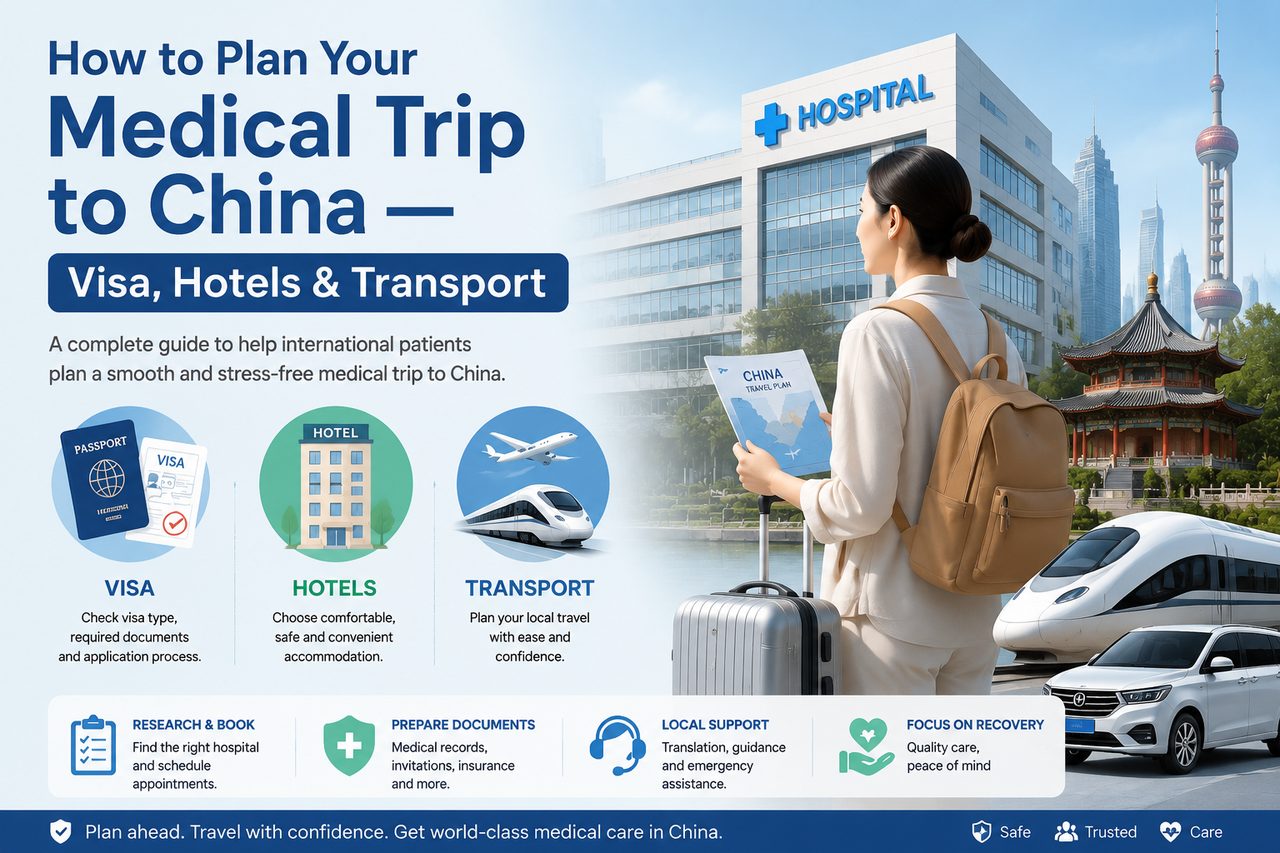
When 42-year-old Michael first heard the word “lymphoma,” he had no idea where to start looking for treatment. His oncologist in Manchester outlined a chemotherapy protocol. Then came the bill estimate: £8,400 per cycle, with six cycles planned. Michael started searching. That search led him to questions about cancer treatment cost China — and to a much harder question: if he chose to travel, how would the trip itself actually work?
Our team fields questions like Michael’s every week. Not just about prices. About the physical journey: the visa at the consulate, the flight into a city of 25 million people, the first taxi from the airport, the hospital registration desk where nobody speaks English. This article covers that journey. Not the medicine — the transport, the arrival, the first 48 hours, and the practical decisions that make or break a medical trip.
Key Takeaways
- China’s top-tier hospitals treat international patients through dedicated international medical departments, with English-speaking coordinators at 340+ top-ranked hospitals across 37 cities.
- The S2 visa is the correct short-stay category for medical treatment in China — not the M visa, which is strictly for commercial trade.
- Arrival logistics — airport pickup, hospital navigation, registration, payment deposits — are the most underestimated stress point for foreign patients.
- You cannot reserve a public hospital outpatient slot from overseas; locking in a specific specialist requires coordination through the hospital’s international or VIP channel.
The Problem: You Are Not Just Booking a Flight
A medical trip is not a vacation. It is a sequence of time-sensitive, document-heavy, language-barrier-laden steps. Miss one and you are stranded in a foreign city with a medical condition and no clear next move. The US Centers for Disease Control and Prevention notes that medical tourists face elevated risks from poor care coordination, communication gaps, and interrupted continuity of care. A 2023 study in the International Journal for Quality in Health Care found that 23% of medical travelers reported at least one serious logistical failure — lost records, missed appointments, or unplanned additional costs.
China’s healthcare system is excellent at scale. A single top-tier public hospital can see over 10,000 outpatient visits per day. That is the strength — and the challenge. Without Chinese language ability, even registering for a queue number becomes a maze. This is where transport planning stops being about airplanes and starts being about process design.
Why China Delivers Results for International Patients
Clinical Volume Creates Familiarity
Fuwai Hospital in Beijing performs more than 14,000 cardiac surgeries annually — the highest volume of any heart center globally. A surgeon who does a procedure 400 times a year simply sees more anatomical variation than one who does it 60 times. That is not marketing language; it is arithmetic.
For patients asking is heart surgery safe in China, the honest answer sits in that volume data. Outcomes at Fuwai and Zhongshan Hospital in Shanghai are published in peer-reviewed journals and benchmarked against international registries. The safety profile is comparable to major Western centers, with the caveat that hospital selection matters enormously. A top-100 Fudan-ranked hospital is a different world from an unranked provincial facility.
Cost Structure Without Quality Collapse
A cardiac bypass at a top Chinese public hospital runs approximately $12,000 to $20,000. The same procedure in the United States averages over $120,000. That is a 5-to-10-fold difference. The reasons are structural: lower labor costs, high patient throughput, and a hospital financing model that does not carry the same administrative overhead as American systems.
But lower cost does not mean lower standards at the top tier. The Fudan Hospital Rankings evaluate clinical reputation and research output. Hospitals on that list — grouped by city with tier labels — compete for international accreditation. Many also hold JCI certification. When patients search medical tourism packages Shanghai, what they are really asking is whether they can bundle logistics, accommodation, and hospital access into one predictable plan. The answer is yes, but the bundle should be built around the hospital, not the hotel.
How the Trip Actually Works: A Step-by-Step Timeline
Week 1–2: Document Assembly and Hospital Contact
You need your complete medical record: pathology reports, imaging discs (DICOM format preferred), current medication list, and a physician summary in English. Chinese specialists will review these documents before any travel commitment. Without them, you are flying blind.
At this stage, you are also confirming which hospital and department fits your case. For oncology, the specialty-specific top-10 rankings show which institutions lead in your diagnosis. For orthopedic cases, the same resource clarifies where to focus. A patient researching best hospital for spine surgery Beijing would look at the orthopedics reputation list and cross-reference with hospital international department capacity.
Week 3–4: Visa and Travel Booking
The S2 visa is the applicable short-stay category for medical treatment in China. It covers private affairs, including medical visits, typically for up to 180 days. Family members accompanying you also apply for S2. Supporting documents from the Chinese hospital — an invitation letter or treatment confirmation — are usually required. Consulates vary in their exact requirements, so check with the specific embassy or consulate handling your application. Do not assume one visa fits every case.
Book flights into a hub city: Beijing Capital or Daxing, Shanghai Pudong, Guangzhou Baiyun. These airports have direct international connections and are within reasonable distance of the top hospital clusters.
Day 1–2: Arrival and First Hospital Visit
Land, clear immigration, get to your accommodation. If you have arranged airport pickup, this is where it pays for itself. A $200 round-trip transfer eliminates the first language-barrier negotiation of the trip.
Your first hospital visit will involve registration, creation of a medical card, and initial consultation with the international department. Expect a deposit. Public hospitals in China operate on prepayment — you fund an account, and services draw down from it. Bring a payment method that works internationally: major credit cards are accepted at international departments, but confirm before arrival.
Day 3–7: Diagnostics, Consultation, and Decision
Chinese hospitals run diagnostics fast. Blood work, imaging, and specialist consultations can often be completed within 48–72 hours. The specialist will review findings, present a treatment plan, and discuss costs. At this point you decide whether to proceed with surgery, begin treatment, or return home with a written second opinion.
If you are not ready to commit to travel, a written second opinion costs $300–500 and gives you a specialist’s analysis of your existing records without leaving home. That fee is credited in full toward on-the-ground coordination if you later travel within 90 days.
Choosing Your Hospital: What the Rankings Actually Tell You
The Fudan Hospital Rankings are the most authoritative hospital evaluation system in China. The comprehensive list covers the top 100 hospitals, grouped into five tiers from A++++ to A. No specific numerical rank is published for the comprehensive list — only tier bands. For 45 specialties, however, explicit top-10 rankings exist. That is where your decision should live.
A patient asking best hospital for spine surgery Beijing should look at the orthopedics reputation ranking, not the general hospital tier. Beijing hosts 21 of the top-100 hospitals — more than any other city. Shanghai has 18, Guangzhou 10. But the right hospital for your spine is the one with a top-10 orthopedics reputation, regardless of city.
For patients considering book dental implants China cheap, the calculus shifts. Dental implantology in China costs roughly 60–70% less than in the US or UK, with comparable materials (Straumann, Nobel Biocare) widely used. But dental care sits outside the Fudan hospital ranking system — private dental clinics and international dental departments handle most cases. City choice matters less than clinic accreditation and implant brand verification.
| Procedure | China (Top Public Hospital) | United States (Average) | United Kingdom (Average) |
|---|---|---|---|
| Cardiac bypass surgery | $12,000–20,000 | $120,000+ | £25,000–35,000 |
| Hip replacement | $8,000–15,000 | $40,000–60,000 | £12,000–18,000 |
| Dental implant (single, incl. crown) | $800–1,500 | $3,000–5,000 | £2,000–3,500 |
| Cancer chemotherapy (per cycle, common regimens) | $1,500–4,000 | $10,000–30,000 | £4,000–8,000 |
Figures are ranges and vary by hospital, case complexity, and currency fluctuation. Always request a written quote from the hospital’s international department before committing.
Practical Considerations: Documents, Payments, and the Language Barrier
Bring physical copies of everything. Yes, even in 2026. Chinese hospitals still rely heavily on paper records, and having a complete folder speeds every step. Include: passport, visa, medical records, imaging discs, referral letters, vaccination records if relevant, and a list of current medications with generic names.
Payment works differently than in Western systems. Public hospitals require upfront deposits. International departments accept major credit cards, but transaction limits may apply — some banks cap single transactions at $2,000–5,000 for foreign cards. Notify your bank before travel to prevent fraud blocks.
Insurance is reimbursement-based at public hospitals. You pay first, then file with your insurer. Private international hospitals — United Family, Jiahui, Parkway, Raffles — often offer direct billing. If your policy covers international care, a private international hospital may be the smoother path, at roughly 1.5–2 times the cost of a public hospital’s international department.
Language is the single biggest daily friction. Registration desks, pharmacy windows, and imaging departments in public hospitals operate in Mandarin. International departments have English-speaking staff, but the moment you step outside that department — to radiology, to the lab, to the payment counter — you are on your own. A bilingual companion who handles queue numbers, directions, and translation changes the entire experience.
What Recovery Looks Like: Planning the Return Trip
If you undergo surgery, plan for recovery time in China before flying home. For a hip replacement, patients typically stay in the hospital 3–5 days and remain in the city for 10–14 days total before long-haul travel is advisable. This is not a hard rule — your surgeon will clear you based on your case — but booking a return flight too early is a common mistake.
Patients often ask how long is recovery after hip replacement. The honest answer: walking with assistance within 24 hours, discharge within a week, full return to normal activity within 3–6 months. The China-specific consideration is the flight home. Deep vein thrombosis risk after joint surgery makes a 12-hour flight inadvisable within the first week. Plan for a 10–14 day buffer in-country.
After returning home, continuity of care is your responsibility. Request a complete discharge summary in English, including operative notes, implant details (for orthopedic cases), medication list, and follow-up imaging schedule. Share these with your home physician promptly.
Frequently Asked Questions
Not through the standard public outpatient system. Public hospital registration opens for same-day queue numbers only. To lock in a specific senior specialist before travel, you must go through the hospital’s international department or VIP channel, where appointments can be coordinated in advance. This costs more — typically 1.5 to 2 times standard rates — but it is the only legitimate way to guarantee a named specialist.
Hospitals reserve the right to decline treatment if your case is outside their capacity or if your condition makes travel unsafe. This is why remote evaluation matters. A written second opinion or video consultation before you travel gives the Chinese team a chance to review your records and confirm they can help. It reduces — but never eliminates — the risk of arriving and being turned away.
Physically safe, yes. Logistically difficult, absolutely. The hospitals are secure and the cities are safe by international standards. But navigating registration, payments, and consultations without Chinese language support is exhausting and error-prone. Most patients do better with at least one companion — a family member or a professional bilingual medical companion.
Check the Fudan Hospital Rankings. The comprehensive list covers the top 100 hospitals in tier bands. The specialty lists rank the top 10 hospitals in 45 specific fields. Cross-reference with JCI accreditation status. If a hospital appears on neither list and holds no international accreditation, treat its marketing claims with skepticism.
Your Next Step
You now understand the journey: documents first, hospital selection second, visa third, arrival and navigation last. China Medical Services helps international patients coordinate that journey — from hospital matching and remote consultations to bilingual companionship on the ground. We are not a hospital and we do not provide diagnoses. We are the coordination layer between you and the medical expertise you need. When you are ready to explore whether treatment in China makes sense for your case, start with a conversation.
Plan the trip before you book the flight. The medicine is world-class. The logistics are manageable. The difference between a smooth medical journey and a stressful one comes down to preparation — and having someone who knows the system on your side.
For more medical information and treatment options in China, visit chinamedservices.com (China Medical Services).
