Airport Pickup for Wheelchair Users: Costs, Booking, and What to Expect in China
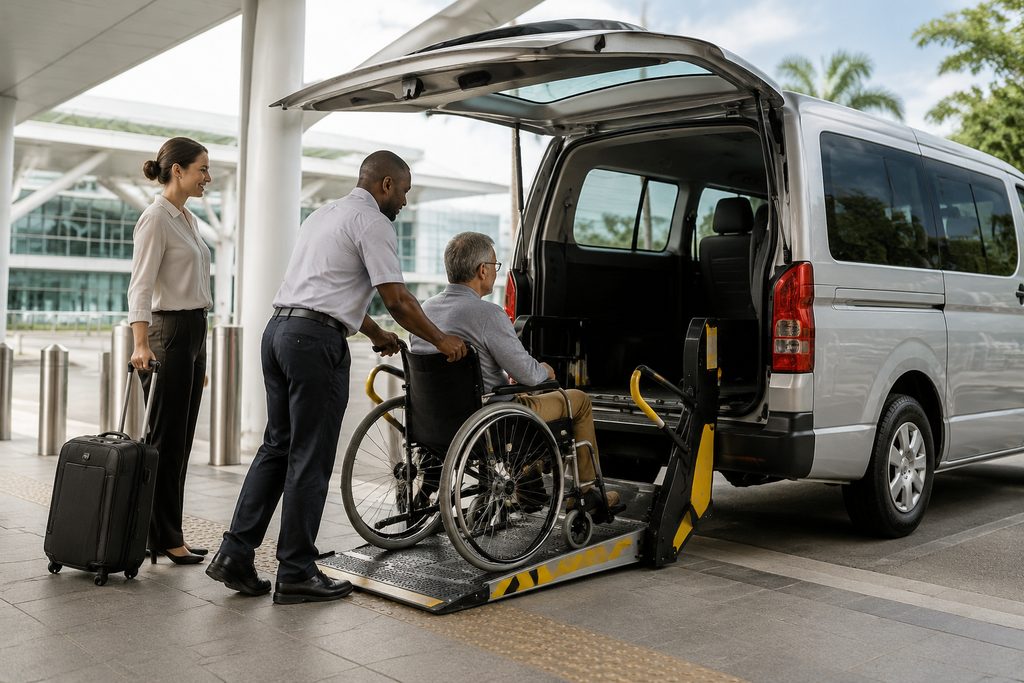
Airport Pickup for Wheelchair Users: What International Patients Actually Need to Know
Landing at Beijing Capital or Shanghai Pudong after a long-haul flight is exhausting for anyone. Add a wheelchair, post-surgical fatigue, or a neurological condition, and the first 90 minutes on the ground can feel like the hardest part of the whole medical trip. The airport wheelchair assistance cost China ranges from free for basic terminal transfers to roughly $200 for a coordinated round-trip medical pickup — but the real question is not the price. It is whether the service actually gets you from the aircraft door to your hospital bed without a breakdown in communication, timing, or physical access.
We coordinate arrivals for international patients at 37 cities across China. What we have learned is that most travelers misunderstand how wheelchair services work at Chinese airports. They assume the system mirrors what they know from Heathrow or LAX. It does not. The infrastructure is modern — often newer than what you find in Europe — but the process is different. Knowing those differences before you book your flight saves hours of waiting and a lot of unnecessary stress.
Key Takeaways
- Basic wheelchair assistance inside Chinese airports is free and arranged through your airline — but it covers only terminal-to-terminal movement, not city or hospital transfers.
- A private medical airport pickup with wheelchair support costs from $200 round-trip, roughly one-tenth of comparable non-emergency medical transport in the United States.
- Shanghai Pudong and Beijing Capital both require wheelchair requests at least 48 hours before departure for international flights; same-day requests are often denied.
- Hospital-arranged pickups exist at major international medical centers, but they are not guaranteed and rarely include an English-speaking escort unless you book one separately.
The Problem: Disembarking into a System That Was Not Designed Around You
Around 1 in 8 international medical travelers to China arrives with some form of mobility limitation. That is not a government statistic — it is what our coordination team sees across oncology, orthopedic, and cardiac cases. A patient flying from Dubai to Guangzhou for a knee replacement may be walking with a cane on departure but cannot bear weight on arrival after 11 hours of cabin pressure and immobility. Another patient, post-stroke, lands in Beijing with aphasia and cannot explain to a Mandarin-speaking ground crew where the pre-booked wheelchair is waiting.
The breakdown usually happens at the handoff points. Airline wheelchair service ends at the arrivals hall curb. Hospital transport begins at the hospital entrance. The gap between those two points — baggage claim, customs, the walk to the parking structure, the 40-minute drive into the city — is where patients get stranded. And if you booked a wheelchair through your airline but did not confirm it 48 hours in advance, there may be no wheelchair at all. Chinese carriers follow IATA guidelines, but operational reality on a busy Monday morning at Pudong Terminal 2 frequently falls short of what the policy promises.
What happens if nothing changes? You wait. Sometimes 90 minutes. Sometimes longer. You sit on a hard plastic chair near the baggage carousel while your escort tries to find a staff member who speaks enough English to understand that the wheelchair never arrived.
Why China’s Airport and Hospital Transfer System Delivers Results
Infrastructure That Rivals Any Western Hub
Shanghai Pudong International Airport handles over 70 million passengers annually. Beijing Capital handles more than 100 million in pre-pandemic years. Both airports have fully accessible terminals with elevators, ramped jet bridges, accessible restrooms, and dedicated assistance lanes through immigration. The physical accessibility is not the problem. The problem is navigation and language. A wheelchair user who knows exactly where to go can move through Pudong Terminal 2 efficiently. A wheelchair user who does not read Chinese signage and cannot ask for directions will struggle regardless of how many ramps exist.
Cost Structures That Make Private Assistance Feasible
Here is where the numbers get interesting. In the United States, non-emergency medical transport with wheelchair support typically costs $150 to $400 for a one-way trip of 20 miles or less. In China, a bilingual escort who meets you at the gate, handles your luggage, pushes your wheelchair through immigration and customs, and rides with you to the hospital costs from $200 round-trip. That is not a typo. The labor economics of China make personalized assistance affordable for almost any patient who can afford the flight itself.
But there is a structural reason the price is low, and you should understand it. The person meeting you is not a paramedic. They are a trained logistics coordinator with medical escort experience. They know the airport layout, they speak English and Mandarin, and they know how to communicate with hospital admissions. They are not providing medical care during the transfer. If you need oxygen, cardiac monitoring, or a nurse escort, that is a different service tier and costs more.
Hospital Integration That Many Patients Overlook
Top-tier Chinese hospitals with international departments — including facilities in our ranked hospital network — often have their own patient transport vehicles. Some will send a driver to the airport. But here is the honest truth: the driver usually speaks no English, and the vehicle may not be wheelchair-accessible unless specifically requested. The hospital assumes a family member or local contact will handle the airport-to-hospital leg. For solo international patients, that assumption creates a real gap. Coordinating the airport pickup and the hospital admission as one continuous process — rather than two disconnected bookings — is what prevents the stranded-at-the-curb scenario.
How to Arrange Wheelchair Assistance at Shanghai Airport: A Step-by-Step Breakdown
The question how to arrange wheelchair at Shanghai airport is one of the most common searches we see from patients heading to Fudan-affiliated hospitals or Jiahui International. The process is straightforward if you know the sequence.
First, request wheelchair assistance through your airline at the time of booking, or no later than 48 hours before departure. This triggers the free airport wheelchair service. The airline notifies the airport ground handler, who positions a wheelchair and an attendant at the arrival gate. This service covers the jet bridge, immigration, baggage claim, and customs. It ends at the arrivals hall exit.
Second, decide what happens after the arrivals hall exit. If a family member is meeting you, the free service is sufficient. If you are traveling alone or with a spouse who cannot manage luggage and a wheelchair simultaneously, you need a second layer. That is where a paid medical transfer comes in. The escort waits at the arrivals hall, takes over from the airport attendant, and handles everything from that point to the hospital admission desk.
Third, confirm the hospital knows your arrival time. Chinese public hospitals do not hold beds for late arrivals. If your flight lands at 6 PM and the international department closes admissions at 5 PM, you may be waiting until the next morning. A coordinated pickup service checks this before you board the plane, not after you land.
Book your wheelchair request with the airline first, then book your ground transfer separately. The two systems do not talk to each other. If you book only one, you will have a gap.
Is Airport Wheelchair Service Free in China Hospitals? What the Fees Actually Cover
The short answer to is airport wheelchair service free in China hospitals is no — hospital-arranged airport pickup is rarely free, and the airport’s own wheelchair service is free but limited in scope. The longer answer requires separating three distinct services that patients often conflate.
The first is the airline-provided airport wheelchair. This is free. It is mandated by international aviation standards and included in your ticket price. The attendant pushes you from the gate through immigration and customs to the arrivals hall. They will not leave the terminal. They will not help you into a car. They will not accompany you to the hospital.
The second is a hospital-arranged pickup. Some private international hospitals in Beijing and Shanghai offer this as a courtesy for surgical patients. It is not standard at public hospitals, even top-ranked ones. When it exists, it is usually a driver with a sedan, not a wheelchair-accessible van. The driver may hold a sign with your name. That is the extent of the service.
The third is a private medical transfer with wheelchair support and bilingual escort. This costs from $200 round-trip. It includes gate meet-and-greet, luggage handling, wheelchair assistance through the terminal, private vehicle transfer to the hospital, and handoff to the admissions team. For patients arriving alone after a 14-hour flight, this third option is often the difference between a smooth admission and a genuinely frightening first day in a foreign country.
| Service Type | Coverage | Typical Cost | English-Speaking Escort |
|---|---|---|---|
| Airline airport wheelchair | Gate to arrivals hall only | Free | Not guaranteed |
| Hospital-arranged pickup | Airport to hospital, driver only | Often free, sometimes $30-60 | Rarely |
| Private medical transfer | Gate to hospital admission, full assistance | From $200 round-trip | Yes |
Medical Tourism Airport Pickup Wheelchair Price: What You Get for Your Money
When patients search medical tourism airport pickup wheelchair price, they are usually comparing China against Thailand, India, or Turkey. The comparison is instructive. In Thailand, a private medical transfer from Suvarnabhumi Airport to a Bangkok hospital costs roughly $80 to $150 one-way. In India, similar services run $50 to $100. China sits at the higher end of the regional range, largely because the distances are greater — Pudong to downtown Shanghai is 45 kilometers — and because bilingual staff command a premium in a country where English proficiency remains limited outside major international hubs.
What the price buys you in China is something the cheaper regional options often lack: operational reliability. A transfer service that knows the exact immigration lane for medical visa holders, knows which elevator at Pudong Terminal 2 is wheelchair-accessible without a 10-minute detour, and knows the admissions protocol at Ruijin Hospital’s international department — that knowledge has real value. It is not just a ride. It is navigation through a system that does not bend for foreigners who cannot read the signs.
For patients weighing the cost, consider what a failed transfer costs. A missed admission window means an extra night in a hotel. A communication breakdown at customs can delay you by hours. A wheelchair that never arrived means a painful walk through a terminal the size of a small city. The $200 round-trip fee is insurance against all of those failures.
Book Airport Wheelchair Transfer for Surgery Abroad: Timing, Documentation, and Common Mistakes
The search phrase book airport wheelchair transfer for surgery abroad implies a level of planning that many patients do not actually do until it is too late. Here is what we tell every surgical patient before they fly to China.
Book the transfer at the same time you book your surgery date. Not a week before. Not after your pre-op consultation. At the same time. Surgical dates shift, and when they shift, your arrival logistics shift with them. A transfer service that knows your surgery is on Tuesday, not Thursday, will adjust the pickup without you having to re-explain everything from scratch.
You will need to provide specific documentation. A copy of your passport photo page. Your flight number and arrival terminal. Your hospital admission letter or appointment confirmation. If you use a wheelchair that folds, the dimensions matter — Chinese sedans have smaller trunks than Western equivalents. If you use a power wheelchair, you need a van, and that changes the vehicle type and the price.
The most common mistake? Assuming the transfer service can wait indefinitely. Flight delays happen. A professional service monitors your flight and adjusts. But if your flight is delayed by 6 hours and lands at 2 AM, the escort may not be able to wait. Clarify the delay policy before you book. The good services have one. The cheap ones do not.
Wheelchair Accessible Airport Pickup Beijing Hospital: What the Capital Does Differently
Beijing presents unique challenges for wheelchair accessible airport pickup Beijing hospital searches. Beijing Capital International Airport is enormous — three terminals spread across a site larger than Monaco. If you land at Terminal 3 and your driver is waiting at Terminal 2, you have a 15-minute shuttle ride just to reach them. A transfer service that does not confirm your terminal in advance is setting you up for a very bad first hour in China.
Beijing Daxing International Airport, the newer facility opened in 2019, is more wheelchair-friendly by design. Wider corridors, more elevators, better signage in English. But it is also 46 kilometers from the city center, farther than Capital Airport. The drive to Peking Union Medical College Hospital from Daxing can take 90 minutes in traffic. From Capital, it is 30 minutes on a good day. Which airport you fly into matters as much as how you get picked up.
The hospitals themselves vary. Beijing United Family Hospital has a dedicated international patient entrance with wheelchair access and English-speaking admissions staff. The public hospitals on our Beijing hospital guide page are more complex. The buildings are accessible, but the flow of patients is overwhelming. A wheelchair user navigating Beijing Friendship Hospital alone during morning admission hours will face crowds that make the airport look calm. This is where a local escort proves their worth — not just at the airport, but in the first two hours inside the hospital.
Practical Considerations: Documentation, Payment, and Communication for Wheelchair Arrivals
You do not need a special permit to bring a wheelchair through Chinese customs. Personal mobility equipment — manual wheelchairs, walkers, canes — enters duty-free as personal effects. Power wheelchairs with lithium batteries require airline approval in advance, and the battery watt-hour rating must be documented. Check with your carrier at least two weeks before departure if you use a power chair.
Payment for private transfer services is typically handled in advance by bank transfer or international credit card. Some providers accept Alipay or WeChat Pay, but those platforms require a Chinese bank account or an international card linked to the app — not something most first-time visitors have set up. Cash in RMB works, but you will need to withdraw it at the airport, and the ATM lines at Pudong can be long.
For visa purposes, remember that medical travel to China uses the S2 visa category, not the M visa. Your transfer service is not a visa sponsor, but your hospital admission letter is a required supporting document. The S2 visa covers short stays for medical treatment and private affairs. If your treatment plan extends beyond 180 days, you need the S1 visa. Neither the airport nor the transfer service checks your visa — immigration does that — but having the right category prevents problems before you board the plane.
Insurance is another layer. Some international health insurance policies cover medical transport from the airport to the hospital. Most do not. If you are traveling under a medical tourism policy, check the fine print. The reimbursement process, if available, requires an itemized receipt from the transfer provider. Ask for one. The professional services provide them automatically.
Frequently Asked Questions
Yes. The airline’s free wheelchair service must be requested for each leg of your journey separately. A request made for your outbound flight does not automatically apply to your return. For the return journey from China, request the wheelchair at least 72 hours in advance through the airline’s local office or your booking agent.
Reputable transfer services monitor flight status in real time and adjust pickup times accordingly. Most include a waiting window of 2 to 3 hours for delays at no extra charge. Beyond that, a standby fee may apply. Confirm the specific delay policy in writing before you book.
No. Immigration and customs are sovereign areas. Only the passenger passes through. The airport’s own wheelchair attendant handles movement through immigration and customs if you have booked the free airline service. Your private escort waits at the arrivals hall exit and takes over from there. The two services work in sequence, not simultaneously.
Yes, for a standard arrival pickup and a departure drop-off within the same city. The price includes the escort’s time, vehicle transfer, and coordination with the hospital. It does not include airport parking fees, tolls, or waiting time beyond the agreed window. Final quotes vary by city and distance — a pickup from Beijing Daxing costs more than one from Beijing Capital due to the 46-kilometer drive.
Standard wheelchair transfer services do not provide medical care. If you require oxygen, cardiac monitoring, or a nurse escort during the airport-to-hospital journey, you need a medical transport service, which costs significantly more and must be arranged through a hospital or specialized provider. Be honest about your medical needs when booking. A standard escort is not equipped to handle a medical emergency.
Your Next Step
Arriving in China for medical treatment does
For more medical information and treatment options in China, visit chinamedservices.com (China Medical Services).
