China Medical Visa Cost: What Our Visa Service Actually Does
China Medical Visa Cost: The Short Answer
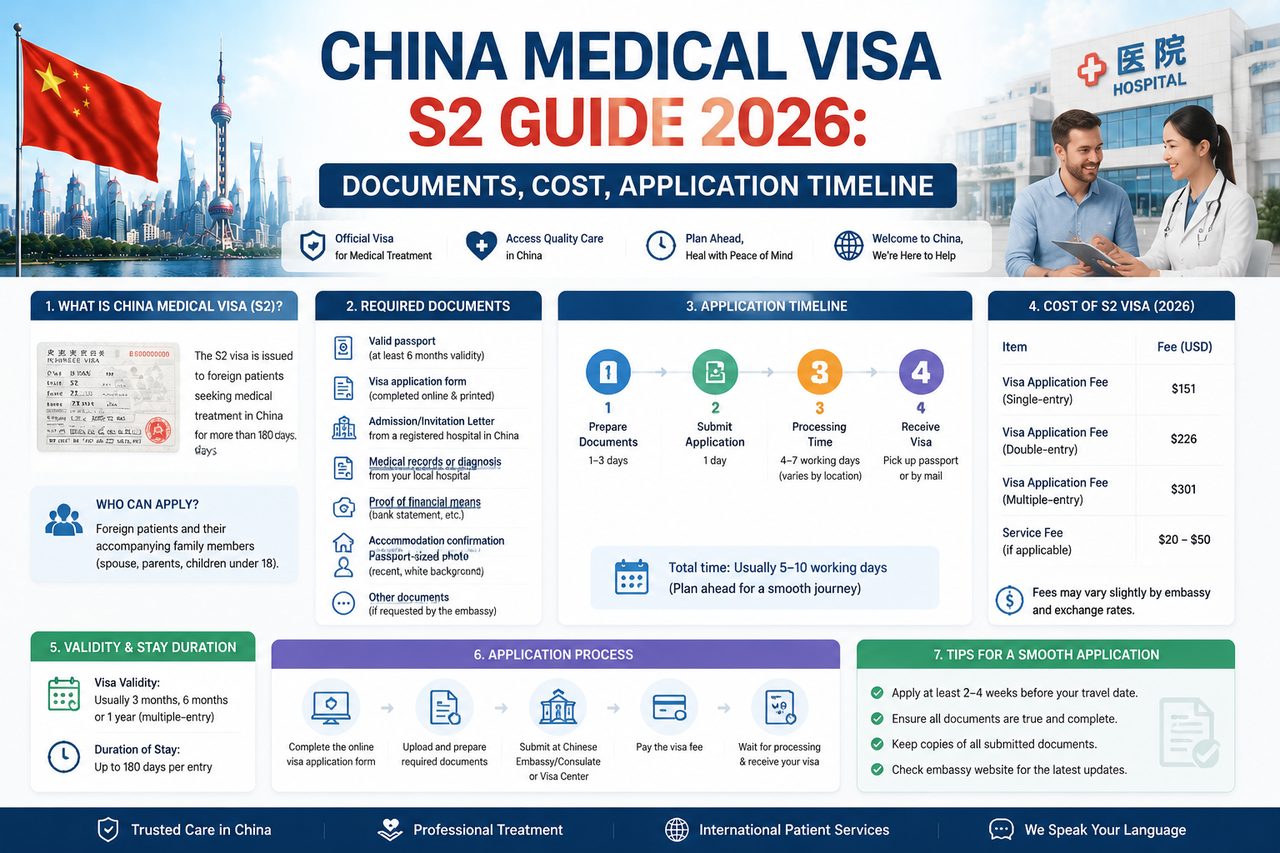
According to China’s National Immigration Administration, over 6.5 million foreigners entered China in the first half of 2024 alone. A meaningful share came for medical treatment. The China medical visa cost itself is modest — typically $140 to $185 in consular fees for most nationalities, depending on reciprocity agreements. But that number misleads. The real cost sits in the preparation: hospital invitation documents, notarized translations, courier fees, and the time you spend getting it right.
Our visa service exists because the application form is the easy part. The hard part is assembling a document package that a Chinese consulate will actually accept. One missing stamp or an invitation letter with the wrong wording sends you back to square one. That’s what we handle.
Who This Is Right For — and Who It Isn’t
You should consider using a structured visa service if your situation includes any of the following:
- You have a confirmed treatment plan or surgical date at a Chinese hospital and need the S2 visa processed correctly the first time.
- You’re traveling with a family member who needs a companion visa, and you want both applications submitted as a coherent package.
- You’ve already tried navigating the Chinese consulate website and found conflicting instructions across different embassies.
- Your home country requires additional authentication steps — some Middle Eastern and African nations need extra legalization layers.
- You’re coordinating treatment across multiple cities, like a consultation in Beijing followed by surgery in Shanghai, and need documentation that reflects that itinerary.
But a visa service is not for everyone. If you’re still exploring whether to come to China at all, start with hospital selection, not visa paperwork. If your treatment is purely cosmetic and you’re comparing Thailand, South Korea, and China, the visa is rarely your bottleneck. And if you have a straightforward case with a hospital that has a dedicated international office that issues invitation letters daily, you may manage fine on your own. We’ll say that plainly: some patients don’t need us. The service earns its value when complexity or stakes are high.
The Options, Compared
When patients ask us how to get a medical visa for China, they’re usually weighing three routes. The table below reflects what we see across consulates in North America, Europe, and the Gulf states as of 2025.
| Route | Typical Processing Time | Consular Fee Range | Who Handles the Documentation | Best For |
|---|---|---|---|---|
| Self-managed S2 application | 4–10 business days after submission | $140–$185 | You, alone | Patients with prior China visa experience and a hospital that issues invitation letters promptly |
| Hospital international office assisted | 3–8 business days | $140–$185 | Hospital staff, partially | Patients at large public hospitals like Peking Union Medical College Hospital or Fuwai Hospital with dedicated foreigner liaison teams |
| Coordinated visa service (ours or similar) | 3–7 business days, often with expedited options | $140–$185 consular fee + service coordination from $300 | Our team, end to end | Patients juggling multiple documents, traveling with family, or facing tight surgical scheduling windows |
The consular fee is identical across all three routes. You’re not paying more for the visa itself. You’re paying for the probability that your application survives first review. A rejected application costs you another consular fee, another appointment slot, and sometimes another month of waiting. That’s the math that matters.
What Our Visa Service Actually Does — Step by Step
People search for “our visa service what it does” expecting a checklist. Here’s the honest version, including what we don’t do.
We start with document audit. Before anything goes to a consulate, we review your passport validity, photo specifications, hospital invitation letter, proof of funds, and any prior China visa history. About 40% of the packages we receive have at least one disqualifying issue — an invitation letter missing the official hospital seal, a passport with less than six months of validity, a photo with the wrong background shade.
Then we coordinate the invitation letter. This is where most self-managed applications stall. Chinese public hospitals issue invitation letters through their international medical departments, not their general administrative offices. The letter must state your diagnosis, proposed treatment period, and the specific visa category recommended. We work with hospital liaisons to ensure the wording matches what your local consulate expects — because consulates in different countries apply slightly different standards.
We prepare the application package. That includes the COVA form (the online application), the appointment booking, the supporting document translations, and a cover letter that explains your medical purpose in plain, consistent language. Inconsistency is the silent killer. If your invitation letter says “cardiac evaluation” but your COVA form says “heart surgery,” the visa officer sees a red flag. We align every document.
We do not guarantee approval. No legitimate service can. We guarantee that your package is complete, consistent, and submitted correctly the first time. The Chinese government retains full discretion over every visa decision. If a service promises you approval, walk away.
China Medical Treatment Visa Requirements: The Documents That Actually Matter
Let’s get specific about China medical treatment visa requirements, because the official list is shorter than what actually gets approved.
The S2 visa is the correct category for medical treatment stays under 180 days. If your treatment plan exceeds 180 days — certain rehabilitation protocols, long-term TCM programs, or multi-stage oncology care — you need the S1 visa, which allows longer stays and typically requires additional proof of accommodation and financial capacity.
For the S2 medical visa, you generally need:
- A passport valid for at least six months beyond your planned entry date, with at least two blank visa pages.
- A completed COVA form, printed and signed.
- A recent passport photo meeting Chinese specifications (33mm x 48mm, white background, no glasses in most consulates now).
- An official invitation letter from the Chinese hospital, stamped and issued by the international medical department.
- Medical records supporting the diagnosis and treatment plan — translated into Chinese or English.
- Proof of financial means to cover treatment and stay — bank statements typically covering the estimated treatment cost plus living expenses.
- A travel itinerary, including accommodation details.
Accompanying family members apply under the same S2 category, but each person needs a separate application and fee. Children require birth certificates and, in some cases, notarized parental consent if only one parent travels.
Here’s what surprises most patients: the invitation letter is not the same as a hospital appointment confirmation. Some hospitals will issue an invitation letter based on a preliminary remote consultation. Others require an in-person registration first. This is where the system gets circular — you need a visa to get to the hospital, but the hospital wants to see you before issuing the letter. This is exactly the kind of friction our coordination service resolves, because we know which hospitals issue letters based on remote evaluation and which don’t.
What It Costs Beyond the Visa Fee
The China medical visa cost question deserves an honest breakdown. The consular fee is the smallest line item. Here’s what a typical patient actually spends before stepping on a plane:
| Expense Item | Typical Range (USD) | Notes |
|---|---|---|
| Consular visa fee | $140–$185 | Fixed by nationality and reciprocity |
| Document translation and notarization | $50–$150 | Medical records, bank statements, birth certificates |
| Courier and application center fees | $30–$80 | Varies by country; some consulates require visa center submission |
| Hospital invitation letter processing | $0–$200 | Some hospitals charge an administrative fee; many don’t |
| Service coordination (ours) | from $300 | Document audit, liaison, submission support |
| Expedited processing (if needed) | $50–$100 | Not available at all consulates |
So the true out-of-pocket cost for visa preparation runs between $570 and $1,015 for most patients using a coordination service. That’s before flights, accommodation, and treatment. Compare that to the cost of a rejected application and a postponed surgery date, and the economics shift.
Also worth stating: medical tourism packages in Shanghai price out differently than standalone visa services. Some private hospitals and facilitators bundle visa support, airport pickup, and accommodation into package deals. Those packages typically start around $2,000 for basic coordination and climb sharply depending on the procedure and hospital tier. If you’re comparing options, ask what’s actually included — a “package” that doesn’t itemize visa fees, hospital charges, and coordination labor is a package designed to hide margin.
Practical Considerations: Timing, Payment, and Follow-Up
Timing is the most underappreciated variable. The S2 visa application cannot be submitted more than 90 days before your intended entry date. But hospital surgical schedules in top-tier institutions like China’s Fudan-ranked public hospitals often book 6 to 12 weeks out. That window is workable, but only if your documents are ready the moment your surgical date is confirmed.
Payment for the visa itself goes to the consulate or visa application center, not to us. We never collect consular fees on your behalf. Our coordination fee is separate and transparent. If you’re working with a private international hospital — the kind that offers direct insurance billing and English-speaking staff, like those listed on our private international hospitals page — the visa process often moves faster because their administrative teams handle invitation letters routinely.
Insurance is another layer. Chinese public hospitals generally operate on a prepayment model. You pay a deposit at admission, and your insurance reimburses you after discharge. Private international hospitals more often bill insurers directly. If your insurer requires pre-authorization for international treatment, start that process before you apply for the visa — the visa officer may ask for evidence of insurance coverage or financial capacity.
After you return home, keep your visa documentation. If you need a follow-up visit, a prior S2 visa with a clean record strengthens your subsequent application. Some patients also need a visa extension if treatment runs long. Extensions are handled by the local Exit-Entry Administration in China, not by your home consulate, and they require hospital documentation confirming the ongoing treatment necessity.
Frequently Asked Questions
No. The S2 visa for medical treatment requires an official invitation letter from a Chinese hospital. Without it, your application will be rejected. The letter must come from the hospital’s international medical department or equivalent, not from an individual doctor’s personal email. If a hospital won’t issue a letter based on your remote consultation, you may need to consider a different hospital or a preliminary evaluation visit under a different visa category, which is rarely practical.
Standard processing runs 4 to 10 business days at most consulates, though some visa application centers add 2 to 3 days for document intake and return. Expedited service, where available, can cut that to 2 to 3 business days. But the clock starts only after your application is complete and accepted. Incomplete applications get returned, not processed. That’s the single biggest source of delay we see.
This is the risk that keeps patients up at night. In practice, S2 medical visa rejections are uncommon when the hospital invitation letter is legitimate and the financial documentation is solid. But rejection does happen, usually due to inconsistencies in the application, insufficient funds shown, or prior visa violations. Our coordination fee covers the preparation work, not the outcome. We advise patients to avoid non-refundable payments for flights, accommodation, or hospital deposits until the visa is approved. Reputable hospitals understand this and will hold surgical slots with a refundable deposit.
No. The M visa is for commercial and trade activities. Applying for an M visa when your actual purpose is medical treatment constitutes misrepresentation and can lead to denial, entry refusal, or future visa restrictions. The correct category for medical treatment is S2, or S1 for stays exceeding 180 days. Some patients ask about the M visa because a facilitator or agency suggested it. Don’t do it. The consulate will see the discrepancy between your stated purpose and your hospital documents.
Not necessarily. The top-ranked public hospitals in China — those on the Fudan rankings — vary widely in their international patient infrastructure. Some, like Peking Union Medical College Hospital and Fuwai Hospital, have dedicated international departments that handle invitation letters smoothly. Others have world-class clinical departments but minimal administrative support for foreign patients. Private international hospitals generally handle visa documentation more efficiently, but they may not offer the same depth of subspecialty expertise for complex cases. This is precisely why hospital selection and visa preparation should be coordinated together, not treated as separate tasks.
Your Next Step
The China medical visa cost is the smallest barrier between you and treatment. The real work is getting the documents right, aligning hospital and consulate requirements, and timing everything around a surgical schedule that doesn’t wait. That’s what we do. We are not a hospital. We don’t diagnose, treat, or influence medical decisions. We are a coordination team that connects international patients with China’s top-tier medical institutions and handles the logistics — including visa preparation — so you can focus on your health. If you’re considering treatment in China and want to understand the full path, from hospital selection to visa submission, start with a conversation. Visit our patient services page and tell us where you are in the process. We’ll tell you honestly what you need and whether we’re the right fit.
For more medical information and treatment options in China, visit chinamedservices.com (China Medical Services).
