Remote Second Opinion: Privacy and Security When Sharing Medical Records in China
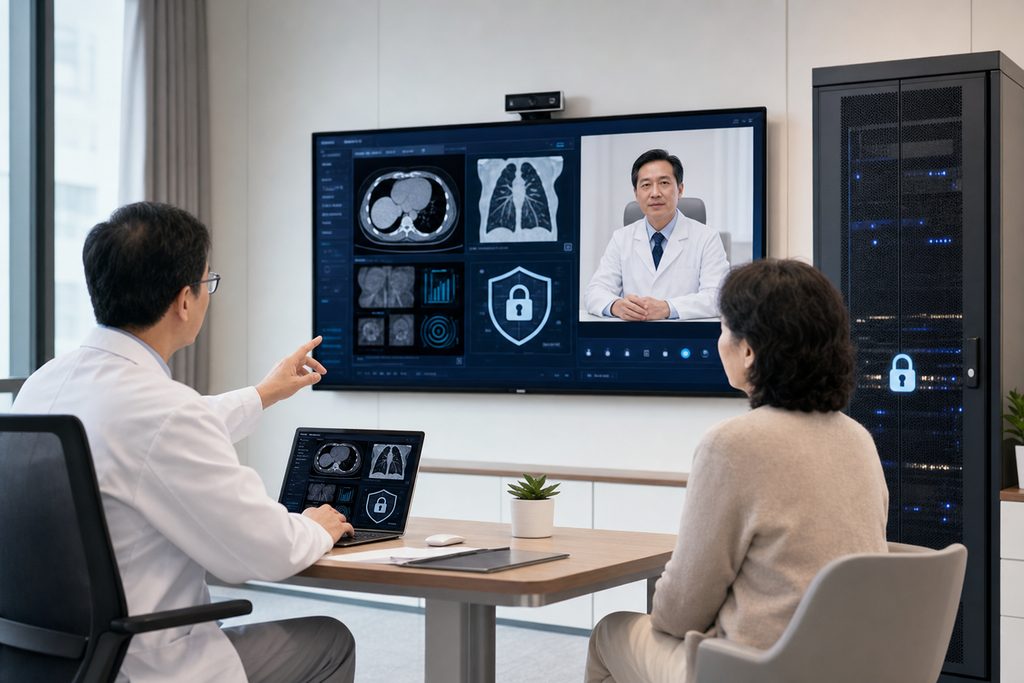
When 42-year-old Michael first heard the diagnosis, he had no idea where to start looking for treatment. His oncologist in Manchester had given him three options, all with similar survival statistics but wildly different side-effect profiles. A colleague mentioned that a hospital in Shanghai had published remarkable outcomes for his exact subtype of lymphoma. Michael sat in his kitchen at 2 a.m., mouse hovering over an upload button on a hospital portal. One question stopped him cold: who actually sees my scans, my pathology report, my entire medical identity once I hit send?
That question matters more than most patients realize. The remote second opinion cost China is modest — typically $300 to $500 for a written review by a top specialist, or $500 to $800 for a video consultation. But the real currency you spend is trust. You are handing over the most sensitive data a person can possess. So let’s talk about what actually happens to it.
Remote Second Opinion Privacy: The Short Answer
Your medical records are generally safe with established Chinese hospital international departments and reputable coordination services. China’s Personal Information Protection Law (PIPL), effective November 2021, imposes strict requirements on how health data is collected, stored, transferred, and deleted. Hospitals face substantial fines for violations. But “generally safe” is not the same as “always safe.” The security depends almost entirely on which channel you use.
Uploading scans through a random WhatsApp number found on a forum? That is a gamble. Going through a hospital’s official international patient center or a vetted coordinator with documented protocols? That is a controlled process with contractual obligations. The difference determines whether your data stays protected or floats around unencrypted servers.
Who Remote Second Opinions Are Right For — and Who They Aren’t
A remote second opinion makes sense when you have a complex diagnosis, a proposed treatment plan with significant risks, or a rare condition where case volume matters. Chinese top-tier hospitals see patient volumes that Western centers rarely match. Fuwai Hospital performs over 14,000 cardiac surgeries annually. That volume produces pattern recognition you cannot get from a textbook.
Who typically benefits:
- Patients with a confirmed cancer diagnosis who want validation of staging or treatment sequencing
- People facing surgery with a high complication risk or long recovery
- Those with rare or complex conditions where local specialists see few cases per year
- Patients who have exhausted standard options and want a fresh clinical perspective
Who should not pursue this:
- Anyone needing emergency intervention. A remote review takes days, not hours
- Patients whose records are incomplete or poorly organized. The quality of the opinion depends entirely on the quality of the input
- People unwilling to share imaging files in digital format. Some hospitals require DICOM files, not JPEG photos of a screen
- Those seeking a prescription. Written opinions are for reference only, not a prescription
The Options, Compared
Not all remote second opinion channels are equal. The table below compares the genuine alternatives for getting a specialist review from China without traveling.
| Channel | Typical Cost | Data Security Level | Turnaround Time | Best For |
|---|---|---|---|---|
| Hospital international department (direct) | $300–$800 | High — hospital PIPL compliance, official portals | 5–14 business days | Patients who know exactly which hospital and department they want |
| Third-party coordination service | $300–$500 written, $500–$800 video | High — contractual data protection agreements, encrypted transfer | 3–10 business days | Patients who need help selecting the right specialist and translating records |
| Private international hospital (United Family, Jiahui, Parkway) | $200–$500 | High — JCI-accredited, Western-style data governance | 3–7 business days | Patients who prefer English-speaking teams and direct insurance billing |
| Informal channels (forums, direct WeChat contacts) | $50–$200 | Low — no enforceable privacy protections | Unpredictable | Not recommended for any serious medical matter |
If you are comparing costs across countries, the remote second opinion cost China is typically one-third to one-fifth of what a U.S. academic center charges for the same service. But cost should not be the deciding factor. The security infrastructure and the reputation of the reviewing specialist matter far more.
How China’s Data Privacy Laws Actually Protect Your Records
This is the section that answers the question you probably typed into Google: is my medical data safe with Chinese telehealth? The honest answer is that China has built a regulatory framework that, on paper, rivals GDPR in its protections for health data. Whether it protects you depends on enforcement and the specific institution handling your records.
The Personal Information Protection Law (PIPL) classifies medical records as “sensitive personal information.” That classification triggers stricter requirements: explicit consent before processing, purpose limitation, and mandatory security safeguards. The Data Security Law (DSL), effective September 2021, adds another layer for data that could affect national security or public interest — which health data can, in aggregate.
The Cybersecurity Law requires hospitals to store certain categories of data within China. For a foreign patient seeking a remote second opinion, this means your records are typically stored on servers inside China, not transferred abroad. That is a double-edged sword. It reduces the risk of cross-border data breaches, but it also means your data sits under Chinese jurisdiction. If you have concerns about that, you should know it before you upload.
Never send medical records through unencrypted email or consumer messaging apps. Reputable channels use hospital portals, encrypted file transfer systems, or secure cloud platforms with access controls. If a “coordinator” asks you to send scans via WhatsApp, that is a red flag.
There is a practical layer beyond the law. Top-tier Chinese hospitals that regularly handle international patients have internal protocols that often exceed minimum legal requirements. Their international departments know that one data breach would destroy their reputation with foreign patients. That reputational pressure creates real accountability.
What a Secure Remote Second Opinion Process Actually Looks Like
You should know what a proper process looks like before you commit. A secure remote second opinion from a Chinese hospital or reputable coordinator follows a predictable sequence:
Step 1: Intake and consent. You complete a form that specifies exactly who may access your records, for what purpose, and for how long. PIPL requires this. If no consent form appears, walk away.
Step 2: Record collection and de-identification. Your name, date of birth, and other direct identifiers may be removed before the specialist reviews your case. The reviewing doctor sees clinical data — scans, pathology reports, blood work — not your passport number.
Step 3: Translation and standardization. If your records are in English, German, or Arabic, they are translated into Chinese for the reviewing specialist. Translation introduces a small error risk, which is why reputable services have medical translators, not general translators.
Step 4: Specialist review. The assigned specialist examines your complete file. For complex cases, this may involve discussion with colleagues in related departments.
Step 5: Written report or video consultation. You receive a written opinion in English, or you speak directly with the specialist via video. The written opinion is for reference only — it is not a prescription and cannot be used to obtain medication.
Step 6: Data retention and deletion. Reputable services specify retention periods — often 6 to 12 months — after which your records are deleted upon request. You have the right to ask for deletion under PIPL.
How Secure Is Online Medical Consultation in China: The Hospital Perspective
Let’s look at this from the hospital’s side, because that is where the real security decisions happen. A question we hear often: how secure is online medical consultation China when the hospital is public, not private?
Public hospitals in China are government-affiliated institutions. Their IT infrastructure is subject to state security requirements, including mandatory cybersecurity reviews and data localization rules. That means your records are not casually transferred to third-party cloud providers in other countries. The servers are in China, managed under Chinese law.
But public hospitals also face resource constraints. A top-tier public hospital might process 10,000 outpatient visits per day. The IT department is stretched. Data security at these institutions is often more about compliance than about proactive threat hunting. Private international hospitals — United Family, Jiahui, Parkway — tend to have more modern data governance, partly because they serve a foreign patient base that demands it and partly because JCI accreditation requires it.
So which is better for privacy? There is no universal answer. A public hospital’s international department may have dedicated staff who handle foreign patient data with more care than the general outpatient system. A private hospital may have better IT infrastructure but less experience with your specific condition. You need to weigh both factors.
Privacy of Medical Records Remote Second Opinion China: What Could Go Wrong
Being honest about risks is more useful than pretending they don’t exist. The privacy of medical records remote second opinion China depends on several failure points that patients rarely consider.
Risk 1: The human factor. A junior staff member emails the wrong file to the wrong address. A translator saves your records to a personal laptop. These are not China-specific risks — they happen in every healthcare system — but they are real.
Risk 2: Data retention ambiguity. Some institutions do not have clear deletion schedules. Your records may sit on a server longer than necessary. Under PIPL, you have the right to request deletion, but enforcement requires you to know who holds the data and to follow up.
Risk 3: Cross-border transfer. If a hospital uses a third-party telemedicine platform hosted outside China, your data may cross borders without your explicit knowledge. Reputable services disclose this. Less reputable ones do not.
Risk 4: Scope creep. You consented to a second opinion for your lung nodule. Then the hospital uses your anonymized data for research without asking again. PIPL requires separate consent for research use, but compliance is uneven.
Ask three questions before you upload anything: Who exactly will see my records? Where are the servers located? What is your deletion policy? If the answers are vague, find another channel.
Best Hospitals for Remote Second Opinion Shanghai: What to Look For
A written second opinion from a top-tier specialist typically costs $300 to $500. A video consultation runs $500 to $800. Multidisciplinary team reviews cost $1,500 to $2,000. Coordination fees for document handling and booking start at $300. Prices vary by hospital and case complexity. These fees cover the review and coordination labor, not treatment.
No. A written remote second opinion is for reference only. It is not a prescription, and it cannot be used to obtain medication. The Chinese specialist may suggest treatment directions, but any actual treatment must be prescribed and supervised by a licensed physician you see in person. If you travel to China, the remote opinion can inform your in-person consultation, but it does not replace it.
What happens to my records after the review is complete?
Reputable services specify retention periods — typically 6 to 12 months — after which records are deleted upon request. Under China’s Personal Information Protection Law,
Frequently Asked Questions
Yes. The hospitals used for international patients are JCI-accredited and follow the same international safety standards as top hospitals in the US and Europe. Surgical teams perform high volumes of procedures — often more than their Western counterparts — which studies show leads to better outcomes.
Costs vary by procedure and hospital, but international patients typically save 40-80% compared to US prices — even when factoring in travel and accommodation. A consultation with our team will give you an exact, all-inclusive quote with no hidden fees.
Send us your existing medical reports to get started. We handle everything from hospital selection and appointment scheduling to visa assistance and post-operative recovery planning. Your medical records are reviewed by the specialist before you even book a flight.
For more medical information and treatment options in China, visit chinamedservices.com (China Medical Services).
