Child Life Specialist Service China: Play Therapy and Emotional Preparation for Pediatric Surgery
Key Takeaways
- Research shows that children who receive pre-surgical psychological preparation through play therapy experience up to 30% less anxiety and require fewer sedatives before pediatric procedures.
- China’s top-tier pediatric hospitals are rapidly adopting certified child life services, combining Western psychosocial care models with high-volume surgical expertise that often exceeds 5,000 pediatric cases annually at a single center.
- Language barriers remain the single biggest obstacle for international families — most hospital-based child life programs operate exclusively in Mandarin, making bilingual coordination essential for non-Chinese-speaking children.
- Not all Chinese hospitals offer dedicated child life specialists. Understanding which facilities have established programs and how to access them before you travel determines whether your child receives emotional preparation or arrives to a purely clinical environment.
The Problem: A Terrified Child Facing Major Surgery Alone
A 2016 meta-analysis published in the Journal of Pediatric Nursing examined preoperative anxiety in 2,983 children across 14 countries. The findings were stark — approximately 50% to 75% of children undergoing surgery develop significant fear and anxiety before their procedure. This is not a minor issue. Preoperative anxiety in children predicts postoperative delirium, longer recovery times, increased pain perception, and more frequent nightmares that can persist for weeks after discharge.
Parents feel this acutely. You watch your six-year-old clutch the hospital gown, eyes wide, unable to articulate what terrifies them. The standard approach in many hospitals — a rushed explanation from a busy surgeon, a sedative pre-med — treats the body but ignores the mind. What changes this equation is a child life specialist China pediatric surgery program that uses structured play therapy to transform the unknown into something manageable. The difference between a child who has been prepared and one who has not is visible the moment they enter the operating theater corridor.
Who We Are
China Medical Services is not a hospital. We do not provide medical treatment, clinical diagnoses, or direct patient care. We are your logistical architects — a bilingual coordination team that bridges the gap between international families and China’s top-tier pediatric surgical centers. Our team handles hospital matching, appointment scheduling through official international department channels, visa guidance for S2 medical visas, and on-the-ground bilingual medical companionship. We connect you with the right facility that offers certified child life services, then ensure nothing gets lost in translation when your child needs emotional preparation the most.
What a Child Life Specialist Actually Does — and Why It Changes Surgical Outcomes
The profession emerged in the United States in the 1960s, but its evidence base has solidified dramatically in the last two decades. A certified child life specialist holds a bachelor’s or master’s degree in child development, psychology, or a related field, completes a 600-hour clinical internship, and passes a rigorous certification exam. They are not playtime supervisors. They are psychosocial clinicians who use therapeutic play, age-appropriate medical education, and coping techniques to reduce the psychological trauma of hospitalization.
When you book a child life specialist China pediatric surgery consultation, here is what the process typically involves:
Pre-Admission Preparation Through Medical Play
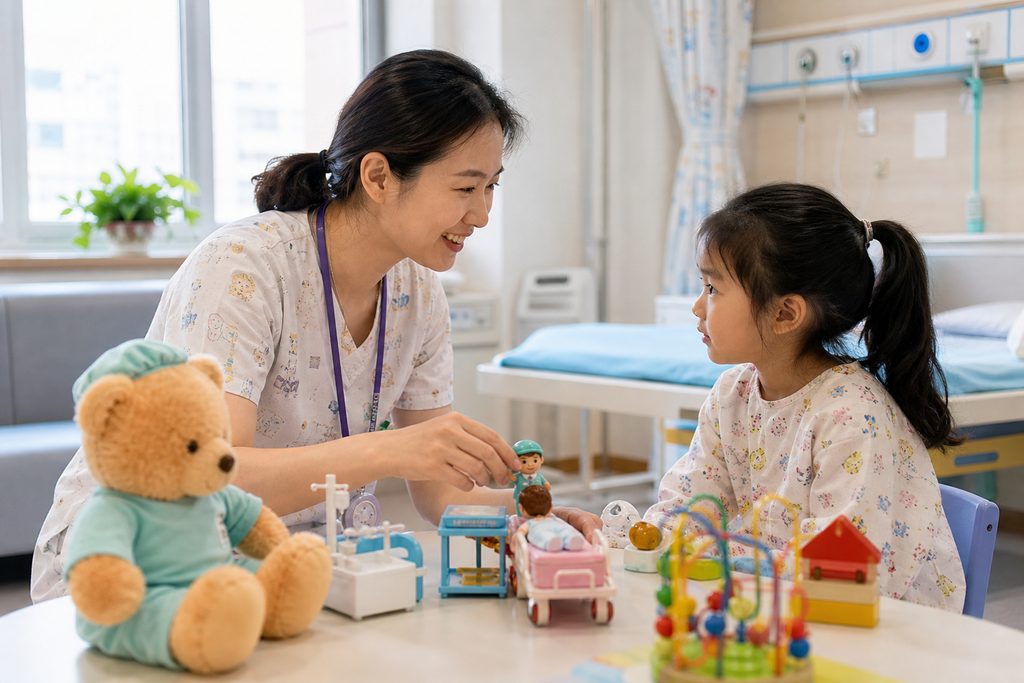
One week before a scheduled tonsillectomy at a major Shanghai children’s hospital, a child life specialist meets your five-year-old daughter. She does not start with words. She brings a teaching doll, a real anesthesia mask (disconnected), hospital ID bracelets, and a miniature IV setup. Your daughter puts the mask on the doll first. She listens to the doll’s heartbeat with a real stethoscope. She decorates the mask with stickers. By the time she sees that same mask in the pre-op room, it is no longer a threat — it is familiar. This technique is called medical play, and a 2020 randomized controlled trial in Pediatric Anesthesia found it reduced preoperative anxiety scores by 28.4% compared to standard verbal preparation alone.
Distraction and Coping During Induction
The moment of anesthesia induction — when a child is wheeled into the operating room and the mask descends — is often the peak anxiety point. Child life specialists use age-appropriate distraction: I-spy games, tablet-based interactive stories, guided imagery (“imagine you’re blowing up a giant balloon”), or simply holding a favorite toy. Some Chinese pediatric centers now allow a parent accompanied by the child life specialist into the induction room until the child is asleep, a practice associated with significantly smoother inductions.
Post-Operative Support and Normalization
The work does not end when surgery does. Children wake up disoriented, in pain, with tubes and monitors attached. A specialist provides developmentally appropriate explanations — “that tube is helping your tummy rest” — and uses play to help the child process what happened. This reduces the risk of lasting medical trauma that can manifest as needle phobias or white-coat syndrome years later.
Is Play Therapy Available for Foreign Kids in Chinese Hospitals?
The short answer: yes, but selectively. The longer truth requires understanding how pediatric psychosocial care has evolved in China’s hospital system.
Fifteen years ago, the concept of a dedicated child life department was virtually nonexistent in mainland Chinese hospitals. Pediatric surgery was technically excellent — China’s top centers were performing complex congenital heart repairs and neurosurgeries at volumes unmatched anywhere — but the emotional experience of the child was largely unaddressed. That changed rapidly starting around 2010, driven by three forces: increasing international patient volume demanding Western-standard psychosocial care, partnerships with US children’s hospitals that included staff training exchanges, and a growing domestic awareness of patient-centered care metrics.
Today, several hospitals in our network have established child life or child-friendly healthcare programs. The play therapy for children before surgery China cost varies significantly by institution. At private international hospitals like Shanghai United Family Hospital or Jiahui International Hospital, child life services are often integrated into the pediatric surgical package, with dedicated specialists on staff who speak English. At top public hospitals like Children’s Hospital of Fudan University or Beijing Children’s Hospital, child life programs exist but typically operate in Mandarin, and accessing them as a foreign family requires coordination through the hospital’s international department.
This is where the language gap becomes acute. A Mandarin-speaking child life specialist can do brilliant work — but if your child does not understand the words, the therapeutic effect diminishes sharply. Our bilingual medical companions bridge this gap, translating not just language but cultural context during preparation sessions.
Best Hospitals in China with Child Life Services
Not every pediatric surgical center offers dedicated psychosocial preparation. Based on our direct coordination experience with international families, here are the facilities where child life or equivalent child-friendly surgical preparation programs are most established:
| Hospital | City | Child Life Program | English Support |
|---|---|---|---|
| Children’s Hospital of Fudan University | Shanghai | Dedicated child life department; medical play rooms on surgical floors | Available through international department |
| Shanghai Children’s Medical Center (SCMC) | Shanghai | Child-friendly surgery program with pre-op play therapy; partnerships with US children’s hospitals | Bilingual specialists in some departments |
| Beijing Children’s Hospital, Capital Medical University | Beijing | Established child life services; therapeutic play program for surgical inpatients | Requires interpreter coordination |
| Shanghai United Family Hospital | Shanghai | Full child life services integrated into pediatric care; English-speaking specialists | Fully English-capable |
| Jiahui International Hospital | Shanghai | Pediatric psychosocial support team; pre-surgical preparation standard for children | Fully English-capable |
| Guangzhou Women and Children’s Medical Center | Guangzhou | Child-friendly healthcare initiative with play-based preparation | Limited English; interpreter recommended |
This list is not exhaustive. Several other pediatric centers in our top-ranked hospital network offer evolving child life programs. The key variable for international families is not just whether a program exists, but whether it can be delivered in a language your child understands. That determines whether the emotional preparation actually works.
How to Prepare My Child Emotionally for Surgery in China
Parents often ask us this question with a sense of helplessness. They are not clinicians. They do not know what to say or what to avoid. The evidence on parental involvement in pre-surgical preparation is nuanced — parents who are themselves highly anxious can inadvertently increase their child’s distress. But parents who are equipped with the right tools become the most powerful co-regulators in the room.
Here is what child life specialists in our partner hospitals typically recommend, and what we help families implement before they ever set foot in the hospital:
Honest, Age-Appropriate Language — Starting at Home
Do not tell your four-year-old that surgery is “just a little nap” or that “the doctor is only going to look.” When the child wakes up in pain with an IV in their arm, trust is broken. Instead, use concrete, neutral language: “The doctor is going to fix the inside of your tummy while you are in a special sleep. When you wake up, your tummy might feel sore, and there will be a small straw in your hand to give your body water. Mommy will be right there.” This is harder to say. It is also what preserves the parent-child trust bond through a frightening experience.
Pre-Hospital Familiarization
If you can book child life specialist for pediatric surgery Shanghai or Beijing before you travel, the specialist will often send preparation materials in advance — photos of the hospital room, the recovery area, the types of equipment your child will see. Some programs offer video tours. Your child arrives already knowing what the environment looks like, which strips away a layer of fear that comes from pure unfamiliarity.
Packing a Coping Kit
This sounds simple, but it is evidence-based. A bag packed by the child that includes: a favorite stuffed animal (which can also get a “hospital bracelet”), a comfort blanket, noise-canceling headphones (hospital sounds are loud and unpredictable), a tablet loaded with familiar shows, and a “worry stone” or fidget toy for moments of high anxiety. The act of packing gives the child agency. Agency is the antidote to helplessness.
What You Need to Know Before Going Alone
We want to be completely direct about what navigating this alone looks like. Some families attempt to coordinate directly with Chinese hospitals, believing they can save on coordination fees. Here is what they encounter:
- Visa Requirements: Foreign nationals traveling to China for medical treatment require an S2 visa with a specific notation indicating medical purpose. The application requires an official invitation letter from the treating hospital, a detailed treatment plan, and proof of sufficient funds. Hospitals do not issue these invitation letters casually — they require confirmed appointments and often a deposit. Navigating this paperwork without a local coordinator means weeks of back-and-forth with hospital administrative staff who may not communicate in English.
- Registration and Scheduling Systems: Chinese public hospitals do not allow overseas patients to pre-book outpatient appointments online without a Chinese ID or local phone number. The registration kiosks at the hospital operate in Mandarin. Walk-in registration for a top pediatric surgeon can mean arriving at 5 AM and still not getting a number. The international department channels exist specifically to bypass this — but they are not publicly listed on English-language websites.
- The Language Barrier During Emotional Preparation: Even if you successfully book an appointment and find a hospital with a child life program, the preparation session will almost certainly be conducted in Mandarin at public hospitals. Your child will not understand the specialist. The therapeutic value collapses. You need a bilingual facilitator who can translate not just words, but tone, pacing, and the playful rapport that makes the intervention work.
How We Help You Navigate This
These barriers are not accidental. They are structural features of a healthcare system designed primarily for a domestic population of 1.4 billion. Our role is to create a parallel pathway for international families that preserves access to China’s clinical excellence while layering in the psychosocial support that Western families expect.
When a family contacts us about pediatric surgery with child life preparation, here is the workflow we typically coordinate:
First, we match your child’s surgical needs and age to the right facility. A three-year-old needing complex cardiac surgery may be best served at Shanghai Children’s Medical Center, where surgical volumes are among the highest in the world and the child life team has experience with cardiac patients. A ten-year-old needing orthopedic surgery might be directed to a different center with a stronger play therapy program for school-age children. This matching step alone saves families from contacting hospitals that either lack child life services or cannot deliver them in English.
Second, we coordinate the pre-arrival preparation. We work with the hospital’s child life department to obtain preparation materials — photos, videos, age-appropriate explanations of the procedure — and ensure these reach you before you board the plane. When you book child life specialist for pediatric surgery Shanghai through our coordination, the specialist knows your child’s name, age, developmental level, and specific fears before the first session begins.
Third, our bilingual medical companion is present during the child life preparation session, the pre-op waiting period, and the recovery room transition. They are not just translators. They are a consistent, calm presence who ensures that nothing said to your child gets lost or softened in translation. The specialist says, “This mask will feel tight for a moment, then you’ll fall asleep.” Your companion ensures your child hears exactly that, in English, with the same reassuring tone.
Our bilingual medical companion service starts from $200 per day, and our hospital appointment coordination begins from $300. These are coordination fees — they cover the logistical work of bridging two healthcare cultures. Hospital treatment charges are separate and paid directly to the facility.
What Play Therapy for Children Before Surgery Costs in China
Let us address the financial question directly. The play therapy for children before surgery China cost breaks into two categories:
At private international hospitals where child life services are integrated into the pediatric surgical package, you typically do not see a separate line item for play therapy. The service is included in the overall surgical fee, which — for a common procedure like tonsillectomy — ranges from approximately $3,000 to $6,000 at a facility like Shanghai United Family. This is still 60% to 80% less than the same procedure with equivalent psychosocial support at a US children’s hospital.
At top public hospitals, the child life preparation session itself may cost between $50 and $150 as a separate consultation fee when booked through the international department. The surgical procedure cost is significantly lower — often $800 to $2,000 for the same tonsillectomy — but you will need to factor in the cost of bilingual companionship to make the preparation session effective for a non-Mandarin-speaking child.
Our coordination fee for arranging this — including hospital matching, appointment scheduling, and ensuring a child life specialist is assigned to your case — starts from $300. Any video consultation or coordination fees paid are credited in full toward on-the-ground coordination if you proceed with travel within 90 days. This is a one-time credit applied to our coordination fee only, never to hospital treatment charges.
Frequently Asked Questions
No. No ethical specialist would make that promise. What the evidence shows — and what we have observed across hundreds of pediatric cases — is that prepared children experience significantly less distress, require fewer sedatives, and recover faster psychologically. Fear does not disappear. But it becomes manageable. A child who understands what is happening and has coping tools is fundamentally in a different position than a child who is simply overwhelmed.
This is precisely where a skilled child life specialist becomes indispensable. Children with autism spectrum disorder, for instance, often experience extreme distress in unfamiliar medical environments. A specialist adapts the preparation — using social stories, visual schedules, sensory-friendly approaches, and longer desensitization periods. When you inform us of your child’s specific needs during the initial consultation, we match you with a hospital whose child life team has relevant experience. Not all programs have this capacity. We will tell you honestly if the right fit exists in our network.
Ideally, four to six weeks before your planned travel. This allows time for the hospital to issue the invitation letter needed for your S2 medical visa, for the child life team to prepare and send age-appropriate materials to your home, and for at least one video familiarization session before you arrive. Last-minute arrangements are sometimes possible — particularly at private international hospitals — but the preparation quality suffers when everything is compressed into 48 hours before surgery.
Are child life specialists in China certified to the same standards as in the US or Europe?
Certification standards vary. Some specialists at international hospitals hold the Certified Child Life Specialist (CCLS) credential from the Association of Child Life Professionals in the United States. Others have been
For more medical information and treatment options in China, visit chinamedservices.com (China Medical Services).
