Follow-Up Care After Flying Home: Managing Recovery From Surgery Abroad in China
Follow-Up Care After Flying Home: Managing Recovery From Surgery Abroad in China
Key Takeaways
- Structured follow-up care after surgery abroad China is not an afterthought — it is a planned protocol that begins before you leave the hospital and extends 12 months or more after your return.
- Telehealth follow up after surgery in China is standard practice at university-affiliated hospitals, with most international departments offering scheduled video reviews at the 2-week, 6-week, and 3-month marks.
- The biggest failure point is not medical — it is records transfer. Incomplete discharge summaries and imaging files in non-DICOM formats cause unnecessary repeat imaging and delays at home.
- You need a named follow-up coordinator before discharge. Without one, you risk fragmented communication between your Chinese surgical team and your home physician.
Follow up care after surgery abroad China is the question most patients only start asking on the flight home. That is late. The truth is that a well-run international surgical program designs your post-operative pathway before you ever check in for surgery. And the gap between what patients expect and what actually happens after they land is where complications get missed, recoveries stall, and home physicians get frustrated.
A 2023 study in the International Journal for Quality in Health Care found that 34% of medical tourists experienced at least one post-discharge complication after returning home, with communication breakdown between the treating facility and the home physician cited as the leading contributing factor. That is a hard number. But it is also a fixable number. This article explains exactly how the follow-up system works — the telehealth protocols, the records you need, the costs, and the questions to ask before you leave.
The Problem: Surgery Abroad Ends, But Recovery Does Not
Before you leave the hospital, you should receive a bilingual discharge package. This includes the operative report, anesthesia record, pathology results if applicable, a medication list with generic drug names (not just Chinese brand names), and a wound-care instruction sheet with photographs. The international coordinator walks you through each document. You are given a WeChat contact or hospital portal login for follow-up questions.
Some hospitals now provide a QR code that links to your complete imaging files in DICOM format — the universal standard that any radiologist anywhere can open. This is a critical detail. Without DICOM files, your home physician may be unable to review your CT or MRI scans, forcing repeat imaging that costs time and money.
Weeks 2–6: Scheduled Video Reviews
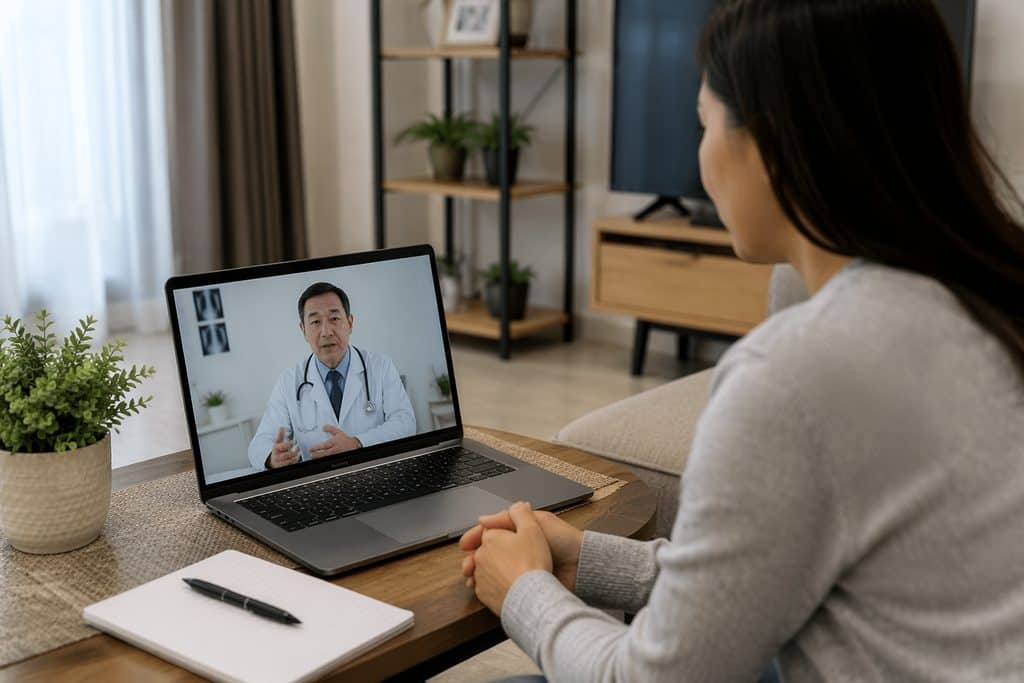
Remote consultation after flying home from surgery abroad typically follows a fixed schedule. The first video review happens around day 10–14. The surgeon or a member of the surgical team examines the wound via camera, reviews any photos you have uploaded, and checks for signs of infection or abnormal healing. The second review usually lands at week six — the point at which most patients are cleared to resume normal activity or begin physical therapy.
These are not casual check-ins. They are structured appointments with the same team that performed your surgery. You upload photos of the incision site through the hospital portal 24 hours before the call. The surgeon reviews them alongside your operative notes. The call itself lasts 20–40 minutes.
Months 3–12: As-Needed Access
After the initial recovery window, follow-up shifts to as-needed. Most international departments provide a direct communication channel — typically WeChat or a hospital app — where you can send questions to the surgical team. Response times vary, but the better programs commit to 48–72 hours for non-urgent queries.
For patients who had orthopedic procedures, cardiac surgery, or oncology treatment, the surgical team may request updated imaging from your local facility at the 6-month and 12-month marks. You upload the new scans through the portal, and the Chinese team reviews them remotely. This closes the loop and ensures that late complications or recurrences are caught by the people who know your case best.
What a Medical Tourism Aftercare Package Price Actually Covers
Let us talk about money. The medical tourism aftercare package price varies widely depending on the hospital, the complexity of the surgery, and the length of follow-up included. At top Chinese public hospitals with international departments, a comprehensive aftercare package — including scheduled video consultations, portal access, and records management — typically runs from $300 to $800 for a 12-month period. This is often bundled into the overall surgical quote or offered as a separate line item.
Some private international hospitals in China, such as those profiled in our guide to JCI-accredited private hospitals, include 12 months of telehealth follow-up in their surgical packages at no additional charge. Others bill per video consultation at $100–300 per session.
Here is how the pricing typically breaks down:
| Follow-Up Component | Typical Cost (USD) | What It Includes |
|---|---|---|
| Scheduled video review (per session) | $100–300 | 20–40 minute consult with surgical team, photo review, written summary |
| 12-month aftercare package (public hospital international dept) | $300–800 | 3–4 scheduled reviews, portal access, records management, email/WeChat access |
| 12-month aftercare package (private international hospital) | $500–1,500 | Unlimited scheduled reviews within reason, direct specialist access, dedicated coordinator |
| Records translation and DICOM imaging conversion | $50–150 | Full bilingual operative report, imaging files in universal format |
| Urgent video consult (within 24 hours) | $150–400 | Priority scheduling with on-call surgical team member |
These figures are reference points. Final pricing varies by hospital and case complexity. What matters is not the absolute number but what the package actually delivers: named contacts, scheduled touchpoints, and a defined escalation path if something goes wrong.
Can I Get Follow Up Care at Home After Surgery in China?
Yes — and in most cases, you should. The goal of a well-designed aftercare protocol is not to keep you tethered to China. It is to make your home physician a full partner in your recovery. That means the Chinese team hands over a complete, translated record set and remains available for consultation when your local doctor has questions.
The practical reality is that most home physicians are willing to provide post-operative care for patients who had surgery abroad, provided they receive adequate documentation. A 2022 survey of primary care physicians in the United States and United Kingdom found that 71% were willing to manage post-surgical follow-up for medical tourists if they received a complete operative report, discharge summary, and direct contact information for the treating surgeon. The willingness dropped to 31% when documentation was incomplete or in a foreign language.
So the question is not whether you can get follow-up care at home. It is whether you will arrive home with the documentation that makes that care possible. A bilingual discharge package is not a courtesy — it is the difference between a smooth handoff and a confused, delayed recovery.
What Your Home Physician Needs: A Practical Checklist
Before you board your flight, verify that you have each of the following. Missing any one of these items will complicate your home follow-up.
- Operative report in English — not a summary, but the full report describing exactly what was done, what was found, and what materials were used.
- Anesthesia record — particularly important if you had general anesthesia, as it documents any airway issues or medication reactions.
- Pathology report — if any tissue was removed, the pathology results must be included, ideally with a translation.
- Discharge medications list — with generic drug names, dosages, and duration. Chinese brand names are meaningless to your home pharmacist.
- Imaging files in DICOM format — on a USB drive or accessible via a secure download link. JPEG screenshots of scans are not sufficient for diagnostic review.
- Wound care instructions with photographs — showing what normal healing looks like at each stage, so you and your home doctor can spot abnormalities early.
- Direct contact for the surgical team — a named individual, not a general hospital switchboard. This is typically the international coordinator or a physician assistant.
- Antibiotic and anticoagulant plan — if you are on post-operative blood thinners, the duration and monitoring plan must be explicit.
Practical tip: Ask for two copies of everything. One paper copy for your home physician’s file, one digital copy stored in a cloud folder you control. Paper gets lost. Digital files get corrupted. Redundancy is cheap insurance.
The Hard Cases: What Happens When Something Goes Wrong After You Land
Let us be honest about the difficult scenarios. You are home. It is week three. The incision site is warm, red, and draining. Your local doctor suspects a surgical site infection. They want to know what antibiotic the Chinese team would recommend given the specific procedure and any cultures taken during surgery. They need an answer within hours, not days.
This is where the quality of your aftercare package is tested. A good program has an escalation protocol: you contact the international coordinator through the hospital portal or WeChat, the coordinator reaches the surgical team, and you receive a response — typically within 24 hours for urgent cases, often faster. The Chinese team may recommend a specific antibiotic, request photos or a local culture swab, or advise you to go to a local emergency department with specific instructions for the treating physician.
But here is the hard truth: no remote protocol can replace in-person evaluation when complications arise. If your local doctor says you need to be seen urgently, you go. The Chinese team can advise, but they cannot examine you. The aftercare package is a support system, not a substitute for local medical care.
Some patients ask whether they should fly back to China for revision surgery or complication management. The answer depends on the nature of the complication and the advice of both your home physician and the Chinese surgical team. In most cases, minor complications — superficial infections, small wound dehiscence, controlled pain — are managed at home with remote guidance. Major complications — hardware failure, deep infection, internal bleeding — may require a return trip or intervention by a local specialist. This is a decision made case by case, never by a fixed rule.
Practical Considerations: Documentation, Insurance, and Communication
Three practical areas deserve attention before you commit to surgery in China, because each one directly affects the quality of your follow-up care.
Documentation standards. Request the bilingual discharge package before you agree to surgery, not after. Some hospitals include this as standard; others charge a translation fee. The cost is trivial compared to the value. Insist on DICOM imaging files, a full operative report, and a named follow-up contact. If the hospital cannot provide these, that is a red flag — not necessarily a dealbreaker, but a signal that you will need to work harder to assemble your own records.
Insurance and reimbursement. If you are using international health insurance, confirm what follow-up services are covered. Many policies cover the surgery itself but exclude telehealth follow-up or records translation. Some insurers require pre-authorization for post-operative video consultations. Check before you leave. If you are paying out of pocket, the aftercare costs outlined above are modest relative to the surgical fee — but they are real, and they should be in your budget.
Communication channels. WeChat is the dominant communication platform in China. Most international departments use it for patient follow-up. If you do not have WeChat, set it up before you travel. It is free, it works on both iOS and Android, and it will be your primary line to your surgical team after you return home. Email works too, but response times are typically slower. Some hospitals use dedicated patient portals, but WeChat remains the default.
Frequently Asked Questions
How long does follow-up care after surgery in China last?
Most structured aftercare packages run for 12 months from the date of discharge. The first three months involve scheduled video reviews at fixed intervals — typically weeks 2, 6, and 12. After that, follow-up is as-needed, with direct access to the surgical team through the hospital portal or WeChat. Some specialties, particularly cardiac surgery and oncology, recommend follow-up extending to 24 months or longer.
What if my home doctor refuses to manage my post-operative care?
This happens, and it is usually about documentation, not hostility. If your home physician is unwilling to take over your care, ask what they need. In most cases, a complete bilingual operative report, DICOM imaging, and direct contact with the surgical team resolves the concern. If your doctor still declines, you have the right to seek care from another physician. You can also request that the Chinese team provide a written management plan that any competent local doctor can follow.
Can I get a prescription from the Chinese surgical team after I return home?
Chinese physicians cannot write prescriptions that are valid outside China. What they can do is provide a written medication plan with generic drug names and dosages, which your home physician can then prescribe. For controlled substances, the process is more complex and may require in-person evaluation by a local doctor. Do not attempt to bring large quantities of prescription medication across international borders — customs regulations apply, and violations can be serious.
What if I need emergency care at home related to my surgery?
Go to your nearest emergency department. Do not wait for the Chinese team to respond. Once you are stable, contact your international coordinator and provide the treating physician’s contact information. The Chinese surgical team can then communicate directly with your local doctors to provide operative details, imaging, and recommendations. The aftercare package is designed to support this kind of urgent handoff, but it cannot replace local emergency care.
How much should I budget for follow-up care after returning home?
If your aftercare package is bundled into the surgical fee, budget nothing additional beyond any local co-pays or imaging your home physician orders. If you are paying per consultation, budget $300–800 for a standard 12-month follow-up period with three scheduled video reviews. Add $50–150 for records translation if not included. Urgent consultations cost more, but they are rare. These are reference figures — final costs vary by hospital and case complexity.
Your Next Step
Follow-up care after surgery abroad China is not something you hope works out. It is something you verify before you commit. Ask to see the aftercare protocol in writing. Confirm the documentation package, the telehealth schedule, and the escalation path for complications. If the answers are vague, keep looking.
Our team at China Medical Services helps international patients evaluate hospitals, understand follow-up protocols, and coordinate the entire journey from first consultation to post-operative care. We are not a hospital and we do not provide medical advice or diagnoses. What we do is help you ask the right questions and connect you with institutions that meet the standards described in this article. When you are ready to explore
For more medical information and treatment options in China, visit chinamedservices.com (China Medical Services).
