Proxy Consultation for Central Asian Patients: How It Works
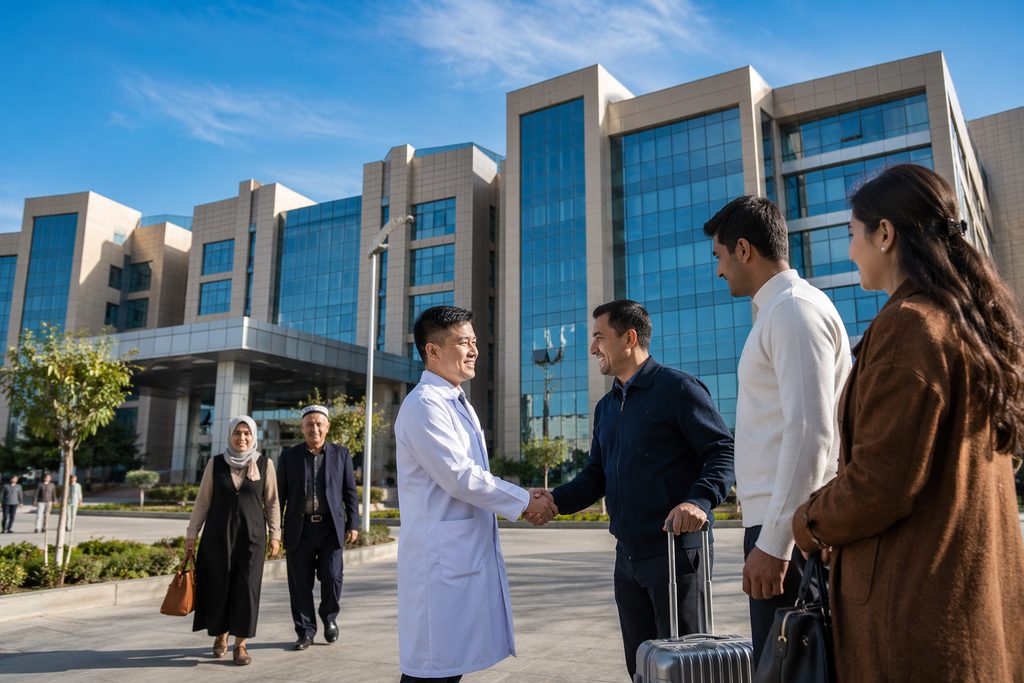
According to data from China’s National Health Commission, the country’s public hospitals handled over 8 billion outpatient visits in 2023. A growing share of those visits now involve international patients. For families across Kazakhstan, Uzbekistan, Kyrgyzstan, and Tajikistan, the appeal is straightforward: access to 340+ top-ranked hospitals at costs that often run 70–80% below Western private care. But there is a structural problem. Most Chinese public hospitals do not allow overseas patients to book outpatient appointments remotely. You cannot simply email a hospital and secure a slot with a cardiologist in Beijing. This is where the proxy consultation model has emerged as a practical workaround for medical tourism China for Central Asian patients.
What does a proxy consultation actually mean? Someone physically goes to the hospital on your behalf. They register under your name, present your translated medical records, speak with the specialist, and relay the doctor’s assessment back to you. It is not a diagnosis. It is not treatment. It is a structured way to get your case in front of a Chinese specialist without flying to China first. For patients in Almaty or Tashkent who need clarity before committing to an expensive trip, this changes the math.
How This Actually Works, Step by Step
The sequence is more involved than most people expect. Here is the real flow, based on how our coordination team handles cases from Central Asia.
Step 1: You send us your existing medical file. That means discharge summaries, imaging reports (CT, MRI, ultrasound), lab results, pathology slides if relevant, and a short description of your current symptoms and treatment history. The file does not need to be in English. Russian and Kazakh documents are common. We arrange certified translation into Chinese — this step alone typically takes 3 to 5 working days.
Step 2: We match your case to a hospital and department. Not every hospital suits every case. A patient with a complex cardiac arrhythmia might be directed toward Fuwai Hospital in Beijing, which performs over 14,000 cardiac surgeries annually. A patient with liver cancer would more likely be matched with Zhongshan Hospital in Shanghai. Our hospital database covers 37 cities and 340+ institutions, filtered by the Fudan ranking system and JCI accreditation status. We do not guess. We match based on the specialty reputation data we maintain.
Step 3: A proxy visits the hospital in person. This is the core of the service. A bilingual coordinator goes to the outpatient department, creates a hospital medical card under your name, registers for the relevant department, and waits in line. Chinese public hospital queues are real — morning registration for a top specialist often starts before 7 a.m. The coordinator presents your translated records and explains your case to the doctor.
Step 4: You receive a written summary. The doctor may recommend further tests, adjust a medication plan, or state whether surgical treatment in China is feasible. We translate that response and send it to you, usually within 24 to 48 hours after the visit. If the doctor requests additional imaging or a video follow-up, we coordinate that as a separate step.
Step 5: You decide. Some patients stop here — they got the answer they needed. Others proceed to a video consultation or plan travel to China for in-person treatment. The proxy consultation is designed to prevent unnecessary flights, not replace actual care.
Proxy Consultation for Central Asian Patients: What It Solves
Central Asian patients face a specific set of barriers when considering Chinese hospitals. The first is language. Almost no public hospital in China operates in Russian or Kazakh. English-speaking staff are concentrated in private international clinics, not in the top-tier public institutions where the most experienced specialists work. The second barrier is geography. A flight from Nur-Sultan to Beijing is about 5 hours. From Tashkent to Shanghai, roughly 7 hours. That is close enough to be tempting — but far enough that a wasted trip is expensive. The third barrier is the registration system itself.
Here is the reality: China’s top public hospitals run on a same-day registration model for general outpatient care. You cannot reserve a slot online from abroad for a standard outpatient visit. Walk-in registration is the norm. The specialist you want to see may only hold clinic hours two mornings a week. If you arrive without local knowledge, you can easily spend a week just trying to get registered. A proxy consultation removes that uncertainty. Someone who knows the hospital’s rhythm handles the queue.
So what does a proxy consultation actually deliver? Three things. First, confirmation that a Chinese specialist is willing to review your case. Second, a preliminary treatment direction — whether surgery, medication adjustment, or further diagnostics are recommended. Third, a realistic cost estimate for proceeding with in-person care. None of this is a guarantee of admission. But it is the difference between flying blind and flying informed.
A Realistic Timeline
People underestimate the waiting steps. Here is what a typical proxy consultation timeline looks like for a patient from Kazakhstan or Uzbekistan, from first contact to a usable answer.
| Stage | What Happens | Duration |
|---|---|---|
| Day 1–3 | You submit medical records; we review completeness and request missing documents | 2–3 days |
| Day 4–8 | Certified translation of records into Chinese (Russian/Kazakh → Chinese) | 3–5 working days |
| Day 9–12 | Hospital and department matching; confirmation of specialist outpatient schedule | 2–4 days |
| Day 13–15 | Proxy visit: registration, queueing, consultation with specialist | 1 day on-site |
| Day 16–18 | Translation of doctor’s response; written summary delivered to you | 1–3 days |
| Week 3–4 | Optional: video consultation with the same specialist or second opinion review | 1–2 weeks |
| Month 2+ | If proceeding to treatment: S2 visa application, travel planning, hospital admission coordination | 4–8 weeks |
Notice where the hidden delays sit. Translation is the step most people forget. A 40-page medical file in Russian does not translate itself overnight. And specialist outpatient schedules matter — a top oncologist at a Fudan-ranked hospital may hold clinic only on Tuesday and Thursday mornings. If your records arrive on a Friday, the proxy visit may not happen until the following week.
Visa processing adds another layer. For medical travel to China, the applicable short-stay category is the S2 visa, which covers private affairs including medical treatment. Processing times vary by embassy and season, but 2 to 4 weeks is a realistic range. Some patients apply for the S2 visa after receiving the proxy consultation result, since the hospital’s written response can serve as supporting documentation.
What Can Go Wrong — and What Happens Then
Honesty matters here. Proxy consultations do not always produce the answer the patient hopes for. Here are the common failure modes and the actual recourse.
The specialist declines to give a definitive opinion. Chinese doctors are often cautious about commenting on a case without seeing the patient in person. They may say: “The records are insufficient. The patient needs to come for further testing.” That is not a rejection — it is a request for more data. The recourse is a follow-up step: either a video consultation where the patient can speak directly with the doctor, or additional imaging done locally and sent for review. Some cases simply cannot be resolved remotely, and the honest answer is that an in-person visit is required.
The hospital refuses proxy registration. This happens occasionally. Some hospitals have tightened rules around third-party registration, particularly for high-demand departments. The workaround is to use the hospital’s official international medical services channel, where proxy coordination is more accepted. Not every hospital has this channel. Our team knows which ones do and which ones require the patient to be physically present for the first visit. If a proxy consultation is not feasible at a given hospital, we say so before accepting payment.
The cost estimate surprises you. A proxy consultation gives you a preliminary treatment cost range. But actual costs shift once the doctor sees you in person and orders tests. A cardiac surgery quoted at $15,000 may become $22,000 after additional imaging and a longer ICU stay. The reverse also happens — some cases turn out simpler than expected. The point is that the proxy consultation gives you a floor, not a ceiling.
You cannot get the specific specialist you asked for. Top names in Chinese medicine are heavily booked. A proxy visit may land you with a senior attending physician in the same department rather than the department chair. That is not a downgrade in most cases — senior attendings at Fudan-ranked hospitals are highly experienced. But if you specifically need a named expert, a video consultation through the hospital’s international channel is often the more reliable route. We do not promise specific doctors. We promise that a qualified specialist in the relevant department will review your case.
How to Find a Doctor in China from Kazakhstan: Decision Criteria
If you are searching for how to find a doctor in China from Kazakhstan, you have likely already hit the wall of hospital websites that are mostly in Chinese and phone numbers that nobody answers. The practical path is narrower than most people think. You have three realistic options.
Option 1: Use a hospital’s official international department. Many top hospitals — including Peking Union Medical College Hospital, Zhongshan Hospital, and West China Hospital — operate international medical service centers. These centers handle foreign patients, provide English-speaking staff, and can sometimes arrange proxy or video consultations. The catch: they are often priced at 1.5 to 2 times the standard outpatient rate. A standard specialist consultation that costs 100 RMB locally may cost 800–1,500 RMB through the international channel. Still, for many patients, the official channel is the safest entry point.
Option 2: Work with a coordination service like ours. We handle the translation, registration, proxy visit, and follow-up. The cost of proxy medical consultation China services typically starts from $300 for hospital appointment coordination, with the proxy visit itself billed separately depending on hospital and department. Written second opinions from top-tier specialists run $300 to $500. Video consultations range from $100 to $800 depending on the seniority of the specialist. These are coordination fees — they do not include hospital charges, which are paid directly to the hospital.
Option 3: Fly to China and handle it yourself. This works if you speak Chinese or have a trusted local contact. It is the cheapest option in pure service fees, but the most expensive in time and uncertainty. A week in Shanghai for a patient and one family member easily costs $1,500–2,500 in flights and hotels before any medical expense. And you may still fail to get registered with the right specialist.
So how do you choose? Ask one question: how much uncertainty can you tolerate? If you need a definitive answer before booking flights, a proxy or video consultation is the rational first step. If you have family in China who can navigate the system, that changes the equation. But most Central Asian patients do not have that network.
Practical Considerations: Records, Visas, Payment, and Follow-Up
The logistics are not glamorous, but they determine whether the process works. Here is what actually matters.
Medical records quality. Chinese specialists are trained to read imaging, not just reports. If you have a CT or MRI on a disc, send the disc image files, not just the written report. Pathology slides should be sent as digital scans where possible. Incomplete records are the single most common reason a proxy consultation produces an inconclusive result.
Visa category. For medical treatment in China, the applicable visa is S2 for short stays, not the M visa, which is for commercial and trade activities. Family members accompanying the patient also apply for S2. The hospital’s invitation letter or the written consultation response can support the visa application. Requirements vary by Chinese embassy, so confirm with the specific consulate serving your region — Almaty, Astana, Tashkent, and Bishkek each have their own processing norms.
Payment. Public Chinese hospitals require prepayment. You pay a deposit at admission, and charges are deducted as services are provided. International insurance is generally reimbursement-based for public hospitals — you pay out of pocket, then claim. Private international hospitals in China, such as United Family or Jiahui, often offer direct billing with major insurers. That convenience comes at a higher price point.
Language. Even at hospitals with international departments, the radiology department, the pharmacy, and the billing office may have no English-speaking staff. A bilingual medical companion — from $300 per day — handles registration queues, payment counters, pharmacy pickups, and translation during consultations. For patients from Central Asia who speak neither Mandarin nor English fluently, this is not a luxury. It is the difference between getting through the day and getting lost in a hospital that sees 10,000+ outpatient visits daily.
Follow-up at home. Chinese doctors will provide a discharge summary and medication plan. But ongoing monitoring happens at home. You need a local physician in Almaty or Tashkent who is willing to manage the post-treatment phase. Arrange this before you travel. The Chinese hospital will not chase you for follow-up — that responsibility transfers to you and your local doctor.
Remote Second Opinion China Oncology: A Specific Use Case
Oncology is the most common reason Central Asian patients request a remote second opinion China oncology review. The logic is simple: cancer treatment protocols differ between countries, and Chinese oncology departments handle enormous case volumes. A medical oncologist at a top Chinese cancer center may see more cases of a specific tumor type in a year than a regional oncologist in Kazakhstan sees in a decade. That volume translates into pattern recognition.
The process for a written second opinion is straightforward. You submit imaging, pathology reports, treatment history, and current status. A specialist in the relevant oncology department reviews the file and provides a written assessment: whether the current treatment plan aligns with Chinese protocols, whether alternative therapies are available in China, and whether the patient is a candidate for any clinical approach offered at that hospital. The cost for a written second opinion from a top-tier specialist runs $300 to $500. A video consultation with the same specialist costs $500 to $800. A multidisciplinary team review — where an oncologist, surgeon, and radiologist review the case together — runs $1,500 to $2,000.
One important note: any consultation fee paid to us is credited in full toward on-the-ground coordination if you later travel to China for treatment within 90 days. That credit applies to our coordination fee only — never to hospital treatment charges. It is a way to make the remote step feel less like a sunk cost.
For patients asking whether someone else can consult a Chinese doctor for them, the answer is nuanced. A proxy can present records and relay questions. But Chinese oncologists are often reluctant to make treatment changes without seeing the patient. The proxy consultation is best understood as a triage step: it tells you whether traveling to China is worth it. If the specialist says your current treatment is appropriate, you save yourself a trip. If the specialist says a different approach is worth considering, you have a concrete reason to book the flight.
Best Hospitals in Shanghai for International Patients: A Quick Orientation
Shanghai deserves its own note because it is the most common entry point for Central Asian patients. The city has 18 hospitals in the Fudan Top 100 composite ranking — second only to Beijing. For international patients, a few names come up repeatedly.
Zhongshan Hospital, Fudan University — a leading center for cardiology, cardiac surgery, and liver disease. Its cardiac surgery volume is among the highest in China. Ruijin Hospital, Shanghai Jiao Tong University — strong in endocrinology, hematology, and general surgery. Huashan Hospital, Fudan University — known for neurology, neurosurgery, and infectious disease. Shanghai East Hospital and Renji Hospital also maintain active international patient departments.
For patients who prefer Western-style care with English-speaking staff and direct insurance billing, Shanghai’s private international hospital sector includes United Family, Jiahui, Parkway, and Raffles. These are JCI-accredited and operate at a higher price point — often 3 to 5 times the cost of a public hospital’s international department. But the experience is smoother. No queues, no language barrier, and appointments can be booked remotely. For a first video consultation, a private international hospital is often the path of least resistance.
Which is better? It depends on your priority. If you want the highest-volume specialist at the lowest cost, the public hospital international department is the answer. If you want minimal friction and are willing to pay for it, the private sector works. Our Shanghai hospital guide breaks down the public and private options in more detail. And for patients who need help narrowing the choice, our consultation service starts with a free discussion of your case.
Frequently Asked Questions
Can someone else consult a Chinese doctor for me without me being there?
For more medical information and treatment options in China, visit chinamedservices.com (China Medical Services).
