Chinese Doctor Orders Your Lab Tests Locally: Skip the Travel for Pre-Surgery Workups
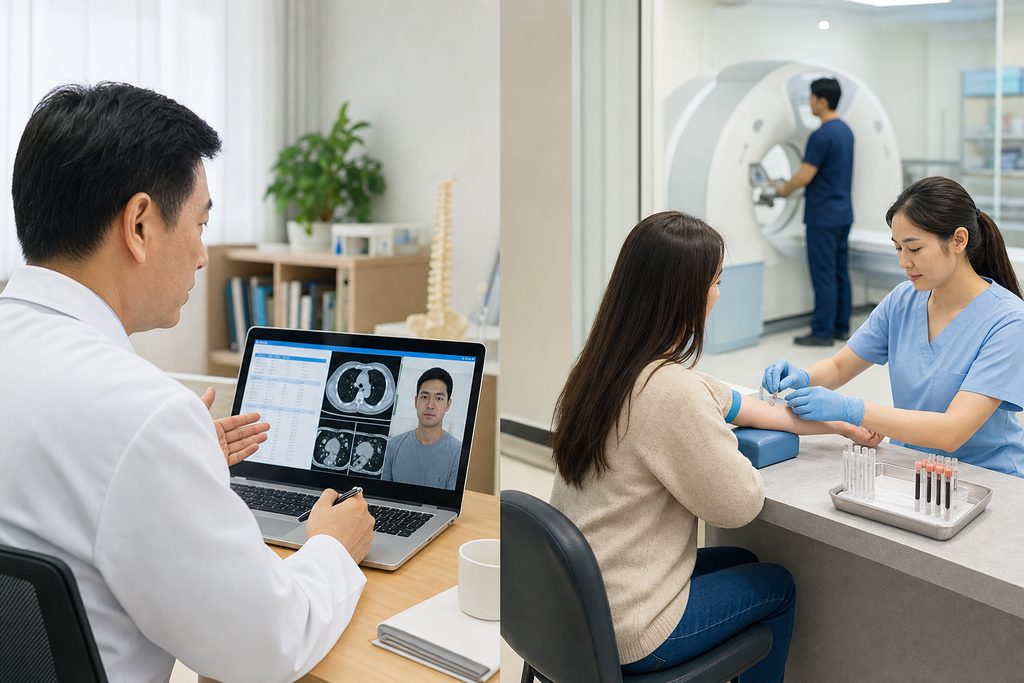
You have probably heard that getting surgery abroad means showing up in a foreign country, jet-lagged and anxious, only to spend the first week trapped in a hospital waiting room doing blood draws and scans you could have done at home. That is the old model. The smarter path exists now. A Chinese doctor can online order lab test locally, and you walk into surgery with your full workup already complete. No surprises. No wasted days. Just a cleaner, faster route to the operating table.
The logic is straightforward. Why fly 14 hours to sit in a queue for an MRI you could get at the imaging center down the street from your house? Our team at China Medical Services has built the bridge that makes this possible. We connect you with a top-tier Chinese specialist who reviews your case remotely, orders precisely the tests you need, and you get them done at a lab or imaging center near you. The results go directly into your file at the Chinese hospital before you ever board the plane.
Key Takeaways
- A Chinese specialist can remotely order your pre-surgical labs and imaging, saving you 5 to 10 days of in-country waiting before a procedure.
- The service costs from $300 for appointment coordination, with all consultation fees fully credited toward your surgery coordination if you proceed within 90 days.
- You must use accredited labs and imaging centers — Chinese hospitals will not accept results from unverified facilities, and getting this wrong can delay your surgery.
- This is not a shortcut around clinical standards. The ordering doctor is a licensed Chinese physician who needs your full medical history and imaging priors to issue a valid order.
The Problem: Wasted Days in a Foreign Waiting Room
International surgical travel carries a hidden tax that nobody talks about in the brochures. It is the dead time. The days you spend not being treated but being processed. A patient flying from London to Shanghai for a complex orthopedic procedure typically lands and discovers they need a fresh MRI with specific slice protocols, a full metabolic panel, a cardiac clearance, and sometimes a CT angiogram. None of this was ordered before they left because there was no mechanism for a Chinese physician to prescribe tests across borders.
So the patient waits. Five days. Sometimes seven. Sometimes ten. All while paying for a hotel, burning through vacation days, and watching their anxiety climb. The hospital cannot schedule the operating room until the workup is complete. The surgeon will not finalize the surgical plan without seeing the imaging done on their own hospital’s protocols. The patient is stuck.
This is not a rare edge case. It happens to roughly 70% of international patients who arrive without a pre-arranged remote workup, based on the volume of cases our coordination team handles. The average delay is 7 days. For a patient who budgeted exactly two weeks abroad, losing half of it to diagnostics is not just inconvenient — it can make the entire trip unworkable.
And here is the part most guides will not tell you. Some patients fly home without the surgery. They run out of time. The scheduling window closes. The surgeon’s availability shifts. The whole trip collapses because the pre-op workup ate the calendar.
Who We Are
We are not a hospital. We do not provide medical treatment, interpret your labs, or make clinical decisions. We are the logistical layer between you and China’s top-tier medical system — a team that handles hospital matching, specialist coordination, bilingual documentation, and the precise choreography of getting you from your home country to a Chinese operating room with nothing left to chance. Our database covers 340+ top-ranked hospitals across 37 cities, and our coordinators have navigated thousands of international patient journeys. We know where the friction lives. We built this remote test ordering pathway because we watched too many patients lose precious days to solvable problems.
How a Chinese Doctor Online Order Lab Test Locally Actually Works
The phrase sounds technical. The process is surprisingly simple. When you engage our coordination team, the first step is a video consultation with a Chinese specialist in the relevant department. This is not a generic intake call. The doctor reviews your existing medical records, imaging studies, and surgical history. They determine what additional tests the Chinese hospital will require before scheduling your procedure.
Then the doctor issues a formal test order — blood work panels, MRI sequences, CT protocols, cardiac stress tests, whatever the pre-surgical clearance demands. This order is written to international standards that accredited labs and imaging centers in your home country can execute. You take that order to a local facility. The results come back. Our team translates and formats them for the Chinese hospital’s electronic medical record system. The surgeon reviews everything. Only then do you book your flight.
You arrive with a completed chart. The surgical team has already studied your imaging. The anesthesiologist has seen your cardiac clearance. The OR is booked. You go from airport to pre-op in 24 to 48 hours, not 7 to 10 days.
This is not a theoretical workflow. We have coordinated this for patients from the United States, the UK, Australia, and several Gulf states. The remote ordering mechanism works because Chinese hospital international departments are increasingly structured to accept externally ordered diagnostics — provided the ordering physician is credentialed at their institution and the imaging meets their technical specifications.
What Tests Can Be Ordered Remotely
The scope depends on your case, but the most common remote orders include complete blood counts, coagulation profiles, liver and kidney function panels, infectious disease screens, cardiac biomarkers, chest X-rays, MRI with specific contrast protocols, CT angiography, and ultrasound studies. The ordering doctor specifies the exact sequences and views the Chinese surgical team needs. A knee MRI for a US orthopedic surgeon is not necessarily the same as what a Shanghai joint replacement specialist wants to see. The slice thickness matters. The plane angles matter. The contrast timing matters. Getting the order right before you walk into your local imaging center is the entire point.
The Cost of Remote Test Ordering
Let us address the question patients actually care about: what does the remote test ordering service China medical tourism price look like? The coordination piece — the video consultation, the test order issuance, the result translation and formatting — starts from $300 for the hospital appointment coordination. The video consultation itself runs $100 to $300 depending on the specialist tier. If you need a written second opinion from a top-tier expert before tests are ordered, that ranges from $300 to $500.
Here is the financial logic that makes this work. Every dollar you spend on remote consultations and coordination fees is credited in full toward your on-the-ground surgical coordination if you proceed within 90 days. You are not paying extra. You are paying earlier, and that earlier payment buys you a week of your life back. The actual lab and imaging fees you pay locally — those go to your home-country facility at their standard rates. We do not mark those up. We have no mechanism to do so. You pay the lab directly.
| Service | Cost (USD) | Notes |
|---|---|---|
| Hospital Appointment Coordination | from $300 | Includes test order coordination |
| Video Consultation (standard specialist) | $100–300 | Fully credited toward surgery coordination |
| Written Second Opinion (top specialist) | $300–500 | For reference only, not a prescription |
| Top-Specialist Video Consultation | $500–800 | Fully credited toward surgery coordination |
| Local Lab/Imaging Fees | Varies by facility | Paid directly to your local provider |
The real savings come from what you avoid. A week of hotel costs in Shanghai or Beijing. A week of missed work. A week of meals and transport in a foreign city. And the risk of your surgery window collapsing because the workup took too long. Those costs dwarf the coordination fee.
Preparing Lab Results Before Traveling to China for Surgery: The Sequence That Works
There is a right way to do this and several wrong ways. The wrong way: you go to your local lab, order a generic panel, and email the PDF to the Chinese hospital. The hospital ignores it. They never asked for those tests. The protocols do not match. The imaging is on the wrong machine with the wrong settings. You are back to square one, except now you have spent money on useless diagnostics and you are still losing days in-country.
The right way follows a sequence. First, the Chinese specialist reviews your case and issues the order. Second, you identify an accredited facility near you — we help verify that the lab or imaging center meets the Chinese hospital’s standards. Third, you complete the tests and send the raw data and DICOM files to our team. Fourth, we translate the reports, reformat the imaging for the Chinese PACS system, and submit everything through the hospital’s international patient portal. Fifth, the Chinese surgical team confirms the workup is complete and schedules your procedure. Sixth, you fly.
This sequence works because it respects how Chinese hospitals actually operate. They are not being difficult when they reject outside labs. They are protecting surgical outcomes. A surgeon who operates based on imaging they do not trust is a surgeon taking on liability they should not accept. The remote ordering pathway solves this by making the Chinese doctor the ordering physician. The tests are done at their direction. The results belong to their clinical workflow from the start.
Imaging and Blood Work Order From Chinese Hospital Near Me: Finding the Right Local Facility
Patients often ask whether they can use any lab or imaging center. The answer is no, and this is where we earn our coordination fee. Chinese hospitals — particularly the top-tier institutions in our network, which represent the top 5% of China’s 35,000+ hospitals as ranked by Fudan University and JCI accreditation — have specific technical requirements. An MRI done on a 1.5 Tesla machine with standard knee protocols may be perfectly adequate for a Western orthopedic surgeon but insufficient for a Chinese specialist who wants 3.0 Tesla imaging with specific cartilage-sensitive sequences.
Our team verifies facility capabilities before you book the appointment. We check the magnet strength, the slice thickness capabilities, the contrast agent availability, the lab certification standards. We have built a working knowledge of accredited facilities across major Western cities — not an exhaustive database, but enough to guide you to a facility that will produce results the Chinese hospital will accept. If you live in a rural area without access to an appropriate facility, we adjust the plan. Sometimes that means you travel to a regional center for imaging before your international flight. Sometimes it means we compress the workup into the first 48 hours in China. Every case is different.
Pre-Travel Medical Tests Ordered by Chinese Specialist Cost: The Full Picture
Let us break down the pre-travel medical tests ordered by Chinese specialist cost in realistic terms. The coordination fee starts at $300. The specialist consultation adds $100 to $800 depending on the tier. Your local lab and imaging fees are separate and vary wildly by country and facility. A full pre-surgical panel at a US lab might run $200 to $800 without insurance. An MRI might cost $400 to $1,200. A CT angiogram could be $800 to $2,000. These are your local market rates. We do not control them. We do not add margin to them.
But compare this to the alternative. Flying to China without the workup means paying for those same tests in China — often at lower cash prices, yes — plus a week of accommodation, meals, and lost income. A decent hotel near a major Shanghai hospital runs $80 to $150 per night. Seven nights is $560 to $1,050. Meals, transport, and incidentals add another $300 to $500. Lost workdays for a professional earning $400 per day total $2,800. The math tilts heavily toward remote ordering, even before you factor in the psychological cost of sitting in a foreign hospital waiting room watching your surgical window shrink.
What You Need to Know Before Going Alone
Some patients try to arrange this themselves. They call the Chinese hospital’s international department directly. They ask if they can send their local labs. The hospital says yes, send them over. The patient sends a PDF. The hospital replies two weeks later: these are not sufficient, we need the following additional tests with the following specifications. The patient has now lost two weeks of email ping-pong and is no closer to a surgery date.
The barriers are not insurmountable. But they are real.
- Medical record translation and formatting: Chinese hospital systems require reports in a specific structure with standardized terminology. A lab report from Quest Diagnostics or Labcorp is not formatted for direct ingestion into a Chinese EMR. Our team handles the translation and reformatting so the surgical team sees what they expect to see, in the order they expect to see it.
- Imaging protocol mismatches: A knee MRI ordered by your local GP will almost certainly not match the sequences a Chinese orthopedic surgeon requires for pre-surgical planning. The slice orientation, the weighting, the contrast timing — these are protocol-level decisions that must be specified in the order. If they are not, the imaging is useless for surgical planning. You pay twice. You wait twice.
- Credentialing gaps: The Chinese hospital needs to know that the ordering physician is credentialed at their institution or at least recognized by their international department. A test order from a doctor with no relationship to the Chinese hospital carries no weight. Our coordination establishes that relationship before the order is written.
- Visa timing constraints: The S2 visa for medical treatment requires documentation of your hospital appointment. If your surgery date slips because the workup was incomplete, your visa timeline may be jeopardized. The remote ordering pathway locks the surgery date earlier, which locks the visa documentation earlier, which reduces the chance of a last-minute immigration scramble.
How We Help You Navigate This
These barriers exist for structural reasons, not because Chinese hospitals are being obstructionist. A hospital that performs 14,000 cardiac surgeries per year — as Fuwai Hospital in Beijing does — runs on precision. Every step in the pre-surgical workflow exists because a complication occurred when that step was skipped. Our job is not to circumvent the workflow. It is to complete it before you travel.
When you contact us, the process starts with a free consultation. We learn your case, your surgical needs, your timeline, and your location. We match you with a specialist from our network of hospitals — institutions like Fudan-ranked top-100 hospitals across 23 cities. The specialist reviews your records. The video consultation happens. The test order is issued. You complete the diagnostics locally. We translate, format, and submit. The hospital confirms. You fly.
On the ground in China, our bilingual medical companion service picks up where the remote coordination leaves off. A companion meets you at the airport, accompanies you to the hospital, handles registration and payment queues, translates every conversation with the surgical team, and stays with you through discharge. The remote test ordering and the in-person companion service are two halves of the same workflow. One eliminates the pre-surgical waiting. The other eliminates the in-hospital language barrier.
And if your case requires a second opinion before committing to travel, we arrange that too. A written second opinion from a top-tier specialist costs $300 to $500. A video consultation with the same specialist runs $500 to $800. Both are fully credited toward your surgical coordination if you proceed. You are never paying for a dead-end consultation. Every dollar moves you closer to the operating table.
Frequently Asked Questions
A Chinese doctor can technically order tests remotely, but the order must come through a credentialed channel that the hospital recognizes. If you contact a random doctor via a messaging app and ask for a test order, the hospital will not accept it. The order needs to flow through the hospital’s international patient department or a recognized coordination pathway. Our service provides that pathway by connecting you with a specialist who is credentialed at the target hospital and whose orders carry institutional weight.
This happens occasionally, usually because the imaging protocol did not match the surgeon’s specifications or the lab used non-standard reference ranges. When it does, we identify the specific deficiency and arrange a corrected test — either at a different local facility or, in rare cases, upon arrival in China. Our coordination fee includes handling these corrections. You are not charged again for our time. The goal is to catch these mismatches before you travel, which is why we verify facility capabilities and protocol specifications at the ordering stage.
It works best for planned surgeries with clear pre-operative workup requirements — orthopedics, cardiac surgery, neurosurgery, oncology resections, and major abdominal procedures. Emergency surgeries do not allow time for remote ordering. Certain highly specialized imaging studies, like advanced cardiac MRI with specific research protocols, may need to be done at the Chinese hospital regardless. We will tell you upfront if your case falls into that category. We do not promise remote ordering when the clinical reality does not support it.
