Full Companion for Central Asian Patients: China Medical Care Explained
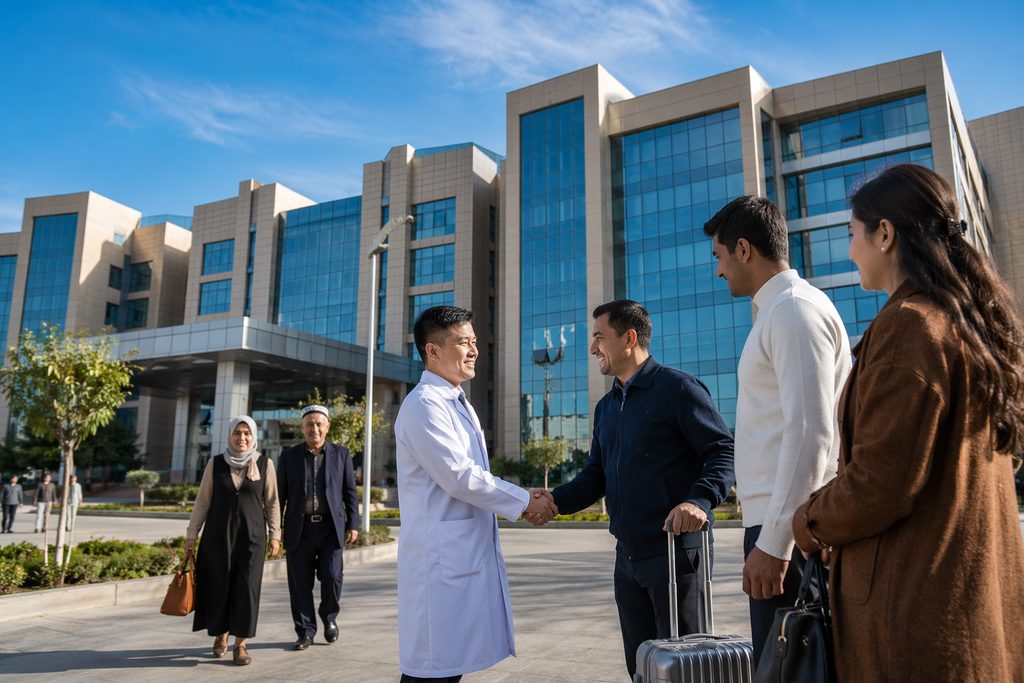
According to China’s National Health Commission, over 300,000 international patients entered the country for medical treatment in 2024, with Central Asian nationals representing one of the fastest-growing groups. The best hospital in China for Central Asian patients depends on the diagnosis, but Fuwai Hospital in Beijing performs more than 14,000 cardiac surgeries annually — the highest volume of any heart center worldwide. That scale matters when you are traveling 3,000 kilometers for a bypass.
This guide explains how to plan treatment from Kazakhstan, Kyrgyzstan, Uzbekistan, Tajikistan, or Turkmenistan. We cover hospital selection, S2 visa requirements, realistic costs, payment methods, and the role of a bilingual medical companion. No fluff. Just the details that determine whether your trip succeeds or stalls.
Full Companion for Central Asian Patients: The Short Answer
A full companion for Central Asian patients means having a bilingual coordinator handle hospital registration, queue management, fee payment, translation, and navigation inside facilities that see 10,000 outpatient visits per day. It does not mean a doctor. It means a local professional who prevents the administrative chaos that derails treatment for patients without Mandarin skills.
The caveat: public hospital outpatient departments in China do not accept advance bookings from overseas. You cannot email a hospital and reserve a surgery date. What you can do is use a coordination service that arranges the hospital card, registers you on the correct day, and accompanies you through every step. That is the realistic model.
Who This Is Right For — and Who It Isn’t
Central Asian patients typically travel to China for cardiac surgery, oncology treatment, orthopedic procedures, reproductive medicine, or complex diagnostics. The system works best when you have existing medical records and a clear clinical question.
Good candidates:
- Patients with a confirmed diagnosis who need a second opinion or surgical plan
- Those who can provide CT, MRI, lab results, and pathology reports in any language for translation
- Families traveling with a patient who needs in-person support for logistics
- Patients seeking cost savings of 50–80% compared to treatment in Turkey, South Korea, or Germany
- Individuals open to both public hospital international departments and private JCI-accredited facilities
Who should not pursue this:
- Patients in unstable condition who cannot tolerate a 5–7 hour flight without medical escort
- Those expecting a guaranteed surgery date before any in-person consultation — no legitimate service can promise that
- Patients who need long-term rehabilitation far from home with no family support in China
- Anyone unwilling to pay hospital deposits upfront; Chinese hospitals require prepayment before admission
If you fall into the second list, staying closer to home or choosing a destination with a simpler pathway may be wiser.
The Options, Compared
Central Asian patients weigh three realistic pathways for treatment in China. Each has different cost structures, language support, and scheduling flexibility.
| Option | Typical Cost Structure | Language Support | Advance Booking | Best For |
|---|---|---|---|---|
| Public hospital, standard outpatient | Lowest treatment fees; heart bypass $12,000–20,000 | Minimal English; Mandarin required | Not available from overseas | Budget-conscious patients with a local guide |
| Public hospital, international/VIP department | 1.5–2x standard fees; bypass $18,000–35,000 | English-speaking coordinators available | Partial coordination possible | Patients wanting senior specialists with fewer queues |
| Private international hospital (JCI) | Highest fees; bypass $35,000–60,000 | Full English service | Direct scheduling possible | Families prioritizing comfort, insurance billing |
Most Central Asian patients choose the middle column: public hospital international departments. You get senior faculty from top-ranked institutions like Fudan-ranked hospitals without the full private markup. But remember — even VIP channels require an in-person consultation before surgery is scheduled.
How to Get a Medical Visa from Kazakhstan to China
Kazakhstani citizens — and nationals of other Central Asian republics — apply for an S2 visa for short-term private affairs, including medical treatment. The S2 is not a dedicated “medical visa” in the way some countries issue one; it is the visa category used for treatment visits under 180 days. Stays beyond 180 days require an S1 visa.
You will need:
- A valid passport with at least 6 months remaining and two blank pages
- A completed visa application form with a recent photo
- An invitation letter or medical appointment confirmation from the Chinese hospital
- Medical records translated into English or Chinese (for the hospital, not the embassy)
- Proof of sufficient funds for treatment and stay
- Round-trip flight booking and hotel reservation
Processing takes 4–10 working days at the Chinese embassy in Astana or consulate in Almaty, depending on whether you choose standard or express service. Apply only after the hospital has confirmed your initial consultation or admission plan. Embassies rarely issue S2 visas without a hospital document.
Family members accompanying the patient apply for their own S2 visas under the same application, listing the patient as the primary traveler. Do not apply for an M visa — that category is strictly for commercial and trade activities and will be rejected for medical purposes.
What Documents Do I Need for Surgery in Shanghai?
Shanghai hospitals — including Zhongshan Hospital Fudan University and Ruijin Hospital — require a specific document set before any surgical admission. Prepare these before you fly:
- Complete medical history with dates of diagnosis and prior treatments
- Imaging: CT, MRI, X-ray, ultrasound — preferably in DICOM format on CD or USB
- Pathology and biopsy reports if cancer is suspected
- Recent blood work (within 30 days) including CBC, liver and kidney function, coagulation profile
- List of current medications with dosages
- Passport copy and visa page
- Emergency contact and next-of-kin information
All documents should be translated into English or Chinese. Our team handles certified translation as part of the coordination process — this is one of the highest-value services for Central Asian patients, because poorly translated records delay surgical evaluation by days or weeks.
Heart Bypass Surgery Cost China: What Central Asian Patients Actually Pay
The heart bypass surgery cost in China ranges from $12,000 to $20,000 at top public cardiac centers like Fuwai Hospital, compared to $120,000 or more in the United States and $25,000–40,000 in South Korea or Turkey. That price covers the surgery itself, standard ICU stay, and routine post-operative care. It does not include:
- Pre-operative consultations and diagnostic tests ($500–1,500)
- International department or VIP ward upgrade (adds 50–100%)
- Extended ICU stay beyond the standard 2–3 days
- Companion services, translation, and logistics coordination
- Accommodation for family members during a 2–3 week hospital stay
Fuwai Hospital’s cardiac surgery volume — over 14,000 procedures annually — means surgeons perform bypasses every single day. That repetition translates to refined technique and predictable outcomes. For Central Asian patients with coronary artery disease, the cost-to-expertise ratio is difficult to match elsewhere.
Can I Pay for Treatment in China with Kyrgyzstan Bank Card?
This is one of the most practical questions we receive. The short answer: sometimes, but do not rely on it.
Chinese hospitals accept UnionPay cards, major international cards (Visa, Mastercard) at international department counters, WeChat Pay, Alipay, and cash. Kyrgyzstan bank cards — including DemirBank, KICB, and RSK cards — work at some hospital payment terminals if they carry Visa or Mastercard branding. But daily withdrawal limits, foreign transaction fees, and occasional network rejections make card-only payment risky.
The safer approach: carry a mix of US dollars in cash (declared at customs if over $5,000), a Visa or Mastercard from any country, and set up WeChat Pay or Alipay after arrival by linking an international card. Hospital deposits for surgery typically range from $5,000 to $15,000 and must be paid before admission. Confirm payment methods with the hospital’s international department before you travel.
Medical Tourism Packages Beijing for Foreigners: What They Include
Plan for 3–6 weeks minimum. Document translation takes 3–5 days. Visa processing takes 1–2 weeks. The first in-person consultation happens within days of arrival, but surgery scheduling depends on the surgeon’s calendar and pre-operative test results. Complex cases requiring additional imaging or specialist referrals can extend the timeline to 8–10 weeks.
Chinese top-tier hospitals have robust complication management protocols, but you need to understand the financial reality: any extended ICU stay, additional surgery, or unexpected intervention adds cost beyond the initial deposit. International patients should budget a 20–30% contingency above the quoted treatment price. Your companion can help you communicate with the hospital’s billing department, but they cannot negotiate clinical decisions or guarantee outcomes.
English helps at international department counters, but most nurses, technicians, and pharmacy staff in public hospitals speak only Mandarin. Registration machines, queue systems, and payment terminals are all in Chinese. A companion handles these logistics so you can focus on your health. Many patients who initially planned to manage alone end up requesting support after their first day.
Your Next Step
China offers Central Asian patients access to top-ranked hospitals at a fraction of Western prices — but the system was built for Chinese speakers. We are not a hospital, and we do not diagnose or treat. We are a coordination team that handles hospital matching, document translation, visa guidance, and bilingual companionship so you can navigate treatment without the chaos.
Start with a free consultation. Tell us your diagnosis, your records, and your budget. We will tell you honestly whether China is the right choice for your case — and if it is, which hospital and pathway fits. Request your free consultation here.
Frequently Asked Questions
Yes. The hospitals used for international patients are JCI-accredited and follow the same international safety standards as top hospitals in the US and Europe. Surgical teams perform high volumes of procedures — often more than their Western counterparts — which studies show leads to better outcomes.
Costs vary by procedure and hospital, but international patients typically save 40-80% compared to US prices — even when factoring in travel and accommodation. A consultation with our team will give you an exact, all-inclusive quote with no hidden fees.
Send us your existing medical reports to get started. We handle everything from hospital selection and appointment scheduling to visa assistance and post-operative recovery planning. Your medical records are reviewed by the specialist before you even book a flight.
For more medical information and treatment options in China, visit chinamedservices.com (China Medical Services).
