Children Hospital Visit Preparation Service: Helping Kids Understand Parent Treatment
Key Takeaways
- Over 70% of children whose parents undergo major surgery show signs of anxiety or behavioral regression without proper preparation, according to child psychology research from the American Academy of Pediatrics.
- China’s top-tier hospitals now offer structured family support programs, but accessing them independently as a foreign patient remains nearly impossible without local coordination.
- Language barriers, unfamiliar hospital environments, and cultural differences can amplify a child’s fear—turning what should be a manageable family challenge into a traumatic experience for everyone involved.
- Preparation is not about shielding children from reality. It is about giving them an age-appropriate framework to process what is happening, which directly improves the parent’s recovery trajectory and the family’s emotional stability during treatment.
The Problem: When a Parent’s Treatment Becomes a Child’s Crisis
Approximately 1 in 5 international patients traveling to China for medical treatment bring at least one dependent child with them. That is not a peripheral statistic. It represents thousands of families each year who arrive in an unfamiliar country, facing a serious medical procedure, with a child who has no framework for understanding why their parent is suddenly in a hospital bed connected to machines. The clinical reality is straightforward—the surgery, the protocol, the recovery timeline. The human reality is messier. A six-year-old does not process “cardiac bypass surgery.” They process “Mommy is gone and strangers are doing something scary to her.”
What happens without preparation is predictable and well-documented. Children develop separation anxiety. They act out. They regress developmentally. And the parent, already fighting their own recovery, now carries the additional weight of guilt and worry about their child’s emotional state. Cortisol levels spike. Sleep quality deteriorates. Recovery slows. The family unit, which should be a source of stability during treatment, becomes another source of stress.
The research is clear on this point. A 2023 meta-analysis published in the Journal of Pediatric Psychology examined 47 studies on parental hospitalization and child outcomes. The conclusion: structured preparation programs reduced child anxiety scores by an average of 38% and measurably improved parent recovery metrics, including shorter hospital stays and lower rates of post-operative complications linked to stress. Preparation works. But preparation requires resources, expertise, and local knowledge that most international families simply do not have when they arrive in China for treatment.
Who We Are
We are not a hospital. We do not provide medical treatment, clinical diagnoses, or therapeutic interventions. What we provide is the logistical and human infrastructure that makes family-centered medical travel possible. Our team connects international patients with China’s top-ranked hospitals—340+ institutions across 37 cities—and handles everything that falls between the medical procedure and the human experience surrounding it. That includes helping families prepare their children for a parent’s hospitalization. We coordinate child-friendly hospital visit packages China families can actually access, bridging the gap between what hospitals offer and what foreign patients can navigate independently.
Why Structured Child Preparation Delivers Results
Clinical Volume Creates Institutional Experience
China’s top-tier hospitals operate at a scale that most Western institutions cannot match. A major teaching hospital like West China Hospital in Chengdu handles over 20,000 inpatient surgeries annually. Within that volume, a significant percentage involves patients who are parents of young children. The hospital systems have seen it all—the panicked five-year-old in the waiting room, the teenager who refuses to visit, the toddler who does not understand why they cannot climb into the hospital bed. This volume translates into institutional muscle memory. Child life specialists, family liaison nurses, and pediatric psychology consultations are increasingly integrated into major departments, particularly in oncology, cardiac surgery, and orthopedics where extended hospital stays are common.
That does not mean these services are automatically available to international patients. They are not. But the infrastructure exists, and knowing how to access it is the difference between a supported family experience and a chaotic one.
Age-Appropriate Communication Frameworks Work
The core of any effective child preparation program is not complicated. It is structured, honest communication calibrated to developmental stage. A three-year-old needs concrete, sensory-based explanations: “Daddy’s leg has a problem inside, and the doctors are going to fix it while he sleeps. When you visit, he will have a big bandage, but you can sit next to him and hold his hand.” A ten-year-old needs more: the basic physiology, the timeline, what the hospital room looks like, what machines do what, and—critically—reassurance that the illness is not their fault and the parent will come home.
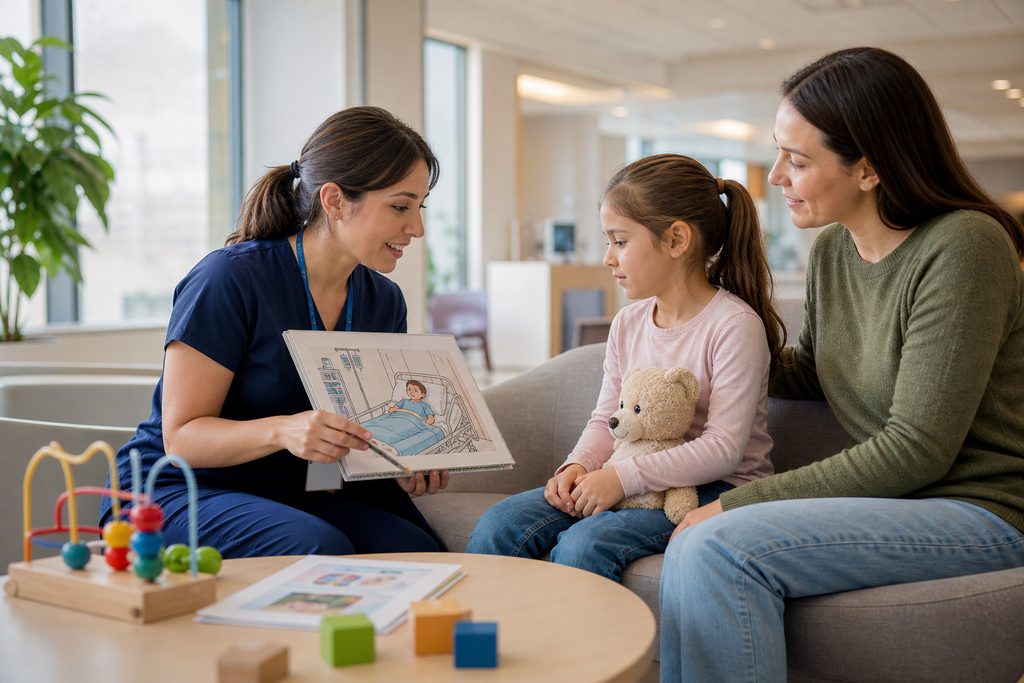
What makes child-friendly hospital visit packages China hospitals have developed effective is that they combine this communication framework with environmental familiarization. The child sees the room before the parent is in it. They meet a nurse who explains things in simple terms. They understand the context before they encounter the emotional reality. This pre-exposure dramatically reduces fear responses.
The Cost Equation: Prevention Is Cheaper Than Crisis Management
Families often ask about the cost of child counseling during parent treatment abroad. The question assumes counseling is a line-item expense. The better framing is cost avoidance. A child who is properly prepared for a parent’s hospitalization is far less likely to need emergency psychological intervention mid-treatment. They are less likely to develop behavioral issues that disrupt the family’s ability to focus on recovery. And the parent—who is, after all, the actual patient—recovers faster when they are not simultaneously managing a child in crisis.
For families traveling to China for medical care, child preparation services typically range from $300 to $800 depending on the complexity of the case and the number of sessions required. This includes pre-arrival consultation, age-appropriate educational materials, hospital familiarization coordination, and ongoing support during the treatment period. When weighed against the cost of an extended hospital stay due to stress-related complications—or the emotional cost of a traumatized child—the math is straightforward.
What You Need to Know Before Going Alone
Attempting to arrange child support services independently as a foreign patient in China’s public hospital system is difficult. Not impossible, but genuinely difficult. Here is what you are up against:
- Language and Cultural Barriers: Child life services in Chinese public hospitals are delivered in Mandarin. The educational materials are in Chinese characters. The family liaison nurses may speak some English, but nuanced emotional conversations about a child’s fears require fluency that most hospital staff do not have. Even in Shanghai’s top international departments, the default assumption is that the family will handle their own emotional support needs.
- Access and Navigation: Most child-friendly hospital resources are embedded within specific departments and are not advertised as standalone services. You cannot simply call a hospital and ask for a “child visit preparation package.” The services exist, but they are accessed through internal referrals, department-level relationships, and institutional knowledge that foreign patients lack.
- Logistical Complexity: Coordinating a child’s hospital visit involves scheduling around the parent’s treatment timeline, the child’s emotional readiness, the availability of appropriate staff, and the hospital’s visitation policies—which vary significantly between public wards and international VIP units. One misaligned piece and the visit becomes counterproductive rather than supportive.
How We Help You Navigate This
Our approach is built around a simple principle: the child’s experience is not separate from the parent’s treatment. It is part of it. When a family contacts us about medical travel to China, one of the first questions we ask is whether children will be accompanying the patient. If the answer is yes, we build a parallel support track that runs alongside the medical coordination.
Before travel, we connect families with bilingual child psychologists who specialize in medical trauma preparation. These are not generic counselors. They understand the specific hospitals, the specific procedures, and the specific environmental factors that children will encounter. They can describe what a Chinese hospital room looks like, what sounds the monitors make, what the recovery ward smells like. This specificity matters. Abstract reassurance does not help a child. Concrete previewing does.
During treatment, we coordinate child-friendly hospital visit packages China hospitals offer through their international departments. This means the visit is structured: a staff member greets the child, explains what they will see, walks them through the environment before entering the parent’s room, and stays present to answer questions. The parent is prepared in advance—medically stable, positioned comfortably, with any intimidating equipment explained and normalized. The visit becomes a connection, not a confrontation with fear.
For families considering family medical tourism China with kids support, we also handle the practical logistics that reduce ambient stress. Airport transfers, family-appropriate accommodation near the hospital, bilingual accompaniment for non-medical errands. When a family is not worried about how to buy groceries or navigate the metro, they have more emotional bandwidth for the conversations that matter.
And for parents who need to know how to prepare my child for parent surgery in China in practical terms, we provide structured guidance: when to tell the child, what words to use at different ages, how to answer the hard questions (“Will you die?”), and how to maintain the child’s routine during the parent’s recovery. This is not therapy. It is practical, evidence-based preparation delivered by people who have done it hundreds of times.
Frequently Asked Questions
Yes, but the rules vary significantly by hospital and ward type. Public general wards often restrict visitors under 12 due to infection control protocols. International VIP wards and private hospital rooms are far more accommodating, typically allowing children to visit with prior arrangement and appropriate supervision. We always confirm specific visitation policies for your chosen hospital before you travel, so there are no surprises. The key variable is not the city—it is the specific hospital and the level of care unit you are admitted to.
Hospitals with robust international departments tend to offer the most family-friendly environments. In Shanghai, Jiahui International Hospital and the international wing of Ruijin Hospital have dedicated family support staff. In Beijing, Peking Union Medical College Hospital’s international department is well-equipped for accompanying family members. Private international hospitals like United Family Healthcare across multiple cities are designed from the ground up with Western family expectations in mind, including child life services and English-speaking staff throughout. The trade-off is cost—private international hospitals charge rates closer to Western private care, while public hospital international departments offer a middle ground.
This happens. Some children, despite preparation, become overwhelmed when they actually see their parent in a medical setting. We plan for this. Every coordinated visit includes a staff member whose job includes monitoring the child’s emotional state and intervening if distress escalates. The visit can be shortened, paused, or ended early without judgment. The goal is not a perfect visit. The goal is a manageable experience that does not create new trauma. Sometimes that means a five-minute visit instead of thirty. Sometimes it means trying again the next day. Flexibility is built into the process because rigidity is the enemy of emotional safety.
It is a fair question. The honest answer is that some children handle a parent’s hospitalization with remarkable resilience and need minimal structured support. But you cannot know in advance which child will be fine and which will develop significant anxiety. The research consistently shows that even resilient children benefit from preparation—they may not show distress, but they still carry questions and fears they do not know how to articulate. Preparation is not about fixing a problem. It is about preventing one. For families already managing the stress of international medical travel, prevention is worth far more than crisis intervention.
Your Next Step
Bringing a child along for a parent’s medical treatment in China is not a logistical complication to be managed. It is a family experience to be supported. The preparation you do before travel—the conversations, the familiarization, the structured support—determines whether that experience strengthens your family or strains it. We cannot make the treatment itself easy. But we can make sure your child walks into that hospital room prepared, not afraid, and your recovery is not undermined by worry about the people who need you most.
If you are considering treatment in China and traveling with children, start with a conversation. No commitment, no pressure. Just a clear assessment of what your family would need and how we would support it. Reach out for a free consultation and we will help you think through the practical and emotional logistics before you book a single flight.
For more medical information and treatment options in China, visit chinamedservices.com (China Medical Services).
