Neurological Rehab Hospitals in China: Costs, Safety and Recovery Timelines
Key Takeaways
- Intensive inpatient neuro rehabilitation in a top Chinese public hospital typically runs $150–$400 per day for the bed, nursing and therapy combined — a fraction of U.S. rates, which often exceed $1,500 per day.
- China’s largest rehabilitation departments treat very high daily volumes, which means therapy is delivered in structured blocks — often three to five hours a day, six days a week — rather than the shorter sessions common in Western outpatient settings.
- The real barrier is not medicine. It is navigation: public hospital rehab wards generally cannot be booked from overseas, and almost nothing on site is in English.
- Any rehab plan should be built around a realistic functional goal — sitting balance, walking with a cane, returning to work — not a vague hope of “full recovery.”
The Problem: Recovery Care Is Expensive, Slow and Hard to Access
Stroke is the second leading cause of death worldwide and a leading cause of long-term disability, according to the World Health Organization. In the United States alone, the American Heart Association has estimated the direct and indirect cost of stroke care at tens of billions of dollars annually. For a single patient, the numbers get personal fast.
Inpatient rehabilitation in the U.S. frequently costs more than $1,500 per day, and a typical post-stroke stay of three to six weeks can push a family past $40,000 — before outpatient therapy even begins. In the UK, NHS neuro rehabilitation is free at the point of use but waiting lists for community therapy can stretch for months. In Canada and Australia, the pattern repeats: excellent clinicians, limited beds, long queues.
Families describe the same frustration everywhere. The acute phase ends, the patient is medically stable, and then the clock starts. Every week without intensive therapy is a week of lost function. That gap — between medical stability and functional recovery — is exactly where neurological rehab hospitals in China cost far less and admit far faster.
Why China’s Rehabilitation System Delivers Results
China has built one of the largest rehabilitation infrastructures in the world, and a handful of its hospitals now function as national referral centers for neurological recovery. Here is what makes the system structurally different.
Clinical Volume Creates Experienced Teams
A major Chinese rehabilitation department may see hundreds of stroke, spinal cord injury and traumatic brain injury patients every month. Therapists who treat that volume develop pattern recognition that low-volume settings cannot replicate. The same logic applies across Chinese medicine — a top cardiac surgery center like Fuwai Hospital performs more than 14,000 heart operations a year, the highest volume globally. Repetition builds skill.
Therapy Is Delivered in High-Intensity Blocks
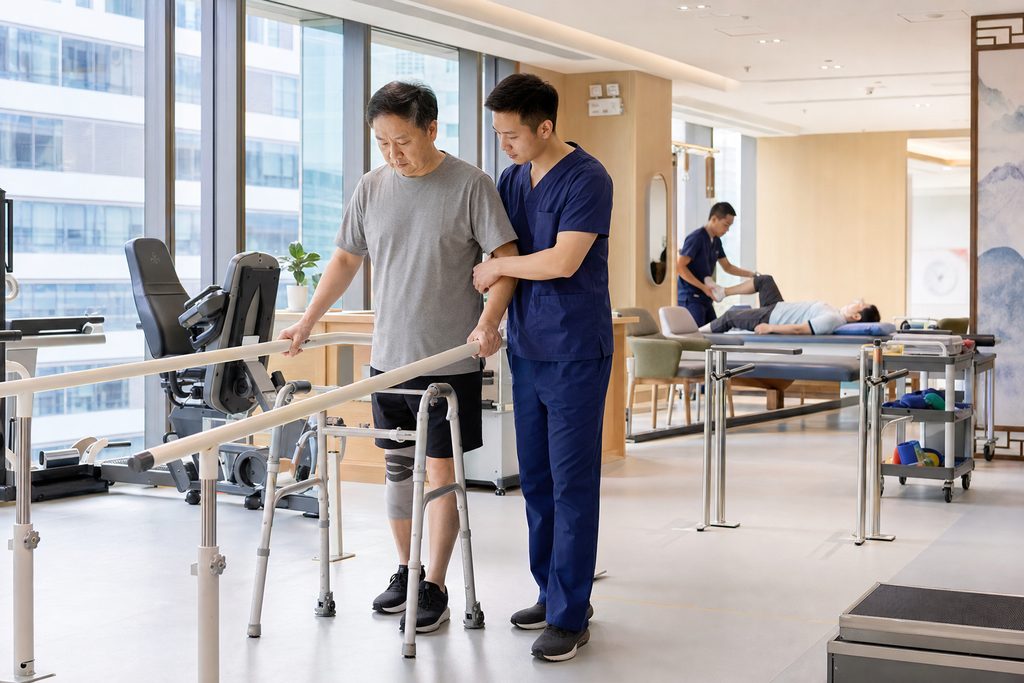
Western inpatient rehab often budgets 60 to 90 minutes of combined therapy per day. Chinese neuro rehab wards commonly run three to five hours daily across physical therapy, occupational therapy, speech therapy and traditional modalities like acupuncture. Robotic gait trainers, functional electrical stimulation, transcranial magnetic stimulation and hydrotherapy pools are standard equipment in top-tier centers.
Cost Advantage Without a Quality Trade-Off
Lower prices come from labor economics and hospital efficiency, not from cutting corners. Nursing and therapist salaries in China are a fraction of Western equivalents, and hospitals operate at scale. The clinical protocols — early mobilization, constraint-induced movement therapy, task-specific training — mirror international guidelines.
| Rehabilitation Setting | Typical Daily Cost (USD) | Typical Length of Stay |
|---|---|---|
| Top Chinese public hospital, neuro rehab ward | $150–$400 | 4–12 weeks |
| Chinese private international hospital | $600–$1,200 | 2–8 weeks |
| U.S. inpatient rehab facility | $1,500–$2,500+ | 2–4 weeks |
| UK private neuro rehab | £800–£1,500 | 2–6 weeks |
Figures are indicative ranges and vary by hospital, city and case complexity.
Which Conditions Chinese Neuro Rehab Hospitals Treat Best
Not every diagnosis benefits equally. The strongest programs cluster around a few categories.
- Post-stroke hemiplegia — the single largest patient group, with mature protocols for gait retraining and upper-limb recovery.
- Traumatic brain injury — cognitive rehab, swallowing therapy and behavioral management.
- Spinal cord injury — bladder and bowel training, wheelchair skills, pressure-injury prevention.
- Post-surgical neuro recovery — after brain tumor resection, aneurysm clipping or spinal fusion.
- Parkinson’s disease and movement disorders — gait and balance programs, often combined with acupuncture.
- Pediatric neuro rehab — cerebral palsy and developmental delay, concentrated in a smaller number of specialist children’s hospitals.
Patients with unstable cardiac conditions, active infection or uncontrolled seizures need medical stabilization first. Rehab comes second.
How Long Does Neuro Rehab Take in China?
This is the question families ask most, and the honest answer is that nobody can promise a timeline. What we can describe is the typical structure.
Weeks 1–2: Assessment. The team scores baseline function — the Berg Balance Scale, the Fugl-Meyer Assessment, the Modified Barthel Index. A therapy plan is written.
Weeks 3–6: The most visible gains. Patients often move from bed-bound to sitting balance, or from sitting to standing with assistance.
Weeks 7–12: Functional consolidation. Walking with a device, dressing, eating, basic communication.
Most international patients plan a 4- to 12-week stay, with a reassessment at week four to decide whether to extend. Progress plateaus are normal. Recovery is not linear.
Is Stroke Rehabilitation in China Safe?
The question deserves a direct answer. China’s top rehabilitation hospitals are accredited institutions with infection-control standards comparable to Western hospitals, and many hold Joint Commission International (JCI) accreditation. JCI publishes its accredited organization list publicly at jcrinc.com, and it is worth checking.
Three practical realities matter more than abstract safety concerns.
Language. A large public hospital may see more than 10,000 outpatients in a single day. Signage, forms and most staff communication are in Chinese. Without interpretation, even simple tasks — finding the therapy gym, understanding a discharge instruction — become difficult.
Booking. Public hospital rehab wards generally cannot be reserved from overseas. You attend an outpatient consultation first, and admission follows based on the doctor’s assessment and bed availability. International departments and VIP channels can sometimes pre-arrange admission, at roughly 1.5 to 2 times the standard price.
Payment. Public hospitals require prepayment; international insurance is usually reimbursed afterward. Private international hospitals often bill insurers directly.
How to Book Neurological Rehabilitation in China
The pathway has five stages, and skipping any one of them creates problems later.
- Records review. Send imaging, discharge summaries and current medication lists for a written second opinion from a Chinese rehabilitation specialist.
- Video consultation. Speak directly with the rehab team to discuss goals and confirm whether the case is suitable.
- Hospital matching. Choose a city and department. Beijing, Shanghai and Guangzhou hold the deepest concentration of top-ranked hospitals.
- Visa. Apply for an S2 visa with a medical-treatment annotation. Family companions apply under the same category. Requirements change, so confirm current rules with the nearest Chinese embassy or consulate.
- Arrival and admission. Attend the outpatient consultation, complete admission formalities, begin therapy.
Written second opinions typically run $300–$500 at top hospitals. Video consultations range from $100–$300 at standard international departments up to $500–$800 with a top specialist. Any consultation fee is credited in full toward on-the-ground coordination if you travel within 90 days.
China Medical Visa for Neuro Rehab: What You Actually Need
Two visa categories apply. The S2 visa covers short-stay medical treatment and private affairs, usually up to 180 days. The S1 visa applies for stays beyond 180 days. Accompanying family members use the same category as the patient.
One correction worth stating plainly: the M visa is for commercial and trade activities. It is not a medical visa. Some online guides get this wrong, and arriving on the wrong visa category creates real problems at the border.
Supporting documents typically include a hospital invitation letter, proof of funds, travel insurance and a round-trip itinerary. Approval is never guaranteed, and processing times vary by consulate. Build in at least three to four weeks before your target admission date.
Practical Considerations Before You Commit
Records. Bring imaging on disc, not just printed reports. Chinese specialists frequently re-read original scans.
Payment. International credit cards work at private hospitals. Public hospitals may require bank transfer or cash for deposits, and daily card limits can complicate large payments. Plan the funding route in advance.
Insurance. Call your insurer before booking. Ask specifically whether they reimburse overseas rehabilitation and what documentation they require.
Follow-up at home. Ask the Chinese team to write a discharge plan your local therapist can execute — exercise prescriptions, equipment recommendations, reassessment intervals.
Housing. Rehab stays are long. Families often rent an apartment near the hospital rather than pay hotel rates for three months.
For a broader view of what is available, our directory of top-ranked Chinese hospitals groups facilities by city and specialty tier. Patients focused on traditional modalities can also review our guide to traditional Chinese medicine hospitals.
Frequently Asked Questions
Expect roughly $150–$400 per day for an inpatient bed plus therapy in a top public hospital, versus $1,500–$2,500 or more per day in the U.S. A three-month stay in China may cost less than three weeks in an American facility. Final pricing depends on the hospital, city and complexity of the case.
Not directly for standard public wards. Most public hospitals require an in-person outpatient consultation before admission, and beds are assigned by the treating physician. International departments and private hospitals can sometimes arrange admission in advance at higher rates. A written second opinion and video consultation are the reliable way to confirm feasibility first.
Plateaus are a normal part of neurological recovery, and good rehab teams reassess and adjust the plan rather than push harder. If a medical complication arises, top Chinese hospitals have full acute-care capacity on site — ICU, imaging, surgical backup. Ask about escalation protocols during your initial consultation.
At private international hospitals, yes — English-speaking staff are standard. At large public hospitals, English support is limited outside the international department. Most international patients arrange bilingual accompaniment for consultations, therapy sessions and administrative tasks.
S2 visas are typically issued for stays of up to 180 days, which covers most rehab programs. Longer treatment requires the S1 category. Rules vary by consulate and change periodically, so verify current requirements before applying.
Your Next Step
China’s top rehabilitation hospitals offer intensive, high-volume therapy at a fraction of Western prices — but the system rewards preparation and punishes improvisation. Get the records reviewed, confirm feasibility by video, and understand the visa and payment logistics before booking flights.
China Medical Services is a coordination platform, not a hospital. We do not diagnose or treat. We connect international patients with 340+ top-ranked hospitals across 37 cities and handle the logistics — records translation, appointment coordination, bilingual accompaniment and visa guidance. Start with a free consultation and we will tell you honestly whether China is the right fit for your case.
This article is for general information only and does not constitute medical advice. Treatment decisions should always be made with a qualified physician who has reviewed your individual case.
For more medical information and treatment options in China, visit chinamedservices.com (China Medical Services).
