Amputation Psychological Support China: Grief, Identity, and Resilience Counseling
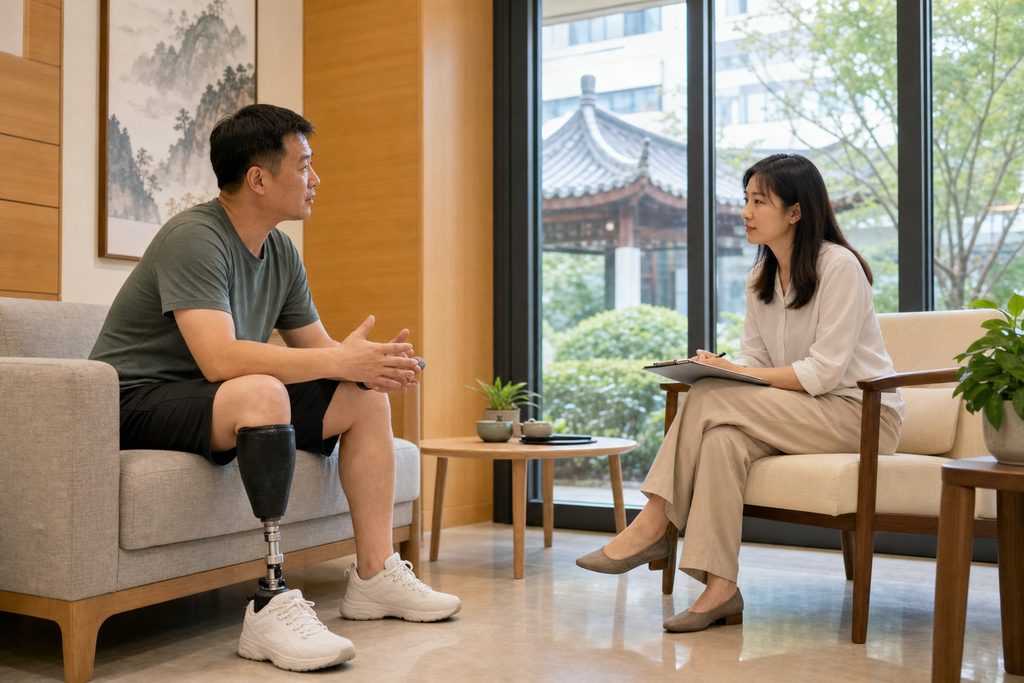
When 34-year-old Elena lost her left leg below the knee after a severe motorcycle accident in Barcelona, the physical trauma was only half the battle. The real fight began when she returned home. She found herself staring at a stranger in the mirror. Her career as a field geologist seemed over. Her identity felt shattered. Her local hospital handed her a pamphlet on prosthetic fitting and a list of general therapists with a six-month waiting list. The message was clear: the physical repair is our job. The rest is yours.
That message is wrong.
Limb loss is not just a surgical event. It is a psychological earthquake. Research from the Amputee Coalition indicates that up to 35% of amputees experience significant depression or anxiety within the first two years. Post-traumatic stress symptoms can affect roughly 1 in 4. Yet in many Western healthcare systems, psychological support is fragmented, underfunded, or tacked on as an afterthought. Patients are left to navigate grief, body image disruption, and identity reconstruction almost entirely alone.
We see a different path.
Key Takeaways
- Up to 35% of amputees face clinical depression, yet dedicated psychological support remains rare in standard rehabilitation plans.
- China’s major rehabilitation centers now offer integrated programs that combine prosthetic fitting with structured grief and resilience counseling.
- Language and cultural barriers are real, but dedicated international patient coordinators make the process navigable.
- Amputation psychological counseling costs in China typically range from $80 to $200 per session, significantly less than comparable Western programs.
The Problem: When the Body Heals but the Mind Does Not
The amputation psychological counseling cost China presents a compelling value, but the real issue runs deeper than money. It is about access to specialists who truly understand the layered trauma of limb loss. A general therapist can help with sadness. They may not grasp the phantom limb pain that wakes you at 3 a.m., the social anxiety of entering a crowded room, or the profound grief of losing the ability to feel sand between your toes.
A 2022 study in the Journal of Rehabilitation Medicine found that fewer than 20% of amputees in several European countries received targeted psychological support during their first year post-surgery. The consequences are measurable: higher rates of prosthetic abandonment, increased pain perception, and a significantly elevated risk of social isolation. The body heals in weeks. The mind can take years. Without proper scaffolding, that healing may never complete.
Who We Are
We are not a hospital. We do not provide medical treatment or clinical diagnoses. Our team at China Medical Services is your logistical bridge to China’s top-ranked rehabilitation and psychological support networks. We connect you with specialized departments that understand the full arc of limb loss recovery. We handle the complexity—the visa paperwork, the hospital matching, the bilingual accompaniment—so you can focus entirely on rebuilding your life.
Why China’s Approach to Limb Loss Psychological Support Delivers Results
China’s top rehabilitation hospitals have moved beyond the outdated model that treats body and mind as separate domains. They have developed integrated, high-volume programs that weave psychological resilience into every stage of recovery. This is not a luxury add-on. It is the core architecture of their care model.
High Patient Volume Builds Unmatched Specialist Expertise
A senior prosthetist in a major Shanghai rehabilitation center may fit more complex lower-limb prostheses in one month than a counterpart in a mid-sized European hospital fits in a year. This exposure creates a clinical intuition that cannot be taught in textbooks. The same principle applies to the psychological team. They have seen hundreds of cases of post-amputation identity disruption. They recognize the subtle signs of maladaptive grief before it hardens into chronic depression. They know the exact moment when a patient is ready to discuss mirror therapy, and when they still need to grieve. That volume-driven expertise is difficult to replicate in lower-caseload systems.
Integrated Prosthetic and Psychological Rehab Packages
One of the most frustrating aspects of Western rehabilitation is the fragmentation. You see the surgeon on Tuesday, the prosthetist on Thursday, and the therapist—if you can find one who specializes in limb loss—maybe next month. They rarely talk to each other. In leading Chinese centers, the model is fundamentally different. Prosthetic limb and psychological rehab packages China-based programs often combine daily physical training with scheduled grief counseling, group therapy with fellow amputees, and family integration sessions. The prosthetist and psychologist share notes. The physiotherapist adjusts the gait training schedule based on the patient’s emotional state that morning. The whole team operates as one unit.
Cost Advantage Without Compromising Depth
Let us address the obvious question directly. Lower cost does not mean lower quality. The structural economics of Chinese healthcare—lower administrative overhead, high patient volume efficiency, and different labor market dynamics—allow for comprehensive care at a fraction of Western prices. Intensive outpatient psychological support that might cost $500 per session in the US or $350 in the UK can be accessed in Shanghai or Beijing for $80 to $200. An integrated two-week inpatient program combining prosthetic adjustment, physiotherapy, and daily resilience counseling may cost less than a single week of equivalent care in many Western private facilities. This is not discount care. It is care delivered in a system with fundamentally different cost structures, often in hospitals ranked among China’s top 5% by the Fudan University hospital ranking system. You can explore our network of top-ranked hospitals across 37 cities to understand the caliber of institutions we work with.
What You Need to Know Before Going Alone
The quality of care available is exceptional. Getting to it independently is genuinely difficult. We want to be completely honest about the barriers.
- Language and Cultural Nuance in Therapy: Psychological counseling requires precise, emotionally attuned communication. Even if a hospital has English-speaking staff, the deepest therapeutic work often depends on understanding cultural context. A Western patient expressing anger about their amputation may be met with a culturally different response than they expect. Our bilingual companions bridge this gap, ensuring nothing is lost in translation during your most vulnerable moments.
- Navigating the Hospital System: China’s top public hospitals handle over 10,000 outpatient visits daily. Registration, payment, and department routing are complex even for locals. For an international patient still processing recent trauma, this labyrinth can be paralyzing. Walking into Shanghai’s vast medical ecosystem without a guide means losing hours, days, or the chance to see the right specialist at all.
- Visa and Logistics: Medical treatment in China requires an S2 visa with specific documentation from the admitting hospital. Gathering these documents, translating medical records, and coordinating dates from abroad is a full-time administrative job. One mistake can delay your care by weeks.
How We Help You Navigate This
These barriers exist for structural reasons. They are not a reflection on you or your organizational skills. Our entire purpose is to dissolve them.
We start by listening. You tell us your situation—the level of amputation, the stage of recovery, the specific psychological struggles you are facing. We then match you with a rehabilitation center that has demonstrated expertise in your exact needs, whether that is limb loss grief therapy Shanghai-based programs or integrated care in Beijing or Guangzhou. We coordinate the invitation letter for your S2 visa. We arrange your appointments. And from the moment you land, a bilingual medical companion is at your side—translating consultations, explaining cultural nuances, and ensuring you never feel lost in the system. We handle the friction so you can focus on the work of rebuilding.
Frequently Asked Questions
The amputation psychological counseling cost China offers typically ranges from $80 to $200 per individual session at top-tier international departments. Group therapy sessions are often less. Comparable specialized counseling in the US or UK can run $250 to $500 or more per session. Intensive multi-week integrated programs in China often cost less than a week of equivalent inpatient care in Western private facilities. Final costs vary by hospital and case complexity.
Learning how to cope with amputation mentally in China involves structured support from day one. The programs we connect you with typically begin with a comprehensive psychological assessment, followed by a tailored mix of individual cognitive behavioral therapy, group sessions with other amputees, and family-inclusion protocols via video call if your family cannot travel. The distance from home can actually aid recovery by removing you from triggering environments and allowing total focus on healing.
Yes. We coordinate pre-travel video consultations so you can meet your psychological team and begin foundational work before you board a plane. To book amputation resilience counseling China-based programs, we manage the scheduling, medical record translation, and all pre-arrival logistics. This ensures continuity of care from your first contact through your full in-person program.
The best psychological support for amputees abroad requires cultural competence from the care team. The international departments we work with employ psychologists and counselors trained in Western therapeutic modalities, including CBT, ACT, and narrative therapy. Many have studied or trained internationally. Our bilingual companions further ensure that cultural nuance is preserved in every session. You are not being asked to adapt to a foreign therapeutic framework; the framework is adapted to you.
This is precisely where the integrated model excels. The prosthetic limb and psychological rehab packages China offers combine daily prosthetic fitting and gait training with scheduled psychological sessions. Your prosthetist and psychologist communicate directly. If you are struggling emotionally, the physical pace adjusts. If a prosthetic adjustment reduces your pain, the psychological team builds on that momentum immediately. The whole program moves as one.
Your Next Step
Limb loss fractures more than bone. It fractures your sense of who you are. But identity can be reconstructed, just as surely as a well-fitted prosthesis can restore mobility. The key is not to treat the wound in isolation. The key is to find a team that sees the whole picture—the grief, the body, the future—and has the expertise to address all of it in concert. That team exists. It is ready for you. And we can help you reach it.
If you are ready to explore what integrated recovery looks like, we invite you to start a conversation with our team at China Medical Services. No pressure. No sales pitch. Just a clear, honest discussion about your situation and whether this path makes sense for you.
For more medical information and treatment options in China, visit chinamedservices.com (China Medical Services).
