Diabetes Prevention in China: Lifestyle Intervention Before Medication
Key Takeaways
- China’s landmark Da Qing study proved that 6 years of lifestyle intervention reduces diabetes incidence by 39% over 30 years—the most compelling long-term data in the world.
- A structured diabetes prevention program in China can cost 60-80% less than comparable Western programs, without sacrificing clinical rigor.
- Language and cultural barriers are significant for foreigners; independent navigation of public health programs is nearly impossible without bilingual support.
- Evidence-based reversal programs in China prioritize food literacy, daily movement, and sleep hygiene long before any prescription is written.
The Problem: Prediabetes Is a Silent Tsunami
Approximately 1 in 3 American adults has prediabetes. That is 96 million people. And 80% of them do not know it. The standard Western approach often waits until blood sugar crosses a diagnostic threshold—then writes a prescription. But that threshold is not a cliff. It is a slow, silent slide that begins years earlier. By the time metformin enters the conversation, the underlying metabolic dysfunction has been building for a decade. The real question is not “What drug do I take?” It is “Can I reverse this before medication becomes non-negotiable?”
That is precisely where China’s prevention model breaks from the script. For over three decades, Chinese researchers have been quietly building the world’s most robust evidence base for lifestyle-first intervention. Not as a supplement to medication. As the frontline treatment. And for international patients facing prediabetes or early metabolic syndrome, understanding this model is not just academic—it is potentially life-altering.
Who We Are
We are China Medical Services. We are not a hospital. We do not provide medical treatment or clinical diagnoses. We are your logistical architects—we bridge the gap between you and China’s top-tier medical expertise. Our network spans 340+ top-ranked hospitals across 37 cities, representing the top 5% of China’s 35,000+ healthcare institutions. When a patient comes to us asking about a diabetes prevention program cost China, we do not quote a fixed price. We listen first. Then we match you with the right clinical team. Then we handle everything else: visa guidance, appointment coordination, bilingual medical companions, and recovery logistics. You focus on your health. We handle the complexity.
Why China’s Lifestyle-First Approach Delivers Results
The Western medical model excels at acute care. It is less effective at chronic metabolic disease. Why? Because a 12-minute primary care visit cannot reshape a lifetime of dietary patterns. China’s top endocrinology and preventive medicine departments operate on a different assumption: that sustained behavioral intervention, delivered with structure and accountability, is the most potent prescription available. The evidence backs this up.
The Da Qing Legacy: 30 Years of Proof
In 1986, researchers in Da Qing, China launched a randomized controlled trial with 577 adults who had impaired glucose tolerance. Participants were assigned to either a control group or one of three lifestyle intervention arms: diet only, exercise only, or diet plus exercise. The intervention lasted just 6 years. But the follow-up continued for three decades. The results, published in The Lancet Diabetes & Endocrinology, showed a 39% reduction in diabetes incidence among the intervention groups compared to controls. Cardiovascular mortality dropped by 26%. All-cause mortality fell. No drug on the market can claim that durable an effect from a time-limited intervention. This study is the foundation of modern diabetes prevention science. And it happened in China. The best lifestyle intervention for diabetes China offers today is built directly on this legacy—structured, group-based, and clinically supervised.
Food as Medicine, Not as Abstraction
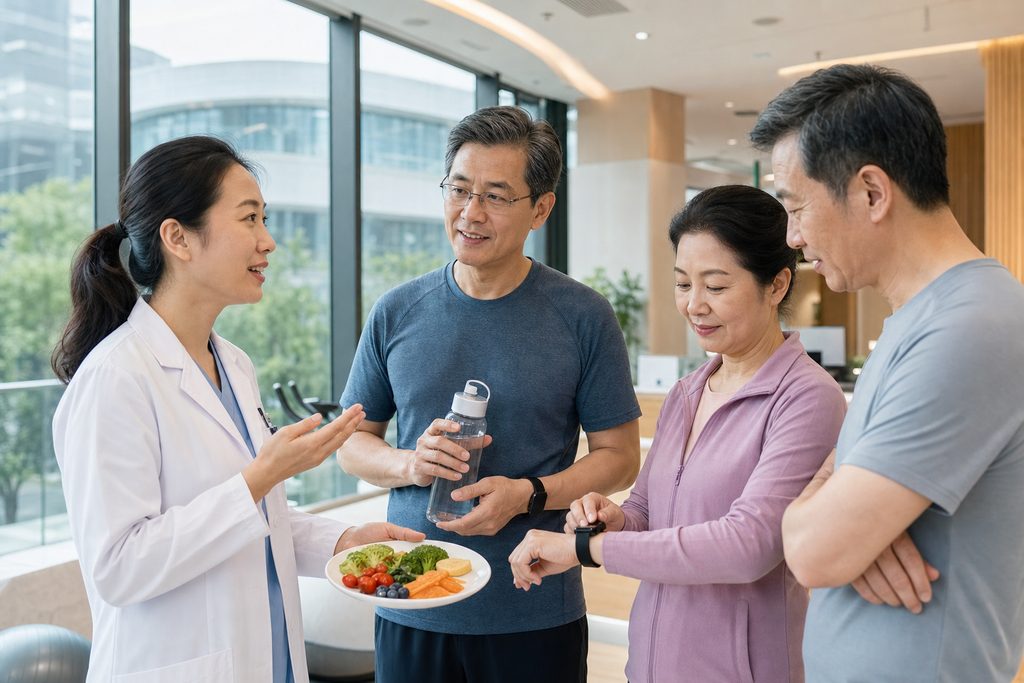
Western dietary advice often defaults to vague exhortations: “Eat more vegetables. Cut back on sugar.” That is not an intervention. That is a bumper sticker. In Chinese preventive programs, dietary counseling is concrete. Traditional Chinese food culture already emphasizes whole ingredients, seasonal eating, and balanced meals. Trained nutritionists in hospital-based programs build on this. Patients learn to compose plates using specific ratios of non-starchy vegetables, lean proteins, and low-glycemic grains. Cooking methods matter. Meal timing matters. The approach is not about deprivation. It is about recalibrating the palate. Many programs include supervised meals and grocery store tours. This is not wellness tourism fluff. It is behavioral conditioning with clinical endpoints.
Movement Prescribed With Precision
Exercise prescriptions in China’s top prevention programs are not generic. A 55-year-old with visceral adiposity and a sedentary job gets a different protocol than a 40-year-old with normal BMI but high postprandial glucose spikes. Traditional practices like tai chi and qigong are often integrated—not as mystical alternatives, but as evidence-based tools for improving insulin sensitivity and reducing cortisol. A 2019 meta-analysis in the Journal of Diabetes Research confirmed that regular tai chi practice significantly reduces fasting blood glucose and HbA1c in adults with prediabetes. When patients ask how does China treat prediabetes without medication, the answer is: with a precise, layered, non-pharmacological protocol that treats movement as a vital sign.
What a Diabetes Prevention Program in China Actually Costs
Let us address the elephant in the room. The diabetes prevention program cost China is a fraction of what comparable programs command in the United States or Europe. A structured, hospital-affiliated lifestyle intervention program in Shanghai or Beijing typically ranges from $800 to $2,500 for a 4-12 week intensive phase. That includes baseline metabolic testing, nutrition counseling, supervised exercise sessions, and follow-up monitoring. In the US, a similar program—such as the CDC’s National DPP—costs between $400 and $600 for a year-long group format, but lacks the integrated medical supervision and comprehensive baseline diagnostics that Chinese hospital programs provide. Private residential wellness retreats in the West easily exceed $5,000 per week.
| Program Type | Duration | Estimated Cost (USD) | Key Inclusions |
|---|---|---|---|
| Hospital-Based Lifestyle Intervention (Shanghai) | 8 weeks | $1,200–$2,500 | Metabolic panel, CGM trial, nutrition counseling, group exercise |
| Private Wellness Retreat (Beijing) | 2 weeks | $3,000–$5,000 | Accommodation, all meals, daily coaching, TCM adjuncts |
| CDC National DPP (USA, for comparison) | 12 months | $400–$600 | Group coaching, digital tracking, no medical diagnostics |
| US Residential Wellness Retreat | 1 week | $4,000–$8,000 | Lectures, spa, basic labs, no long-term follow-up |
These are reference ranges. Final costs vary by hospital, program intensity, and case complexity. Anyone considering a medical tourism diabetes prevention package Shanghai should know that package prices often bundle accommodation and translation services—which adds convenience but also cost. We help patients understand exactly what they are paying for.
Is a Diabetes Reversal Program Safe in China?
The short answer is yes—when conducted under proper medical supervision at a reputable institution. But blunt honesty matters here. Not every program marketed to foreigners meets that standard. The question “is diabetes reversal program safe in China” deserves a nuanced answer. Programs affiliated with Fudan-ranked hospitals or JCI-accredited institutions follow rigorous protocols. These are the same hospitals that handle millions of complex cases annually. Their endocrinology departments are among the busiest in the world. Clinical safety is not the concern.
The risk lies in unregulated wellness centers that operate outside the hospital system. Some promise rapid reversal using unproven herbal regimens or extreme caloric restriction without medical oversight. These are not the programs we connect patients with. We only work with hospital-affiliated preventive medicine departments and accredited private international hospitals. When you book diabetes wellness retreat China through a trusted coordinator, the safety question shifts from “Is the medicine sound?” to “Is the logistics support adequate?” And that is a question we can answer concretely.
What You Need to Know Before Going Alone
China’s healthcare system delivers extraordinary value. But it was not designed for independent foreign visitors. Here are the barriers you will face if you try to arrange a prevention program on your own:
- Visa Requirements: Medical treatment in China requires an S2 visa with the purpose of medical care clearly stated. This is not a tourist activity. Consulates require documentation from the admitting hospital—a formal invitation letter, treatment plan summary, and proof of financial means. Obtaining these documents without a local contact is extremely difficult. Family members accompanying you also need S2 visas. M visas are for business and will be rejected for medical purposes.
- Hospital Registration Systems: Public hospitals in China do not allow overseas patients to pre-register for outpatient services online. You cannot book a prevention program slot from abroad through the hospital’s public portal. Appointments require in-person registration, which means navigating a Chinese-language system on arrival. The international departments of top hospitals do offer pre-arranged appointments—but only through their official coordination channels, not via the general registration desk.
- Language and Cultural Context: A nutrition counseling session conducted entirely in Mandarin is of zero value to an English-speaking patient. Even in hospitals with English-speaking physicians, the support staff—nurses, dietitians, lab technicians—often speak only Chinese. Dietary advice rooted in Chinese culinary traditions needs cultural translation to be actionable for a Western patient. Without a bilingual intermediary, the clinical expertise is present but inaccessible.
How We Help You Navigate This
These barriers exist for structural reasons, not malice. China’s hospital system was built to serve 1.4 billion domestic patients. Adapting it for international visitors requires a dedicated layer of coordination. That is what we provide.
Before you travel, we identify the right hospital and program based on your metabolic profile, language needs, and budget. We handle the visa invitation documentation. We coordinate with the hospital’s international department to secure your program slot. During your stay, a bilingual medical companion accompanies you to every appointment—translating clinical conversations, explaining cultural context, and ensuring you understand every recommendation. After you return home, we facilitate follow-up video consultations so your progress does not stall. Our coordination fees start from $300 for appointment coordination, and any consultation fee is fully credited toward on-the-ground coordination services if you proceed with treatment within 90 days.
We do not promise to reverse your diabetes. No ethical organization can. We promise to connect you with the clinical teams that have the best evidence for doing so—and to remove every logistical obstacle standing between you and that care.
Frequently Asked Questions
Evidence says yes, for many people. The Da Qing study and subsequent trials show that sustained lifestyle change—diet, exercise, weight management—can normalize blood glucose and prevent progression to type 2 diabetes. But “sustained” is the operative word. A two-week retreat is a catalyst, not a cure. The real work continues at home. The best programs in China equip you with a structured maintenance plan and remote follow-up support.
Not everyone responds equally. Genetics, pancreatic beta-cell function, and duration of metabolic dysfunction all play a role. A responsible program includes baseline and follow-up testing to measure your actual response. If lifestyle changes are insufficient, the clinical team will discuss next steps—which may include medication. The goal is not to avoid drugs at all costs. It is to use the least invasive, most durable intervention first.
Look for three markers. First, affiliation with a hospital on the Fudan University Hospital Ranking—these institutions are independently evaluated and represent China’s top tier. Second, JCI accreditation for international-standard care. Third, transparent pricing and clear clinical protocols. If a program cannot explain exactly what testing and interventions are included, walk away. We maintain a curated database of top-ranked hospitals and can help you verify any program’s credentials.
The treatment costs themselves are genuinely lower—often 60-80% less than US equivalents. The structural reasons are real: lower physician labor costs, higher patient volumes, and a healthcare system not built on insurance-driven price inflation. Hidden fees are not typical at reputable hospitals, but incidental costs—translation, accommodation, local transport—add up. We help patients budget realistically so there are no surprises.
Your Next Step
Prediabetes is a window. It does not stay open forever. The evidence for lifestyle-first intervention is overwhelming, and China’s clinical experience with this approach is deeper than anywhere else on earth. The question is not whether the model works. It is whether you can access it without getting lost in translation, paperwork, and logistical friction.
If you are ready to explore what a structured prevention program could look like for you—at a fraction of Western costs, with world-class clinical oversight—our team is here to map out the path. China Medical Services exists to make that path walkable. Reach out for a free consultation through our patient coordination page. No pressure. Just a clear conversation about your options.
For more medical information and treatment options in China, visit chinamedservices.com (China Medical Services).
