ECMO Patient Transfer in China: Mobile Teams, Transport Costs, and How It Works
Key Takeaways
- China now runs over 14,000 ECMO-supported procedures annually across its top-tier hospital network, making mobile ECMO retrieval a mature service at major cardiac and respiratory centers.
- A dedicated mobile ECMO team in China can be deployed for inter-hospital and limited international retrievals, often at a fraction of Western costs — but coordination is everything.
- Flying on ECMO into China is possible. It demands pre-arranged hospital acceptance, a confirmed bed in a specialized ICU, and a receiving team that speaks the same clinical language as the sending team.
- Without local bilingual coordination, the handoff between an international air ambulance crew and a Chinese hospital ECMO team can break down in minutes — and those minutes matter.
The Problem: ECMO Is a Bridge, But the Bridge Needs Two Solid Ends
Extracorporeal membrane oxygenation buys time. That is its entire purpose. A patient in cardiac or respiratory failure gets days, sometimes weeks, of circulatory and gas-exchange support while the underlying condition is treated. But the machine is only half the equation. The other half is getting the patient to the right ICU, with the right surgical or medical team, before complications stack up. Search data from families and case managers shows the same desperate query clusters: how does ECMO patient transfer work internationally, what is the mobile ECMO team cost in China, can you fly on ECMO to China. These are not academic questions. They come from people watching a clock run down.
Most international ECMO transfers originate in regions where advanced cardiac or transplant programs are unavailable. Southeast Asia, the Middle East, parts of Eastern Europe. Families face a brutal choice: keep the patient in a facility that cannot offer definitive treatment, or attempt a long-haul transfer to a center that can. China has emerged as a destination for one structural reason: surgical volume. When a hospital performs thousands of complex cardiac procedures a year, its ECMO retrieval teams are not theoretical. They are on rotation. They have done this before.
But the gap between “China has the capability” and “my family member is safely connected to that capability” is wide. Language, hospital admission protocols, visa logistics, and real-time clinical handoff — these are the choke points. We see them every week.
Who We Are
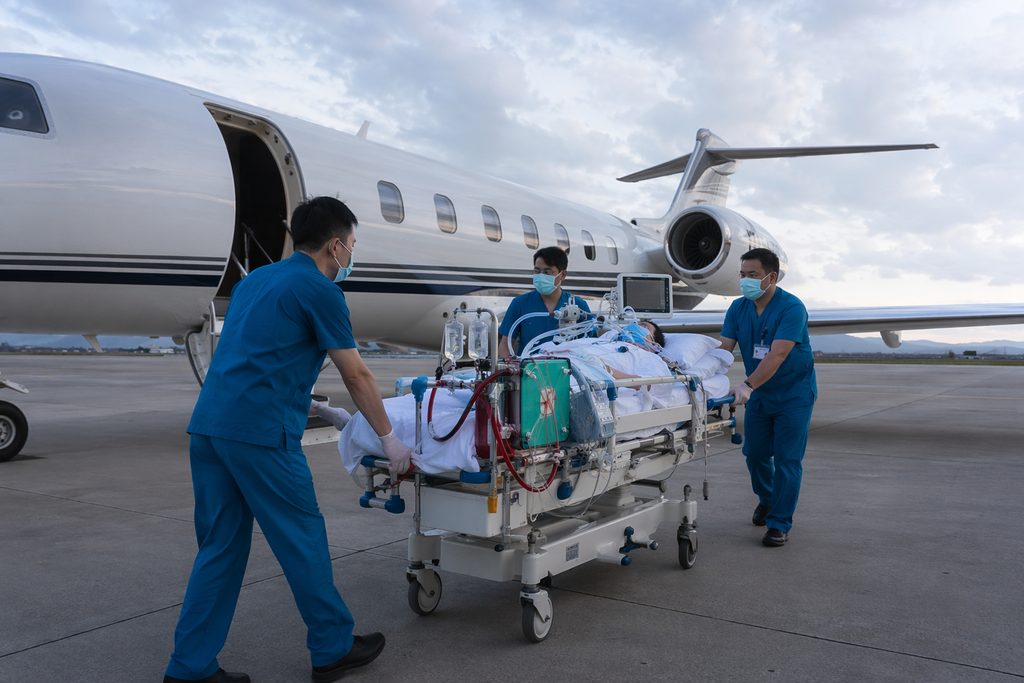
Mobile ECMO in China has moved well beyond the era of improvised transport. The standard retrieval configuration at major centers now includes a compact centrifugal pump console, a portable oxygenator with integrated heat exchanger, and a transport monitor capable of continuous mixed venous saturation and arterial blood gas trending. Cannulation is performed by a cardiac surgeon or interventional cardiologist at the referring facility before transport begins, or — in some configurations — the mobile team arrives, cannulates on-site, and stabilizes before the ambulance or fixed-wing leg starts.
What makes the system structurally different from many Western setups is the integration of ground ambulance networks with hospital command centers. In Shanghai, for example, a request for ECMO retrieval can route through the municipal emergency medical center, which coordinates with the receiving hospital’s ICU bed management system in real time. This is not a private concierge arrangement. It is a public-private operational layer that has been stress-tested through years of high-volume domestic transfers. For international patients, this means the domestic leg — airport to hospital — is often the most predictable part of the journey.
Mobile ECMO Team Cost in China: The Structural Advantage
Let us address the question families search for most directly: mobile ECMO team cost China. In Western Europe or North America, a dedicated ECMO retrieval — including the cannulating physician, perfusionist, ICU nurse, and transport team — can run anywhere from $25,000 to $60,000 for a domestic transfer, with international fixed-wing transports multiplying that figure several times over. In China, the cost for a domestic mobile ECMO team deployment typically ranges from $8,000 to $18,000, depending on distance, team composition, and whether ground or air transport is required. International retrievals that bring a patient into China on ECMO involve additional layers: the air ambulance itself, flight physicians, and the receiving hospital’s acceptance fee. Total costs for a fully coordinated international ECMO transfer into a Chinese top-tier hospital generally fall between $40,000 and $80,000.
These are not small numbers. But they are structurally lower than comparable US or European transfers for two reasons. First, labor costs for highly specialized clinical staff are lower in China, even at the top tier. Second, the hospital acceptance and ICU bed reservation fees — while real — do not carry the same margin structure as private Western hospitals. The cost advantage is not about cutting corners on care. It is about a different economic baseline for the same clinical service.
That said, anyone who quotes you a fixed price before reviewing the patient’s clinical status, current cannulation configuration, and transfer distance is not being honest. The range is real. The final number depends on specifics.
Can You Fly on ECMO to China? The Operational Reality
Yes. But “yes” comes with a chain of conditions that must be locked in before the aircraft leaves the ground. The question “can you fly on ECMO to China” is not really about the flight. It is about the handoff.
A long-haul air ambulance configured for ECMO transport carries a full ICU team: typically a perfusionist or ECMO specialist, a critical care physician, and one or two ICU nurses. The aircraft itself is a flying intensive care unit — pressurized cabin, medical-grade power supply for the pump and monitor, oxygen reserves calculated for the flight duration plus contingencies. The clinical part of the flight is well-established. The challenge is what happens when the aircraft lands in Shanghai, Beijing, or Guangzhou.
Chinese hospitals do not accept unannounced ECMO arrivals. The receiving hospital must have confirmed — in writing — that an ICU bed is available, that the accepting attending physician has reviewed the case, and that the hospital’s own ECMO team is prepared to take over management at the receiving bay. This is not a formality. It is a clinical necessity. The sending team has been managing the circuit for hours. They need to hand off to a team that can immediately verify cannula position, circuit integrity, anticoagulation status, and the patient’s hemodynamic trajectory. A 20-minute gap in the emergency department while someone pages the on-call intensivist is not acceptable.
This is where bilingual coordination stops being a nice-to-have. The sending team’s handoff report — in English, German, Arabic, or Russian — must be accurately relayed to the receiving team in real time. Clinical nuances get lost in translation. “The cannula migrated slightly during the climb-out” is a very different piece of information from “cannula position is stable.” We have seen both versions in handoff reports where no medically fluent interpreter was present.
What You Need to Know Before Attempting This Alone
Families sometimes try to arrange an ECMO transfer into China independently — contacting hospitals directly, negotiating with air ambulance providers, managing the visa process on their own. Here is what that looks like in practice:
- Hospital Acceptance Is Not a Phone Call: Chinese public hospitals receive enormous volumes of domestic patient inquiries daily. An international ECMO transfer request arriving through a general hospital email address or switchboard will rarely reach the right department head in time. The window for acceptance is narrow. Without a pre-existing relationship and a Mandarin-speaking case manager inside the hospital’s international department, the request simply gets lost.
- Visa Timing Can Kill the Transfer: The patient and accompanying family members require S2 visas with medical treatment annotations. Processing times vary by consulate and country. An ECMO transfer cannot wait two weeks for visa approval. Expedited processing exists, but it requires documentation from the receiving hospital — the same documentation that is hard to obtain without a coordinator inside the system.
- Payment and Deposit Structures Are Unfamiliar: Chinese hospitals typically require a substantial deposit before an ICU bed is confirmed for an international transfer. The payment must be made via wire transfer or UnionPay-compatible channels. Western credit cards may not work for large hospital deposits. Insurance direct billing is uncommon in public hospitals, though some international departments are moving toward it. You need someone who can navigate the hospital’s finance office in Mandarin and confirm exactly when the deposit has cleared — because the bed is not held until it does.
How We Help You Navigate This
Our process starts with the clinical documentation. We work with the referring hospital’s ICU team to compile a transfer packet: current ECMO settings, cannulation details, anticoagulation regimen, recent blood gases, echocardiogram reports, and the underlying diagnosis. This packet is translated into clinical Mandarin — not by a general translator, but by a bilingual medical professional who understands the terminology of extracorporeal support.
The packet goes directly to the international department of the receiving hospital — typically one of the centers in our network of 340+ top-ranked hospitals across 37 cities. Because we maintain active relationships with these departments, the case reaches the right attending physician within hours, not days. The hospital reviews the case, confirms acceptance, and issues the documentation needed for the S2 visa application.
While the visa is being processed — and we push for expedited handling at every step — we coordinate with the air ambulance provider on flight logistics. This includes confirming the receiving hospital’s ambulance bay access, arranging a bilingual medical escort to meet the aircraft, and ensuring the receiving ECMO team has the handoff report in both English and Mandarin before the patient arrives. The ground ambulance from the airport to the hospital is pre-booked. The ICU bed is confirmed. The deposit has cleared.
After the patient is admitted, our bilingual medical companions remain available for the family — helping with accommodation, translating during family meetings with the attending team, and managing the practical details that pile up during a prolonged ICU stay. We do not provide medical care. We make sure nothing is lost in the gaps between systems.
For families considering whether to book ECMO ambulance transfer China services, the question is not whether the clinical capability exists. It does. The question is whether the coordination layer is solid enough to get the patient from the referring ICU to the receiving ICU without a dangerous gap. That is the layer we build.
Frequently Asked Questions
How much does a mobile ECMO team cost for a transfer within China?
Domestic mobile ECMO team deployment in China typically ranges from $8,000 to $18,000. This covers the retrieval team — cannulating physician, perfusionist, ICU nurse — plus ground ambulance or helicopter transport to the receiving hospital. The exact figure depends on distance, team size, and whether the team needs to cannulate at the referring facility or the patient arrives already on ECMO. International transfers involving long-haul air ambulance are significantly more, generally $40,000 to $80,000 all-in.
Can a patient really fly on ECMO to China from another country?
Yes, and it happens regularly. The flight itself is managed by a specialized air ambulance crew trained in ECMO transport. The critical requirement is that a Chinese hospital has formally accepted the patient and confirmed an ICU bed before departure. Without that confirmation, the aircraft cannot depart — or worse, it arrives with nowhere to go. We handle the hospital acceptance and bed confirmation as the first step, before any flight logistics are finalized.
Which hospital in China is best for receiving an ECMO transfer?
The best hospital for ECMO transfer abroad depends entirely on the underlying condition. For cardiac surgical cases — aortic dissection, post-cardiotomy shock, bridge-to-transplant — Fuwai Hospital in Beijing and Zhongshan Hospital in Shanghai are the highest-volume centers. For respiratory ECMO, including severe ARDS, the respiratory ICU programs at China-Japan Friendship Hospital in Beijing and West China Hospital in Chengdu have extensive experience. Our team matches the patient’s specific diagnosis to the department with the most relevant volume and capability, not to a generic “best hospital” list.
What happens if the hospital refuses the transfer after we have already started arranging it?
Hospital refusal usually happens for clinical reasons: the receiving team reviews the case and determines that the patient is too unstable for transport, or that the underlying condition is not treatable even with the receiving hospital’s resources. If this happens, we relay the clinical rationale to the referring team transparently. If the refusal comes before significant costs are incurred, the financial exposure is limited to the coordination fee for the case preparation work already done. We do not guarantee acceptance — no ethical coordinator can — but we ensure the hospital’s review is thorough and fast, so families are not left waiting without an answer.
Do we need a visa for the patient, or just for the family members accompanying them?
The patient requires an S2 visa with a medical treatment annotation, even if they arrive sedated and on ECMO. Accompanying family members also need S2 visas. The receiving hospital provides the invitation letter and treatment confirmation documents required for the visa application. We guide families through the specific documentation needed at their local Chinese consulate and push for expedited processing where the patient’s condition justifies urgency.
Your Next Step
ECMO transfer into China is logistically complex, but it is not experimental. The clinical pathways exist. The teams are in place. The costs, while substantial, are often a fraction of what the same transfer would cost into a Western center — without sacrificing the quality of the receiving ICU or surgical program. The variable that determines success or failure is coordination: getting the right clinical information to the right department head, in the right language, fast enough to matter.
If you are a family member or case manager facing this decision, start with a free consultation. We will review the clinical situation, identify the most appropriate receiving centers, and give you a clear picture of timelines, costs, and the steps required — before you commit to anything.
For more medical information and treatment options in China, visit chinamedservices.com (China Medical Services).
