Our Payment Safety Process Explained: How to Pay for Surgery in China Safely
Our Payment Safety Process Explained: How to Pay for Surgery in China Safely
If you are researching how to pay for surgery in China safely, you are likely weighing a significant financial decision from thousands of miles away. The question is not trivial. A heart bypass that costs $120,000 in the United States may run between $12,000 and $20,000 at a top Chinese public hospital. That is a real, verifiable gap. But the mechanics of moving that money across borders — and knowing it will not disappear — keep many patients up at night. Our team at China Medical Services has coordinated payments for patients from over 40 countries. This article explains exactly how the process works, where the risks sit, and what you can do to protect yourself.
Key Takeaways
- Chinese public hospitals require a deposit before admission — typically 50–100% of the estimated treatment cost, paid in RMB after currency conversion.
- International credit cards work at most top-tier hospital international departments, but daily transaction limits and foreign transaction fees apply.
- Wire transfers are the most common method for large deposits, with processing times of 2–5 business days.
- Legitimate hospitals never ask for payment to personal bank accounts, cryptocurrency, or Western Union transfers.
- Written second opinions cost $300–500 and let you verify a treatment plan before committing any deposit money.
The Problem: Sending Large Sums to a Hospital You Have Never Seen
Medical tourism payment protection in China is a legitimate concern because the financial flows are unfamiliar. A patient from Texas or Manchester knows how to pay a local hospital. They know the billing codes, the insurance portal, the credit card on file. None of that applies in Shanghai or Beijing. The hospital will issue an invoice in Chinese yuan. The payment may need to clear before a bed is assigned. The refund process, if treatment changes, follows a different administrative path than what Western patients expect.
Fraud exists in every medical tourism market. The US Federal Trade Commission has documented scams targeting international patients seeking lower-cost surgery abroad. The most common pattern: a fake “facilitator” requests a deposit to a personal account, then disappears. Patients lose $5,000 to $50,000 in a single transaction. The fear is rational. But the fear should not stop you from accessing excellent care. It should push you toward verified channels.
Why the Chinese Hospital Payment System Is Structurally Safer Than You Might Assume
Public Hospitals Operate on a Prepayment Model — Which Means Clear Invoices
Chinese public hospitals do not bill after treatment the way American hospitals do. They require a prepaid deposit before admission. That sounds risky to Western ears. In practice, it means the financial terms are set before you ever enter the operating room. The hospital issues a formal deposit invoice. That invoice has a unique number, a hospital seal, and a specific department code. It is traceable. When treatment finishes, the hospital issues a final settlement statement. Any unused deposit is refunded to the original payment source. This is standard practice across China’s 3,400+ tertiary hospitals.
The prepayment model actually reduces surprise billing. You know the estimated cost before you fly. You see the line items as they accrue. There is no $80,000 surprise “facility fee” six weeks after discharge.
Hospital International Departments Handle Foreign Payments Daily
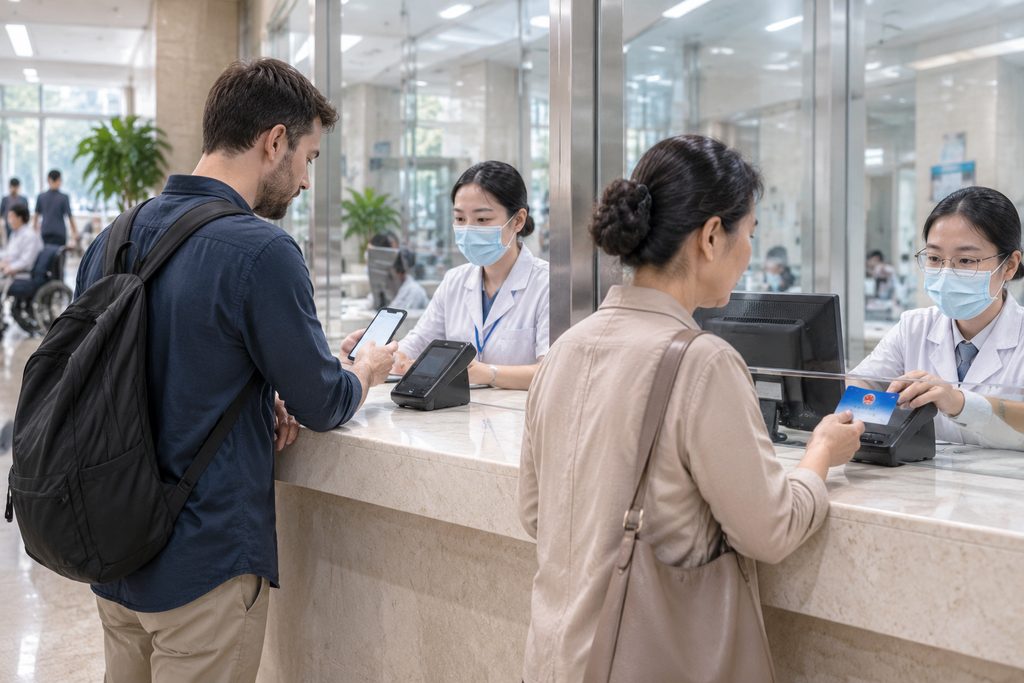
Top Chinese hospitals with international departments — Peking Union Medical College Hospital, Zhongshan Hospital Fudan University, West China Hospital — process foreign patient payments every single day. Their finance offices handle wire transfers, credit card payments, and insurance documentation as routine work. Staff in these departments speak English. They issue bilingual invoices. They understand that international patients need documentation for insurance reimbursement and tax purposes.
This is not a new industry. China has hosted international patients for decades, particularly from Southeast Asia, the Middle East, and Russia. The financial infrastructure is mature.
How to Pay for Surgery in China Safely: The Step-by-Step Process
This is the section you came for. Here is exactly how a payment flows from your bank account to a Chinese hospital — and where the safety checks sit.
Step 1: Get a Written Treatment Plan and Cost Estimate
Before any money moves, you need a formal cost estimate from the hospital. This comes after a remote consultation. You send your medical records. The hospital’s international department reviews them. A specialist provides a written second opinion — what they recommend, what it costs, how long you would stay. This document is your financial anchor. Without it, you are guessing. With it, you can compare against quotes from other hospitals or your home country.
A written second opinion from a top specialist costs $300–500. That is a small sum compared to the treatment itself. It also serves as a fraud filter: legitimate hospitals will provide a written plan before demanding payment. Scammers will not.
Step 2: Confirm the Hospital’s Official Payment Account
This is the single most important safety step. Every legitimate Chinese hospital receives payments through an official institutional bank account. The account name matches the hospital’s registered name. It is never a personal account. It is never a third-party “agent” account. If anyone asks you to send money to a personal name or a company you cannot verify, stop immediately.
You can verify a hospital’s official account by calling the hospital’s international department directly. Use the phone number from the hospital’s official website — not a number provided by a middleman. Ask them to confirm the account details in writing. This takes ten minutes and eliminates the most common fraud vector.
Step 3: Choose Your Payment Method
Can you pay for treatment in China with a credit card? Yes — at most international departments. But there are limits. Chinese hospital POS terminals typically accept Visa, Mastercard, and UnionPay. Daily transaction limits vary by your issuing bank. Many Western banks cap single transactions at $5,000–$10,000 for fraud protection. You may need to call your bank in advance to raise the limit temporarily. Foreign transaction fees of 1–3% apply unless your card waives them.
For deposits above $10,000, a wire transfer is usually the best way to transfer money for surgery abroad. SWIFT transfers to Chinese hospital accounts take 2–5 business days. Your bank will charge a wire fee — typically $25–$50. The Chinese receiving bank may charge a small processing fee. The exchange rate is set when the transfer is initiated, unless you use a specialist currency service that locks rates.
Some private international hospitals in China — United Family, Jiahui, Parkway — accept direct insurance billing. If your insurer has a direct-billing agreement with the hospital, you may not need to pay the full deposit upfront. Check with your insurer before you travel. For public hospitals, you pay first and claim reimbursement after.
Step 4: Keep Every Receipt and Invoice
Chinese hospitals issue formal invoices called fapiao for every payment. These are legally recognized financial documents. You need them for insurance claims, tax deductions, and any dispute resolution. Scan or photograph every document immediately. Store digital copies in at least two places. If you use a coordination service, they should provide you with copies of the hospital’s official invoice — not just a receipt from the service itself.
Step 5: Understand the Refund Process Before You Pay
Ask this question before sending a deposit: “If I cancel or my treatment changes, how do I get my money back?” Chinese hospitals do issue refunds for unused deposits. The process typically takes 2–4 weeks. The refund goes back to the original payment source. Wire transfer refunds take longer than credit card refunds because of international banking delays. Get the refund policy in writing. If a hospital or facilitator is vague about refunds, that is a red flag.
Is It Safe to Pay a Hospital Deposit in China? The Real Risk Assessment
Let us answer the question directly: is it safe to pay a hospital deposit in China? Yes — if you are paying a verified hospital through its official account. The risk is not the hospital. The risk is the intermediaries. Patients who lose money almost always lose it to fake facilitators, unverified agents, or phishing schemes that impersonate real hospitals.
Here is a comparison of payment safety across common scenarios:
| Payment Scenario | Risk Level | Key Protection |
|---|---|---|
| Direct wire to verified hospital official account | Low | Bank records, hospital invoice, traceable transfer |
| Credit card payment at hospital international department | Low | Chargeback rights, card fraud protection |
| Payment through verified coordination service to hospital account | Low to moderate | Service contract, hospital invoice in your name |
| Payment to personal bank account of an “agent” | Extreme | None — this is the primary scam pattern |
| Cryptocurrency or Western Union transfer | Extreme | None — legitimate hospitals never request these |
That table is the honest picture. The payment channel matters more than the country. A wire transfer to a verified institutional account at a top-ranked Chinese hospital is safer than handing a credit card to an unlicensed clinic in many countries.
Avoid Medical Payment Scams in China: The Specific Red Flags
You want to avoid medical payment scams in China. Here are the patterns we have seen over years of coordinating patient care. Every one of these should stop you immediately.
First, any request for payment to a personal bank account. This is never legitimate. Chinese hospitals do not use personal accounts for patient deposits. Period. No exceptions. If a “coordinator” gives you a personal name and account number, walk away.
Second, pressure to pay before you have a written treatment plan. Legitimate hospitals want your medical records first. They want a specialist to review your case. They want to confirm they can treat you. Anyone who demands money before seeing your records is not selling medical care — they are selling urgency.
Third, requests for payment via Western Union, MoneyGram, cryptocurrency, or gift cards. These are untraceable, irreversible channels. No legitimate medical institution in China or anywhere else uses them. The fact that this needs to be said tells you how common the scam is.
Fourth, prices that are dramatically lower than every other quote you receive. If one facilitator quotes $8,000 for a procedure that four hospitals quote at $25,000, the cheap quote is not a bargain. It is bait.
Fifth, a website or email address that does not match the hospital’s official domain. Scammers create fake hospital websites with slightly altered URLs. Always verify the domain. Always call the hospital directly to confirm any communication you receive.
Warning: If you are asked to pay a deposit to a personal account, via cryptocurrency, or through an unverified intermediary, stop the transaction and verify the hospital directly. These are the most common fraud patterns in medical tourism to China.
Medical Tourism Payment Protection in China: What Actually Protects You
Medical tourism payment protection in China is not a formal government program. It is a set of practices you apply. The most important protection is verification. Verify the hospital’s license. Verify the account details. Verify the doctor’s credentials. Verify the cost estimate against independent sources. Each verification takes minutes. Together, they eliminate nearly all fraud risk.
Bank-level protections also apply. Wire transfers leave a permanent record. Credit card payments have chargeback rights under Visa and Mastercard rules. If you pay a legitimate hospital with a legitimate card and the treatment is not delivered, you can dispute the charge. This is not true for cash, Western Union, or crypto.
Insurance adds another layer. Some international health insurers have direct billing arrangements with Chinese private hospitals. JCI-accredited facilities like United Family and Jiahui are more likely to have these agreements. Check with your insurer before committing. If your insurer covers treatment in China, the insurer’s payment process becomes your payment process — and insurers have their own verification requirements.
Written contracts matter too. If you use a coordination service, you should have a contract that specifies exactly what the service does, what it charges, and what happens if the hospital appointment cannot be secured. Our coordination fee for hospital appointments starts at $300, and we refund it in full if we cannot secure the appointment we confirmed. That is the standard you should expect from any legitimate service.
Can You Pay for Treatment in China with a Credit Card? The Practical Answer
Yes, you can pay for treatment in China with a credit card at most international hospital departments. But you need to plan for it. Call your bank before you travel. Tell them you will be making large transactions in China. Ask them to raise your daily limit. Ask about foreign transaction fees. Some cards charge 3% on every overseas transaction — that is $600 on a $20,000 surgery. Other cards waive foreign fees entirely. Know which card you have before you swipe.
Credit cards work best for smaller payments: consultations, diagnostic tests, outpatient procedures. For a $30,000 surgery deposit, a wire transfer is usually more practical. You will get a better exchange rate and avoid daily transaction limits. Some patients split payments: credit card for initial consultation fees, wire transfer for the surgical deposit. That combination gives you both chargeback protection on small amounts and rate efficiency on large ones.
What to Do If Something Goes Wrong
Here is the scenario nobody wants to think about: you sent a deposit and something went wrong. The hospital cancelled your surgery. The facilitator disappeared. The invoice does not match what you agreed to.
If you paid a legitimate hospital directly, contact the hospital’s international department. They have a financial disputes process. Provide your invoice number, payment records, and correspondence. Hospitals want to resolve these issues — their international reputation matters to them. Refund processing times vary, but most hospitals issue refunds for unused deposits within 2–4 weeks.
If you paid through a coordination service, contact the service. A legitimate service has a contract, a complaints process, and a reputation to protect. We handle payment disputes on behalf of our patients, working directly with hospital finance offices to resolve discrepancies.
If you were scammed — you paid a personal account and the person disappeared — your options are limited. Report the fraud to your bank immediately. File a report with your local police and with Chinese authorities if possible. Wire transfer fraud recovery is difficult but not impossible if you act fast. This is why verification before payment is so critical. Recovery after fraud is hard. Prevention before fraud is easy.
Frequently Asked Questions
Most public hospitals require 50–100% of the estimated treatment cost as a deposit before admission. The exact amount is stated on your formal cost estimate. Private international hospitals may require less, especially with direct insurance billing. The deposit is applied to your treatment costs, and any unused portion is refunded.
A SWIFT wire transfer directly to the hospital’s verified official bank account is the safest method for large amounts. It leaves a permanent record, goes to an institutional account, and is traceable end-to-end. For smaller payments, a credit card offers chargeback protection. Never use Western Union, cryptocurrency, or personal account transfers.
This depends entirely on your policy. Some international health insurers reimburse treatment at Chinese hospitals, especially JCI-accredited facilities. Others exclude overseas care. Contact your insurer before you travel. Ask specifically about coverage for treatment in China and what documentation they require. Chinese hospitals issue formal invoices that meet most insurers’ documentation standards.
Refunds for unused deposits typically take 2–4 weeks from the date the hospital processes the refund. Wire transfer refunds take longer than credit card refunds because of international banking delays. Always get the refund policy in writing before sending a deposit. If a hospital refuses to provide a written refund policy, treat that as a red flag.
Yes, in most cases. You can pay the deposit in person at the hospital’s finance office when you arrive. This is actually the safest approach if you are comfortable carrying or accessing the funds. Many patients do a remote consultation first, then travel to China for the in-person consultation and pay the deposit on-site. The trade-off is that you cannot secure a surgery date until the deposit is paid, so you may wait longer for your procedure.
Your Next Step
The core message is simple: paying for surgery in China is safe when you pay a verified hospital through official channels, and dangerous when you pay an unverified intermediary through informal channels. The difference is verification. We help patients at For more medical information and treatment options in China, visit chinamedservices.com (China Medical Services).
