Smart Medication Dispenser Service in China: Never Miss a Post-Surgery Dose
What if the single biggest risk to your surgical recovery wasn’t the procedure itself, but something far more mundane? Something as simple as forgetting a pill.
Every year, approximately 50% of patients with chronic illnesses or post-operative recovery plans fail to take their medications as prescribed, according to the World Health Organization. That’s not a typo. Half of all patients. Poor adherence accounts for an estimated 125,000 deaths annually in the United States alone and contributes to 10% of all hospitalizations. For a medical tourist recovering in an unfamiliar Shanghai apartment or a Beijing serviced suite, jet-lagged and disoriented, the risk of a missed dose isn’t just a statistic. It’s a looming threat that can unravel a $30,000 surgery.
But the technology to solve this already exists in China. And it’s surprisingly accessible.
Key Takeaways
- Medication non-adherence affects 50% of patients globally — for post-surgical tourists, a missed antibiotic or anticoagulant can lead to infection, rejection, or catastrophic complications.
- A smart medication dispenser service in China typically starts from $15–25 per day — a fraction of the cost of a single ER visit or extended hospital stay caused by a dosage error.
- Language barriers make self-management dangerous. Pharmacy labels, alarm settings, and emergency instructions are often in Chinese characters — a locked dispenser with remote monitoring removes the guesswork entirely.
- These services integrate with your broader recovery plan. We coordinate the dispenser with your discharge summary, so the device isn’t just a gadget — it’s an automated extension of your surgeon’s protocol.
The Problem: You Are Your Own Worst Nurse After Surgery
Recovering from a major surgery is a full-time job you never trained for. A patient undergoing a total knee replacement at a top-tier Chinese orthopedics center might leave the hospital with a cocktail of six different medications: an anticoagulant to prevent deep vein thrombosis, a strong analgesic for breakthrough pain, a nerve pain modulator, an antibiotic to protect the surgical site, a proton-pump inhibitor to protect the stomach lining from all the pills, and a stool softener because opioids stop everything. Each has a different schedule. Some must be taken with food. Some must never be taken together. One missed dose of the anticoagulant and a clot can form silently. One double-dose of the opioid because you forgot you already took it, and respiratory depression becomes a real danger.
The typical solution offered to international patients is a handwritten discharge note and a bilingual nurse waving goodbye at the hospital door. That’s not a safety plan. That’s hope wrapped in a piece of paper. For a Western patient used to integrated digital health tools, landing in a Chinese recovery apartment with a plastic pillbox and a prayer is a rude awakening. The smart medication dispenser service cost in China is so low relative to the risk it mitigates that skipping it is a gamble with terrible odds.
Who We Are
We are not a hospital. We do not provide medical treatment, prescribe medication, or offer clinical diagnoses. China Medical Services is the operational bridge between you and the 340+ top-ranked Chinese hospitals in our network across 37 cities. Our team handles the logistics that make safe recovery possible: bilingual medical companions who translate discharge instructions in real time, appointment coordinators who secure your follow-up slots, and technology integrators who program your smart medication dispenser to match your surgeon’s exact protocol. We don’t replace your doctor. We make sure your doctor’s plan actually happens, even when you’re groggy, alone, and 6,000 miles from home.
How a Smart Medication Dispenser Actually Works After Surgery in China
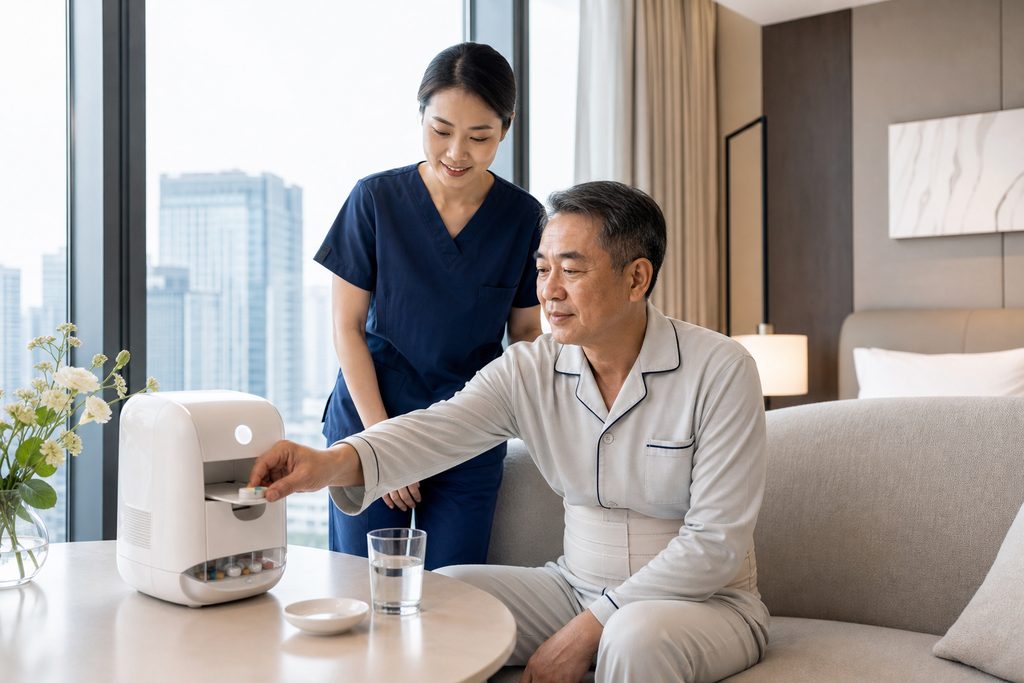
The device itself is a locked, rotating carousel with 28 individual dose compartments. It’s not a glorified alarm clock. It’s a tamper-resistant hardware unit that connects to China’s 4G/5G networks and communicates with a monitoring dashboard. Here’s what happens when we deploy one for a patient recovering from, say, a spinal fusion at a Shanghai hospital.
Programming Before Discharge
Our bilingual medical companion sits with the discharging nurse and the patient. We translate the medication schedule — drug names, dosages, timing, food requirements, tapering schedules — and input it into the dispenser’s cloud-based software. The device is loaded with up to four weeks of medication, each dose sealed in its own compartment. The carousel only unlocks the correct compartment at the correct time. No other compartment can be accessed. A patient in a fog of post-operative fatigue cannot accidentally take Tuesday’s 8 AM dose at 3 AM because they woke up confused.
Active Alerts and Escalation
When it’s time for a dose, the device emits a loud, persistent audio alert and flashes bright LED lights. It will not stop until the patient physically tilts the dispenser to pour the pills out. This is deliberate. Dismissing a phone notification in your sleep is easy. Ignoring a screaming box on your nightstand is not. If the dose is not removed within a 30-minute window, the system sends an SMS alert to a designated caregiver — that could be a family member back home, or our local recovery coordinator in Shanghai. If the dose is still uncollected after 60 minutes, a human being makes a phone call. This is the critical difference between a consumer gadget and a monitored service. The device doesn’t just remind. It verifies and escalates.
Remote Monitoring and Adherence Data
The cloud dashboard logs every dose event with a timestamp. Our team can see, in real time, that the 8 AM antibiotic was taken at 8:03 AM and the 8 PM analgesic was taken at 7:58 PM. This data is shared with the patient and, with consent, with the surgeon’s follow-up team. If a patient consistently takes their pain medication 45 minutes late, it might indicate that the current analgesic protocol isn’t providing adequate coverage, and a medication review can be triggered. This transforms adherence from a binary yes/no question into a stream of actionable clinical data.
Smart Medication Dispenser Service Cost in China: A Breakdown
The economics of post-operative safety are stark. An unplanned readmission for a surgical site infection at an international hospital in Shanghai can cost $5,000–15,000. A pulmonary embolism from a missed anticoagulant dose can be fatal. Against that backdrop, the cost of a monitored dispenser service is a rounding error.
| Service Component | Typical Cost (USD) | Notes |
|---|---|---|
| Smart dispenser hardware rental | $8–15 per day | 28-compartment locked carousel, 4G connected |
| Medication loading & programming | $50–80 one-time | Bilingual setup with discharge summary translation |
| Remote monitoring service | $5–10 per day | Includes SMS escalation to caregiver + coordinator |
| Full-service package (hardware + monitoring) | From $15–25 per day | Two-week minimum typically applies |
| Emergency dose change reprogramming | $25 per incident | If surgeon adjusts medication mid-recovery |
A two-week recovery package, fully loaded and monitored, typically runs $210–350. That’s less than the cost of one night in a private hospital room in most Western countries. The post surgery pill dispenser rental in China is structured as a service, not a product sale. The hardware is rented because it’s recovered, sanitized, and redeployed. This keeps costs low and ensures the device you receive is running the latest firmware.
Why Recovery in China Demands a Different Approach
Recovering in a Chinese city after a procedure at a top-ranked hospital is not like recovering at home. The clinical outcomes at hospitals like Fuwai Hospital for cardiac surgery or Peking Union Medical College Hospital for complex oncology resections are world-class. But the post-discharge environment presents unique challenges that a smart dispenser directly addresses.
The Pharmacy Label Problem
Discharge medications dispensed by a Chinese hospital pharmacy come with labels entirely in Chinese characters. A patient who cannot read Chinese cannot independently verify that the pill in their hand matches the drug on their discharge summary. Our team photographs every medication, translates the label, and cross-references it against the surgeon’s instructions before loading it into the locked dispenser. The patient never needs to read a Chinese label. They just need to respond when the device tells them it’s time.
Jet Lag and Circadian Chaos
A patient who flew from London to Shanghai has a body clock that is 7 hours behind local time. Pain medications and anticoagulants, however, don’t care about time zones. They must be taken on a fixed schedule based on local time. A groggy patient waking at 3 AM local time because their body thinks it’s 8 PM is at high risk of mismanaging their medication. The dispenser is time-zone agnostic. It operates on the protocol’s schedule, not the patient’s confused internal clock.
Integration with Professional Monitoring
Medication adherence monitoring for medical tourists in China is not a standalone product. It’s part of a broader recovery coordination service. Our bilingual medical companions conduct daily check-ins during the critical first week post-discharge. They review the dispenser’s adherence log, check the surgical site for signs of infection, and confirm that pain levels are trending in the right direction. If something looks wrong, they don’t send an email. They walk the patient back to the hospital for an unscheduled review. The dispenser data provides the objective evidence that guides those decisions.
Book a Medication Management Service for Recovery in Shanghai: The Process
Shanghai is the most common recovery base for our international patients, given the concentration of top-ranked hospitals like Zhongshan Hospital and Ruijin Hospital. Setting up a medication management service for recovery here follows a structured pathway.
First, we receive your discharge summary and medication list — ideally 48 hours before your planned discharge. Our clinical coordinator reviews the protocol for any obvious scheduling conflicts or high-risk combinations. We flag anything that needs clarification with the surgical team. This pre-discharge review alone has caught dosing errors that would have sent a patient back to the emergency department.
On discharge day, a bilingual medical companion meets you at the hospital. We collect the physical medications from the hospital pharmacy, photograph and translate every label, and load the dispenser in your presence. We walk through the alert system with you. We confirm the emergency contact numbers programmed into the escalation chain. By the time you leave the hospital, the dispenser is armed and active. You don’t configure anything. You don’t download an app. You just recover.
For patients who want to book a medication management service for recovery in Shanghai before they even leave their home country, we can coordinate the entire setup in advance. The dispenser is configured and tested before your surgery even begins, so the transition from hospital bed to recovery apartment is seamless.
China Medical Tourism Post Operative Care Packages with Smart Dispenser: What’s Included
We have seen a growing demand from medical tourists — particularly from the Middle East, Southeast Asia, and Eastern Europe — who want an all-inclusive recovery package. They don’t want to piece together a translator, a driver, a nurse, and a pill dispenser from five different vendors. They want one point of accountability.
Our post-operative care packages bundle the smart dispenser with daily bilingual companion visits, wound care observation, medication adherence reporting, and transport to all follow-up appointments. A typical two-week package for a patient recovering from a cardiac procedure in Beijing might include:
- Smart medication dispenser with full programming and 14-day monitoring
- Daily 90-minute companion visits (vital sign spot checks, wound inspection, dispenser log review)
- Transport to and from two scheduled follow-up appointments at Fuwai Hospital
- 24/7 emergency phone line with English-speaking coordinator
- Weekly adherence report shared with the surgical team and family back home
These China medical tourism post operative care packages with smart dispenser integration solve the fragmentation problem. The dispenser doesn’t exist in a vacuum. It’s the automated backbone of a human-supported recovery system. The companion who visits at 10 AM already knows, from the cloud dashboard, that the 8 AM medications were taken on time. That visit is more efficient and more clinically focused because the basics are already verified.
What You Need to Know Before Relying on Technology Alone
A smart dispenser is a powerful tool. It is not a substitute for clinical judgment. We tell every patient this upfront.
- Power and Connectivity: The dispenser requires a stable power source and a 4G/5G signal. In rare cases, older apartment buildings in Chinese city centers can have spotty mobile reception. We test connectivity during setup and provide a backup battery pack. If the device goes offline for more than 60 minutes, our monitoring dashboard flags it immediately.
- Medication Changes Mid-Recovery: If your surgeon adjusts your protocol — for example, tapering you off opioids faster than planned — the dispenser must be physically unlocked and reloaded. This requires a service visit. We can typically dispatch a companion within 4 hours in major cities like Shanghai, Beijing, or Guangzhou. In smaller cities, the response time may be longer. We are transparent about this limitation.
- Not a Diagnostic Device: The dispenser tracks adherence, not outcomes. It will not tell you if your surgical site is infected. It will not measure your blood pressure or oxygen saturation. It does one job, and it does it well: it makes sure the right pills are taken at the right time. Everything else requires human eyes and hands — which is why the dispenser is always paired with a companion service, never sold as a standalone solution.
How We Help You Navigate This
Every barrier we have described — the language gap, the jet lag, the confusing pharmacy labels, the fragmented recovery services — exists for structural reasons. China’s healthcare system delivers extraordinary clinical outcomes at scale, but it was not designed with the independent international patient in mind. That’s not a criticism. It’s a fact that creates the space for our work.
Our process begins with a free consultation. You tell us about your planned procedure, your hospital, and your recovery timeline. We recommend a package that matches your clinical needs and your budget. We coordinate directly with the hospital’s international patient center to obtain your discharge summary. We deploy the dispenser, the companion, and the monitoring infrastructure. During your recovery, we are the single point of contact for any issue — from a malfunctioning device to a concerning symptom that needs a doctor’s eyes. When you fly home, we return the hardware, sanitize it, and close your case file.
We don’t sell dispensers. We deliver adherence. The hardware is just the delivery mechanism.
Frequently Asked Questions
It is absolutely available for medical tourists, and in fact, international patients are our primary users. The service was developed precisely because foreign patients face compounding risks — language barriers, unfamiliarity with the healthcare system, and distance from their usual support networks — that make unmonitored recovery especially dangerous. The cloud dashboard is accessible from any country, so your family or referring physician back home can view your adherence data in real time if you grant them access.
The dispenser itself does not detect adverse reactions. It tracks whether doses are taken on schedule. However, the monitoring service includes a panic button feature: pressing a dedicated button on the device sends an immediate alert to our coordinator and your designated emergency contact. Additionally, our daily companion visits are designed to catch adverse reactions early — checking for rashes, asking about new symptoms, and escalating to your surgeon if something seems wrong. The dispenser is one layer of a multi-layered safety system.
Technically, yes — the compartments can hold any solid oral medication. However, we strongly advise against mixing medications sourced from different countries without explicit approval from your Chinese surgeon. Drug formulations, dosages, and inactive ingredients can vary between countries. Our protocol is to use only the medications dispensed by the Chinese hospital pharmacy, prescribed by the surgeon who performed your procedure. This ensures there is one unified medication record and one prescriber accountable for the entire protocol.
The dispenser is portable and battery-backed, so it can travel with you. But moving between cities complicates the monitoring and companion service. If you plan to recover in Shanghai for one week and then move to Hangzhou for a second week, we need to coordinate a handoff between our local teams in both cities. This is entirely feasible, but it requires advance planning — ideally flagged during the initial consultation, not arranged at the last minute. We have coordinators in 37 cities, so multi-city recovery plans are within our operational scope.
How does the smart medication dispenser service cost in China compare to hiring a private nurse?
For more medical information and treatment options in China, visit chinamedservices.com (China Medical Services).
