Traveling Alone with Children for Medical Care in China: Our Family Support Service
Key Takeaways
- Top-tier pediatric and adult surgical care in China costs 70-90% less than in the United States, even when factoring in travel and accommodation.
- Navigating a hospital visit while managing a child alone is the primary stress point — our bilingual companion service handles childcare coordination, translation, and logistics so you can focus on recovery.
- Chinese public hospitals see massive daily patient volumes and have zero built-in childcare infrastructure; arriving without a support plan is not a realistic option for a single parent.
- You should understand the visa category, payment structures, and the critical difference between standard public queues and international VIP channels before booking a flight.
The Problem: High Costs and Impossible Logistics at Home
You have researched the numbers. A cardiac ablation in the United States runs between $20,000 and $35,000 without complications. A spinal fusion can exceed $110,000. For a single parent facing a diagnosis that requires surgery, the math is crushing before you even factor in lost wages, rent, and the care of a child during your recovery. The wait times add another layer of impossibility. In Canada and the UK, patients sometimes wait 40 to 60 weeks for a joint replacement. Pain does not pause for a queue.
What do you do with a seven-year-old while you are under general anesthesia? Who watches them in a hotel room while you attend pre-operative blood work? These are not secondary concerns. They are the core barriers that prevent people from accessing life-changing care. The cost of medical treatment in China with children becomes a calculation not just of dollars but of sanity. You need a structural solution, not a hopeful plan.
Who We Are
We are China Medical Services. We are not a hospital. We do not provide medical treatment, clinical diagnoses, or surgical opinions. Our team functions as your logistical architects on the ground in China. We bridge the gap between you and the expertise housed in China’s top 5% of hospitals — a network of over 340 top-ranked institutions across 37 cities. We handle the friction points: hospital matching, appointment coordination through official international channels, bilingual medical companions who translate and navigate, and the family support logistics that make single-parent medical travel physically possible.
Why China Delivers Results for Families Seeking Surgery
Clinical Volume Drives Better Outcomes
There is a direct, evidence-backed correlation between the number of times a surgeon performs a procedure and the patient’s outcome. This is not a theory. A study published in the New England Journal of Medicine demonstrated that for complex procedures like pancreatectomy, surgeons in the highest-volume quartile had mortality rates nearly half those in the lowest. Chinese hospitals operate at a scale that Western systems cannot replicate. Fuwai Hospital in Beijing performs over 14,000 cardiac surgeries annually — the highest volume on the planet. A pediatric orthopedic surgeon at a top-tier Chinese children’s hospital may correct over 300 congenital scoliosis cases a year. The average US surgeon might see 20. When you are putting your body or your child’s body on the line, volume is not a marketing gimmick. It is a safety margin.
Technology and Efficiency at Scale
The infrastructure moves fast. A top-ranked public hospital in Shanghai can process 15,000 outpatient visits in a single day. That sounds chaotic — and for a foreigner without language skills, it is. But that throughput also means diagnostic machinery runs constantly. MRI results that take two weeks to schedule in a suburban US clinic often appear on a radiologist’s screen within 48 hours here. The international VIP channels we utilize are a distinct layer built on top of this high-volume engine. They give you access to senior specialists and English-speaking coordinators without the raw public queue experience. You get the speed of the system without the friction.
Cost Advantage Without Quality Compromise
Let us address the elephant in the room directly. Lower cost does not mean lower quality. The structural reasons for the price gap are mundane: lower labor costs for nursing and support staff, hospital-owned equipment rather than leased devices, and a high-volume model that amortizes fixed costs aggressively. A heart bypass surgery that costs $120,000 in the US runs between $12,000 and $20,000 at a top Chinese public hospital’s international department. A knee replacement that costs $35,000 in the US costs $8,000 to $12,000 here. The implants are often the same global brands — Stryker, Medtronic, Zimmer Biomet. The imaging machines are Siemens and GE. The cost of medical treatment in China with children, even when you add flights, a service apartment, and our full family support package, leaves most families with a fraction of the bill they would face at home.
What You Need to Know Before Going Alone
We tell every client the same thing upfront: the clinical quality in China’s top 5% of hospitals is world-class. The administrative surface area is brutal if you try to handle it solo. Here is what hits single parents hardest.
- Visa Requirements Are Specific and Non-Negotiable: Medical treatment in China requires an S2 visa with the purpose of medical treatment explicitly noted. Your accompanying child needs the same S2 visa. This is not a tourist activity. You need a formal invitation letter from the hospital, proof of accommodation, and a detailed treatment plan. Applying for the wrong category — like an M business visa — will get you turned away at the border. There is no workaround.
- Payment Systems Do Not Work Like Home: Public hospitals in China operate on a prepaid stored-value system. You load money onto a patient card, and each test, consultation, and medication deducts from that balance. Cash, WeChat Pay, and Alipay dominate. International credit cards often fail at public hospital counters. You need a local payment bridge or a companion who can front the transactions while you reimburse in a structured way.
- There Is No Childcare Infrastructure On-Site: A Chinese public hospital is not a Western hospital with a family lounge and a supervised playroom. It is a high-density clinical processing environment. Your child cannot sit unattended in a hallway while you have a 45-minute consultation with a cardiologist. Without a dedicated support person, you face an impossible choice: cancel the consult or leave your child in a precarious situation.
How We Help You Navigate This
These barriers exist for structural reasons. They are not personal failings. Our team exists to dissolve them one by one, starting from the moment you contact us.
Before you travel, we handle the hospital matching. You send us your medical records and diagnostic images. We translate them into clinical Chinese and route them to the appropriate department heads at our network hospitals — institutions ranked in the Fudan Top 100 and JCI-accredited international facilities. We secure the official invitation letter required for your S2 visa application and walk you through the consular paperwork.
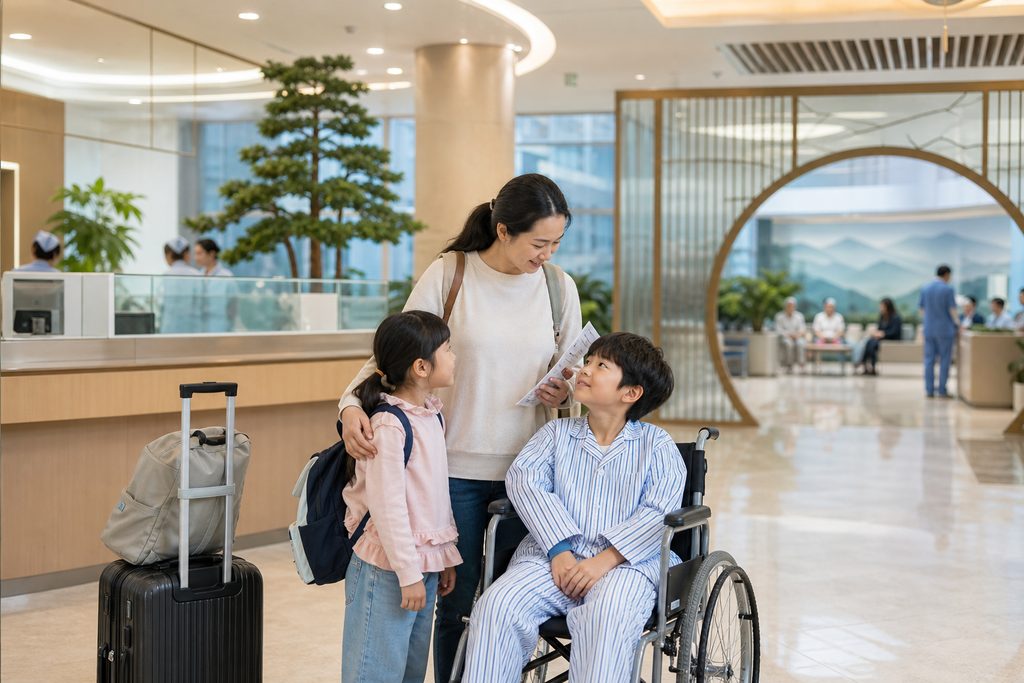
When you land, our bilingual medical companion meets you at the airport. This is not a translator with a dictionary. This is a trained logistics coordinator who understands hospital workflows. They pre-load your patient card with funds. They physically stand in the registration queues while you wait with your child in a quiet area. They sit with your child in the hospital cafeteria during your MRI, coloring or watching a tablet, so you do not have to split your focus. During a surgical admission, the companion manages the discharge pharmacy run, the meal ordering, and the communication with the nursing station about your specific needs as a single parent.
For families who need deeper support, we coordinate a vetted local caregiver through our network. This person stays with your child at a nearby serviced apartment while you are in surgery and during the first 24 hours of recovery. We have seen this arrangement work repeatedly for parents traveling for oncology surgeries, cardiac procedures, and orthopedic interventions. The child stays in a safe, quiet environment. You get the uninterrupted clinical attention you need. The cost of medical treatment in China with children becomes predictable because the variables are managed.
Our coordination also covers the practical edges that derail trips. We arrange the airport transfer. We recommend serviced apartments within walking distance of the hospital — properties with kitchenettes and washing machines, because you cannot live out of a hotel room for three weeks with a child. We brief you on the nearest imported grocery stores and the English-speaking pediatric clinics near your accommodation, just in case your child catches a cold while you are recovering.
We handle the complexity so you can focus on the one thing that matters: getting better and going home with your child healthy and safe.
Frequently Asked Questions
Yes, but only with a documented support plan. The hospital will not admit you for surgery if you are the sole guardian of a minor and have no designated caregiver for that child during your procedure and immediate recovery. This is a patient safety rule, not a bureaucratic hurdle. Our team arranges that designated caregiver — either our bilingual companion or a vetted local childcare professional — and provides the hospital with the necessary documentation. You arrive with the plan already in place.
The treatment itself varies by procedure and hospital tier, but expect to pay 10-20% of the US cash price for the surgery. On top of that, budget for flights, a serviced apartment (roughly $60-120 per night depending on the city), and our coordination services. A bilingual medical companion starts from $200 per day. Full VIP end-to-end coordination, including childcare arrangements, ranges from $5,000 to $8,000 depending on the complexity and duration of your stay. The total all-in cost for a major surgery with two weeks of recovery support rarely exceeds the cost of the surgery alone in the US.
We map this risk before you arrive. During the pre-travel planning phase, we identify the nearest English-speaking pediatric clinic or international hospital to your accommodation. We pre-register your child’s basic information where possible. If an illness occurs, your companion escorts you and your child to the clinic, translates the symptoms, and manages the pharmacy pickup. We have protocols for this. It is a common scenario, and it does not derail your recovery when it is handled systematically.
Both you and your child apply for the S2 visa with a notation for medical treatment. You will need a formal invitation letter from the admitting Chinese hospital, proof of relationship (birth certificate), and a detailed itinerary. We obtain the hospital invitation letter as part of our coordination service and guide you through the specific wording the consulate expects. Processing times vary by country, but we recommend starting the application at least six weeks before your intended travel date.
Recovery does not always follow a calendar. If your surgeon recommends an additional week of observation, we handle the visa extension paperwork, rebook your accommodation, and adjust your companion’s schedule. The S2 visa can be extended within China at the local Exit-Entry Administration bureau. We physically accompany you to that appointment and manage the translation. This is not a rare occurrence — it is a normal part of medical travel that we budget for in the planning phase.
Your Next Step
Traveling alone with a child for surgery is hard. The logistics are real, and the stakes are high. But the alternative — waiting in pain for a year while your savings drain toward an unaffordable bill — is harder. China’s top hospitals offer a genuine path to high-quality, affordable care. You do not need to navigate the language, the queues, or the childcare puzzle by yourself. Start with a conversation. Tell us what you need, and we will map the path from diagnosis to recovery.
Learn more about how our family support coordination removes the friction from medical travel, or explore our database of top-ranked hospitals to see where your treatment could happen. The first step is simple. Reach out, and let us build the plan together.
For more medical information and treatment options in China, visit chinamedservices.com (China Medical Services).
