Spinal Surgery Rehab in China: Post-Fusion & Discectomy Recovery Programs
Key Takeaways
- Structured inpatient rehabilitation after spinal fusion in China typically costs 60-80% less than comparable programs in the United States, without sacrificing clinical quality or equipment standards.
- China’s top orthopedic rehabilitation centers integrate Traditional Chinese Medicine techniques like acupuncture and tuina massage alongside conventional physiotherapy, creating a dual-pathway recovery model rarely available in Western facilities.
- Language barriers in public rehabilitation wards are real and significant — navigating daily therapy sessions without Mandarin support can delay functional progress and increase frustration.
- Recovery timelines are not shorter in China. A single-level lumbar fusion still requires 3-6 months of disciplined rehabilitation. Geography does not change biology — but structured support and daily hands-on therapy access can improve adherence.
The Problem: When Surgery Succeeds but Recovery Stalls
Approximately 400,000 spinal fusions are performed annually in the United States. The surgery itself is only half the equation. Studies published in Spine Journal show that 20-40% of patients report suboptimal functional outcomes after lumbar fusion — not because the surgery failed, but because postoperative rehabilitation was inconsistent, under-supervised, or abandoned too early. Insurance-approved physical therapy visits often cap at 12-20 sessions. That is not enough. Not for a surgery that permanently alters spinal biomechanics.
Discectomy patients face a different trap. The incision heals in two weeks. The nerve pain subsides. The patient feels “fixed” and returns to normal activity. Then the reherniation happens. Research from the European Spine Journal puts recurrent disc herniation rates at 5-15% within the first year — and poor rehabilitation compliance is a major modifiable risk factor.
So the real question is not “where can I get spine surgery.” It is “where can I get a recovery program that actually gives me the best shot at long-term function.”
Who We Are
We are not a hospital. We do not provide medical treatment, prescribe rehabilitation protocols, or make clinical decisions. Our team serves as the operational bridge between international patients and China’s top-tier orthopedic and rehabilitation centers. We handle hospital matching, appointment coordination, visa guidance, bilingual medical companion services, and logistical planning — so that when you arrive, you focus entirely on recovery, not on navigating an unfamiliar system.
Why China’s Rehabilitation Model Delivers Results After Spine Surgery
Volume Creates Specialized Expertise
China’s top orthopedic hospitals operate at a scale that is hard to comprehend from a Western perspective. A single rehabilitation department at a major public hospital may manage 200-300 post-spinal-surgery inpatients at any given time. Therapists on these wards see more lumbar fusion recoveries in one month than a typical US outpatient PT clinic sees in a year. That concentrated exposure builds pattern recognition. Therapists learn to spot subtle movement compensations early and correct them before they become ingrained habits.
This is not speculation. A 2018 systematic review in Clinical Rehabilitation found that therapist experience volume correlated positively with patient functional outcomes in postoperative orthopedic rehabilitation — a finding that holds across healthcare systems.
Dual-Pathway Recovery: Western Physiotherapy Meets TCM
What genuinely differentiates a spinal fusion rehabilitation center China price proposition is the integration of two therapeutic traditions. A typical inpatient rehab day might include 45 minutes of conventional physiotherapy — core stabilization exercises, gait training, neuromuscular re-education — followed by 30 minutes of acupuncture targeting paravertebral muscle spasm and surgical site pain. Later, a TCM practitioner performs tuina massage along the meridians that correspond to the lumbar and sacral regions.
Does acupuncture improve fusion outcomes? The evidence is mixed and honest clinicians acknowledge this. But multiple randomized controlled trials, including a 2021 study in Pain Physician, demonstrate that acupuncture significantly reduces postoperative opioid consumption after spinal surgery. Less pain medication means clearer cognition during physiotherapy sessions. That matters for recovery quality.
Cost Structures That Make Intensive Rehab Accessible
Let us address the obvious question directly. The spinal fusion rehabilitation center China price is lower than Western equivalents for structural reasons — not because of lower quality. Labor costs for skilled therapists are different. Hospital operational overhead follows a different economic model. The result: a three-week inpatient rehabilitation program after lumbar fusion at a top-tier Chinese public hospital typically ranges from $4,000 to $8,000 USD, depending on room type and therapy intensity. Comparable programs in the United States, where they exist at all, can exceed $25,000-40,000 for the same duration.
Private international hospitals in Shanghai and Beijing charge more — typically $8,000-15,000 for similar programs — but offer English-speaking staff, Western-style private rooms, and direct insurance billing. The choice depends on your priorities: maximum cost savings with a bilingual companion, or a fully English-language environment at a still-significant discount to US prices.
| Rehab Setting | Duration | Estimated Cost (USD) | Language Support |
|---|---|---|---|
| Public Hospital (Tier 1) | 3 weeks inpatient | $4,000 – $8,000 | Mandarin; companion recommended |
| Private International Hospital | 3 weeks inpatient | $8,000 – $15,000 | English-speaking staff |
| United States (comparable program) | 3 weeks inpatient | $25,000 – $40,000+ | English |
What a Post-Fusion Recovery Program Actually Looks Like in China
Patients searching for the best discectomy recovery program abroad often have a mental image of passive therapies — lying on a table while someone does something to them. That is not how it works. A serious rehabilitation program in China is structured, progressive, and demanding.
Phase one begins in the hospital, often within 24 hours of surgery. The focus is brutally basic: log-rolling in bed without twisting the spine, ankle pumps to prevent deep vein thrombosis, and the first assisted sit-to-stand transfer. Pain is managed, not eliminated. Chinese rehabilitation philosophy tends to emphasize early mobilization more aggressively than some Western protocols — a reflection of the volume-driven confidence that comes from seeing thousands of post-fusion patients mobilize without incident.
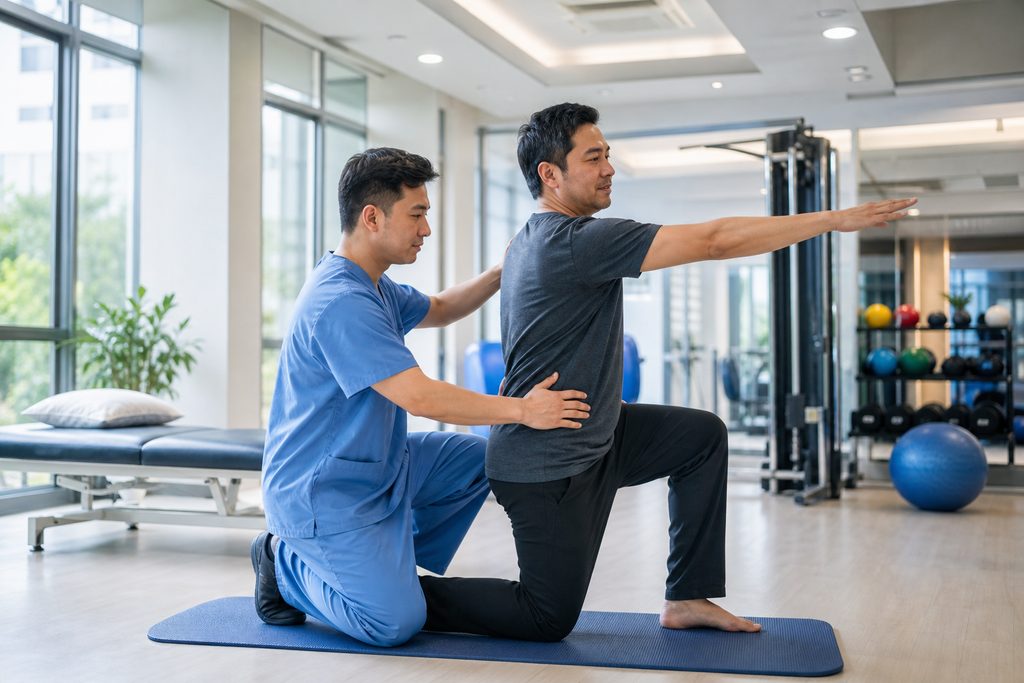
Phase two spans weeks two through six. This is where the work intensifies. Core stabilization exercises progress from supine dead bugs to seated and standing variations. Gait training moves from parallel bars to a walker to independent ambulation. Patients learn to pick objects off the floor using a golfer’s lift, not a spinal flexion. They practice getting in and out of a car without rotating the lumbar spine. Every movement is relearned.
Phase three — the outpatient or extended inpatient phase — runs from week six to month three or beyond. This is where many Western patients fall through the cracks because insurance stops covering visits. In China, patients who choose extended inpatient rehab or daily outpatient sessions maintain continuity. Resistance training is introduced cautiously. Cardiovascular conditioning ramps up. The goal is not just pain-free living but a return to the activities that give life meaning.
How Long Is Recovery After Spinal Fusion in China?
The question how long is recovery after spinal fusion in China has the same answer as anywhere else: it depends on the levels fused, your pre-surgical fitness, and your rehabilitation adherence. A single-level lumbar fusion patient who enters a structured daily rehab program can expect to walk independently within 3-7 days, return to light daily activities by 6 weeks, and resume most normal activities by 3-6 months. Full bony fusion takes 12-18 months — and no rehabilitation program, anywhere on earth, can accelerate osteoblast biology.
What changes in China is not the biological timeline. It is the density of supervised therapy hours during the critical early months. Instead of two 45-minute PT sessions per week, you might receive two hours of combined therapy daily. That volume of supervised practice can compress the functional recovery curve — not the fusion itself, but the neuromuscular re-education that determines how well you move once fused.
Is China Safe for Spine Surgery Rehabilitation?
This question surfaces in nearly every initial consultation. Is China safe for spine surgery rehabilitation — the short answer is yes, with qualifications that honest advisors do not hide. The top-tier hospitals we work with — those ranked in the Fudan University Hospital Rankings or holding JCI accreditation — maintain infection control standards comparable to Western tertiary centers. Surgical site infection rates after spinal procedures at major Chinese orthopedic centers range from 0.5-2%, consistent with international benchmarks published by the International Spine Study Group.
The qualifications matter. China has over 35,000 hospitals. The top 5% deliver world-class care. The rest do not. Our database includes 340+ top-ranked hospitals across 37 cities — and we do not match patients with facilities outside that verified network. Safety is a function of hospital selection, not geography.
Also worth stating plainly: medical malpractice and liability frameworks differ from Western systems. Patients should understand this. It is not a reason to avoid treatment in China — outcomes at top centers speak for themselves — but it is information you deserve before making a decision.
What You Need to Know Before Going Alone
Independent medical travel sounds empowering. In practice, it often means spending your recovery energy on logistics instead of healing. Here are the barriers that trip up well-intentioned patients:
- Visa Requirements: Medical treatment in China requires an S2 visa with a specific annotation for medical purposes. Your accompanying family member also needs an S2. Embassy processing times vary by country. Invitation letters from hospitals must meet specific formatting requirements. Getting this wrong means a visa rejection and a delayed surgery date.
- Public Hospital Registration Systems: Top orthopedic hospitals do not accept international patient registrations through their standard outpatient portals. You cannot simply book online from abroad. The international medical department or VIP clinic is the only pathway for pre-arranged care — and these departments have their own scheduling processes, documentation requirements, and fee structures that are not published on English-language websites.
- Daily Rehabilitation Communication: In a public hospital rehab ward, your physiotherapist likely speaks Mandarin. Instructions during gait training — “shift your weight forward, do not lock your knee, engage your core now” — happen in real time. Misunderstanding a movement cue can mean practicing a harmful compensation pattern for days before anyone notices.
How We Help You Navigate This
These barriers exist for structural reasons, not because anyone is trying to make things difficult. The Chinese healthcare system was built to serve 1.4 billion domestic patients. International patient coordination is an overlay, not the default. Our job is to make that overlay seamless.
We start with hospital matching. Tell us your surgical history, your rehabilitation goals, and your preferences for public versus private settings. We identify 2-3 appropriate facilities from our network of top-ranked hospitals, present their rehabilitation program structures and cost estimates, and let you decide. Then we handle the invitation letter, visa guidance, and appointment coordination through the hospital’s official international department.
When you land, a bilingual medical companion meets you. This person does not provide medical care — they translate, navigate, and advocate. They ensure your physiotherapist’s instructions reach you accurately. They handle registration, payment queues, and pharmacy runs. They are the reason you can focus on your dead bugs and golfer’s lifts instead of wondering which floor the rehab gym is on.
After discharge, we coordinate follow-up imaging appointments and surgeon consultations. If you choose to extend your stay for continued outpatient rehab, we arrange that too. The goal is continuity — no gaps between what the surgeon ordered and what actually happens.
Frequently Asked Questions
Yes, with an important distinction. You cannot book through a public hospital’s general registration system from abroad. But you can arrange a pre-defined rehabilitation program through a hospital’s international medical department — and that is exactly what our coordination service facilitates. The program scope, duration, and cost are confirmed before you travel. If we cannot secure the appointment as specified, our coordination fee is refunded in full.
Shanghai and Beijing are broadly comparable in pricing for spine rehabilitation. Private international hospitals in both cities charge $8,000-15,000 for a three-week inpatient program. Public hospital international departments in Shanghai may run slightly lower than Beijing — perhaps $500-1,000 less for a comparable stay — but the difference is marginal relative to the total cost. The choice between cities should be driven by hospital specialization and surgeon preference, not minor price variations. For a detailed breakdown of medical tourism spine recovery Shanghai cost options, we provide facility-specific estimates during consultation.
This is the question every patient should ask. The hospitals in our network have protocols for managing postoperative complications — infection, hardware failure, neurological deterioration — that align with international standards. Emergency surgical revision capability exists on-site at major orthopedic centers. What differs from your home country is the medicolegal framework and the practical challenge of extended overseas stays if recovery is complicated. We recommend that every patient carry comprehensive medical travel insurance that covers complication management and medical evacuation. We help you understand what your policy covers before you travel. We do not downplay this risk. Spine surgery is serious medicine, and complications happen at a low but real rate regardless of where you are treated.
Look for two independent verification signals. First, check whether the hospital’s orthopedic department appears in the Fudan University Hospital Rankings — the most authoritative hospital evaluation system in China, which ranks specialty departments based on peer reputation and clinical output. Second, verify JCI accreditation status for international-standard quality and safety protocols. Our specialty department database cross-references both signals so you do not have to do this research across Chinese-language websites.
Your Next Step
Recovering well after spinal surgery is not about finding a magic destination. It is about finding a structured, supervised program and committing to the daily work of rehabilitation — in a setting where language barriers and logistical friction do not drain the energy you need for healing. China’s top rehabilitation centers offer that combination: clinical volume that breeds therapist expertise, a dual-pathway approach that integrates conventional and traditional medicine, and a cost structure that makes intensive, daily therapy accessible rather than aspirational.
If you want to understand what a specific program would look like for your situation — which hospitals match your needs, what the timeline and costs would be — our team is here to walk you through it. No pressure. Just information. Get a free consultation and we will help you think through the options.
For more medical information and treatment options in China, visit chinamedservices.com (China Medical Services).
