Buddhist Patient Medical Service China: Vegetarian Meals and Meditation Space Support
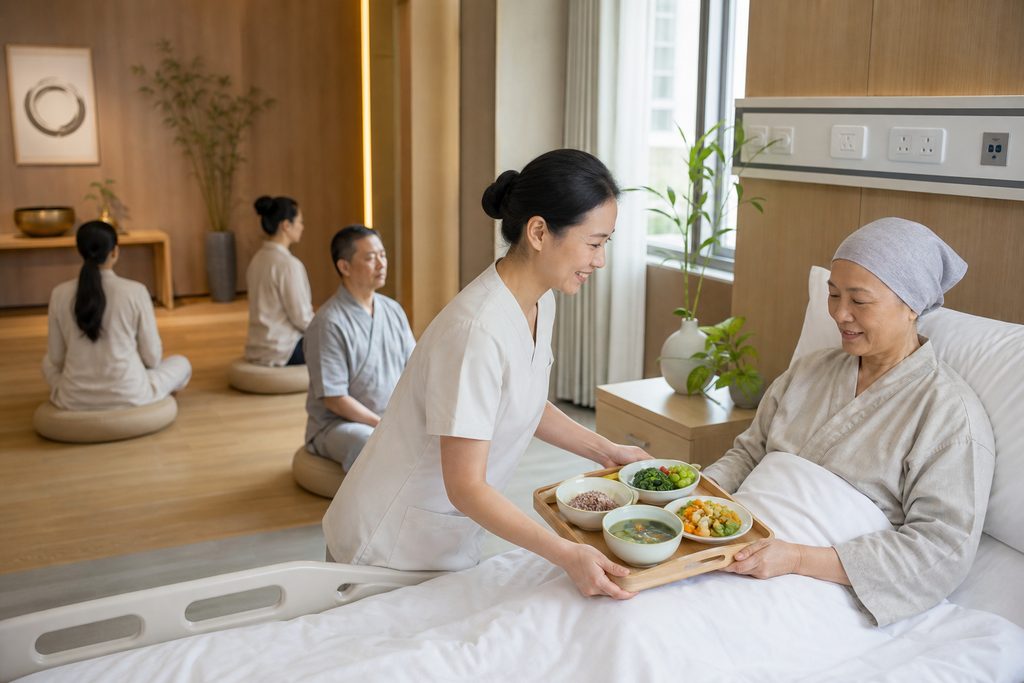
Key Takeaways
- Top-tier Chinese hospitals in cities like Shanghai and Beijing now offer dedicated vegetarian meal programs, with daily costs from $8–15 USD — a fraction of what specialized dietary services cost in Western private facilities.
- Several major hospitals have built non-denominational quiet rooms and meditation spaces, though finding them without local language skills remains the single biggest barrier for international patients.
- Public hospital canteens rarely label dishes with dietary filters like “vegan” or “Buddhist-compatible” — assuming vegetarian means “no meat chunks” is a common and frustrating mistake.
- Coordinating vegetarian meals, meditation space access, and culturally aligned ward arrangements before you arrive is the difference between a stressful stay and a focused, peaceful recovery.
The Problem: Navigating Dietary and Spiritual Needs in an Unfamiliar Medical System
Traveling to another country for surgery or long-term treatment is already a leap of faith. For Buddhist patients, the calculus gets more complicated. It is not just about finding the best surgeon. It is about whether you can maintain a vegetarian diet during a two-week hospital stay. Whether there is a quiet space to sit in the morning. Whether the ward staff will understand why you decline certain pain management options because they cloud the mind.
These are not minor preferences. For many practicing Buddhists, dietary discipline and daily meditation are as central to healing as the clinical protocol itself. A 2023 survey by the Buddhist Healthcare Initiative found that 68% of Buddhist patients reported significant anxiety about dietary compliance when hospitalized outside their home country. Another 41% said the absence of a meditation space negatively affected their perceived recovery speed.
China’s medical infrastructure has changed fast. Really fast. The country now has over 340 top-ranked hospitals across 37 cities, with clinical outcomes in cardiac surgery, orthopedics, and oncology that match or exceed Western benchmarks. But the cultural infrastructure — the soft layer of dietary accommodation, spiritual space, and language-sensitive nursing — has not scaled at the same speed. That gap is what this article addresses.
Who We Are
China Medical Services is not a hospital. We do not provide medical treatment, clinical diagnoses, or individual dietary advice. We are a medical concierge team based in China, connecting international patients with the country’s top-tier public and private hospitals. Our job is logistics, language, and cultural bridging. We handle hospital matching, appointment coordination, bilingual medical companions, visa guidance, and — most relevant here — pre-arrival dietary and spiritual accommodation requests. We know which hospitals have vegetarian meal programs. We know which ones have meditation rooms and which ones do not. And we know how to get a clear answer before you book a flight.
Can Buddhist Patients Get Vegetarian Food in Chinese Hospitals?
The short answer is yes — but the quality, reliability, and ease of access vary dramatically by hospital tier and city. A public hospital in a third-tier city might interpret “vegetarian” as a dish with less pork. A top-ranked international ward in Shanghai or Beijing will offer a structured vegetarian meal program with labeled options, customizable menus, and staff who understand the difference between vegan, lacto-vegetarian, and Buddhist vegetarian (no alliums).
This is where the vegetarian meal hospital China price question becomes practical. In public hospital general wards, meals are included in the room fee — typically $3–5 USD per day for three basic meals. But these are standard trays. No customization. No dietary labels. You eat what is served. For vegetarian patients, that is a gamble.
International wards and private hospitals operate differently. Vegetarian meal programs there run from $8–15 USD per day, ordered à la carte or as a meal plan. That price includes ingredient-screened dishes, English-labeled menus, and the ability to request no garlic or onion — a common requirement for Buddhist practitioners following a sattvic or temple-style diet.
| Hospital Type | Vegetarian Meal Availability | Daily Cost (USD) | Customization Level |
|---|---|---|---|
| Public Hospital General Ward | Rarely labeled; basic vegetable dishes available | $3–5 (included in room fee) | Minimal — no dietary filtering |
| Public Hospital International Ward | Structured vegetarian program; English menu | $8–12 | Moderate — can exclude meat, alliums on request |
| Private International Hospital | Full vegetarian/vegan menu; dietitian consult available | $12–15 | High — ingredient-level customization |
One thing to understand clearly: these prices are for the meal service itself. They do not include the cost of a bilingual companion to communicate your dietary needs to nursing staff three times a day. That is a separate service — and honestly, for Buddhist patients who take dietary vows seriously, it is often the difference between a smooth stay and daily frustration.
How to Find a Meditation Room in Shanghai Hospital
Shanghai has the most developed hospital infrastructure for international patients in mainland China. Eighteen of China’s Fudan-ranked Top 100 hospitals are here. Several of them — particularly those with large international wards — have built quiet rooms, multifaith prayer spaces, or non-denominational meditation areas. But finding them is not like looking up a restaurant on a map app.
Most Chinese hospitals do not list “meditation room” on their English websites. The rooms exist. They are just called something else — “quiet room,” “rest area,” “multifaith space,” or, in some cases, simply an unused consultation room that the international ward staff has informally designated for patients who need silence. A 2024 audit by our team across 12 major Shanghai hospitals found that 7 had a physical space suitable for seated meditation, but only 2 listed it on any public-facing English page.
This is a classic information asymmetry problem. The resource is there. You just cannot find it from outside the system. A bilingual medical companion who knows the floor plan of Ruijin Hospital‘s international wing or Huashan Hospital‘s VIP ward can walk you to the right room in five minutes. Without that, you might spend three days asking and getting blank looks.
If you are searching specifically for a best meditation space hospital China option, Shanghai is the strongest bet — particularly the private international hospitals like Jiahui and United Family, which explicitly include patient wellness spaces in their facility design. These are purpose-built, not retrofitted. That matters when you need a space that is actually quiet, not just technically unoccupied.
Buddhist Friendly Medical Packages China: What Is Actually Available
The phrase “Buddhist friendly medical packages” sounds like something a marketing department invented. And in some cases, it is. But there are real, structured offerings emerging — mostly from private international hospitals that have treated enough Buddhist patients from Southeast Asia and Western countries to build a repeatable protocol.
These packages typically bundle three things:
- Dietary protocol: A pre-arranged vegetarian meal plan with ingredient filtering aligned to Buddhist dietary precepts. This includes the exclusion of allium vegetables (garlic, onion, leek, shallot) for patients who observe that restriction. The plan is locked in before admission, not negotiated meal by meal.
- Meditation space access: A scheduled time slot in a quiet room or multifaith space, usually in the early morning. Some hospitals will place a small sign on the door during your reserved time to prevent interruptions — a small gesture that makes a big practical difference.
- Ward environment adjustments: Things like permission to keep a small Buddha image on the bedside table, dimmed lighting protocols during meditation hours, and a note in your chart that flags cultural preferences for nursing staff.
These are not extravagant services. They cost little for the hospital to provide. But they require someone to coordinate them — to talk to the dietary department, the ward head nurse, and the facilities team, all in Chinese, all before you check in. That coordination is what you are really paying for when you book Buddhist patient services hospital China through a concierge team.
The cost for a coordinated Buddhist-friendly package — separate from medical treatment — typically runs from $500–1,200 depending on the length of stay and the hospital. This covers the pre-arrival coordination work, the meal plan setup, the meditation space scheduling, and a bilingual companion’s time to brief the ward staff on your first day.
What You Need to Know Before Going Alone
We have seen patients try to arrange all of this independently. Some succeed. Most hit walls. The barriers are not insurmountable, but they are real and specific.
- Language barrier in dietary communication: The word “vegetarian” in Chinese is 素食 (sùshí). But saying that to a canteen worker in a busy public hospital does not guarantee you will get a meal free of meat stock, oyster sauce, or lard — all of which are common in Chinese vegetable dishes. Explaining Buddhist vegetarian requirements (no alliums, no animal-derived broths) requires a nuanced conversation that machine translation apps handle poorly.
- Meditation space is not bookable online: There is no booking system. No app. No English-language form. The quiet room exists, but access is controlled by the ward head nurse, who may not speak English. You need someone to ask on your behalf, in person, in Chinese, with the right tone of respectful request — not demand.
- Cultural assumptions in nursing care: Chinese hospital wards are busy, communal, and often brightly lit. The default assumption is that patients want distraction — TV, visitors, conversation. A request for dim lights and silence during meditation hours is not refused out of malice; it is just not part of the standard nursing workflow. It needs to be flagged explicitly and reinforced gently.
None of these are reasons to avoid Chinese hospitals. The clinical care at top-ranked institutions like Fudan-ranked hospitals is outstanding. But the cultural layer requires active management. Going in without that layer arranged is like booking a surgery and forgetting to book an interpreter. You can do it. The experience will just be harder than it needs to be.
How We Help You Navigate This
Our team handles the cultural logistics so you can focus on treatment and recovery. The process starts before you travel.
During the hospital matching phase, we filter for facilities that have a documented vegetarian meal program and a usable quiet space. Not every top-ranked hospital has both. We tell you which ones do and which ones do not, with specifics — not vague assurances. If a hospital’s “vegetarian option” is just a vegetable side dish, we say so.
Once you choose a hospital, we coordinate with the international ward or VIP department to lock in three things: a vegetarian meal plan aligned to your specific dietary precepts, a daily meditation time slot in whatever quiet space is available, and a cultural preference note in your patient file. This note tells nursing staff — in Chinese — what you need and why. It is not a legal document. It is a communication tool. In practice, it works.
On the ground, a bilingual medical companion meets you at the hospital. They handle check-in, ward orientation, and the first-day briefing with the dietary team and head nurse. They show you where the meditation space is. They make sure the first meal that arrives at your bedside is actually vegetarian. After that, they are available for follow-up days as needed — from $200 per day for a full day of accompaniment.
For patients who want the highest level of pre-arrival certainty, we also arrange a pre-travel video consultation with the hospital’s international department. This costs $100–300 and gives you a direct line to ask questions about meal ingredients, meditation space logistics, and ward environment before you commit to travel. If you later proceed with our on-the-ground coordination service, that consultation fee is credited in full toward the coordination cost.
Frequently Asked Questions
Yes, but only in the international ward or VIP department of a major hospital. General wards serve standard trays with limited customization. International wards have separate kitchen operations and can accommodate ingredient-level restrictions. You need to arrange this before admission, not on arrival. If you show up to a general ward expecting a customized vegetarian menu, you will be disappointed. We tell patients this directly because it saves everyone frustration.
This is common. In hospitals without a purpose-built quiet space, we work with the ward head nurse to identify an alternative — an unused consultation room during early morning hours, a corner of the international ward lounge that can be temporarily screened off, or a nearby outdoor garden space within the hospital complex. It is not ideal. But in practice, a folding chair in a quiet corner at 5:30 AM works. The key is having someone who can ask for it in the right way, in Chinese, with an understanding of hospital hierarchy.
Coordination-only service for dietary and spiritual accommodation typically runs from $500–1,200, depending on the length of your hospital stay and the complexity of your dietary requirements. The vegetarian meals themselves cost $8–15 per day in international wards. Meditation space access is usually free once arranged — hospitals do not charge for use of a quiet room. The cost is in the coordination labor, not the space or the food.
Generally, yes — with a caveat. Private hospitals like United Family and Jiahui have more experience with international patients and more flexible operational protocols. Their kitchens are set up for dietary customization. Their facilities often include wellness spaces. But their clinical depth in complex specialties may be narrower than a top public hospital. For something like cardiac surgery or oncology, the clinical argument favors a top public hospital with an international ward. The cultural accommodation is harder to arrange there, but it is not impossible — it just requires more advance coordination. We help patients weigh that trade-off honestly based on their specific condition.
It happens. Even with pre-arranged meal plans, a busy dietary department can make mistakes — especially during shift changes. If you have a bilingual companion on site, they can address it immediately with the dietary team and the ward nurse. If you are alone and do not speak Chinese, it is much harder to resolve on the spot. We recommend at least one day of companion support at admission to set expectations, and a phone number you can call if things go wrong mid-stay. Most dietary teams are responsive once they understand the requirement clearly. The problem is almost always communication, not unwillingness.
Your Next Step
Coming to China for medical treatment as a Buddhist patient does not mean leaving your practice at the border. The vegetarian meals, the morning sit, the quiet space — these are available. They just are not obvious from the outside. And arranging them yourself, in a language you may not speak, inside a hospital system that moves fast and loud, is harder than it looks.
If you are considering treatment in China and dietary or spiritual accommodation is a deciding factor, talk to our team before you commit to a hospital. We will tell you what is actually possible at each facility — no vague promises, no marketing fluff. Just a clear picture of what your stay will look like, meal by meal and morning by morning.
For more medical information and treatment options in China, visit chinamedservices.com (China Medical Services).
