Guangdong Provincial TCM Hospital: International Patient Service for Traditional Chinese Medicine in Guangzhou
Key Takeaways
- Guangdong Provincial TCM Hospital handles over 7 million outpatient visits annually, making it one of the highest-volume traditional Chinese medicine hospitals in the world — clinical repetition at this scale builds diagnostic precision that smaller institutions cannot match.
- The hospital’s international patient service provides English-speaking coordinators, dedicated VIP consultation rooms, and direct access to senior TCM specialists — but you cannot book these services through the hospital’s Chinese-language public registration system.
- Treatment costs for international patients at this hospital typically range from $80 to $300 per specialist consultation, with acupuncture sessions starting around $50 — roughly one-tenth of comparable TCM care in major US cities.
- Navigating the hospital without Chinese language ability is genuinely difficult. The campus spans multiple buildings across several Guangzhou districts. A bilingual medical companion changes the entire experience.
The Problem: Chronic Conditions That Western Medicine Has Not Resolved
According to the US Centers for Disease Control and Prevention, approximately 51.6 million American adults — roughly 1 in 5 — live with chronic pain. Another 40 million adults have an anxiety disorder. Millions more manage autoimmune conditions, digestive disorders, and hormonal imbalances that defy clear diagnosis or effective pharmaceutical intervention. These patients share a common frustration: they have tried the standard protocols. They have taken the medications. They are still suffering.
A 2023 survey published in the Journal of Pain Research found that 67% of chronic pain patients reported dissatisfaction with conventional treatment outcomes after two years. That is not a fringe statistic. That is two out of three people walking out of doctors’ offices no better than when they walked in. Many of these patients begin researching alternatives. They read about acupuncture. They hear about herbal medicine. They wonder whether traditional Chinese medicine might offer something their current care is missing.
But where do you go? The local acupuncturist with a six-month certificate? The wellness spa offering “Chinese herbal consultations” alongside facials? Or a hospital that has been practicing traditional Chinese medicine for over 90 years, integrated with modern diagnostics, and staffed by physicians who see more complex cases in a month than most Western TCM practitioners see in a career?
That hospital exists. It is in Guangzhou. And its doors are open to international patients — if you know how to navigate them.
Who We Are
We are China Medical Services. We are not a hospital. We do not provide medical treatment, clinical diagnoses, or therapeutic recommendations. What we do is solve the logistical puzzle that stands between you and China’s most respected medical institutions. Our team handles hospital matching, appointment coordination, bilingual medical companionship, visa guidance, and the hundreds of small practical details that make the difference between a smooth treatment journey and a stressful one. We have built relationships with over 340 top-ranked hospitals across 37 Chinese cities. Guangdong Provincial TCM Hospital is one of the institutions we know best — and one of the ones our patients ask about most often.
Why Guangdong Provincial TCM Hospital Delivers Results for International Patients
Guangdong Provincial TCM Hospital is not a small clinic. It is one of the largest and most academically rigorous TCM institutions in China. Founded in 1933, the hospital now operates across multiple campuses in Guangzhou, including the main Dade Road campus, the Ersha Island campus, the Fangcun campus, and the University Town campus. The numbers tell part of the story: over 3,000 inpatient beds, more than 7 million outpatient visits per year, and a medical staff exceeding 5,000. But the number that matters most to international patients is the clinical volume in specific departments — because in medicine, repetition builds expertise.
Clinical Volume That Builds Diagnostic Precision
Consider the dermatology department. Guangdong Provincial TCM Hospital’s dermatology division sees over 3,000 outpatient visits daily. Daily. The physicians here have treated more cases of psoriasis, eczema, and chronic urticaria using integrated Chinese-Western protocols than almost any department on earth. For a patient who has cycled through topical steroids and immunosuppressants without lasting relief, that volume translates into something tangible: a doctor who has seen your condition hundreds of times before and knows which herbal formulations, acupuncture protocols, or dietary adjustments actually shift the underlying pattern.
The acupuncture and moxibustion department handles over 1,200 patient encounters per day. The rehabilitation department manages post-stroke recovery, spinal cord injury rehabilitation, and chronic pain cases at a scale that generates pattern recognition no textbook can teach. This is the structural advantage of a high-volume Chinese hospital: the clinicians are not guessing. They are drawing on a clinical experience base that is, in many subspecialties, unmatched globally.
Integration of TCM and Modern Diagnostics
There is a persistent misconception among Western patients that traditional Chinese medicine hospitals in China operate like historical museums — all pulse-taking and herb drawers, no technology. This is wrong. Guangdong Provincial TCM Hospital is equipped with MRI, CT, PET-CT, and full laboratory diagnostic capabilities. The physicians here do not choose between TCM and modern medicine. They use both.
A typical consultation for chronic pain might begin with an MRI to rule out structural pathology, followed by a TCM pattern differentiation based on tongue diagnosis, pulse diagnosis, and a detailed symptom history. Treatment might combine acupuncture, moxibustion, and herbal decoctions with physiotherapy and, where appropriate, Western anti-inflammatory medications. This is not alternative medicine in the Western sense. It is integrated medicine practiced at a hospital where TCM and conventional diagnostics coexist as parallel tools — not competing ideologies.
What Is Traditional Chinese Medicine Treatment Like in Practice?
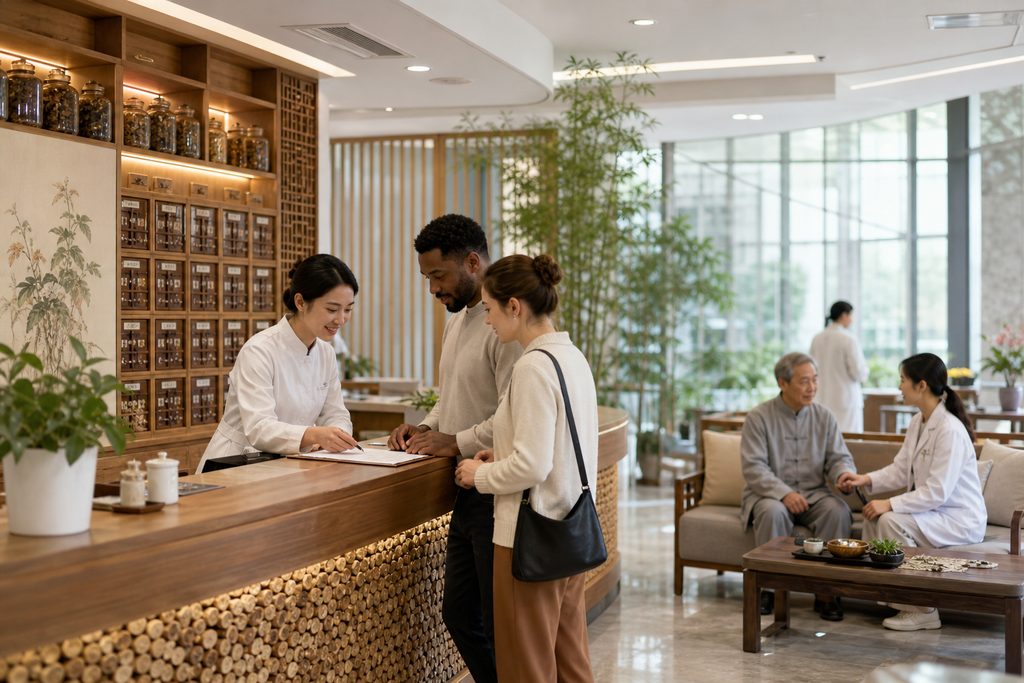
Patients who have never experienced TCM in a hospital setting often arrive with expectations shaped by Western media — images of dimly lit rooms, mysterious powders, and practitioners who speak in metaphors about wind and dampness. The reality at Guangdong Provincial TCM Hospital is different. The international patient service operates out of clean, modern consultation rooms. The intake process is thorough: a senior TCM physician will spend 20 to 40 minutes on an initial consultation, far longer than the average 12-minute primary care visit in the United States.
Treatment modalities vary by condition. For chronic pain, you might receive acupuncture with electrical stimulation, followed by cupping therapy and a customized herbal prescription dispensed as granules you dissolve in hot water. For a dermatological condition, the approach might involve oral herbal medicine, topical herbal washes, and dietary counseling based on TCM food energetics. For a gynecological or fertility concern, treatment could span multiple cycles and combine acupuncture timed to specific phases of the menstrual cycle with herbal formulations adjusted as your body responds.
The key difference from a Western TCM clinic is depth. The hospital pharmacy stocks over 400 individual Chinese herbs and hundreds of proprietary formulations. The acupuncture department has treatment rooms dedicated to specific conditions — facial paralysis, post-stroke sequelae, lumbar disc herniation — staffed by physicians who treat those conditions all day, every day. This is not a generalist’s approach. It is deep specialization within a traditional framework.
How Does Acupuncture Work for Chronic Pain? The Evidence Base
Skepticism about acupuncture is reasonable. For decades, Western researchers dismissed it as placebo — elaborate ritual with needles but no biological mechanism. The evidence has shifted. A 2018 meta-analysis published in the Journal of Pain analyzed data from nearly 21,000 patients across 39 randomized controlled trials. The conclusion was unambiguous: acupuncture produced clinically meaningful reductions in chronic pain compared to both sham acupuncture and standard care. The effect was not placebo. The effect was real and durable, persisting at 12-month follow-up.
The mechanism is increasingly understood. Functional MRI studies show that acupuncture modulates activity in the limbic system, the brain’s pain-processing and emotional-regulation center. Needle insertion at specific points triggers the release of adenosine, a neuromodulator with natural analgesic properties. Electroacupuncture stimulates the release of endogenous opioids — your body’s own painkillers. This is not mystical energy. It is neurochemistry, increasingly well-mapped by modern research.
At Guangdong Provincial TCM Hospital, acupuncture is not delivered as a standalone wellness service. It is embedded within a comprehensive treatment plan that may include herbal medicine, dietary therapy, and physiotherapy. For chronic low back pain — one of the most common reasons international patients seek TCM care — the hospital’s integrated protocol typically produces measurable improvement within four to six sessions, though chronic conditions often require longer courses of treatment.
Traditional Chinese Medicine Hospital Guangzhou Cost: What International Patients Actually Pay
Let us address the question that drives most international patient inquiries: what does treatment cost? The answer varies by condition, treatment complexity, and whether you access care through the hospital’s international service channel or attempt to navigate the standard public system. For international patients using the hospital’s VIP international service, here are the reference ranges:
| Service | Cost Range (USD) | Notes |
|---|---|---|
| Initial specialist consultation (senior TCM physician) | $80–$150 | 30–40 minute comprehensive evaluation |
| Follow-up consultation | $50–$100 | Includes prescription adjustment |
| Acupuncture session (single body region) | $50–$80 | 30–45 minutes, may include electroacupuncture |
| Acupuncture session (multiple regions or complex protocol) | $80–$150 | Includes adjunctive techniques like cupping or moxibustion |
| Herbal medicine (per week supply, granules) | $30–$80 | Varies significantly by formula composition |
| Cupping therapy session | $30–$60 | Often combined with acupuncture |
| Tuina therapeutic massage (30 minutes) | $40–$70 | Performed by licensed TCM practitioners |
| Inpatient stay (per day, international ward) | $200–$400 | Private room, includes nursing care and meals |
These figures reflect the hospital’s international service pricing. They are approximate and vary by case complexity, physician seniority, and treatment duration. But the broader comparison is what matters to most international patients: a course of 10 acupuncture sessions with herbal medicine at Guangdong Provincial TCM Hospital costs roughly $800 to $1,500 total. In San Francisco, New York, or London, the same course of treatment from a qualified TCM practitioner would run $1,500 to $3,000 or more — and the practitioner would have treated a fraction of the case volume of a senior physician at a top Chinese TCM hospital.
For complex chronic conditions requiring multi-week inpatient rehabilitation — post-stroke recovery, for example — the cost differential is starker. A three-week inpatient TCM rehabilitation program at Guangdong Provincial TCM Hospital typically costs $6,000 to $12,000 for international patients, including daily acupuncture, physiotherapy, herbal medicine, and nursing care. Comparable programs in Western rehabilitation facilities, where they exist at all, can exceed $30,000 to $50,000.
How to Book TCM Treatment Guangzhou International Service: The Actual Process
Booking treatment at Guangdong Provincial TCM Hospital as an international patient is not as simple as calling a number or filling out an online form. The hospital’s international service exists, but it is not a slick commercial operation with a dedicated English-language website and 24-hour call center. It is a functional department within a massive public hospital that serves primarily Chinese patients. Understanding the real process prevents frustration.
The international patient department does accept direct inquiries. You can contact them by phone or email, and they can schedule appointments with English-speaking coordinators. However, the response time varies. Pre-arranging an appointment before you travel to Guangzhou is possible, but it requires persistence and often multiple follow-ups. The department coordinates with specific senior physicians who have experience treating international patients and who can conduct consultations with the assistance of English-speaking medical interpreters.
For patients who want to ensure a specific appointment time with a specific senior specialist — particularly the hospital’s most sought-after physicians in dermatology, acupuncture, or gynecology — the coordination becomes more complex. These physicians have full schedules. Their availability for international patients is limited. This is where working with an experienced medical coordination service changes the timeline from “maybe next month” to “confirmed for next week.”
We handle the pre-arrival coordination: medical history translation, physician matching based on your specific condition, appointment scheduling, and confirmation. On the day of your consultation, a bilingual medical companion meets you at the hospital, guides you through registration and payment, accompanies you into the consultation room for interpretation, and ensures you understand your diagnosis, treatment plan, and prescription instructions. After your visit, we coordinate follow-up appointments, herbal medicine dispensing, and any additional services you need.
What You Need to Know Before Going Alone
Guangdong Provincial TCM Hospital is an extraordinary institution. It is also a large, busy Chinese public hospital where almost everything happens in Mandarin and Cantonese. If you are considering navigating it independently, here is what you will face:
- Language barrier — total and immediate: Registration forms, directional signage, pharmacy instructions, and consultation conversations are in Chinese. The international patient department has English-speaking staff, but they are a small team within a hospital of 5,000+ employees. Step outside their office, and you are on your own linguistically. Even ordering food in the hospital canteen requires Chinese.
- Payment systems that reject foreign cards: The hospital’s standard payment terminals are designed for Chinese bank cards and WeChat Pay or Alipay — mobile payment platforms linked to Chinese bank accounts. International credit cards are not accepted at most payment counters. The international service department can process foreign cards or wire transfers, but if you attempt to pay at a standard cashier window, your Visa or Mastercard will be useless.
- Physical navigation across a multi-campus system: The hospital operates across four main campuses in Guangzhou. Your acupuncture treatment might be at the Ersha Island campus while your herbal consultation is at Dade Road. These campuses are not adjacent. Traffic in Guangzhou is dense. Without someone who knows the layout, you will lose hours to logistics.
- Visa requirements that are easy to get wrong: Medical treatment in China requires an S2 visa with the specific purpose of medical treatment noted. This is not an M visa — M visas are for commercial and trade activities only. Applying for the wrong visa category can result in denial at the border. The application requires an invitation letter from the hospital, medical records, and proof of financial means. We have seen patients book flights and hotels only to have their visa applications rejected because of documentation errors.
How We Help You Navigate This
These barriers are real. They are also solvable. Our role is to handle the friction so you can focus on your treatment. Before you travel, we collect your medical history, translate it into Chinese, and submit it to the hospital’s international department for physician matching. We confirm which senior specialist is best suited to your condition — not just any available doctor, but the one whose clinical focus aligns with what you need.
We coordinate your visa invitation letter, ensuring the hospital provides the correct documentation with the proper stamps and wording. We advise on accommodation near the relevant hospital campus — because staying at a hotel 45 minutes from your treatment campus in Guangzhou traffic is a mistake you only make once. When you arrive, your bilingual medical companion meets you at the hospital entrance, handles registration and payment, interprets during your consultation, and ensures your prescription is filled correctly at the hospital pharmacy.
If your treatment requires multiple sessions over several weeks — common for chronic pain, dermatological conditions, or fertility support — we coordinate the entire schedule, adjust appointments as needed, and remain available throughout your stay. We have helped patients navigate everything from simple acupuncture courses to multi-week inpatient rehabilitation for post-stroke recovery. The complexity does not scare us. It is what we do.
For patients considering treatment at Guangdong Provincial TCM Hospital, we recommend starting with a video consultation. The hospital’s senior physicians can review your medical history, assess whether TCM treatment is appropriate for your condition, and provide a preliminary treatment plan before you commit to travel. This costs between $100 and $300 depending on the specialist’s seniority, and it is credited in full toward our coordination service if you proceed with in-person treatment within 90 days. It is the lowest-risk way to determine whether this path makes sense for you.
Frequently Asked Questions
It is unquestionably among the top tier. In China’s authoritative Fudan University hospital rankings, Guangdong Provincial TCM Hospital is consistently ranked among the top traditional Chinese medicine hospitals nationally. Its dermatology, acupuncture, and rehabilitation departments are particularly renowned. For foreigners, the hospital’s location in Guangzhou — a major international gateway city with direct flights from Europe, North America, Southeast Asia, and the Middle East — makes it logistically more accessible than TCM hospitals in more remote Chinese cities. The international patient department has been operating for over a decade and has experience with patients from dozens of countries. That said, “best” depends on your condition. For respiratory diseases, a TCM hospital in Beijing might be more appropriate. For digestive disorders, a Shanghai institution might have deeper expertise. We help patients match to the right hospital, not just the most famous one.
TCM is not a first-line treatment for acute emergencies, infectious diseases requiring antibiotics, or surgical conditions. Where it demonstrates particular effectiveness — supported by both clinical tradition and growing research evidence — is in chronic, complex conditions where conventional medicine often struggles: chronic pain syndromes, autoimmune disorders, dermatological conditions like eczema and psoriasis, gynecological disorders including infertility and endometriosis, gastrointestinal functional disorders, post-stroke rehabilitation, and certain mental health conditions including anxiety and insomnia. TCM excels at treating the patient’s whole pattern rather than isolated symptoms. The approach is particularly valuable for patients with multiple overlapping conditions that do not fit neatly into Western diagnostic categories.
This depends entirely on your condition and treatment plan. A simple diagnostic consultation with acupuncture can be accomplished in one to three days. A course of treatment for chronic pain typically requires two to four weeks, with sessions two to three times per week. Inpatient rehabilitation programs for post-stroke recovery or severe chronic conditions often run three to six weeks. Herbal medicine can be prescribed in quantities sufficient for one to three months, allowing you to continue treatment at home after your initial consultation. The hospital’s international service can arrange follow-up video consultations for prescription adjustments, so you do not necessarily need to remain in Guangzhou for the entire treatment duration. We help patients plan realistic timelines based on their specific condition and the physician’s recommended protocol.
Yes — with important context. Chinese herbal medicine dispensed at a hospital like Guangdong Provincial TCM Hospital is subject to China’s pharmaceutical regulations, which include quality control standards, heavy metal testing, and Good Manufacturing Practice requirements. The hospital pharmacy sources herbs from certified suppliers and conducts its own quality testing. This is fundamentally different from ordering unregulated herbal supplements online or from unlicensed practitioners. The physicians prescribing these herbs are fully licensed medical doctors who have completed five to eight years of TCM medical education plus years of clinical residency. Adverse events from properly prescribed and dispensed Chinese herbal medicine are rare. That said, herb-drug interactions are real. You must disclose all medications you are taking — including supplements — to your TCM physician. Our medical companions ensure this information is accurately communicated during your consultation.
In most cases, yes — and this is precisely how Guangdong Provincial TCM Hospital practices medicine. The hospital’s physicians are trained in both TCM and conventional medicine. They routinely treat patients who are concurrently under the care of Western physicians for conditions like hypertension, diabetes, or autoimmune disease. The key is communication. Your TCM physician needs to know what medications you are taking, what diagnoses you have received, and what treatments you are currently undergoing. We translate and submit your complete medical records before your consultation to ensure the physician has full context. You should also inform your Western physician about any TCM treatment you receive, particularly herbal medicines, so they can monitor for potential interactions. Integrated care works best when all your providers have complete information.
Your Next Step
Guangdong Provincial TCM Hospital offers international patients something genuinely rare: access to world-class traditional Chinese medicine practiced at enormous clinical volume, integrated with modern diagnostics, and delivered by physicians who have devoted their careers to conditions that Western medicine often struggles to resolve. The barriers to access — language, logistics, visas, payment systems — are real but entirely navigable with the right support.
If you are considering TCM treatment in Guangzhou, start with a conversation. Tell us about your condition, your treatment history, and what you are hoping to achieve. We will provide an honest assessment of whether Guangdong Provincial TCM Hospital is the right fit, what a realistic treatment timeline looks like, and what costs you should expect. There is no charge for the initial consultation, and no pressure to proceed. You deserve clear information before making any decision. Reach out to our team when you are ready to explore the possibility.
Medical Disclaimer: This article is for informational purposes only and does not constitute medical advice. Traditional Chinese medicine treatments should be pursued under the supervision of qualified physicians. Always consult with your primary care provider before beginning any new treatment. Outcomes vary by individual. China Medical Services does not provide medical treatment or clinical diagnoses.
For more medical information and treatment options in China, visit chinamedservices.com (China Medical Services).
