Your TCM Treatment Journey: Acupuncture, Herbal Medicine & Cupping with Your Guide
While patients in Germany wait an average of 18 days just to get a specialist appointment for chronic back pain, a traditional Chinese medicine hospital in Shanghai can often accommodate a new international patient for an initial acupuncture and cupping session within the same week. The cost differential is just as stark: a full session of acupuncture in a top-tier Beijing TCM hospital runs approximately $40 to $60, compared to $75 to $150 per session in major US cities. These are not alternative therapies operating on the fringe. They are a parallel, state-backed medical system that treats over 900 million outpatient visits annually.
But the gap between knowing this and actually doing it is wide. The idea of navigating a TCM hospital in a foreign country stops most people cold. The language barrier alone feels insurmountable. And it is. Without a bridge, you are walking into a system where even the signage is in characters you cannot read. That is precisely where a structured guide changes everything.
Key Takeaways
- A full TCM treatment journey in China integrates acupuncture, herbal prescriptions, and cupping in a single coordinated care plan, not as isolated spa treatments.
- The acupuncture treatment cost China ranges from $30 to $80 per session in top public TCM hospitals, roughly 60-70% less than Western private clinics for comparable or higher-volume expertise.
- Language and cultural navigation are the true barriers—not treatment quality. A bilingual medical companion is not a luxury; it is the difference between a therapeutic plan and a guessing game.
- Realistic expectations matter: TCM excels at chronic pain, stress-related disorders, and functional recovery. It is not a first-line treatment for acute surgical emergencies or aggressive cancers.
The Problem: Chronic Conditions Are Managed, Not Resolved, in Many Western Systems
Approximately 1 in 5 adults in the United States lives with chronic pain. The standard care pathway—anti-inflammatory medications, physical therapy, corticosteroid injections, and eventually surgery—costs the US healthcare system an estimated $560 billion annually. And yet, patient satisfaction with this model remains stubbornly low. A 2023 study published in the Journal of Pain Research found that nearly 40% of chronic pain patients feel their treatment plan is inadequate.
People start looking elsewhere. They search for functional medicine, naturopathy, and increasingly, traditional Chinese medicine. The problem is not a lack of interest. The problem is fragmentation. A patient might try acupuncture at a local community clinic in London. They might order herbs online from an unverified source. They might get cupping at a spa. These are disconnected dots. They do not constitute a treatment journey. A real TCM treatment journey is a physician-led, multi-modal protocol. It is diagnosis first, then a layered intervention of needles, herbs, and suction therapy, adjusted weekly. That integrated model is what China’s TCM hospitals deliver as a matter of routine.
Who We Are
We are not a hospital. We do not provide medical treatment or clinical diagnoses. Our team is the logistical bridge between you and China’s top-tier TCM hospitals. We handle the unglamorous, high-friction tasks that derail international patients: matching your condition to the right TCM department, coordinating appointments, securing a bilingual medical companion who translates your symptoms accurately, and sorting out the S2 visa invitation letter. We work with 340+ top-ranked hospitals across 37 cities. Our job is to make sure you walk into the right clinic, speak to the right physician, and leave with a treatment plan you actually understand.
What a TCM Treatment Journey Is Like in Practice
The phrase “TCM treatment journey” gets thrown around loosely. Let us be precise about what it means inside a Chinese TCM hospital. This is not a spa. It is a clinical environment with white coats, patient files, and a pharmacy dispensing raw herbs by the gram.
The First Consultation: Diagnosis Before Needles
Your first visit lasts 30 to 45 minutes. The TCM physician takes your pulse on both wrists—three positions, three depths. They examine your tongue coating, color, and shape. They ask questions that might seem unrelated to your chief complaint: sleep quality, temperature preferences, emotional state. This is pattern differentiation. In TCM theory, your lower back pain might be diagnosed as “kidney yang deficiency with blood stasis,” not “lumbar disc herniation at L4-L5.” The treatment targets the pattern, not just the anatomical site.
This diagnostic process is the part most often lost in cross-cultural care. Without a skilled interpreter who understands TCM terminology, “kidney yang deficiency” becomes a confusing abstraction. Our bilingual companions are trained in TCM-specific vocabulary precisely for this reason.
Acupuncture: The Core Modality
After diagnosis, the physician inserts needles. A typical session uses 10 to 20 needles, retained for 20 to 30 minutes. The practitioner may manipulate them manually or attach electrodes for low-frequency stimulation. The acupuncture treatment cost China at a public TCM hospital runs from $30 to $80 per session. A course of treatment for chronic conditions usually involves 8 to 12 sessions, spread over 4 to 6 weeks. That puts the total acupuncture cost at roughly $240 to $960 for a full course—less than the cost of 3 sessions in a private New York clinic.
Some patients ask: how effective is acupuncture with cupping? The two modalities work on different layers. Acupuncture targets deeper meridian pathways. Cupping pulls stagnant blood and interstitial fluid toward the surface. Together, they address both deep and superficial stagnation. A 2022 meta-analysis in BMJ Open found that combined acupuncture and cupping therapy for chronic neck pain produced significantly better outcomes than acupuncture alone, with a mean difference of -1.2 on the VAS pain scale.
Herbal Medicine: The Ongoing Therapy
After the needles come out, the physician writes an herbal prescription. This is not a pre-packaged supplement bottle. It is a formula of 8 to 15 raw herbs, adjusted to your specific pattern. You take the prescription to the hospital’s herbal pharmacy. They weigh and package the herbs. You boil them at home—or the hospital prepares them as a vacuum-sealed decoction. A week’s supply typically costs $15 to $40.
If you are looking for a specific herbal medicine clinic Shanghai price, the public TCM hospitals affiliated with Shanghai University of Traditional Chinese Medicine—like Shuguang Hospital or Longhua Hospital—charge in this range. Private TCM clinics in the French Concession may charge $50 to $100 per week for herbs, reflecting the added service of English-speaking practitioners. The formulation changes every 1 to 2 weeks as your pattern shifts. This is dynamic prescribing, not a static supplement regimen.
Cupping: Not Just for Athletes
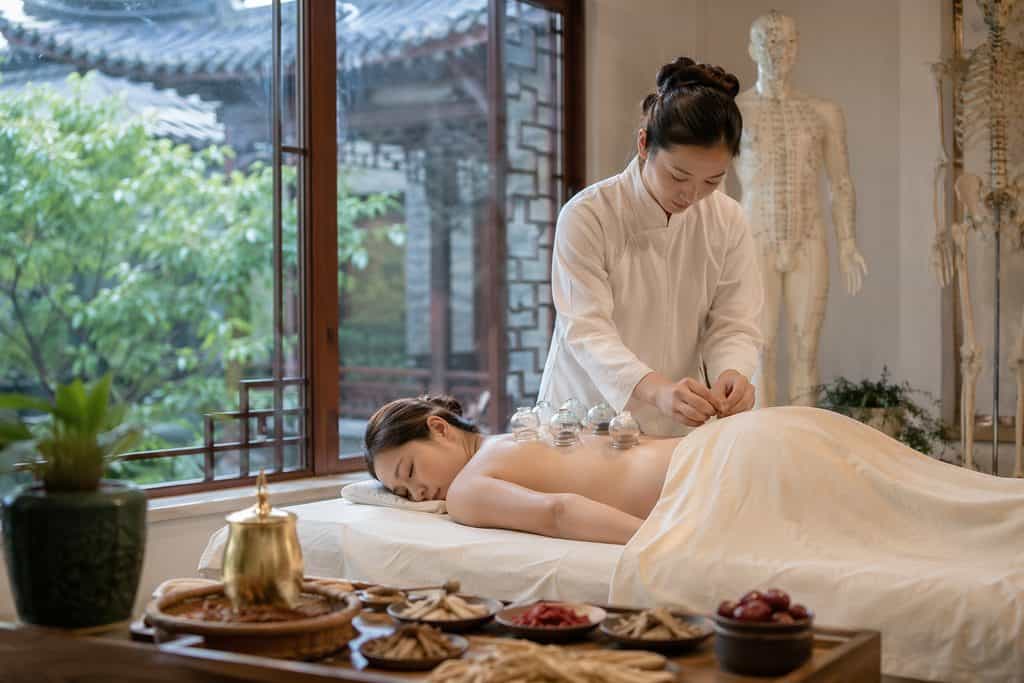
Cupping therapy packages Beijing hospitals offer are typically bundled with acupuncture, not sold as standalone spa treatments. A combined acupuncture and cupping session at a hospital like Beijing Hospital of Traditional Chinese Medicine costs $50 to $80. The cups—glass or bamboo—are applied with suction for 5 to 15 minutes. The circular marks, caused by extravasated blood, fade in 3 to 7 days. They are not bruises in the traumatic sense. They are diagnostic and therapeutic markers.
Cupping moves stagnant blood and lymph. For patients with chronic shoulder tension, fibromyalgia, or respiratory congestion, it provides relief that manual therapy alone often cannot match. The key is that it is applied by a physician who understands when to use it and when not to. Cupping over an area of acute inflammation or skin infection is contraindicated. This is clinical judgment, not a protocol anyone can follow from a YouTube video.
Why China’s TCM Hospitals Deliver Results That Fragmented Care Cannot
A senior TCM physician in a busy Shanghai hospital sees 40 to 60 patients per day. Over a 20-year career, that is over 200,000 patient encounters. Pattern recognition at that volume becomes deeply refined. The physician has seen thousands of presentations of “liver qi stagnation” or “spleen qi deficiency.” They know the subtle variations. They adjust formulas with confidence born of repetition. This is not mysticism. It is high-volume clinical experience applied to a coherent theoretical framework.
The herbs dispensed in China’s public TCM hospitals come through regulated supply chains. The Chinese Pharmacopoeia sets standards for authentication, heavy metal limits, and pesticide residues. The pharmacy is in the same building as the clinic. The physician writes the formula. The pharmacist fills it. You can watch the raw herbs being weighed. This vertical integration eliminates the quality control problems that plague international herbal imports, where independent lab testing has found that up to 30% of TCM products sold online contain undeclared ingredients or contaminants.
An acupuncture session in a US private clinic costs $75 to $150 because it carries the overhead of a small business: rent, malpractice insurance, billing staff, and a low patient volume. A TCM hospital in China operates at enormous scale with salaried physicians and publicly subsidized infrastructure. The acupuncture treatment cost China reflects this structural efficiency, not a compromise in quality. The physician treating you may be a professor at a TCM university who has published in peer-reviewed journals like Evidence-Based Complementary and Alternative Medicine. Their expertise is not discounted. The system’s overhead is.
What You Need to Know Before Going Alone
We tell every prospective patient the same thing: the medicine is excellent. The logistics are brutal. Here is what you face without a guide.
- Language Barrier in Clinical Settings: TCM terminology does not translate easily. “Damp-heat in the lower jiao” or “wind-cold invading the lung” are precise diagnostic categories. A general Mandarin interpreter will not know these terms. You need someone who speaks both clinical Mandarin and TCM theory. Otherwise, your complex symptom picture gets reduced to “stomach problems” or “back pain,” and the treatment loses specificity.
- Registration and Payment Systems: Public TCM hospitals require a hospital-issued card for all transactions. You load money onto it. You swipe it at each station: registration, consultation, acupuncture room, pharmacy. The machines have Chinese interfaces. The queues are long. A single missed step—forgetting to swipe at the pharmacy before going to the herbal dispensary—can cost you an hour of confusion. International credit cards often do not work. You need WeChat Pay or Alipay, which require a Chinese bank account to fully activate as a foreigner.
- Visa Requirements Are Specific: Medical treatment in China requires an S2 visa with a notation specifying the purpose. The hospital must provide an official invitation letter with its seal. You cannot enter on a tourist L visa and legally receive planned medical treatment. The S2 application also requires documentation of your medical condition and the treatment plan. Getting these documents from a hospital you have never visited is a circular problem that stops many patients before they start.
How We Help You Navigate This
These barriers exist for structural reasons, not because the system is hostile to foreigners. China’s public hospitals were built to serve a domestic population of 1.4 billion people. International patients are an afterthought in the standard workflow. Our role is to route you through the channels designed to accommodate foreign patients.
Before you travel, we match your condition to the right TCM department. If you have rheumatoid arthritis, we connect you with a hospital that has a dedicated rheumatology TCM ward, not a general acupuncture clinic. We coordinate the appointment and secure the invitation letter for your S2 visa. We brief you on what to expect: the pulse diagnosis, the herbal taste, the cupping marks.
During your treatment, a bilingual medical companion accompanies you to every appointment. They handle registration, payment, and pharmacy runs. More importantly, they translate your symptom updates accurately and relay the physician’s instructions clearly. You focus on the treatment. We handle the friction.
After you return home, we coordinate follow-up video consultations if your herbal formula needs adjusting. The fees for these remote consultations—typically $100 to $300—are credited in full toward any future on-the-ground coordination service within 90 days. This is a one-time credit applied to our coordination fee only, never to hospital treatment charges. It keeps the relationship open without financial penalty for continuing care remotely.
What Conditions Respond Well to a TCM Treatment Journey
Honesty matters here. TCM is not a cure-all. It has specific strengths and clear limitations. Understanding what is a TCM treatment journey like means understanding where it fits and where it does not.
Chronic pain conditions—low back pain, cervical spondylosis, fibromyalgia, osteoarthritis—are the strongest evidence base. A 2022 systematic review in JAMA Network Open analyzing over 20,000 patients found that acupuncture was associated with statistically significant pain reduction compared to sham acupuncture and usual care for chronic musculoskeletal pain, with effects persisting at 12-month follow-up.
Functional gastrointestinal disorders respond well. Irritable bowel syndrome, functional dyspepsia, and chronic constipation have TCM treatment protocols with herbal formulas that have been studied in randomized controlled trials. Stress-related conditions—insomnia, anxiety, tension headaches—are also core TCM territory. The pattern differentiation model maps well onto the complex interplay of symptoms these conditions produce.
What TCM does not do: it does not replace surgery for structural problems. It does not treat aggressive cancers as a standalone therapy. It does not manage acute infections better than antibiotics. Any physician who tells you otherwise is selling something. The responsible approach is integrative: TCM alongside conventional care, not instead of it.
Frequently Asked Questions
What is the acupuncture treatment cost China compared to the US?
In a public TCM hospital, a single acupuncture session costs $30 to $80. A full course of 10 sessions runs $300 to $800. In the United States, the same 10 sessions would cost $750 to $1,500 at community clinics and significantly more at hospital-affiliated centers. The differential reflects China’s lower labor costs and high-volume public hospital model, not a difference in practitioner training—many senior TCM physicians in China hold doctoral degrees and academic appointments.
How do I book traditional Chinese medicine treatment abroad without speaking Chinese?
You cannot effectively book it alone unless you speak medical Mandarin. The hospital websites are in Chinese. The phone operators speak Chinese. The appointment systems require a Chinese ID number or hospital card. The practical path is to work with a medical concierge service that coordinates directly with the hospital’s international department. We handle the booking, the documentation, and the on-the-ground translation. Attempting to book traditional Chinese medicine treatment abroad independently usually results in showing up at the wrong department, missing required documents, or being unable to communicate your medical history accurately.
How effective is acupuncture with cupping compared to acupuncture alone?
The combination is more effective for certain conditions, particularly chronic neck and shoulder pain, based on multiple randomized trials. A 2022 meta-analysis in BMJ Open found a clinically meaningful advantage for combined therapy. However, the benefit is condition-specific. For some internal medicine conditions treated with acupuncture—like nausea or insomnia—cupping adds little. A qualified TCM physician determines whether the combination is indicated based on your pattern diagnosis, not a generic protocol.
Can I buy cupping therapy packages Beijing hospitals offer as a one-time experience?
Hospitals do not sell “packages” in the spa sense. Cupping is prescribed as part of a treatment plan, typically bundled with acupuncture. You can request it as a standalone therapy during a consultation, and the physician will assess whether it is appropriate. Some private TCM clinics in Beijing catering to international patients offer more flexible single-session pricing, but the clinical model remains diagnosis-first. You cannot walk in and order cupping off a menu the way you might at a wellness center.
What happens if the herbal medicine does not agree with me?
Adverse reactions to Chinese herbal medicine are uncommon but real. The most frequent issue is mild digestive upset as your system adjusts to the formula. More serious reactions—liver enzyme elevations, allergic responses—are rare and typically associated with improper prescribing or contaminated products. In a Chinese TCM hospital, the physician adjusts the formula within days if you report side effects. This is the advantage of being treated in the same system where the herbs are dispensed: the feedback loop is tight. If you experience any concerning symptoms, you stop the herbs and contact the physician immediately. Do not push through. The formula is meant to be adjusted.
Your Next Step
A TCM treatment journey in China is not a mystical retreat. It is a structured, physician-led medical intervention delivered at a fraction of Western costs, backed by a hospital system that has refined these modalities over decades. The medicine is real. The barriers are logistical, not clinical. Language, payments, visas—these are solvable problems. They should not be the reason you forgo a treatment pathway that could genuinely change your relationship with a chronic condition.
If you are considering this seriously, start with a conversation. Our team provides a free consultation to assess whether your condition is a good fit for TCM treatment in China. We will tell you honestly if it is not. No pressure. No vague promises. Just a clear assessment from people who navigate this system every day.
For more medical information and treatment options in China, visit chinamedservices.com (China Medical Services).
