TCM for Foreigners in China: Clinics, Costs, and How to Book
Key Takeaways
- Traditional Chinese medicine is fully open to international visitors, and a growing number of hospitals now run dedicated international departments with English-speaking staff.
- Acupuncture, herbal consultation, and structured wellness packages can be arranged in major cities within days — not months.
- Language is the single biggest obstacle. Outside international clinics, English is rare, and appointments cannot be booked from overseas the way you would book a Western specialist.
- Treat TCM as complementary care with real limits. It is not a replacement for emergency medicine, cancer treatment, or surgery, and no honest provider will tell you otherwise.
What if the treatment you have been curious about for years is legal, regulated, and available in your city next week — but you simply do not know how to walk through the door? That is the situation many international visitors face with traditional Chinese medicine. The medicine is here. The path in is not always obvious.
If you are searching for a tcm clinic China for foreigners can actually use, the good news is that the field has changed. Twenty years ago, foreigners mostly encountered TCM through tourist-oriented shops with questionable credentials. Today, several of China’s top-ranked hospitals operate formal international departments, and a growing number of private clinics are built specifically around non-Chinese-speaking patients. The gap is no longer availability. It is information.
The Problem: Great Medicine, Walled Off by Language and Logistics
China’s public hospital system is enormous. There are more than 35,000 hospitals nationwide, and the top 5% — ranked by the Fudan University Hospital Rankings and JCI accreditation — sit in a tier of their own. The catch is that these institutions were designed for a domestic population of 1.4 billion. Their default operating language is Mandarin, and their default booking method is a same-day queue.
For a foreign visitor, that creates three specific problems.
First, most public hospital outpatient departments cannot be reserved from overseas in advance. You show up, you take a number, you wait. Second, the TCM department of a major hospital may see hundreds of patients in a morning, and the consultation itself might last eight minutes. Third — and this is the one that stops people cold — without Mandarin, you cannot describe your symptoms, understand a diagnosis, or read a herbal prescription.
The result is that many foreigners who would genuinely benefit from acupuncture or herbal therapy simply give up, or settle for a hotel spa “acupuncture” session that has nothing to do with real clinical practice.
Why China Delivers Results in Traditional Chinese Medicine
There is a reason people travel here for this rather than staying home. The depth of the field is simply different.
Clinical Volume and Institutional Depth
TCM is not a niche alternative sector in China. It is a parallel medical system with its own universities, licensing exams, and hospital wards. A licensed TCM physician in a Chinese hospital typically completes five years of undergraduate medical training plus a residency, and many hold dual credentials in both traditional and Western medicine. That is a meaningfully different training path from a weekend-certification practitioner in a Western wellness studio.
Volume matters too. Large TCM hospitals in cities like Beijing, Shanghai, and Chengdu treat tens of thousands of patients annually, which means the physicians you see have seen your condition — many times, not occasionally.
Integration With Modern Diagnostics
At the top-tier hospitals, TCM does not operate in isolation. If you arrive with a complaint that could have a serious underlying cause, you can be referred for bloodwork, imaging, or a Western-medicine consultation in the same building, often the same day. That integration is the real differentiator. You are not choosing between traditional and modern care. You are getting both, with the TCM physician aware of your lab results.
Cost Structure
An acupuncture session at a reputable Chinese hospital typically costs a fraction of what you would pay in the United States or Western Europe. The table below gives realistic ranges, but every figure varies by hospital, city, and case complexity.
| Service | Typical Range in China (USD) | Typical Range in the US (USD) |
|---|---|---|
| Acupuncture session (hospital-based) | $15 – $60 | $75 – $200 |
| Initial herbal consultation | $20 – $80 | $100 – $300 |
| Herbal prescription (2 weeks) | $30 – $120 | $60 – $250 |
| Tuina therapeutic massage (60 min) | $20 – $70 | $80 – $150 |
| Multi-day wellness package (5–7 days) | $400 – $1,500 | Rarely offered |
These are reference figures only. Final pricing depends on the hospital tier, whether you use a standard or international department, and the length of your treatment plan.
How to Find an English-Speaking TCM Doctor in Shanghai (and Elsewhere)
This is the practical question, and it deserves a practical answer. If you are specifically trying to find an English-speaking TCM doctor in Shanghai, you have three realistic routes.
Route one: the international department of a major hospital. Hospitals like Ruijin, Zhongshan, and several dedicated TCM hospitals in Shanghai maintain international clinics with English-capable staff. You pay a premium — often 1.5 to 2 times the standard consultation fee — but you get interpretation, shorter waits, and a physician accustomed to foreign patients.
Route two: private international clinics. Facilities such as United Family, Jiahui, and similar JCI-accredited providers offer English-first service, direct insurance billing in some cases, and a more Western-style appointment experience. The trade-off is cost, which runs considerably higher than public hospital TCM departments.
Route three: a coordination service. This is where a bilingual medical companion earns their fee. Someone registers you, queues on your behalf, translates the consultation in real time, and helps you fill the herbal prescription correctly. Our team at China Medical Services handles exactly this — registration, interpretation, and logistics — so the medical conversation is not lost in translation.
Is Acupuncture Safe in China for Tourists?
This is a fair question, and the honest answer is: safe when you go to a licensed clinical setting, and risky when you do not.
At hospitals and accredited clinics, acupuncture is performed with single-use sterile needles, and practitioners are state-licensed. The main risks in that setting are minor — small bruises, occasional lightheadedness, mild soreness at needle sites. Serious adverse events are rare in trained hands.
The risk profile changes entirely at tourist-oriented spas, hotel “wellness corners,” and unlicensed shops. Reused needles, untrained staff, and no clinical oversight are the real dangers. If a venue cannot show you a medical license and a sealed needle packet, walk out.
There are also people who should not receive acupuncture without medical clearance: those on blood-thinning medication, people with bleeding disorders, pregnant patients in certain trimesters, and anyone with an active infection at the intended site. Tell your practitioner about these conditions before the first needle goes in.
Practical Considerations Before You Book
Visa. If you are traveling to China specifically for medical treatment or a structured wellness program, the applicable short-stay category is the S2 visa, which covers medical treatment and private affairs and requires supporting documents from the hospital. Stays exceeding 180 days fall under S1. Accompanying family members apply under the same S2 category. Note that the M visa is for commercial and trade activities and does not apply to medical travel. Always confirm current requirements with the nearest Chinese embassy or consulate, since rules change.
Payment. Public hospitals generally require prepayment, and international insurance is typically reimbursed after the fact rather than billed directly. Some private international clinics do offer direct billing with selected insurers — ask before you book. Foreign credit cards are accepted at most international departments but not everywhere in the public system, so carry a backup payment method.
Booking reality. Remember that standard public hospital outpatient slots usually cannot be reserved from abroad. If you want a guaranteed appointment time with English support, you are effectively choosing the international department route, and you should plan around that cost.
Follow-up after you return home. Herbal formulas are usually dispensed as dried herbs or granules for a defined course — commonly two to four weeks. Ask your physician to write the formula in both Chinese and Latin botanical names, so a practitioner at home can review it if needed. Continuity of care matters more than a single dramatic session.
If you want a structured starting point, you can explore China’s dedicated TCM hospitals through our traditional Chinese medicine hospital directory, which lists institutions by city and specialty focus.
What a Realistic TCM Visit Looks Like, Day by Day
Here is how a typical short course actually unfolds, so you can plan around it.
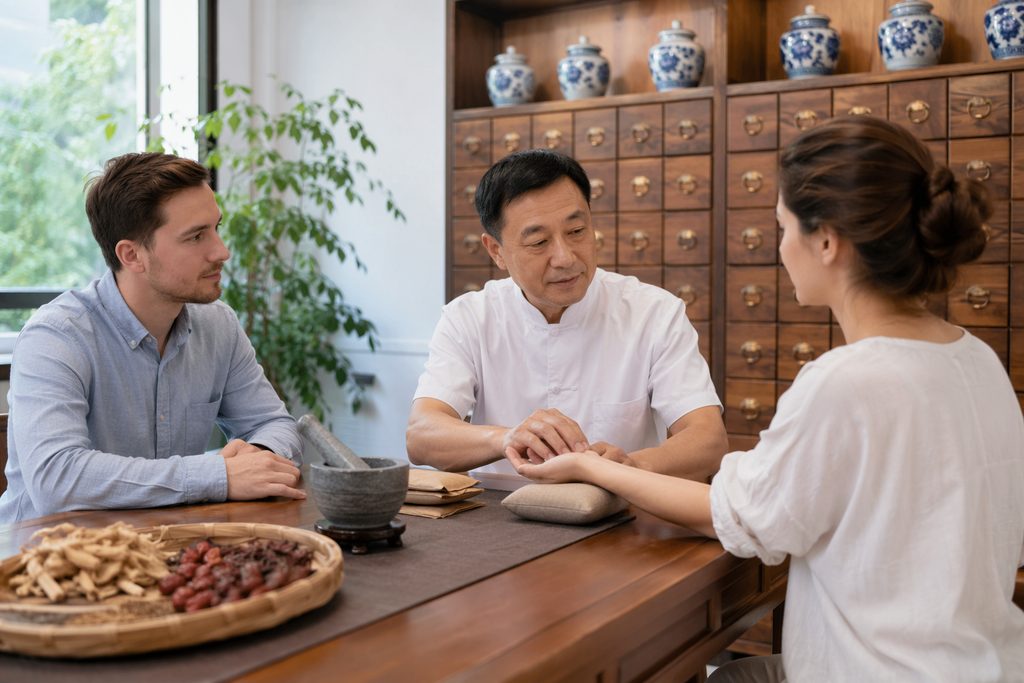
Days 1–2: Arrival and initial consultation. The physician takes a full history, checks your pulse and tongue, reviews any Western lab work you brought, and proposes a treatment plan. You receive your first acupuncture session the same day or the next.
Days 3–6: Treatment block. Acupuncture typically runs every one to two days, and your herbal formula is adjusted as your body responds. Tuina or cupping may be added depending on your condition.
Days 7–10: Review and prescription. The physician assesses progress, finalizes your herbal course to take home, and writes a summary in English for your records. For chronic conditions, a longer program of two to four weeks is common.
This timeline is illustrative, not prescriptive. Recovery and response vary by individual, and no responsible provider will promise a specific outcome on a specific date.
Frequently Asked Questions
No. You can book a consultation directly, either at a hospital’s international department or a private clinic. That said, if your symptoms could indicate a serious condition, a proper workup comes first — TCM is a complement, not a substitute for diagnosis.
At public hospital TCM departments in Beijing, expect roughly $15–$60 per acupuncture session and $20–$80 for an initial herbal consultation, with international departments charging 1.5 to 2 times those figures. Multi-week herbal courses and wellness packages push total costs higher. Every quote varies by hospital and case complexity.
Yes, but only through providers set up for international patients — private clinics and hospital international departments. Standard public hospital appointments generally require you to register in person on the day. If you want everything pre-arranged, plan for the international route and its higher price point.
Serious reactions are rare, but if you experience severe pain, numbness, dizziness, or an allergic response to herbs, stop treatment and seek medical attention immediately. Major hospitals have emergency departments on site. Keep your treatment records with you so any physician can see what you received.
Not automatically. Certain herbs interact with blood thinners, blood pressure medication, immunosuppressants, and thyroid drugs. Always disclose your full medication list to the TCM physician, and ask them to flag any known interactions before you start a formula.
Your Next Step
Traditional Chinese medicine in China is genuine, regulated, and accessible — but it rewards preparation. Know which route fits your budget, bring your records, confirm your visa category, and go in with realistic expectations about what TCM can and cannot do.
We are China Medical Services, a coordination service that connects international patients with hospitals across 37 Chinese cities. We are not a hospital and we do not provide diagnoses or treatment. What we do is handle the practical layer — hospital matching, appointment coordination, written second opinions, video consultations, and bilingual medical companions who stay with you through registration, payment, and the consultation itself.
If you would like to understand your options before committing to anything, start with a free consultation. There is no pressure and no obligation — just a clear picture of what is possible.
This article is for general information only and does not constitute medical advice. Always consult a qualified physician before starting or changing any treatment, and confirm current visa requirements with your nearest Chinese embassy or consulate.
For more medical information and treatment options in China, visit chinamedservices.com (China Medical Services).
