Hospital Deposit Accounts in China: Who Actually Holds Your Money?
Does the Deposit Account Belong to the Hospital? Understanding Prepayment in Chinese Healthcare
You’ve probably heard that paying for surgery abroad means wiring money into a black hole, hoping the hospital eventually treats you. The reality is more structured than that. When an international patient asks us does the deposit account belong to the hospital, they are really asking a deeper question: who controls my money, and what happens if treatment plans change? Chinese public hospitals operate on a prepayment system that differs fundamentally from Western post-treatment billing. The account is opened in the patient’s name, administered by the hospital, and drawn down as services are rendered. Understanding this distinction matters before you commit to treatment in China.
Our team at China Medical Services has guided patients through this exact process across 37 cities and 340+ top-ranked hospitals. The prepayment structure is standardized across public institutions, though the amounts and refund mechanics vary. Let’s break down exactly how the system works, where your money sits, and what protections exist.
Key Takeaways
- Hospital deposit accounts in China are opened under the patient’s name, not the hospital’s corporate account — funds remain legally yours until services are billed.
- Top-tier Chinese public hospitals require prepayment before admission, typically 50-100% of the estimated treatment cost, with daily itemized deductions.
- Refunds of unused balances are processed through the hospital finance department, usually within 3-7 business days of discharge.
- International patients should always request English-language daily statements and retain every deposit receipt for insurance reimbursement.
The Problem: Prepayment Confusion Creates Financial Anxiety
Medical tourism to China has grown steadily, with an estimated 500,000 international patients seeking treatment annually across major cities like Beijing, Shanghai, and Guangzhou. Many arrive with a deep-seated assumption from Western healthcare: you receive treatment first, then fight with insurance later. Chinese public hospitals invert this model. You prepay, then receive treatment, then receive a refund if costs came in under the estimate.
This inversion triggers real anxiety. A cardiac bypass at Fuwai Hospital might run $12,000-20,000 — a fraction of the $120,000+ US price tag, but still a substantial upfront sum. Patients from the US, UK, Australia, and the Gulf states frequently ask us whether that deposit is safe, who holds it, and what happens if surgery is cancelled. The fear is not irrational. Wire $15,000 to an unfamiliar institution in a country where you don’t speak the language, and you want certainty about where that money sits.
The confusion is compounded by inconsistent terminology. Some hospitals call it a “deposit account,” others a “prepayment account” or “hospitalization deposit.” All mean the same thing: a patient-named account that the hospital draws from as services accrue.
Does the Deposit Account Belong to the Hospital? The Legal Structure
Here is the direct answer. The deposit account is opened in the patient’s name using the patient’s passport or Chinese ID number. The hospital administers the account but does not own the funds. Legally, the money remains yours until the hospital bills against it for actual services rendered. Think of it like a secured escrow account managed by the hospital’s finance department.
This structure matters for three reasons. First, if treatment is cancelled before admission, the full balance is refundable. Second, if treatment costs less than estimated, the surplus is returned to you — not retained by the hospital. Third, the account cannot be seized by hospital creditors because it is not hospital property. The funds are patient assets held in trust.
How the Prepayment System Actually Works
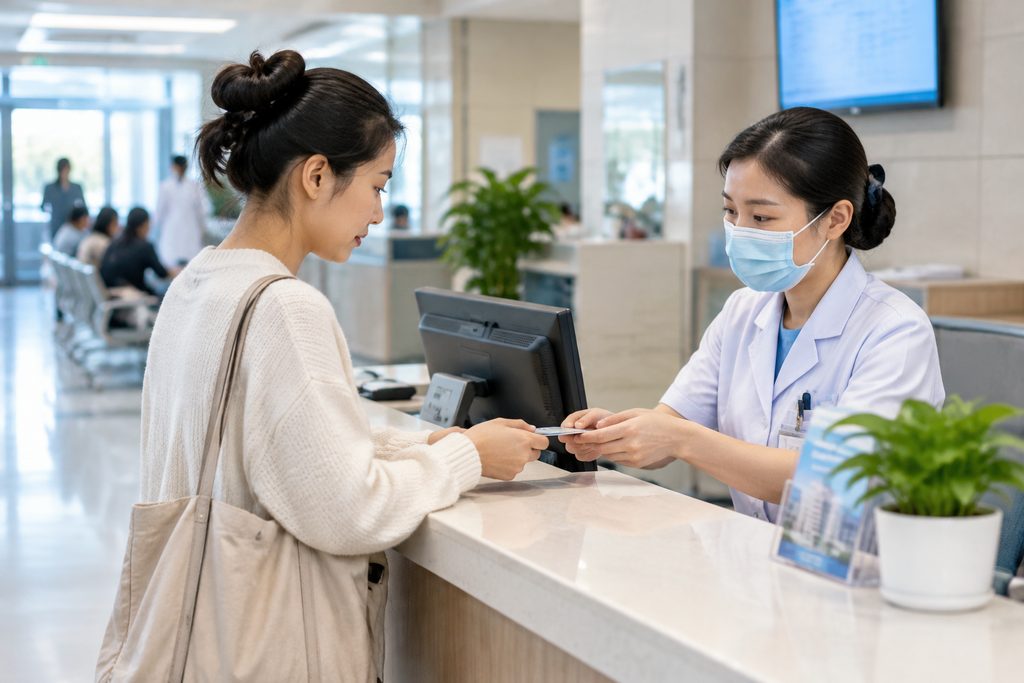
When you are admitted to a Chinese public hospital, the admissions office calculates an estimated treatment cost based on your diagnosis and planned procedure. You then deposit 50-100% of that estimate at the cashier window or via bank transfer. The hospital issues a deposit receipt with your name, patient ID, and account number. Every day, the nursing station and pharmacy post charges to your account: bed fees, medication, lab tests, imaging, surgical supplies. You can request a daily itemized statement at any time.
When the balance drops below a threshold — typically 20-30% of the initial deposit — the hospital asks you to top up. If you refuse or cannot pay, non-emergency services pause until the balance is restored. This is the hard truth of the prepayment model. It protects the hospital from unpaid bills but shifts cash-flow pressure onto the patient.
Who Controls the Account Day to Day
The hospital’s finance department controls the ledger. The patient controls the balance. You cannot withdraw funds while admitted without a discharge order, but you can see exactly what has been charged. The account is not accessible to individual doctors or nurses — only the finance office can post charges or process refunds. This separation of duties is standard across top-tier institutions like Peking Union Medical College Hospital and West China Hospital.
For international patients, we recommend requesting a bilingual statement every 48 hours. Most major hospitals in Beijing and Shanghai can provide English-language billing summaries. If yours cannot, a bilingual medical companion can translate the daily charges for you.
Why China’s Prepayment Model Delivers Cost Transparency
The prepayment system, for all its upfront friction, creates a level of cost transparency that surprises many Western patients. You know the estimate before admission. You see charges accrue daily. You receive a final itemized bill at discharge. There is no surprise billing six weeks later, no out-of-network anesthesiologist bill, no facility fee appearing from nowhere.
Volume-Driven Pricing Keeps Estimates Accurate
Chinese top-tier hospitals operate at extraordinary scale. Fuwai Hospital alone performs over 14,000 cardiac surgeries annually — the highest volume of any heart center globally. That volume means the hospital knows precisely what a given procedure costs. Estimates are built from thousands of prior cases, not guesswork. When Zhongshan Hospital quotes you $18,000 for a valve replacement, that number reflects real historical data, not a negotiating position.
Structural Cost Advantages Without Quality Compromise
Labor costs in Chinese healthcare are dramatically lower than in the US or Europe. A senior cardiac surgeon’s annual salary in China might be $80,000-120,000, compared to $400,000-600,000 in the US. Hospital construction costs, pharmaceutical pricing, and device costs are also lower. These structural factors explain why the same procedure costs one-fifth to one-tenth the Western price without any sacrifice in clinical outcomes. The Fudan-ranked top 100 hospitals represent the top 5% of China’s 35,000+ hospitals, with outcomes published in peer-reviewed international journals.
What Happens to Your Deposit If Treatment Changes Course
Treatment plans change. A biopsy reveals a different pathology. A pre-surgical scan shows the tumor is smaller than expected. A patient decides to pursue a less invasive option after consulting with the surgical team. The deposit account structure handles these pivots more gracefully than most patients expect.
If your treatment plan changes before admission, the hospital recalculates the estimate. You may need to top up or may receive an immediate partial refund. If the change happens mid-admission — say, a planned open surgery converts to a laparoscopic procedure — the daily charges simply reflect the new reality. The final bill is what it is, and the surplus comes back to you.
Refund Mechanics and Timeline
At discharge, the hospital finance office reconciles your account. Any remaining balance is refunded. For Chinese citizens, refunds are often instant via the original payment method. For international patients, refunds typically process via bank transfer within 3-7 business days. Some hospitals issue refunds in cash if the balance is under a certain threshold, though this varies by institution. You will need to present your passport and the original deposit receipts.
Keep every deposit receipt. If you lose the original receipt, the refund process becomes significantly more complicated. Some hospitals require a notarized statement and police report for lost receipts. Store them with your passport.
Comparing Deposit Requirements Across Hospital Types
Not all Chinese hospitals handle deposits the same way. The distinction matters for your cash-flow planning.
| Hospital Type | Typical Deposit Requirement | Refund Timeline | Insurance Direct Billing |
|---|---|---|---|
| Public Top-Tier (Fudan Ranked) | 50-100% of estimated cost | 3-7 business days | No — patient pays, then claims reimbursement |
| Public Hospital International Department | 100% of estimated cost | 3-5 business days | Sometimes — select international insurers |
| Private International Hospital (JCI) | Deposit or credit card hold | 1-3 business days | Yes — direct billing common |
| TCM Hospital | Lower — often per-treatment | Same day to 3 days | Rarely |
Private international hospitals like United Family and Jiahui operate closer to Western norms. They accept credit cards, often bill insurers directly, and require smaller deposits relative to the total cost. The trade-off is price: private international care costs 2-3 times more than public top-tier care, though still below US prices. For patients with comprehensive international insurance, private international hospitals offer the smoothest financial experience.
Practical Considerations: Deposit Accounts and Your Financial Safety
You can navigate the deposit system independently. Many patients do. But the process requires attention to detail that is harder to maintain when you are also managing a serious medical condition in an unfamiliar country.
Documentation You Must Bring
Your passport is non-negotiable — it is the basis for your patient ID and deposit account. Bring multiple photocopies. If a family member will manage payments on your behalf, they need their own passport and a signed authorization letter. Some hospitals require a notarized power of attorney for financial management by a third party. Check with the hospital’s international office before you travel.
Payment Methods and Limits
Chinese public hospitals accept UnionPay cards, Chinese bank transfers, and cash in RMB. International credit cards are increasingly accepted at major hospitals in Beijing, Shanghai, and Guangzhou, but do not count on it. Wire transfers from overseas banks are possible but slow — allow 5-10 business days for clearance. There is no legal limit on deposit amounts for medical treatment, but your home country may have reporting requirements for large international transfers. US citizens, for example, must report foreign wire transfers exceeding $10,000 via FinCEN Form 114.
Visa and Stay Duration
Medical treatment in China requires an S2 visa, annotated for medical purposes. Family members accompanying you also apply for S2 visas. The S2 visa typically allows stays of up to 180 days, which covers most treatment and recovery timelines. For longer stays, an S1 visa applies. Your hospital’s international office can provide the invitation letter required for the visa application. Do not apply for an M visa — that category is for commercial and trade activities and will not be accepted for medical travel.
Insurance Reimbursement After the Fact
Most international insurers reimburse Chinese hospital expenses after treatment. You pay the deposit upfront, receive itemized receipts, and submit claims upon return home. Some insurers have direct billing arrangements with Chinese private international hospitals, but public hospitals almost universally require patient payment first. Request English-language invoices at discharge — most top-tier hospitals can provide them, but you must ask. The deposit receipt, daily statements, and final discharge invoice together form your reimbursement package.
Frequently Asked Questions
No. The deposit is your money held in trust. If you decline treatment before or during admission, the hospital must refund the unused balance. The refund process takes 3-7 business days after discharge or cancellation. Disagreements about individual charges can be escalated to the hospital’s medical affairs office, but the core refund right is not in dispute.
You request a discharge from the first hospital, which triggers account reconciliation. The unused balance is refunded to you, and you bring those funds to the second hospital to open a new deposit account. The process is bureaucratic but straightforward. Allow one full day for the discharge and refund process before traveling to the second hospital.
Effectively no. Chinese public hospitals are state-owned institutions. They cannot declare bankruptcy in the Western sense. Your deposit is held as patient funds, legally distinct from hospital operating capital. Even in the unlikely event of institutional restructuring, patient deposits are protected by the same regulatory framework that governs all public hospital finances.
Your Next Step
The deposit account question reflects a broader concern: can I trust this system with my health and my money? The answer is yes, but trust is built on understanding. The prepayment model is transparent, the funds remain legally yours, and the refund mechanics are well-established. What international patients most need is not a different financial system but a guide who knows how to navigate the one that exists. That is what we do at China Medical Services — we coordinate hospital selection, appointment scheduling, visa documentation, and bilingual accompaniment across China’s top-tier medical institutions. We are not a hospital and do not provide medical advice. But we can help you understand the deposit process, prepare your documentation, and ensure you are never alone at the cashier window. If you are considering treatment in China, start with a free consultation to discuss your specific case and get a realistic picture of costs, timelines, and the deposit requirements at the hospitals that match your needs.
For more medical information and treatment options in China, visit chinamedservices.com (China Medical Services).
