Paying a Personal Account in China: A Major Red Flag for Medical Fees
Paying a Personal Account: A Major Red Flag — The Short Answer
Have you ever been asked to wire money to an individual’s bank account to secure a hospital bed or a surgeon’s time in China? If the answer is yes, stop. Paying a personal account for medical treatment coordination is a major red flag. Legitimate Chinese hospitals bill through institutional accounts, not private ones. Anyone demanding payment to a personal WeChat, Alipay, or a named individual’s bank card is operating outside the formal healthcare system. You are likely dealing with a broker, a fixer, or an outright scam.
The caveat is nuance. Some private international clinics and small TCM practices may use a director’s account for convenience. But for any top-tier public hospital — the kind you find on the Fudan ranking — the payment path is institutional. Always.
Who This Is Right For — and Who It Isn’t
Understanding proper payment channels matters most for patients who need complex, scheduled care. That includes cardiac surgery, oncology treatment, orthopedic procedures, and fertility services. If you are planning any of these in China, you need to know how money moves.
Who should be extra vigilant:
- Patients coordinating surgery from abroad before arriving in China
- Families seeking expedited access to a named specialist
- Anyone using an intermediary who promises admission dates
- Patients unfamiliar with Chinese hospital registration systems
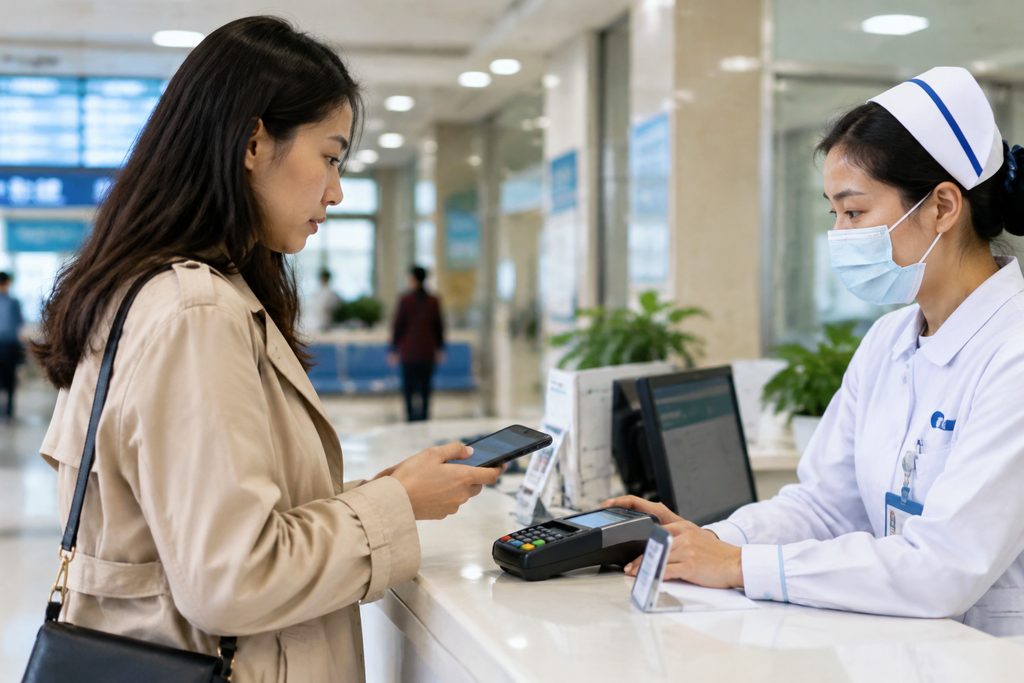
Who can relax a bit? If you are walking into a public hospital’s international department in person, paying at the cashier window with a card, and receiving an official invoice (发票, fapiao), the path is standard. The risk concentrates in remote arrangements.
The Options, Compared
How does legitimate payment actually work? Here is the landscape.
| Payment Channel | Where It Applies | What You Receive | Risk Level |
|---|---|---|---|
| Hospital cashier (in person) | Public hospital international department, private international hospital | Official hospital invoice (fapiao), itemized receipt | Low |
| Hospital bank transfer (institutional account) | Pre-admission deposit for scheduled surgery, VIP international department | Hospital-stamped confirmation, official invoice after payment clears | Low |
| Third-party medical coordination service (institutional account) | Proxy consultation, appointment coordination, bilingual companion services | Service contract, invoice from the coordination company | Moderate — verify the company’s registration |
| Personal account (individual’s name) | Claimed by brokers, fixers, unregistered agents | Usually nothing official | High — major red flag |
If you are working with a coordination service, the invoice should come from a registered company. If the person on WhatsApp asks you to send money to their cousin’s bank card, walk away.
Why Legitimate Chinese Hospitals Never Ask for Personal Payments
China’s top-tier public hospitals operate under strict financial supervision. Fuwai Hospital, Peking Union Medical College Hospital, and Zhongshan Hospital are all public institutions. Their accounts are audited. Every yuan that enters must be traceable to a patient file and a service rendered.
That means a surgeon at a public hospital cannot legally accept direct payment for a bed, a surgery slot, or a consultation. Doing so would violate hospital policy and Chinese anti-corruption law. So when a broker tells you the money goes to “the doctor’s assistant” or “the department head’s account,” that story collapses under scrutiny. The doctor would be risking their license.
Private international hospitals like United Family or Jiahui are different. They are businesses. They invoice through corporate accounts. You pay the hospital, not an individual. Even there, a personal account request is abnormal.
What a Personal Account Request Actually Signals
So what is really happening when someone asks you to pay a personal account? A few possibilities, none good.
The person may be a pure scammer with no hospital connection at all. They collect deposits from multiple overseas patients and disappear. Or they may be a real broker who has some relationship with a hospital, but they are charging you an inflated “access fee” that the hospital never sees. You are paying for a queue jump that may not exist.
And here is the uncomfortable part: even if the broker does deliver an appointment, you have no receipt from the hospital for that payment. If the surgery is cancelled, if the doctor changes, if you need a refund — you have no standing. The hospital has no record of your money. The broker may refund you, or may not.
What It Costs — and What You Should Actually Pay
Let’s talk numbers. A bilingual medical companion for a day at a Chinese hospital runs from $300. A written second opinion from a top specialist costs $300–500. Hospital appointment coordination starts from $300. These are service fees paid to a coordination company — and they should always go to a corporate account.
The hospital’s own charges are separate. A cardiac bypass at a top Chinese public hospital ranges from $12,000 to $20,000. That money goes directly to the hospital cashier or the hospital’s bank account. Never to an individual.
If a broker quotes you a “package” of $30,000 for surgery and asks for a $5,000 deposit to a personal account to “lock the date,” the deposit is the red flag. The surgery fee may be real. The deposit channel is not.
Practical Considerations: Verifying Payment Legitimacy in China
Before you wire a single dollar, do three things.
First, ask for the receiving entity’s business license (营业执照). A legitimate coordination company will provide it. Check the name matches the account holder. If the account name is a person’s name while the license is a company, that is a mismatch.
Second, ask which hospital and department the service connects to. Then verify independently. The hospital’s international department has a phone number and an email. Contact them. Ask if they work with that coordination company. Many do not.
Third, request a formal invoice after payment. In China, a fapiao is a legal tax document. A company that cannot issue one is not a company you want to pay.
Warning: Never pay for surgery or hospital admission to a personal account. Hospital admission deposits go to the hospital. Service coordination fees go to a registered company. There is no legitimate third path.
How We Handle Payments at China Medical Services
Our billing is boring on purpose. Every invoice comes from our registered company. Every payment goes to our corporate account. We do not accept payment to personal accounts, and we never ask patients to pay a doctor or a hospital staff member directly.
When you use our coordination services — whether for a bilingual medical companion, a written second opinion, or hospital appointment coordination — the fee is transparent. It covers case management: translating your records, communicating with the hospital’s official international department, arranging logistics. It does not buy access. It buys competent navigation.
And here is a policy we are proud of: any consultation fee you pay is credited in full toward on-the-ground coordination if you proceed within 90 days. That credit applies to the coordination fee only. It never touches hospital treatment charges. Those go to the hospital, always.
Frequently Asked Questions
No. In public hospitals, direct payment to a doctor for clinical services is prohibited. In private hospitals, payment goes through the hospital billing system. If a doctor or someone claiming to represent a doctor asks for direct payment, treat it as a serious warning sign.
Contact your bank immediately and request a recall or fraud investigation. Report the incident to the hospital’s international department, if a hospital was named. Document everything — messages, transfer receipts, names. If the amount is significant, consider reporting to local police in China through the hospital’s legal affairs office or a lawyer. Recovery is difficult but not always impossible.
Request their business license, check the company name against the account holder, ask for references from past patients, and independently contact the hospital they claim to work with. A legitimate company will not hesitate on any of these. A broker will deflect, delay, or get angry.
Your Next Step
The rule is simple: hospital money goes to hospitals. Service money goes to registered companies. Personal accounts are for friends and family, not medical fees. If you are planning treatment in China and want to avoid the minefield of brokers and fixers, our team at China Medical Services can help you navigate the legitimate path. We are not a hospital, and we do not diagnose or treat. We are the coordination layer that connects you with the right institution, the right department, and the right paperwork. Request a free consultation and tell us what you need. We will tell you honestly what is possible, what it costs, and who you will be paying.
Stay safe. Verify every account. And never pay a personal account for medical care in China.
For more medical information and treatment options in China, visit chinamedservices.com (China Medical Services).
