Stroke Emergency Service for Foreigners in China: Rapid Response and Treatment Coordination
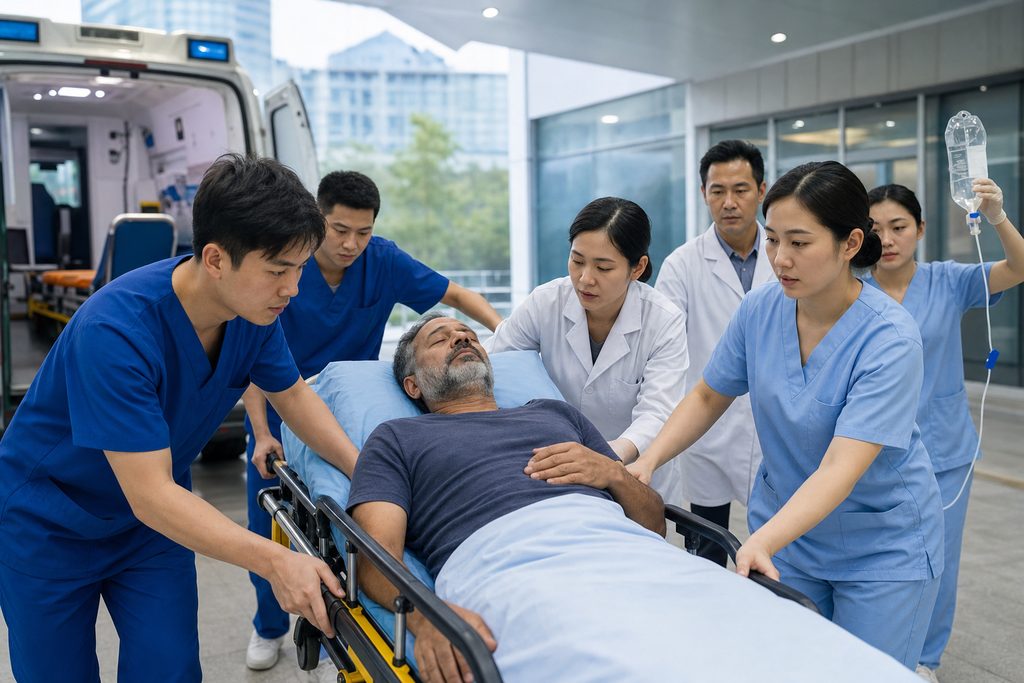
Every minute a stroke goes untreated, approximately 1.9 million neurons die. The clock starts the moment symptoms appear. For a foreigner in China — whether an expat living in Beijing or a traveler in Shanghai — that clock ticks louder. You are in an unfamiliar medical system. You may not speak the language. You do not know which hospital door to enter. The search for stroke emergency treatment for foreigners in China is not a theoretical exercise. It is a race against brain damage, paralysis, or death.
China’s top-tier hospitals now rival the best stroke centers in the United States and Europe in speed and technology. Door-to-needle times under 60 minutes. Thrombectomy capabilities available 24/7. Neurosurgeons who perform hundreds of endovascular procedures every year. But access does not happen by accident. It requires knowing where to go, what to say, and how to move through a system designed for Chinese-speaking citizens — not international patients.
Our team has coordinated stroke emergencies for foreign patients across Beijing, Shanghai, Guangzhou, and other major Chinese cities. We have seen what works. We have also seen what fails. This article explains exactly how rapid stroke care operates in China for foreign patients, which hospitals lead in acute stroke intervention, what it costs, and how a coordinated response can cut hours off the critical treatment window.
Key Takeaways
- China’s top stroke centers achieve door-to-needle times comparable to the best US hospitals — often under 45 minutes — when patients arrive through the right channel.
- Foreign patients face three immediate barriers: language, hospital navigation, and payment — all of which can delay thrombolysis beyond the 4.5-hour window.
- Emergency stroke intervention in China costs a fraction of US prices: thrombectomy typically ranges from $8,000 to $15,000 versus $40,000+ in America.
- Private international hospitals like United Family provide English-speaking emergency rooms but may lack the high-volume thrombectomy teams found in major public hospitals.
- Coordination — not just hospital choice — is the determining factor in whether a foreign patient receives timely, appropriate stroke care.
The Problem: A Stroke Happens. Now What?
Stroke is the second leading cause of death worldwide and a leading cause of long-term disability. In China, stroke has surpassed heart disease as the number one cause of mortality, with an estimated 2.4 million new cases each year. For a foreigner in China, the statistics are not the scary part. The scary part is the moment you or someone next to you slurs their speech, loses strength on one side, or suddenly cannot understand words.
You call an ambulance. In China, the emergency number is 120. The dispatcher likely speaks Mandarin only. You try to explain the symptoms. You try to give an address. Precious minutes bleed away. The ambulance arrives. The crew may not know which hospital has a stroke unit, which emergency department has a neurologist on call, or which facility can perform a mechanical thrombectomy at 2 a.m. They take you to the nearest hospital. That hospital may not be the right one.
This is not a hypothetical. We have seen foreign patients arrive at community hospitals that lack CT perfusion imaging. We have seen them wait in general emergency queues while ischemic damage spreads. A 2023 analysis published in The Lancet Regional Health – Western Pacific found that while China’s top 100 hospitals have dramatically improved acute stroke care, significant disparities remain between tertiary centers and lower-level facilities. For a foreign patient, the gap between arriving at the wrong hospital and the right one can mean the difference between walking out and never walking again.
The question is not whether China can treat stroke at a world-class level. It can. The question is whether you can access that level of care when every second counts.
Who We Are
We are not a hospital. We do not employ doctors, we do not provide medical treatment, and we do not make clinical decisions. We are China Medical Services — a team that has spent years building relationships with the international departments of China’s leading hospitals. We know which emergency rooms have 24/7 stroke teams. We know how to get a foreign patient registered, triaged, and imaged without language delays. We are the bridge between you and the right care, at the right time. Our role is logistical. It is also, in a stroke emergency, potentially life-saving.
How Fast Is Stroke Care in China for Foreign Patients?
Speed is the only metric that matters in acute stroke treatment. For ischemic stroke — which accounts for approximately 87% of all strokes — intravenous thrombolysis with tPA must be administered within 4.5 hours of symptom onset. Mechanical thrombectomy, where a catheter physically removes the clot, has a window of up to 24 hours in select patients with salvageable brain tissue. But every study confirms the same truth: faster treatment means better outcomes.
China’s top stroke centers now report door-to-needle times that meet or exceed international benchmarks. At Beijing Tiantan Hospital, one of the world’s highest-volume stroke centers, the median door-to-needle time for thrombolysis dropped below 40 minutes — faster than the 60-minute target set by the American Heart Association. Shanghai’s Huashan Hospital and Guangzhou’s First Affiliated Hospital of Sun Yat-sen University report similar metrics. These are not outliers. They represent what is possible when a patient enters the right facility through the right channel.
But that is the key phrase: through the right channel. A foreign patient who walks into a general emergency department unannounced may wait hours for a neurology consult. The same patient, pre-registered through a hospital’s international medical center and met by a bilingual coordinator, can go from door to CT scan in under 25 minutes. The medical capability is identical. The access pathway is entirely different.
24/7 Stroke Emergency Service for Expats in Beijing
Beijing operates the densest concentration of top-tier stroke centers in China. The city’s 21 hospitals on the Fudan ranking include several with dedicated stroke units and endovascular teams available around the clock. For expats in Beijing, the emergency landscape splits into two paths.
The public hospital path leads to institutions like Beijing Tiantan Hospital and Xuanwu Hospital — both internationally recognized for neurology and neurosurgery. Tiantan alone treats over 20,000 stroke inpatients annually and performs thousands of thrombectomies. Their emergency stroke protocol activates a multidisciplinary team the moment a suspected stroke patient arrives. But the default language is Mandarin. Registration forms, consent documents, and discharge instructions are in Chinese. A foreign patient navigating this alone will lose time — and time is brain.
The private hospital path leads to facilities like Beijing United Family Hospital, which offers English-speaking emergency physicians, Western-style patient communication, and direct insurance billing. United Family can administer thrombolysis and stabilize a stroke patient. For complex endovascular procedures, however, they may transfer patients to a partner public hospital with a higher-volume neurointerventional team. This hybrid model — private hospital triage followed by public hospital intervention — is a practical reality that many expats do not discover until they are in the middle of an emergency.
Our team maintains direct contact with the international departments at all major Beijing stroke centers. When a call comes in — a 62-year-old Australian expat with sudden-onset aphasia and right-sided weakness — we know which hospital has an available thrombectomy suite and a neurointerventionalist on call. We activate the response before the patient arrives. That is the difference between searching for 24/7 stroke emergency service for expats Beijing in a panic and having a plan already in motion.
Best Hospital for Foreigner Stroke Emergency in Shanghai
Shanghai’s stroke care infrastructure rivals Beijing’s in quality and exceeds it in certain subspecialties. The city’s 18 Fudan-ranked hospitals include multiple centers with dedicated stroke pathways. For foreign patients, three institutions stand out — each with distinct strengths and considerations.
Huashan Hospital, affiliated with Fudan University, runs one of China’s most advanced neurology departments. Its stroke center operates a “green channel” — a fast-track pathway that bypasses standard emergency triage for suspected stroke patients. The goal: CT imaging within 25 minutes of arrival, thrombolysis within 45 minutes. Huashan’s neurointerventional team performs over 1,000 endovascular procedures annually. The international medical center provides English-language coordination, though availability at 3 a.m. depends on pre-arranged contact.
Zhongshan Hospital, also Fudan-affiliated, excels in cardiovascular and cerebrovascular care. Its hybrid operating suites allow simultaneous imaging and intervention — a critical advantage when every minute counts. The hospital’s international department has experience with foreign patients but operates primarily during business hours. After-hours emergencies require navigation of the standard emergency system.
Renji Hospital, affiliated with Shanghai Jiao Tong University, has invested heavily in its stroke center over the past five years. It now performs among the top tier nationally in door-to-reperfusion times. Renji’s location in Pudong makes it geographically convenient for many expats living in Shanghai’s eastern districts. The hospital has English-speaking staff in its international wing, though coverage varies by shift.
What makes one of these the best hospital for foreigner stroke emergency Shanghai depends on the specific situation. An ischemic stroke requiring thrombectomy at midnight points toward Huashan or Zhongshan. A transient ischemic attack during business hours might be well-served at Renji. The hospital’s technical capability is only half the equation. The other half is whether a bilingual coordinator can meet the patient at the emergency entrance, handle registration, translate the NIH Stroke Scale assessment, and ensure the consent process moves without delay.
Cost of Emergency Stroke Intervention in China
The financial dimension of stroke care matters. Even in an emergency, foreign patients — particularly those without Chinese health insurance — face out-of-pocket costs that vary dramatically by hospital type and treatment complexity. The cost of emergency stroke intervention China is, by any honest comparison, substantially lower than equivalent care in the United States or Europe. But “lower” does not mean “cheap,” and understanding the numbers before an emergency eliminates one source of stress during an already terrifying moment.
| Procedure | China (Public Hospital, International Dept) | China (Private International Hospital) | United States (Average) |
|---|---|---|---|
| Emergency CT + CT Angiography | $300 – $600 | $800 – $1,500 | $3,000 – $5,000 |
| IV Thrombolysis (tPA) | $1,500 – $3,000 | $3,000 – $5,000 | $15,000 – $25,000 |
| Mechanical Thrombectomy | $8,000 – $15,000 | $20,000 – $35,000 | $40,000 – $80,000 |
| ICU Stay (per day) | $500 – $1,200 | $1,500 – $2,500 | $5,000 – $10,000 |
| Inpatient Rehabilitation (per week) | $800 – $2,000 | $2,000 – $4,000 | $8,000 – $15,000 |
These figures represent ranges based on actual cases we have coordinated. They vary by hospital, city, and case complexity. A straightforward thrombectomy with a short ICU stay at a public hospital’s international department in Guangzhou might total $12,000. The same procedure at a private hospital in Shanghai could reach $40,000. Both numbers are well below the $100,000+ that the same care often costs in the United States.
Payment works differently than many Western patients expect. Public hospitals — even their international departments — typically require a deposit before admission. The deposit for stroke care often ranges from $5,000 to $15,000, depending on anticipated procedures. Private international hospitals may bill insurance directly if they have an agreement with your insurer. We help patients understand these requirements before arrival so that financial discussions do not delay treatment.
One structural reason costs stay lower: Chinese public hospitals operate on high volume and streamlined workflows. A neurointerventionalist at Tiantan may perform five or more thrombectomies in a single shift. The fixed costs of the angiography suite, the nursing staff, and the imaging equipment spread across far more procedures than a typical US center. The quality of the equipment — Siemens or Philips angiography systems, identical to those in top Western hospitals — does not differ. The economics do.
What You Need to Know Before Going Alone
Honesty matters more than reassurance. A foreign patient attempting to navigate a Chinese stroke emergency without coordination faces real obstacles. These are not theoretical. They are the specific barriers we have watched delay care for patients who tried to go it alone.
- Language in the Emergency Room: Even in Beijing and Shanghai, the front-line emergency staff — triage nurses, registration clerks, CT technologists — rarely speak functional medical English. Describing symptom onset time, medical history, and current medications requires Mandarin or a translator. Stroke assessment scales like the NIHSS depend on precise language. A misinterpreted word can change a treatment decision.
- Hospital Selection Under Pressure: Ambulance crews in China generally transport patients to the nearest hospital, not the best hospital for the condition. Refusing transport or redirecting to a specific facility requires assertive communication in Chinese and knowledge of which hospitals have stroke capabilities. Most foreign patients lack both.
- Payment and Registration Systems: Public hospitals require a Chinese ID or passport for registration. The registration process — even in an emergency — involves queuing, depositing funds onto a hospital card, and presenting that card at each step. A foreign credit card may not work. Alipay or WeChat Pay may be required. These friction points consume minutes that a stroke patient does not have.
- Informed Consent for Procedures: Thrombolysis and thrombectomy require informed consent. The consent forms are in Chinese. The doctor explaining risks and benefits speaks Chinese. A foreign patient or family member must understand what they are signing — including the 6% risk of symptomatic intracranial hemorrhage with tPA — without the luxury of time. Rushed consent under a language barrier is a recipe for confusion and regret.
How We Help You Navigate This
These barriers exist for structural reasons, not because anyone intends to obstruct care. China’s hospital system was built to serve a population of 1.4 billion Chinese citizens. The international departments at major hospitals are add-ons, not the default. They work well when activated properly. They do not activate themselves.
Our coordination begins before an emergency. For expats and frequent travelers, we establish a baseline: your medical history translated into Chinese, your insurance information verified, your preferred hospitals identified, and our emergency contact number saved in your phone. This preparation costs nothing and takes less than an hour. It means that when a call comes — “My husband can’t move his left arm, his speech is slurred, we are in our apartment in Jing’an” — we do not start from zero.
During the emergency, we direct you to the appropriate hospital based on your location, symptoms, and the specific capabilities available at that moment. We call the international department. We alert the stroke team. A bilingual coordinator meets you at the emergency entrance. While the medical team assesses and images, our coordinator handles registration, deposit payment, and communication with your family. You focus on the patient. We handle everything else.
After the acute phase, we coordinate the transition to inpatient care, rehabilitation, and — if needed — medical evacuation or repatriation. Stroke recovery is measured in months and years. The first hours determine survival. The weeks that follow determine quality of life. We stay involved through both phases.
Can You Book Urgent Stroke Treatment Abroad in China?
A question we hear often: “I am not in China yet, but I need stroke treatment soon. Can I book urgent stroke treatment abroad China in advance?” The answer requires a distinction between emergency and urgent care.
You cannot book emergency stroke treatment. No hospital in the world accepts reservations for a thrombectomy
Frequently Asked Questions
Yes. We work with JCI-accredited and major Grade 3A tertiary hospitals that follow international safety standards comparable to top hospitals in the US and Europe. Surgical teams perform high volumes of procedures — often more than their Western counterparts — which studies show leads to better outcomes.
Costs vary by procedure and hospital, but international patients typically save 40-80% compared to US prices — even when factoring in travel and accommodation. A consultation with our team will give you an exact, all-inclusive quote with no hidden fees.
Send us your existing medical reports. The relevant specialty reviews them and gives you a written opinion, including treatment direction and options, before you commit to any travel. From there you can add a video consultation with the doctor, or have us attend an appointment on your behalf.
For more medical information and treatment options in China, visit chinamedservices.com (China Medical Services).
