Online Medical Record Access Service China: View Lab Results and Images from Anywhere
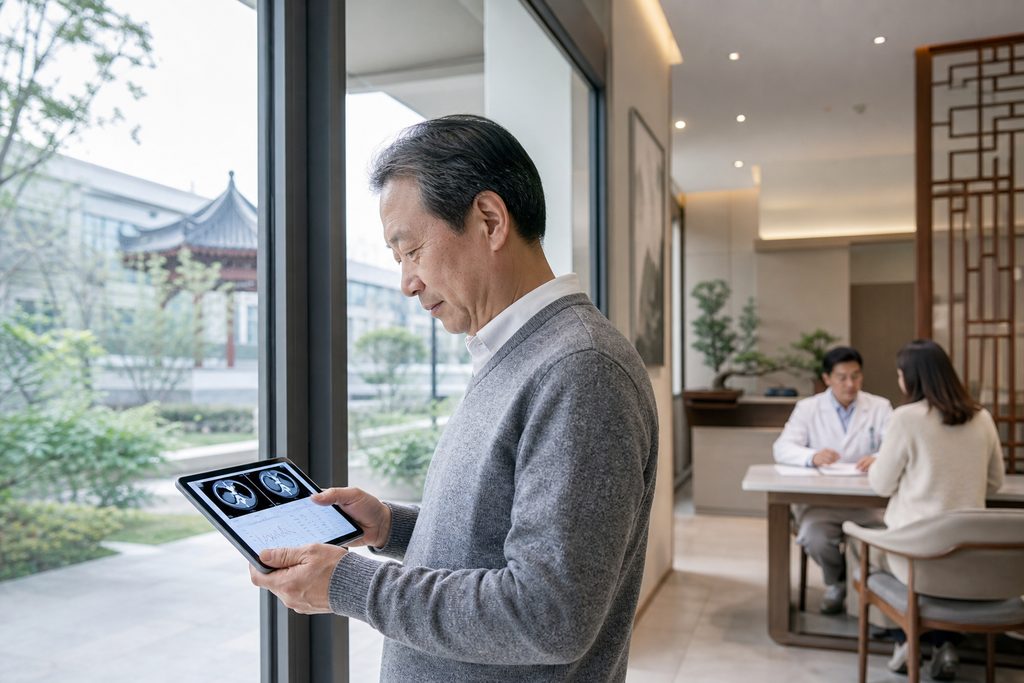
You have probably heard that getting medical treatment in China means leaving your data behind. The scans, the blood work, the surgical notes. Gone. Locked in a system that does not talk to your doctor back home.
That is not exactly true.
The reality is more nuanced. China’s top-tier hospitals have invested heavily in digital infrastructure. Patient portals exist. Radiology images are stored in standard DICOM formats. Lab results sit in structured databases. The problem is not that the data is inaccessible. The problem is that accessing it from outside China requires navigating a system designed for domestic patients with local phone numbers and Chinese ID cards.
We see this every week. A patient returns to London or Dubai after a successful procedure at a Shanghai hospital. Their follow-up appointment is in three days. Their local oncologist needs the pre-operative CT scans and pathology slides. The patient logs into the hospital’s mini-program. It asks for a SMS verification code sent to a Chinese phone number they no longer have.
That is where a structured approach to medical record retrieval makes the difference between a smooth continuity of care and a stressful scramble.
Key Takeaways
- Most Chinese public hospitals do generate digital records — but their patient portals are built for domestic users with local credentials, creating a real barrier for international patients after they leave the country.
- Radiology images are typically stored in standard DICOM format and can be exported, but the process requires in-person authorization or a legally designated representative at the hospital’s medical records department.
- Lab results and discharge summaries are usually available as PDF exports — but expect them in Chinese, requiring certified translation for use by physicians in your home country.
- You should plan your record retrieval strategy before leaving China. Retroactive requests from abroad are significantly harder and slower to fulfill.
The Problem: Your Data Exists, But You Cannot Reach It
Approximately 80% of China’s Grade A tertiary hospitals have implemented some form of electronic medical record system. That figure comes from the China Hospital Information Management Association’s 2023 survey. The systems are functional. They store laboratory results, radiology reports, operative notes, and discharge summaries. But they were designed with a single use case in mind: a Chinese citizen with a national ID number and a mainland phone number accessing their records while physically present in China.
For international patients, this creates a structural mismatch. You received world-class care. The surgical team at Fuwai Hospital performed a complex cardiac procedure with outcomes that rival any center globally. Your post-operative CT scans are sitting on a server in Beijing. And you cannot download them from your apartment in Toronto because the system’s two-factor authentication requires a China Mobile number that expired when you left.
This is not negligence. It is a design assumption. The hospital’s IT infrastructure was never architected for cross-border patient mobility. Fixing that requires understanding how Chinese hospitals actually manage medical records — and what levers exist to retrieve them.
Who We Are
We are not a hospital. We do not provide medical treatment, interpret lab results, or offer clinical diagnoses. Our team functions as a logistical bridge between international patients and China’s top-ranked medical institutions — 340+ hospitals across 37 cities. We handle the operational friction that stops you from getting your records: hospital liaison work, document authentication, certified translation, and secure digital delivery. Think of us as your on-the-ground coordination layer, not your medical provider.
How Chinese Hospitals Actually Store Your Records
Before discussing how to access my medical records from China hospital online, it helps to understand what you are trying to retrieve. The landscape is fragmented. Different hospital tiers use different systems. A private international hospital like United Family runs on a Western-style EHR platform with English-language interfaces and patient portal access. A public academic medical center like Peking Union Medical College Hospital uses a domestically developed system with a Chinese-only interface and no external API.
Radiology: DICOM Images Exist, Export Is Manual
This surprises many patients. You assume your MRI and CT scans are trapped in some proprietary format. They are not. China’s radiology departments overwhelmingly use the DICOM standard — the same one used at Mayo Clinic or Charité in Berlin. The images themselves are portable. The bottleneck is authorization. To export DICOM files, the hospital’s medical records department requires a signed release form from the patient (or a legal representative) presented in person with identification. Some hospitals will burn images to a CD. Others provide a USB drive. A growing number can upload to a cloud storage link — but that link is often behind the Great Firewall and inaccessible without a VPN from outside China.
If you need to view MRI and CT scan results from Chinese hospital abroad, the technical pathway exists. The administrative pathway is where things stall. A hospital in Guangzhou will not email your scans to a Gmail address. They have no mechanism for that. Someone needs to physically go to the records window, submit paperwork, collect the media, and then handle the secure digital transfer to your physician.
Laboratory Results: Structured Data, Unstructured Access
Blood work, pathology reports, microbiology cultures. These are generated by laboratory information systems that output structured reports. Most hospitals print them. Many also store them as PDFs within the patient portal. The challenge for international patients asking “how can I get my lab test results from Beijing hospital remotely” is that the portal’s export function is often restricted to viewing within China. You can see your complete blood count on the screen. You cannot download the file. Screenshots are not clinically useful for your hematologist back home.
Some hospitals have WeChat-based mini-programs that allow report viewing. These work beautifully while you are in China with an active WeChat account linked to a Chinese phone number. The moment you switch to a foreign SIM card, session authentication breaks. We have seen patients locked out of their own oncology panels because of a phone number mismatch. The data is there. The access token is not.
Why a China Medical Record Access Service for International Patients Changes the Equation
The core value of a China medical record access service for international patients is not that it does something impossible. It is that it does something extremely difficult to coordinate remotely. Our team handles the in-person authorization, the document collection, the certified translation, and the secure digital delivery. You get a single ZIP file or cloud folder with everything your home physician needs — radiology DICOM files, lab PDFs, operative notes, discharge summaries, and pathology slides — all in English where required.
This matters for clinical continuity. A 2022 study in the Journal of the American College of Radiology found that repeat imaging due to unavailable prior studies occurs in approximately 9% of transferred patients and adds a median delay of 2.8 days to treatment decisions. That delay is avoidable. When your oncologist in Munich has your Shanghai PET-CT on their workstation before your first follow-up appointment, the conversation shifts from “we need to re-scan everything” to “let us review your existing imaging and plan from there.”
The Online Patient Portal Reality
Some international patients search for an online patient portal China hospital radiology images expecting a MyChart-style experience. That expectation is reasonable. The delivery is inconsistent. Private international hospitals in Shanghai and Beijing — Jiahui, Parkway, Raffles — offer portals that approximate what Western patients expect. You log in, you see your appointments, your lab trends, your imaging reports. Download buttons work. English is available.
Public hospitals are different. Their portals are functional but designed for the domestic user. The interface is in Chinese. Navigation assumes familiarity with Chinese healthcare workflows. Image viewers may require IE-mode browsers or specific plugins. This is not a judgment on quality. It is a reflection of who the system was built to serve. When you ask “can I see my X-ray and blood work from Shanghai clinic online,” the honest answer is: probably yes, but only with the right credentials and possibly only from within China. Without local support, the portal becomes a locked door you can see through but not open.
What You Need to Know Before Going Alone
We believe in telling patients the hard truths upfront. Attempting to retrieve medical records from a Chinese hospital independently is possible. It is also time-consuming and error-prone. Here are the barriers you will face:
- In-Person Authorization Requirements: Under China’s Regulations on Medical Records Management in Medical Institutions (2013 revision), medical records belong to the hospital. Patients have the right to access and copy them, but the request must be made in person or through a legally authorized representative with notarized documentation. A phone call or email from abroad will not suffice. Someone must appear at the medical records department with identification and a signed release form.
- Language and Format Barriers: Your discharge summary will be in Chinese. Your operative note will use Chinese medical terminology that does not map neatly to ICD-10 codes. Your lab reference ranges may differ from those used in your home country. Simply emailing these documents to your physician abroad creates more confusion than clarity. Certified medical translation is not optional — it is essential for clinical decision-making.
- Digital Infrastructure Fragmentation: Hospital A in Beijing uses System X. Hospital B in Shanghai uses System Y. Neither talks to the other. If you received care at multiple institutions, your records are siloed across incompatible platforms. There is no national patient portal that aggregates everything. Retrieving a complete record set means contacting each hospital separately.
How We Help You Navigate This
These barriers exist for structural reasons, not because hospitals are uncooperative. Chinese medical institutions are generally willing to release records to patients who follow the correct procedure. The difficulty is knowing the procedure and executing it when you are 8,000 kilometers away.
Our process starts before you leave China. During your treatment episode, we coordinate with the hospital’s medical records department to identify exactly what records exist and what format they are stored in. We verify your portal access works. We download and back up everything available digitally. For records that require in-person collection — radiology CDs, pathology slides, sealed medical reports for insurance — we handle the physical retrieval, digitization, and secure transfer.
After you return home, we manage the translation workflow. This is not machine translation. We work with certified medical translators who understand both the source terminology and the target clinical context. Your German cardiologist receives an operative report that reads like a medical document, not a garbled literal translation. We also handle apostille or notarization if your home institution requires authenticated documents for insurance or legal purposes.
The entire process typically takes 5-10 business days from authorization to delivery, depending on hospital responsiveness and translation volume. Rush processing is available for urgent clinical needs — for example, when a tumor board meeting is scheduled and prior imaging must be reviewed.
Frequently Asked Questions
Yes, but the process is slower and requires a representative in China. You will need to provide notarized authorization documents, a copy of your passport, and specific details about which records you need. Our team can act as your authorized representative, handling the in-person collection and digital delivery. Expect 7-14 business days for retroactive requests versus 3-5 days for requests initiated while you are still in China.
Almost certainly yes, if the files are exported in DICOM format — which is the standard across Chinese hospitals. DICOM files can be opened by any modern PACS system, OsiriX, or even free viewers like RadiAnt. The images themselves are universally compatible. The accompanying reports will need translation. We provide both the original Chinese report and a certified English translation so your radiologist can correlate findings.
This happens occasionally with older records or at smaller hospitals. Paper records and printed films still exist. In these cases, we photograph or scan the documents at high resolution and, for films, arrange professional digitization. The resulting digital files are clinically usable, though image quality may not match a native DICOM export. We will be transparent about any quality limitations before delivering files to your physician.
Medical data transfer involves inherent privacy considerations. We use encrypted file transfer protocols and never store your records on public-facing servers. That said, cross-border health data flows are subject to the regulations of both China and your home country. China’s Personal Information Protection Law (PIPL) imposes requirements on health data export. We structure our transfers to comply with both Chinese export rules and the receiving country’s import standards, including HIPAA where applicable. If your institution requires a data processing agreement, we can provide one.
Costs vary by hospital, record volume, and translation requirements. A basic retrieval from a single hospital with standard document translation typically starts from $300. Complex cases involving multiple hospitals, large radiology datasets, or expedited processing will be higher. We provide a fixed quote after understanding your specific situation — never a surprise bill. Any fees paid for record retrieval services are credited in full toward our on-the-ground coordination service if you return to China for additional treatment within 90 days.
Your Next Step
Medical records are not an afterthought. They are the connective tissue between your treatment in China and your ongoing care at home. Getting them right means your local physician can build on the work already done, rather than starting from scratch with repeat scans and redundant tests. The systems exist to retrieve your data. The gap is in the coordination layer — and that is exactly what we provide.
If you are planning treatment in China or have already returned home and need your records, tell us about your situation. We will outline exactly what is retrievable, how long it will take, and what it will cost. No obligation. Just clarity.
Medical Disclaimer: This article is for informational purposes only and does not constitute medical advice. China Medical Services is a coordination and logistics provider, not a healthcare facility. Always consult a qualified physician for medical decisions. Record retrieval services are subject to hospital policies and Chinese regulatory requirements, which may change without notice.
For more medical information and treatment options in China, visit chinamedservices.com (China Medical Services).
