Disability-Inclusive Medical Tourism China: Your Barrier-Free Treatment Journey
Key Takeaways
- China’s top-tier hospitals increasingly feature barrier-free infrastructure, with many newer facilities built to international accessibility standards — but older public hospital wings can present real challenges for wheelchair users.
- A wheelchair accessible hospital China price for coordination services starts from $300 for appointment booking, with full bilingual companion support from $200 per day — a fraction of what comparable facilitation costs in Singapore or Germany.
- Not every Chinese hospital is equally accessible. The gap between a modern international wing in Shanghai and a crowded public corridor in an older Beijing facility can be significant. Knowing which hospitals to choose matters as much as the treatment itself.
- Disability-inclusive medical travel in China works best when you have someone on the ground who has physically verified the ramps, elevators, and room configurations before you book your flight.
The Problem: Medical Travel Wasn’t Designed for Wheelchair Users
Most medical tourism infrastructure assumes a patient who can walk through airports, step into taxis, and navigate hospital corridors independently. For the estimated 1.3 billion people worldwide living with significant disabilities — roughly 16% of the global population according to WHO data — that assumption is a quiet form of exclusion. You search for treatment options abroad and find glossy websites showing modern facilities. What you do not find is whether the MRI suite has a transfer board, whether the recovery ward bathroom door is wide enough for a turning radius, or whether the hospital entrance has a ramp with a manageable gradient.
These are not minor details. They determine whether a treatment journey is possible at all. A patient from London or Sydney researching how to find disability friendly medical treatment China quickly discovers that accessibility information is fragmented. Some hospitals publish accessibility statements. Most do not. The information exists — but it is in Chinese, buried in local forums, or known only to staff who have worked on the ground. That gap between what is available and what is discoverable is where most plans fall apart.
Who We Are
We are not a hospital. We do not provide medical treatment or clinical diagnoses. Our team functions as your logistical architects — we bridge the gap between you and China’s top-tier medical expertise by handling the practical barriers that make healthcare travel daunting. That means verifying wheelchair accessibility before you book, arranging bilingual companions who know which elevators work and which corridors avoid stairs, and coordinating with hospital international departments so that when you arrive, the facility is prepared for your specific mobility needs. We work with over 340 top-ranked hospitals across 37 cities. We have seen which facilities get accessibility right and which ones require workarounds. We share that knowledge honestly.
Why China’s Accessible Medical Infrastructure Delivers Real Options
Newer Hospitals Built to Universal Design Standards
China’s hospital construction boom over the past fifteen years has an unexpected advantage for disabled patients. Many facilities built after 2010 incorporate universal design principles from the ground up — wide corridors, level thresholds, roll-in showers, and elevators positioned near main entrances. This is not universal. A hospital built in 1985 in central Beijing will have a very different accessibility profile than a private international wing opened in Shanghai’s Pudong district in 2019. But the trend is clear. When you search for a barrier free IVF clinic Shanghai cost and accessibility details, the newer private and international facilities consistently offer step-free access, adjustable examination tables, and staff trained in assisted transfer techniques. These structural features exist because the facilities were designed for them — not retrofitted awkwardly into older buildings.
West China Hospital in Chengdu, for instance, completed a major campus expansion with accessibility as a core design requirement. Peking Union Medical College Hospital‘s international department has dedicated patient coordinators who can arrange wheelchair-accessible transport between buildings. These are not marketing claims. Our team has walked these routes.
Coordination Services at a Fraction of Western Costs
Let us address the question directly. A wheelchair accessible hospital China price for comprehensive coordination — including pre-arrival accessibility verification, bilingual companion services, and hospital appointment booking — starts from approximately $300 for basic appointment coordination, with full-day companion support from $200. Compare this to disability-inclusive medical facilitation in Germany, where similar coordination services can run €800–1,200 per day, or Singapore, where private patient advocates charge SGD 500–800 daily. The structural reasons are straightforward: China’s labor costs for skilled bilingual professionals are lower, hospital international departments are motivated to accommodate overseas patients, and the sheer volume of medical travelers creates efficiencies that smaller destinations cannot match.
This does not mean cheap. It means the economics allow for a higher level of personalized attention at a price point that does not consume your treatment budget. A VIP end-to-end coordination package — covering everything from airport wheelchair assistance to post-discharge recovery accommodation — runs $5,000–8,000. That is comprehensive. For patients considering medical tourism packages for disabled patients China, the math often works out favorably when compared to staying home and paying private rates without adequate accessibility support.
Clinical Volume That Translates to Experience With Complex Cases
Chinese top-tier hospitals treat volumes that most Western facilities cannot match. Fuwai Hospital in Beijing performs over 14,000 cardiac surgeries annually. A major orthopedic center in Shanghai may complete more joint replacements in a month than a regional US hospital does in a year. For patients with disabilities who have complex medical presentations — where a mobility impairment intersects with cardiac, neurological, or orthopedic conditions — that volume matters. Surgeons who have seen thousands of cases are less likely to be surprised by anatomical variations, medication interactions, or recovery complications. The clinical teams have encountered your situation before. They have protocols. They know what works.
What You Need to Know Before Going Alone
Honesty about barriers builds trust. Here is what you will face if you attempt to arrange barrier-free treatment in China independently:
- Accessibility Verification Is Nearly Impossible Remotely: Most Chinese public hospital websites do not publish detailed accessibility information in English — or in any language. You cannot determine from a website whether the urology department is accessible via elevator or only stairs. You cannot know if the rehabilitation gym has ceiling lifts. Someone must physically visit and check. Without a local contact, you are making a significant bet based on incomplete information.
- Visa Requirements Are Specific and Unforgiving: Medical treatment in China requires an S2 visa with the purpose of medical treatment clearly stated. Accompanying family members also need S2 visas. The application requires an invitation letter from the treating hospital — something individual patients often struggle to obtain without an established relationship with the hospital’s international department. M visas are for business. They do not cover medical treatment. Getting this wrong means denial at the border.
- Public Hospital Navigation Demands Physical Presence: Even after you secure an appointment, the day-of process in a Chinese public hospital involves queuing for registration, paying at separate cashier windows, collecting test results from different floors, and physically presenting documents at multiple stations. A hospital like Ruijin in Shanghai sees over 10,000 outpatient visits daily. The crowds are real. Without a bilingual companion who knows the layout — including which routes avoid stairs and which elevators actually work — a wheelchair user can lose hours navigating a system designed for able-bodied efficiency.
- Recovery Accommodation Needs Advance Scouting: Hospital discharge does not mean you are ready to fly home. You will need a hotel or serviced apartment with genuine wheelchair accessibility — roll-in shower, bed height compatible with transfers, door widths adequate for your chair. Chinese hotel accessibility ratings are inconsistent. A “wheelchair accessible” room listing sometimes means a grab bar in the bathroom and nothing more. Scouting is essential.
How We Help You Navigate This
These barriers exist for structural reasons — not malice, but a system that evolved to serve a domestic population at massive scale. Our role is to translate between that system and your needs.
Before you travel, we verify accessibility at the specific hospital departments relevant to your treatment. Not the lobby. Not the website photos. The actual corridors, examination rooms, and recovery wards where you will spend your time. We confirm details that matter: door widths, elevator dimensions, transfer board availability, adjustable bed heights. We arrange the hospital invitation letter required for your S2 visa application. We book appointments through official international department channels — not through backdoors or personal connections, but through the legitimate pathways that exist for overseas patients. Our appointment coordination service starts from $300, and if we cannot secure the appointment you need, we refund that fee in full.
During your treatment, a bilingual medical companion — from $200 per day — handles every logistical step. Registration queues. Payment windows. Test result collection. Navigating between departments. Translating conversations with doctors, nurses, and administrative staff. This person is not a medical professional. They are your logistical anchor in a complex environment, ensuring that your energy goes toward recovery rather than fighting the system.
After discharge, we help arrange accessible accommodation that we have personally verified, coordinate follow-up appointments, and manage the documentation you need for insurance reimbursement back home. If you booked a remote consultation with us before traveling — a video consultation with a top specialist runs $500–800 — that consultation fee is credited in full toward your on-the-ground coordination service if you proceed with treatment within 90 days. It is a one-time credit applied to our coordination fee, never to hospital treatment charges. We mention this because it matters for budgeting: you are not paying twice for the same expertise.
Frequently Asked Questions
Safety depends heavily on which hospital and which department you choose. Beijing hosts 21 of China’s top 100 hospitals, including Peking Union Medical College Hospital and Fuwai Hospital, both of which have international departments with dedicated patient coordinators and accessible facilities. But an older public ward in a general hospital without international patient services can be challenging — narrow doorways, limited elevator access, and crowded corridors are common. The key variable is not the city. It is the specific facility and whether someone has verified accessibility before you arrive. Beijing can be very safe for disabled patients when the right hospital is selected and proper ground support is in place.
Work through official hospital international departments — never through agents who promise to “expedite” access through personal connections. Legitimate booking requires the hospital to issue an official invitation letter, which then supports your S2 visa application. Our team coordinates directly with these international departments. We do not claim to guarantee a specific surgeon or surgery date — no legitimate service can make that promise, because Chinese public hospitals require in-person consultation before scheduling surgery. What we do guarantee: we will verify accessibility, arrange the appointment, and refund our coordination fee if we cannot secure the booking. That is the standard you should demand from any facilitator.
Your treating hospital manages all medical complications — that is their clinical responsibility, not ours. Our role is logistical continuity. If a complication extends your stay, we handle visa extension paperwork, accommodation adjustments, and rescheduling of follow-up care. We stay in contact with the hospital’s international department to ensure communication between you and your clinical team remains clear. We are not clinicians. We are the people who make sure you can focus on healing while we manage the practical chaos that medical complications create.
Yes — and Shanghai is one of the better cities in China for this. Several private international hospitals in Shanghai offer IVF services in facilities designed with universal access in mind, including adjustable examination chairs and step-free layouts. Costs vary significantly by clinic and treatment protocol, but coordination services to arrange your IVF journey — including accessibility verification, appointment booking, and bilingual companion support — start from our standard rates. The clinic’s treatment fees are separate and paid directly to the hospital. We can provide current pricing ranges during a free consultation, but final costs always depend on your specific protocol and the clinic’s current fee schedule.
Your Next Step
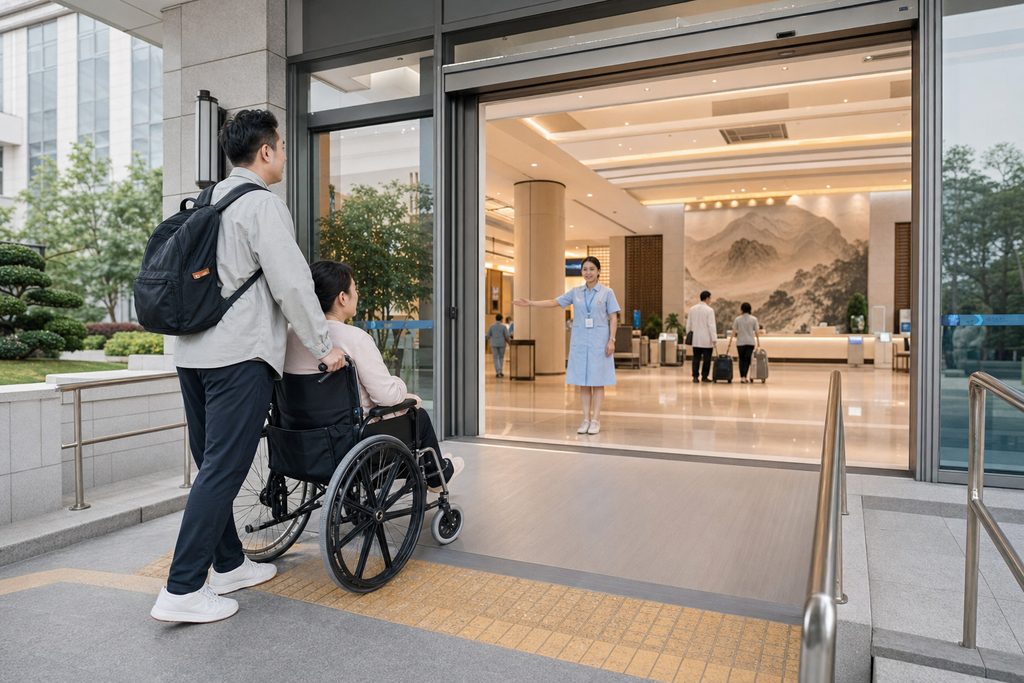
Disability-inclusive medical travel to China is not a theoretical possibility — it is happening now, for patients who have the right information and the right support on the ground. The infrastructure exists. The clinical expertise is world-class. The cost advantage is real. What determines whether a treatment journey succeeds or fails is rarely the medicine itself. It is whether someone verified the ramp, booked the right hospital wing, and was standing at the entrance when you arrived.
If you are researching medical tourism packages for disabled patients China, start with a conversation. No commitment. No pressure. Just clarity about what is possible for your specific situation. Request a free consultation and we will help you understand your options — honestly, specifically, and without the hard sell.
For more medical information and treatment options in China, visit chinamedservices.com (China Medical Services).
